
AR Target Evaluation Report 2026: Biology & R&D Strategy
Linda
Explore androgen receptor (AR) biology, prostate cancer treatment, AR mutations, resistance mechanisms, clinical competition, and R&D strategies in 2026.
A source-aware assessment of androgen receptor biology, clinical validation, resistance mechanisms, and opportunities for differentiated prostate cancer research.
Evidence cutoff: October 14, 2026 · Target: AR / NR3C4 · UniProt: P10275
The androgen receptor (AR) is one of the most clinically established targets in prostate cancer. Androgen deprivation and AR pathway inhibitors have changed outcomes across several disease stages. Yet the same therapeutic success has created a difficult competitive question: where can a new AR-directed treatment improve upon existing standards, particularly after resistance develops?
This target evaluation uses a Noah AI-assisted research workflow to organize the public evidence around AR signaling, clinical therapy, biomarkers, resistance mechanisms, and investigational strategies. The goal is a reviewable R&D perspective—not an autonomous treatment or investment decision. Explore Noah AI's human-in-the-loop research workflow.
NOAH AI · RESEARCH INPUT
AR Target Overview
| Dimension | Assessment |
|---|---|
| Target | Androgen receptor (AR / NR3C4), a ligand-activated nuclear hormone receptor and transcription factor. |
| Primary disease context | Prostate cancer, including metastatic hormone-sensitive and castration-resistant settings. |
| Established therapy | Androgen deprivation, enzalutamide, apalutamide, darolutamide, and androgen synthesis suppression with abiraterone. |
| Major resistance biology | AR amplification, ligand-binding-domain mutations, AR splice variants such as AR-V7, and AR-independent lineage plasticity. |
| R&D opportunity | Resistance-aware degradation, mutation-specific mechanisms, prospective biomarker selection, and well-justified combinations. |
Executive View
AR Target Attractiveness: High biological and clinical validation; high competition. Established AR pathway therapies demonstrate that disrupting androgen signaling can produce meaningful clinical benefit. However, a follow-on program cannot differentiate itself on AR binding alone: it must answer a specific resistance, tolerability, sequencing, or population question.
Biology and Disease Context
Androgen binding promotes AR-mediated transcription supporting prostate cancer growth. Under androgen deprivation, tumors may restore pathway output through receptor amplification, altered ligand specificity, splice variants, or intracrine androgen production. Some advanced tumors escape through AR-independent lineage programs, which may not respond to further receptor inhibition.
Validation Evidence
Enzalutamide, apalutamide, and darolutamide have evidence in defined prostate cancer states; abiraterone suppresses androgen synthesis via CYP17A1 and should not be mislabeled as a direct AR antagonist. Treatment setting, previous exposure, and combination regimen matter when interpreting trial results.
Clinical Competition
The benchmark spans approved AR-pathway therapies, taxanes, radioligand and other systemic treatments where appropriate, and investigational degraders. Luxdegalutamide (ARV-766) was licensed to Novartis and was listed in Phase 2 development during 2026; bavdegalutamide (ARV-110) trials were completed in 2025. Neither is an approved AR-targeted degrader.
IP and R&D Strategy
Relevant differentiation surfaces include small-molecule ligand-binding chemotypes, degrader architecture and linker chemistry, N-terminal-domain approaches, mutation and splice-variant coverage, biomarker-directed use, and combination or sequencing claims. Competitive density is not a freedom-to-operate determination.
Biology and Disease Context
AR acts as a ligand-responsive transcriptional regulator. Testosterone and dihydrotestosterone bind the ligand-binding domain, favoring receptor activation and transcription of androgen-responsive genes. Suppression of androgen signaling remains central to prostate cancer therapy, but resistance is molecularly heterogeneous.
AR amplification can sustain signaling in low-androgen conditions; ligand-binding-domain alterations such as T878A, L702H, and F877L can change receptor pharmacology depending on the allele and treatment history. AR-V7 is a splice variant lacking the canonical ligand-binding domain, enabling ligand-independent signaling in some tumors. These mechanisms should be assessed separately rather than grouped under a single "AR-resistant" label.
The prospective multicenter PROPHECY study associated circulating-tumor-cell AR-V7 detection with poorer outcomes on abiraterone or enzalutamide. It also showed that patients with AR-V7-positive disease can still benefit from taxane therapy. The result makes AR-V7 relevant to treatment research, but assay variation, cellular localization, prior treatment, and the absence of a universal companion diagnostic limit routine generalization.
Clinical Validation and Competitive Landscape
To prioritize R&D work, a useful comparison must connect the disease context to the actual treatment strategy, type of human evidence, resistance limitation, and development implication. The Noah research output below keeps these dimensions visible in one place without presenting exploratory subgroup observations as head-to-head proof.
NOAH AI · SOURCE-LINKED RESEARCH OUTPUT
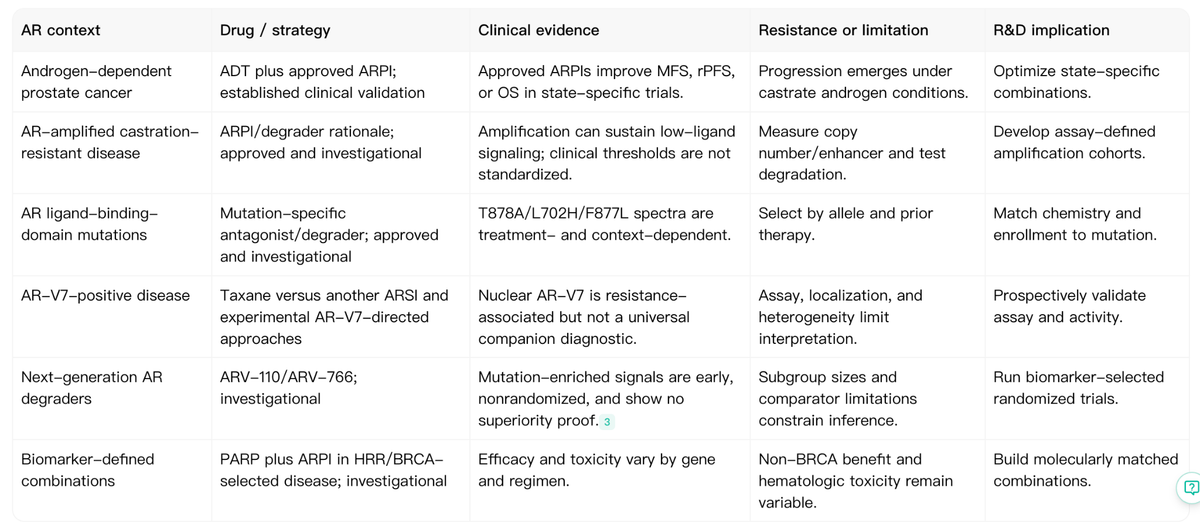
Established standards versus emerging mechanisms. Approved AR-pathway therapy provides strong clinical validation, but different stages of prostate cancer have different eligibility, endpoints, and treatment combinations. Investigational AR degraders attempt to remove the receptor rather than merely occupy its ligand-binding domain. Initial mutation-enriched observations are promising for mechanism evaluation, but small, nonrandomized cohorts cannot establish superiority.
Biomarker-directed combinations. PARP inhibitor plus AR-pathway combinations have regulatory evidence in certain molecularly selected mCRPC populations, especially those with relevant BRCA or homologous-recombination-repair alterations. Benefit and hematologic toxicity vary by gene and regimen; biomarker labels and eligibility criteria must be checked for the exact product and setting.
From evidence search to a reviewable comparison: Use Noah AI for free to explore a specific AR research question. Free credits are available, with no credit card required to get started.
IP and R&D Recommendation
AR is a proven but highly contested target. An IP assessment should consider compound and degrader chemistry, AR mutation coverage, delivery or dosing innovations, biomarker-defined populations, combination claims, and patent rights in relevant jurisdictions. Public patent descriptions alone do not establish ownership, enforceability, expiration, or freedom to operate; dedicated patent diligence is required.
Advance: Prioritize approaches with clear resistance biology, meaningful differentiation from approved therapy, reproducible biomarker assays, and prospective clinical development plans—for example, an AR degrader with a defined mutation rationale or a biomarker-matched combination.
Hold: Programs with encouraging preclinical or early response signals but uncertain mutation coverage, assay performance, tolerability, or clinical positioning. Development decisions should preserve the distinction between exploratory activity and randomized benefit.
Deprioritize: Undifferentiated AR antagonist follow-ons without a credible resistance, safety, sequencing, or patient-selection advantage. Likewise, AR-V7 positivity alone should not be treated as a universal prescribing algorithm or a guarantee of response to an investigational agent.
Bottom line: AR remains exceptionally well validated, but room to win is narrower than the target's biology alone suggests. The most defensible programs address measurable resistance mechanisms and show why their approach could improve outcomes in a clearly defined population.
Try Noah AI for Free
Use Noah AI to investigate AR signaling, compare clinical evidence, organize resistance mechanisms, and produce source-aware target evaluation tables for human review.
Free credits are available. No credit card is required. Sign Up and Try Noah AI →
Evidence cutoff: October 14, 2026. This report is for research and competitive-intelligence purposes, not patient treatment, legal, regulatory, or investment advice. Trial status, product labeling, and source claims should be verified before publication or operational use.