
Best Afforai Alternatives for Reviewing Multiple Medical Papers (2026)
Linda
Compare the best Afforai alternatives for reviewing multiple medical papers in 2026, including Noah AI, Elicit, SciSpace, Paperguide, and Consensus.
Compare five AI research tools for reading, comparing, and synthesizing multiple medical papers—with a real Noah AI example using four randomized migraine prevention trials.
Updated October 2026 · Biomedical literature review · AI research tool comparison
Reviewing multiple medical research papers is not simply a matter of reading abstracts and combining the conclusions.
Medical studies can investigate similar interventions while using different patient populations, eligibility criteria, outcome definitions, treatment schedules, and follow-up periods.
A reliable review must preserve these differences while identifying which findings are supported by the original research.
Afforai became known as an AI-powered research assistant that could help researchers search, read, organize, and compare academic papers.
The product has since been rebranded as Logically. Its current research workspace includes reference management, document-based research, AI-assisted writing, and citation-backed analysis.
These capabilities make it useful for research involving several documents. However, researchers may also want alternatives with different strengths in biomedical evidence extraction, systematic-review workflows, clinical study comparison, and literature synthesis.
In this guide, we compare five relevant Afforai alternatives and examine what a real Noah AI research workflow can produce when reviewing four randomized clinical trials.
Testing disclosure: We tested Noah AI directly. Other tools are described based on their official documentation and documented workflows. We did not perform a controlled head-to-head benchmark of all tools.
Quick Answer: What Are the Best Afforai Alternatives?
The best alternative depends on how you work with research papers.
Noah AI is worth considering for biomedical research questions that require structured comparisons across studies and source-grounded evidence synthesis.
Elicit is particularly useful for formal systematic-review workflows.
SciSpace supports literature search, paper comparison, and PDF investigation.
Paperguide combines paper analysis and cited research reports.
Consensus supports question-driven academic search and literature synthesis.
| Tool | Research Focus | Best-Fitting Workflow |
|---|---|---|
| Noah AI | Medical and life-science research | Structured clinical evidence comparison and synthesis |
| Elicit | Research extraction and systematic reviews | Paper screening, extraction, and review reports |
| SciSpace | Academic paper analysis | Literature search, customizable comparisons, and PDF reading |
| Paperguide | Research and reference workflows | Multi-paper analysis and cited literature reports |
| Consensus | Evidence-backed academic research | Question-driven literature discovery and synthesis |
In this article, "best" refers to suitability for specific research workflows, such as clinical evidence synthesis, systematic-review screening, or PDF analysis. These recommendations are based on workflow fit, not independently measured accuracy, speed, or overall performance rankings.
What Is Logically (Formerly Afforai)?
Logically (formerly Afforai) is an AI-powered workspace designed around academic sources, reference management, and research writing.
Its documented features include organizing references, working with multiple papers, researching connected documents, generating cited answers, annotating files, and writing with references.
Researchers using this type of workspace often need to perform several tasks together:
- Find and collect relevant publications.
- Read several papers on the same research question.
- Extract comparable findings from different studies.
- Identify disagreements or limitations.
- Connect important claims to their original sources.
- Turn the extracted evidence into a reviewable research draft.
Afforai already supports multi-document research, so an alternative should not be evaluated only by whether it can summarize multiple PDFs.
A more useful comparison asks how a particular tool handles the transition from individual papers to a structured, medically meaningful evidence synthesis.
That is the focus of our Noah AI test.
1. Noah AI — For Comparing Medical Studies and Synthesizing Clinical Evidence
Noah AI is a research Agent for medical, pharmaceutical, and life-science research workflows.
Its Agent can be given a medical research question and instructions to identify supporting literature, extract study-level evidence, compare results, and organize conclusions with source information.
In our direct test, Noah produced two especially relevant outputs:
- A structured comparison of four randomized clinical trials.
- A cross-paper synthesis mapping major evidence questions to supporting studies and interpretation limits.
We used a real medical research question rather than a generic prompt asking the AI to summarize papers.
Real Noah AI Test: Comparing Four Migraine Prevention Clinical Trials
We selected four randomized clinical trials evaluating monoclonal antibodies targeting the calcitonin gene-related peptide (CGRP) pathway for migraine prevention.
These trials make a useful multi-paper review example because they studied different therapies in episodic or chronic migraine and used distinct endpoint definitions and assessment windows.
The four studies were:
- STRIVE (2017): Erenumab in episodic migraine.
- HALO-CM (2017): Fremanezumab in chronic migraine.
- EVOLVE-1 (2018): Galcanezumab in episodic migraine.
- PROMISE-2 (2020): Eptinezumab in chronic migraine.
Rather than asking which drug is best, the research task examined how the study populations, treatment regimens, primary outcomes, results, safety findings, and limitations differed across the publications.
The evidence cutoff was October 22, 2026. This was a focused narrative comparison of four selected trials, not a systematic review or network meta-analysis.
Step 1: Start With a Defined Medical Research Question
We began in Noah AI Agent using Deep Research.
The research question was:
How do four major randomized clinical trials of CGRP-pathway monoclonal antibodies differ in their patient populations, interventions, primary endpoints, treatment results, safety findings, and interpretation limitations?
This question defines a comparison task rather than requesting four unrelated paper summaries.
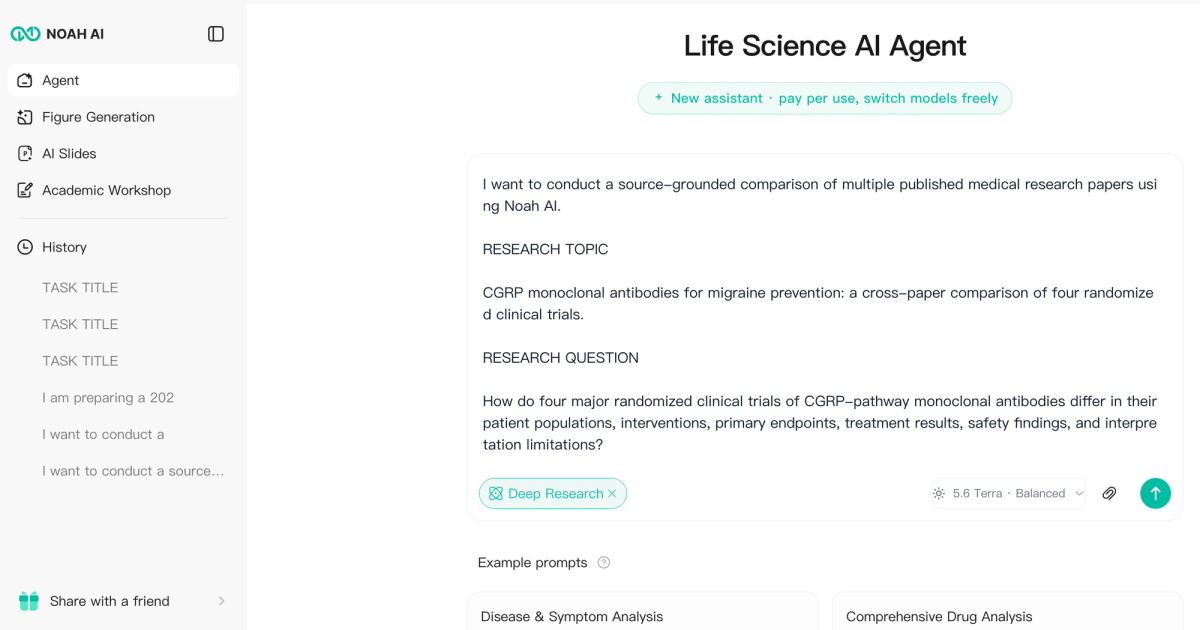
A well-defined question matters because multiple medical papers can share a clinical topic without measuring equivalent outcomes.
Comparing them requires attention to the original trial design, not just a general summary of each paper's conclusion.
Step 2: Extract Comparable Data From Multiple Medical Papers
Noah generated a table titled Multiple Medical Papers Comparison.
Each row represented one original trial, while the columns identified:
- Trial name and publication year
- Patient population
- Intervention and comparator
- Main outcome and reported result
- Original research source
This structure is useful because it places the evidence from different papers in a shared format while retaining the distinctions between them.
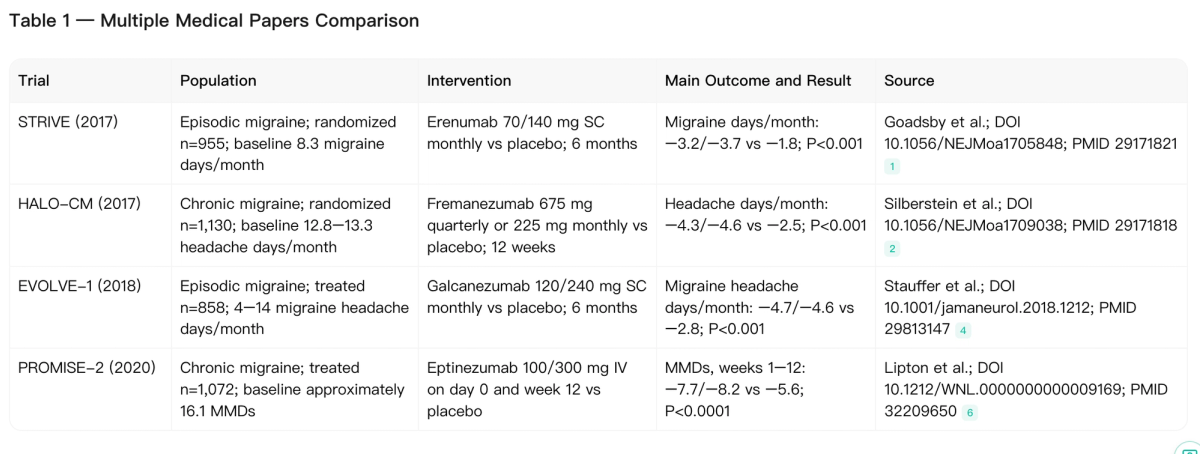
The output distinguished two episodic-migraine trials from two chronic-migraine trials.
It also preserved the different endpoint terms used by the researchers, including migraine days, migraine headache days, qualifying headache days, and monthly migraine days.
These measurements are related, but they cannot automatically be treated as equivalent.
What Did the Individual Papers Report?
STRIVE randomized 955 adults with episodic migraine to erenumab or placebo. The mean monthly migraine-day reduction over months four through six was 3.2 days with 70 mg, 3.7 days with 140 mg, and 1.8 days with placebo.
Both erenumab doses demonstrated statistically significant reductions compared with placebo. Original STRIVE publication.
HALO-CM evaluated fremanezumab in 1,130 randomized participants with chronic migraine. Reported reductions in qualifying headache days per month were 4.3 days with quarterly dosing, 4.6 days with monthly dosing, and 2.5 days with placebo during the 12-week assessment period.
Both active regimens showed statistically significant improvements in the study's primary endpoint. Original HALO-CM publication.
EVOLVE-1 evaluated galcanezumab for episodic migraine. Among 858 treated participants in the intent-to-treat population, monthly migraine headache days declined by 4.7 days with 120 mg, 4.6 days with 240 mg, and 2.8 days with placebo.
Both active doses outperformed placebo on the study's primary endpoint. Original EVOLVE-1 publication.
PROMISE-2 evaluated intravenous eptinezumab in chronic migraine. During weeks one through twelve, monthly migraine days decreased by 7.7 days with 100 mg, 8.2 days with 300 mg, and 5.6 days with placebo.
These findings supported the studied eptinezumab regimens over placebo. Original PROMISE-2 publication.
These results demonstrate why a multi-paper evidence table is more useful than an unstructured sequence of individual summaries.
Readers can examine population, intervention, endpoint, result, and source together without losing the original trial context.
Step 3: Synthesize the Evidence Without Losing Study Differences
After the trial-level comparison, Noah generated a second table titled Cross-Paper Evidence Synthesis.
Rather than repeating the numerical results from each paper, this table grouped the research into four broader evidence questions:
- Preventive efficacy in episodic migraine
- Preventive efficacy in chronic migraine
- Endpoint definitions and follow-up
- Safety and cross-trial comparison
Each row identified the relevant supporting studies, summarized what the research showed, and explained an important limitation.
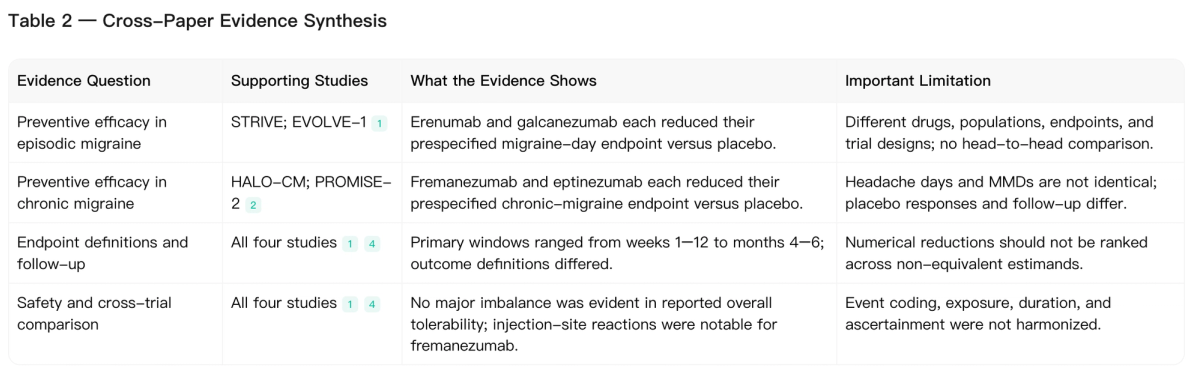
This was one of the most useful parts of the test.
The synthesis grouped STRIVE and EVOLVE-1 as evidence for episodic migraine prevention, while HALO-CM and PROMISE-2 contributed evidence for chronic migraine prevention.
It also explicitly cautioned against comparing numerical reductions across studies with different endpoint definitions and assessment windows.
That distinction matters because PROMISE-2 reported a larger numerical reduction in monthly migraine days than some other trials.
This does not establish that eptinezumab is more effective than the other CGRP-pathway antibodies. PROMISE-2 studied a chronic-migraine population, used its own primary endpoint, and employed a different treatment schedule.
None of these four selected trials directly compared all four antibodies against one another.
Consequently, an appropriate synthesis can conclude that the tested regimens showed preventive efficacy against placebo within their respective trials, but it cannot establish a reliable superiority ranking across drugs.
The same caution applies to safety. Differences in event reporting, study duration, exposure, and follow-up prevent a simple cross-trial safety ranking.
What Noah AI Actually Demonstrated
The test produced three useful outputs for researchers reviewing multiple medical papers.
First, a research-question-driven workflow. The task was organized around a specific clinical evidence question rather than a request for generic paper summaries.
Second, a standardized study comparison. Noah placed four original trial publications into a consistent extraction structure with numerical results and source identifiers.
Third, a cross-study evidence synthesis. Noah grouped trial findings into clinically meaningful questions and preserved major limitations affecting interpretation.
These outputs help researchers move from separate publications toward a more coherent evidence review.
However, the demonstration does not prove that Noah has independently verified every value in every full-text publication, nor does it establish greater accuracy than Afforai or other competing tools.
The original trial reports should still be checked before publication, and a formal systematic review would require additional methodological steps.
Compare Multiple Medical Papers with Noah AI
Explore biomedical literature, organize study-level findings, and build source-grounded evidence syntheses with Noah AI.
Free Credits Available · No Credit Card Required
Free credits are limited. Credit requirements vary depending on the research task.
2. Elicit — For Structured Extraction and Systematic Reviews
Elicit is an AI research platform supporting literature discovery, evidence extraction, and formal systematic-review workflows.
It is relevant when a researcher needs to investigate many papers using consistent data fields, rather than simply read several independent summaries.
Elicit's documented systematic-review capabilities include literature gathering, screening, extraction, and structured reporting.
Researchers can define the information they want to extract and inspect evidence from the included publications.
This can be useful when working on a systematic review with explicit inclusion criteria, exclusion criteria, and defined extraction questions.
Best fit: Formal review screening, structured evidence extraction, and workflows requiring methodological control.
Important limitation: Automated extraction and screening outputs still require researcher verification. A generated report does not independently establish that every eligible study was found.
3. SciSpace — For Reading and Comparing Research Papers
SciSpace provides academic literature search, paper analysis, PDF-based questions, and literature-review workflows.
Its Literature Review interface can organize retrieved studies using comparison fields, while Deep Review supports broader analysis of a research question across multiple publications.
Researchers can use these features to inspect study design, compare results, explore relevant literature, and return to individual papers for more detailed reading.
SciSpace is particularly relevant when a project begins with a collection of papers that need to be examined and organized.
Best fit: Literature discovery, customizable paper comparisons, full-text investigation, and PDF-centered review.
Important limitation: The researcher must ensure that AI-extracted values correspond to the correct endpoint, analysis population, and original publication.
4. Paperguide — For Multi-Paper Research and Cited Literature Reports
Paperguide offers a research workspace combining academic paper discovery, AI-assisted paper analysis, reference management, and literature-review reporting.
Its Research Agent can investigate topics across academic literature and saved papers, while its PDF research interface supports questions about the methods, results, and conclusions of one or more documents.
Paperguide also offers synthesized reports with citations connected to source publications.
These features overlap with the needs of researchers who want to review multiple medical papers without manually assembling every comparison from scratch.
Best fit: Citation-backed multi-paper research, academic paper investigation, and integrated literature-review reporting.
Important limitation: Claims and extracted findings still need to be checked against original studies, particularly when clinical outcomes or statistical results are involved.
5. Consensus — For Research-Question-Driven Evidence Reviews
Consensus is an academic research platform that helps users investigate questions through published scientific literature.
Its Deep Review workflow can break a question into subtopics, search for relevant research, and generate a structured synthesis of findings.
Consensus can therefore be useful when the first goal is to understand what a body of published research says about a medical question.
It also supports evidence tables and other structured outputs depending on the task.
Best fit: Natural-language evidence discovery, question-driven literature exploration, and cited research synthesis.
Important limitation: A generated synthesis still requires inspection of the source studies, particularly when different papers define their outcomes differently.
Afforai vs Noah AI: What Is the Main Difference?
Afforai, now Logically, and Noah AI both support research with source-backed outputs, but they can serve different priorities.
Logically emphasizes a connected academic workspace for references, documents, annotations, AI research, and writing.
Noah AI is oriented toward medical and life-science research tasks. In our case study, its Deep Research workflow produced a clinical paper comparison and a separate evidence-synthesis table.
| Research Need | Noah AI | Afforai / Logically |
|---|---|---|
| Primary workflow | Biomedical research Agent | Integrated academic research workspace |
| Working with multiple papers | Source-grounded research and structured comparisons | Multi-document questions, paper comparison, and library research |
| Research organization | Question, evidence, findings, and limitations | References, files, annotations, and writing |
| Source-grounded output | Cited research outputs demonstrated in our test | Citation-backed document research |
| Example use case | Compare clinical trials and synthesize evidence | Read and organize a library of research papers |
These differences reflect product positioning and the outputs observed in our Noah test. They are not evidence that one platform is universally more accurate than the other.
How to Choose an Afforai Alternative for Multiple Medical Papers
The most useful tool depends on the type of work you need to complete.
| Your Main Task | Tool to Consider |
|---|---|
| Compare medical clinical trials and synthesize findings | Noah AI |
| Screen and extract evidence for a systematic review | Elicit |
| Read and compare individual PDFs | SciSpace |
| Combine paper research with a reference library | Paperguide or Logically |
| Explore a medical research question across published literature | Consensus |
Researchers may also combine multiple tools, such as using a literature-discovery platform to identify publications and a domain-focused Agent to organize study-level evidence.
Regardless of the platform, the final review should be checked against the original publications.
How to Review Multiple Medical Research Papers with AI
A practical AI-assisted review can follow five steps.
- Define the Research Question — Specify the clinical population, intervention or exposure, relevant comparator, outcomes, and evidence cutoff. A focused question helps prevent unrelated studies from being combined.
- Identify the Relevant Original Studies — Retrieve studies that directly address the research question. Record publication identifiers and distinguish randomized trials from observational studies or secondary evidence. If the task is a formal systematic review, use a documented and reproducible search and selection process.
- Extract Consistent Study-Level Fields — Collect the same categories of information across papers: population, sample size, intervention, comparator, endpoint, numerical result, follow-up, limitations, and source. Use the original study's definitions instead of silently harmonizing terms that may measure different outcomes.
- Synthesize Findings Across Papers — Group findings by meaningful research questions. Identify consistent results, disagreements, methodological differences, and important gaps. Do not simply concatenate abstracts or rank treatments by unadjusted results from different trials.
- Verify Sources and Interpretation — Check numerical findings, outcome definitions, study limitations, DOI or PMID identifiers, and relevant corrections against the original publications. AI-generated evidence tables can support this process, but they do not replace human assessment of the underlying clinical research.
Frequently Asked Questions
What Are the Best Afforai Alternatives in 2026?
Noah AI, Elicit, SciSpace, Paperguide, and Consensus are relevant alternatives for different academic research workflows. The best choice depends on whether the user prioritizes clinical evidence synthesis, systematic screening, PDF reading, or general literature research.
Is Afforai Still Available?
Afforai has been rebranded as Logically. The newer name refers to the research workspace that developed from the original Afforai product.
Can Noah AI Compare Multiple Medical Papers?
Yes. In our direct test, Noah AI organized four randomized migraine prevention trials into a structured comparison table and generated a separate cross-paper evidence synthesis with supporting studies and limitations.
Is Noah AI a Good Afforai Alternative?
Noah AI is a relevant alternative for medical and life-science research requiring structured evidence analysis. Afforai, now Logically, remains relevant for research-library management and document-centered academic workflows. The tools overlap but emphasize different research needs.
Can AI Compare Several Medical Research Papers at Once?
AI tools can assist with extracting comparable information from multiple publications and synthesizing findings across studies. Results still need to be checked for differences in methodology, patient population, endpoints, and numerical reporting.
What Is a Cross-Paper Evidence Synthesis?
Cross-paper evidence synthesis is the process of integrating findings from multiple publications around shared research questions while identifying supporting studies, methodological differences, and limitations.
Is an AI-Generated Literature Review a Systematic Review?
Not automatically. A formal systematic review requires a defined protocol, reproducible searches, study screening, risk-of-bias assessment, and appropriately documented evidence synthesis. AI-generated narrative comparisons can support research but do not substitute for these requirements.
Can I Try Noah AI for Free?
Yes. Noah AI offers free signup credits through its Basic plan, with no payment required to register. Usage depends on the credit balance and the research task selected.
Final Verdict: Which Afforai Alternative Is Best for Medical Paper Reviews?
There is no universal best alternative for every researcher.
Elicit is useful for systematic-review workflows. SciSpace supports literature exploration and PDF-centered analysis. Paperguide combines multi-paper investigation with cited research reports. Consensus is suited to research-question-driven literature review and evidence exploration.
Noah AI is particularly worth considering when the objective is to turn a medical research question into a structured comparison of clinical studies and a source-grounded evidence synthesis.
Our migraine prevention example demonstrated that workflow using four original randomized trials. Noah organized study populations, treatments, endpoints, and numerical outcomes, then synthesized findings by evidence question while preserving important interpretation limits.
The central benefit is not simply summarizing more papers. It is making the relationships between individual studies, research findings, and broader conclusions easier to inspect.
For researchers reviewing several medical publications, that is a useful starting point for a more rigorous, independently verified evidence review.
Review Multiple Medical Papers with Noah AI
Organize biomedical research, compare clinical trials, and build structured evidence syntheses linked to the original literature.
Free Credits Available · No Credit Card Required
Free signup credits are subject to current plan limits and per-task usage requirements.