
Best AI Tools for Biomedical Research Question Refinement (2026)
Linda
Compare five AI research tools and learn how to turn a broad biomedical question into a focused, evidence-informed research question using a real Noah AI workflow.
Compare five AI research tools and learn how to turn a broad biomedical question into a focused, evidence-informed research question using a real Noah AI workflow.
A biomedical research question can be scientifically interesting and still be too broad to investigate meaningfully.
Questions such as "Does the gut microbiome affect cancer treatment?" or "Can a biomarker predict disease progression?" may describe important research areas, but they leave crucial decisions unresolved.
Which patients are being studied? What exactly is being measured? Which treatment or exposure is relevant? What outcome matters? And does the question concern association, prediction, or causation?
These distinctions influence which studies are relevant, how results should be compared, and what conclusions can reasonably be drawn.
AI tools can help researchers identify ambiguous wording, examine relevant biomedical literature, compare alternative question formulations, and develop more precise research questions.
However, research question refinement is not simply asking AI to make a question shorter. The goal is to make the scientific meaning clearer without introducing unsupported assumptions.
In this guide, we compare five AI tools for biomedical research question refinement and demonstrate a real Noah AI workflow using a published research topic: gut microbiome characteristics and immunotherapy response in melanoma.
Broad Question → Identify Ambiguities → Review Evidence → Compare Alternatives → Refine the Question → Verify Evidence Boundaries
Testing disclosure: We tested Noah AI directly for the biomedical research question refinement case shown below. Other tools are described using their publicly documented features and typical research workflows. This is a use-case comparison, not a controlled performance benchmark.
Evidence cutoff for the demonstrated Noah AI case: October 13, 2026.
Quick Answer: What Are the Best AI Tools for Biomedical Research Question Refinement?
The most useful tool depends on which part of the research question needs improvement.
Some tools are better suited to exploring existing literature, while others help compare scientific claims, identify uncertainty, or organize multiple alternative research questions.
| AI Tool | Best Use | Key Consideration |
|---|---|---|
| Noah AI | Evidence-informed biomedical question analysis and structured refinement. | Researchers must verify sources, definitions, and final scientific judgments. |
| Elicit | Explore relevant papers, clarify research scope, and iteratively investigate related questions. | Literature coverage and extracted evidence still require checking. |
| Consensus | Search academic evidence and investigate whether existing studies answer a proposed question. | Evidence summaries do not automatically establish question novelty or causal relationships. |
| Scite | Examine how important studies have been cited, supported, or contrasted. | Citation classifications require contextual interpretation. |
| ChatGPT Deep Research | Explore alternative formulations and synthesize information from multiple sources. | Scientific references and conclusions must be independently verified. |
No single tool guarantees that a research question is novel, feasible, or scientifically well designed.
The appropriate choice depends on whether the immediate problem involves defining variables, understanding existing evidence, distinguishing conflicting findings, or selecting a more precise scientific question.
1. Noah AI — For Structured Biomedical Research Question Refinement
Noah AI is designed for medical, pharmaceutical, and life-science research workflows.
Its Agent workflow can be prompted to investigate biomedical questions, organize relevant evidence, compare scientific alternatives, and generate structured research outputs.
For question refinement, researchers can specify an existing research question and ask Noah to identify unclear populations, exposures, treatment settings, outcomes, and assumptions.
In our actual test, Noah generated three alternative question formulations, compared their improvements and remaining limitations, and produced a final refined research question.
Best suited for: Researchers who want to move from a broad biomedical question toward an evidence-informed, structured question with explicit scientific boundaries.
Noah does not need a separately verified one-click "Research Question Refinement Generator" feature for this workflow. The demonstrated result was produced by giving its research Agent a detailed, structured prompt.
Explore Noah AI's research workflow →
2. Elicit — For Research Question Exploration and Literature Scoping
Elicit provides AI-assisted research workflows that can help users explore academic questions, find relevant papers, extract information, and investigate a topic iteratively.
Its Research Agent workflows support follow-up questions and refinement of the information being investigated.
This can be useful when the original research question contains several possible populations, endpoints, or methodological directions.
For example, a researcher exploring the relationship between the microbiome and immunotherapy could use the literature to distinguish studies focusing on microbial diversity from studies examining individual organisms or community-level features.
The main limitation is that refining the literature search does not automatically produce a scientifically justified final research question.
The researcher still needs to evaluate whether the selected population and outcome match the intended scientific inference.
3. Consensus — For Checking Existing Scientific Evidence
Consensus is an AI-powered academic search tool that retrieves relevant scientific publications and supports evidence-based research exploration.
Researchers can search using natural-language questions, add population or study-design constraints, and use follow-up queries to investigate narrower versions of an initial question.
For biomedical research question refinement, this is useful for checking whether a proposed question is already well covered and whether the literature contains important disagreements.
For example, a search about gut microbiome diversity and immunotherapy response may reveal that reported relationships vary between patient cohorts and study methods.
Such findings can motivate a more focused question about reproducibility rather than a broad question asking whether the microbiome is relevant at all.
However, an AI-generated evidence synthesis should not be treated as a definitive claim that a research question is novel or that a biological relationship is causal.
4. Scite — For Investigating Conflicting and Supporting Evidence
Scite uses citation-context analysis to help researchers investigate how scientific papers have been cited by subsequent publications.
Its Smart Citations distinguish citation statements classified as supporting, contrasting, or mentioning an earlier work.
This can be helpful when a research question is based on a prominent early finding that later studies may have qualified or challenged.
In microbiome research, for example, researchers may initially focus on a specific bacterial species reported to be associated with immunotherapy response.
Examining subsequent literature may suggest that cross-cohort reproducibility, measurement methods, or treatment context deserve greater attention than the original single-species association.
Citation classifications are indicators for further reading, not a substitute for examining the actual methods, results, and limitations of the cited studies.
5. ChatGPT Deep Research — For Exploring Alternative Research Questions
ChatGPT with Deep Research can support multi-source research and produce structured analyses with source links.
For question refinement, researchers can request several alternative formulations, compare the assumptions behind each version, and ask which variables or outcomes are missing.
It can also help distinguish an association question from a prediction or causal-intervention question.
This flexibility is useful during early research planning.
Nevertheless, the researcher must verify whether the proposed refinements are consistent with the primary scientific literature and whether the available evidence supports the intended conclusions.
Which AI Tool Should You Choose?
Rather than relying on an unsupported overall ranking, match the tool to the research task.
| Your Research Need | Tool to Consider |
|---|---|
| Create and compare structured question refinements using biomedical evidence. | Noah AI |
| Explore relevant academic literature and narrow research scope. | Elicit |
| Investigate existing evidence and research disagreements. | Consensus |
| Inspect how influential scientific claims are discussed in later literature. | Scite |
| Generate and compare alternative research question formulations. | ChatGPT Deep Research |
What Is Biomedical Research Question Refinement?
Biomedical research question refinement is the process of improving an existing scientific question by making its key concepts, target population, measurements, outcome definitions, and intended inference more precise.
It differs from generating new research ideas.
It also differs from a PICO formulation task, which primarily structures a clinical question around Population, Intervention, Comparator, and Outcome.
Research question refinement can involve PICO elements, but it may also require defining molecular features, biological mechanisms, analytical constructs, temporal relationships, or the type of scientific conclusion being sought.
| Research Workflow | Main Question |
|---|---|
| Research idea generation | What could we investigate? |
| Hypothesis generation | What scientific explanation could be tested? |
| PICO formulation | What population, intervention, comparison, and outcome define the question? |
| Question refinement | Which definitions and assumptions must change to make the question more scientifically precise? |
| Feasibility assessment | Can the resulting question realistically be investigated? |
The difference becomes clearer when applying the process to an actual biomedical topic.
Real Noah AI Case: Gut Microbiome and Immunotherapy Response in Melanoma
We tested a broad research question involving the gut microbiome and melanoma immunotherapy.
ORIGINAL RESEARCH QUESTION
Does the gut microbiome affect immunotherapy response in patients with melanoma?
This question addresses an important biomedical topic.
Previous studies have found associations between the gut microbiome and outcomes following immune checkpoint inhibitor therapy in melanoma.
However, the question does not specify which patients are included, which immunotherapy regimen is being studied, which microbiome feature is measured, or how treatment response is defined.
The word "affect" is also problematic because it may imply a causal relationship that the available human observational studies cannot establish.
Our objective was to use published evidence to identify these weaknesses, compare better question formulations, and produce a final question with a clearly defined scientific scope.
Step 1 — Start with the Broad Biomedical Research Question
We entered the original research question into Noah AI Agent and requested an evidence-grounded refinement.
The demonstrated workflow used:
- Agent: Noah AI
- Research domain: Medical & Academia
- Mode: Deep Research
- Model: 5.6 Terra · Balanced
- Evidence cutoff: October 13, 2026
The prompt asked Noah to identify ambiguous terms, evaluate relevant published evidence, compare alternatives, and distinguish association from prediction and causation.
It also instructed the Agent not to fabricate a novel research gap or describe an exploratory microbiome signal as a clinically validated biomarker.
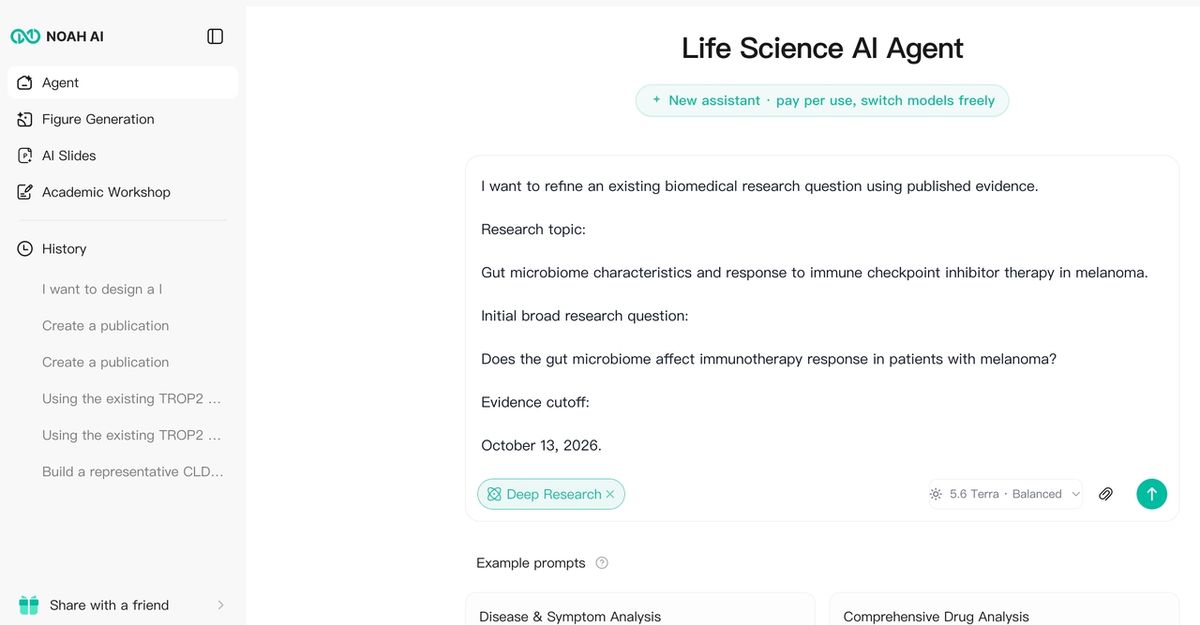
Starting with the exact original question is important because researchers need to understand which definitions changed during refinement.
Otherwise, a final AI-generated question can appear scientifically precise without showing how it relates to the initial research objective.
Step 2 — Identify Ambiguous Terms and Missing Definitions
Noah's analysis identified several ambiguities in the original question.
"Gut microbiome" could refer to diversity, individual bacterial taxa, community-level signatures, functional pathways, or other biological measurements.
"Immunotherapy" could include anti-PD-1 monotherapy or combination checkpoint blockade.
"Response" could mean objective response, progression-free survival, overall survival, or another clinical outcome.
Each of these possibilities represents a different scientific question.
| Original Term | Why It Is Ambiguous | Possible Refinement |
|---|---|---|
| Melanoma patients | Disease stage and subtype are unspecified. | Adults with advanced cutaneous melanoma. |
| Immunotherapy | Multiple checkpoint inhibitor regimens are possible. | A specified anti-PD-1 treatment context. |
| Gut microbiome | Diversity, taxa, and functional signatures are different measurements. | Prespecified stool microbiome community or functional features. |
| Response | Objective response and survival outcomes are not interchangeable. | RECIST-defined treatment response, with PFS analyzed separately. |
| Affect | May imply causation without an interventional comparison. | Ask about observational association and reproducibility. |
This step is more substantive than a wording edit.
A change from "immunotherapy response" to "RECIST-defined objective response after a specified anti-PD-1 regimen" changes how eligible studies and outcomes would be selected.
Similarly, changing "affect" to "is associated with" changes the level of scientific inference the question seeks.
Step 3 — Check What the Published Biomedical Literature Already Shows
Research question refinement should be informed by previous evidence.
In this case, the literature does not support claiming that gut microbiome associations with melanoma immunotherapy response are newly discovered or unexplored.
Several influential studies have already investigated related questions.
SCIENCE · 2018
Gut Microbiome Modulates Response to Anti-PD-1 Immunotherapy in Melanoma Patients
Gopalakrishnan and colleagues reported associations between fecal microbial diversity, particular microbial groups, and anti-PD-1 treatment response in a selected melanoma cohort. The human association does not itself establish causality.
NATURE MEDICINE · 2022
Cross-Cohort Gut Microbiome Associations with Immune Checkpoint Inhibitor Response in Advanced Melanoma
Lee and colleagues studied pretreatment stool microbiome features across advanced melanoma cohorts. The associations were relevant but cohort-dependent, with limited reproducibility of individual microbiome signatures.
NATURE MEDICINE · 2022
Intestinal Microbiota Signatures of Clinical Response and Immune-Related Adverse Events in Melanoma Patients Treated with Anti-PD-1
McCulloch and colleagues investigated baseline microbial community signatures associated with clinical response and other outcomes in anti-PD-1-treated melanoma cohorts, while highlighting important between-cohort heterogeneity.
Together, these studies suggest that a generic question asking whether the gut microbiome is associated with immunotherapy outcomes would cover ground already investigated.
A more useful refinement is to identify which features, populations, treatment regimens, and endpoints can be compared consistently, and whether reported associations reproduce across independent cohorts.
Existing literature provides the scientific justification for narrowing the question. It does not automatically prove that the new formulation is novel or operationally feasible.
Step 4 — Distinguish Association, Prediction, and Causation
One of the most important refinement decisions concerns what type of scientific claim the question intends to evaluate.
In biomedical research, association, individual-level prediction, and causation require different evidence.
| Question Type | Example | Required Interpretation |
|---|---|---|
| Association | Are baseline microbiome features associated with response? | Observational relationship, subject to confounding and measurement limitations. |
| Prediction | Can a prespecified model predict response in an independent cohort? | Requires appropriate external validation and evaluation of performance. |
| Causation | Does altering the microbiome improve treatment response? | Requires a design capable of evaluating the intervention's causal effect. |
These questions are not interchangeable.
Finding that a microbial signature is associated with response among patients receiving immunotherapy does not automatically demonstrate that the signature can reliably predict an individual's future response.
It also does not demonstrate that modifying the microbial community would improve treatment efficacy.
In the tested Noah analysis, observational association and cross-cohort reproducibility were identified as more defensible targets for the refined research question than an unsupported causal claim.
Step 5 — Compare Alternative Research Question Formulations
Refinement should not consist of producing one increasingly complicated question without comparing alternatives.
Different formulations may be appropriate for different scientific purposes.
In our test, Noah AI generated and compared three alternatives:
- Version A: A focused observational association question.
- Version B: An exploratory microbiome-based prediction question.
- Version C: A cross-cohort reproducibility question.
The final comparison evaluated what each formulation improved and which important limitations remained.
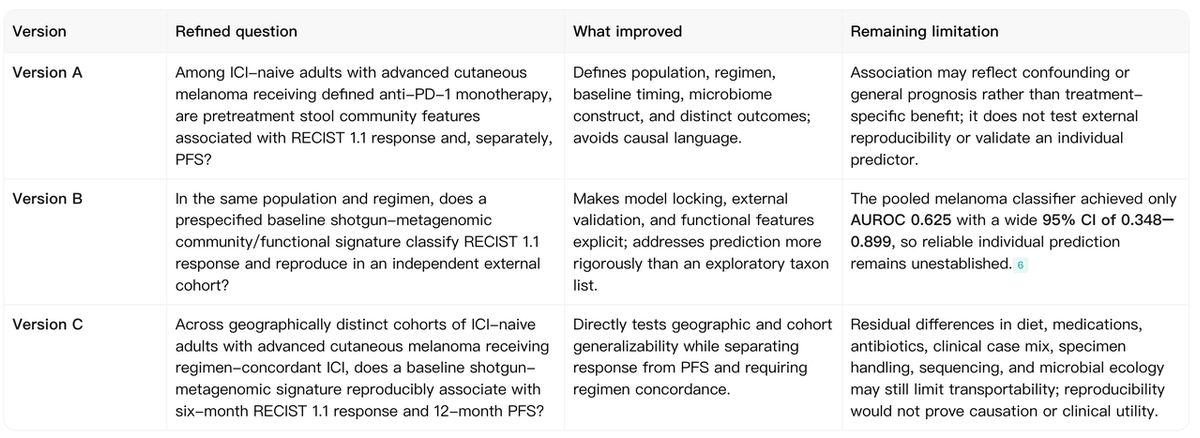
Version A defined a clearer observational association question by specifying the melanoma population, anti-PD-1 context, pretreatment sampling, and clinical outcomes.
Version B moved toward exploratory biomarker prediction. This introduced additional requirements involving model specification and external validation.
Version C emphasized whether associations could reproduce across geographically distinct cohorts receiving compatible treatment regimens.
Noah recommended Version C for this case because the published evidence had already highlighted cohort-dependent microbiome findings and limited reproducibility.
Why Version C was selected
The major unresolved issue is not simply whether microbiome associations have been observed. It is whether a clearly defined association can be reproduced across comparable patient cohorts, treatment regimens, and measurement conditions.
This is a case-specific recommendation, not evidence that the most complex or narrowest research question is always the best choice.
Step 6 — Select the Final Refined Biomedical Research Question
The next step is to integrate the strongest elements into one research question without introducing unsupported scientific assumptions.
In the completed Noah report, the final formulation was:
FINAL REFINED RESEARCH QUESTION
Among adults with ICI-naive advanced cutaneous melanoma starting a specified anti-PD-1 regimen, are prespecified baseline stool shotgun-metagenomic community or functional signatures associated with RECIST-defined treatment response, and are those associations reproducible across geographically distinct, regimen-concordant cohorts?
The refined question specifies the population, treatment setting, sampling time, microbiome measurement, clinical endpoint, and intended scientific inference.
Rather than assuming a universal microbiome biomarker, it asks whether prespecified associations reproduce across comparable cohorts.
It also uses association language rather than claiming that microbial signatures cause treatment response.
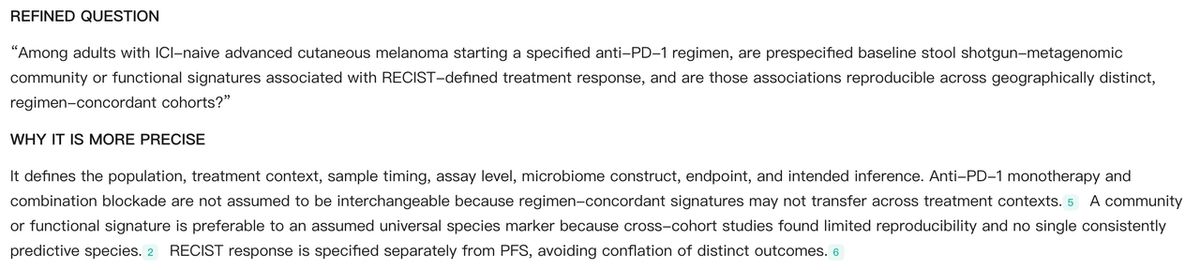
The main benefit is not that the refined question sounds more technical.
Its definitions make the intended evidence comparison clearer and reduce the risk of confusing observational associations with validated prediction or causation.
Step 7 — Compare the Research Question Before and After Refinement
The clearest way to evaluate the refinement is to compare each dimension of the question.
| Dimension | Before | After |
|---|---|---|
| Population | Patients with melanoma | Adults with ICI-naive advanced cutaneous melanoma |
| Treatment | Immunotherapy | Specified anti-PD-1 regimen, analyzed in regimen-concordant cohorts |
| Biological feature | Gut microbiome | Prespecified shotgun-metagenomic community or functional signature |
| Sample timing | Unspecified | Baseline stool collected before treatment |
| Outcome | Response | RECIST-defined treatment response; PFS considered separately |
| Inference | Potentially causal wording | Observational association and cross-cohort reproducibility |
The final question has a clearer scientific meaning, but it is not yet an executable study protocol.
Investigators would still need to specify the anti-PD-1 drug and treatment line, the exact microbial feature set, sequencing and processing methods, response assessment schedule, confounders, and criteria for comparing cohorts.
Those requirements should remain explicit instead of being hidden behind a polished research question.
Step 8 — Check What the Refined Research Question Can and Cannot Answer
Refining a question does not automatically strengthen the available evidence.
A scientifically precise question may still address an uncertain relationship or require data that are not yet available.
| What the Question Can Investigate | What It Cannot Establish on Its Own |
|---|---|
| Whether a defined pretreatment microbiome signature is associated with treatment response. | That the microbiome causes the response. |
| Whether the association reproduces across comparable patient cohorts. | That the signature is a validated clinical prediction test. |
| Whether cohort differences influence the observed association. | That changing the microbiome improves immunotherapy efficacy. |
| Whether a specific association is consistent within a defined regimen. | That the same signature is transferable to every checkpoint inhibitor regimen. |
This final evidence-boundary check is essential because a question can be specific, well written, and relevant without demonstrating clinical utility or a causal biological mechanism.
In the melanoma microbiome case, cohort heterogeneity and inconsistent signatures remain important scientific uncertainties.
Research question refinement helps make those uncertainties testable. It does not resolve them in advance.
Refine Your Biomedical Research Question with Noah AI
Turn broad biomedical questions into focused, evidence-informed research questions with clearer populations, variables, outcomes, and scientific boundaries.
Noah AI can be used for free. Free credits are available, and no credit card is required.
A Practical Framework for Refining Biomedical Research Questions
The approach demonstrated in this case can be adapted to other biomedical research areas.
Before selecting a final question, assess whether the following elements are adequately defined:
| Element | Key Question |
|---|---|
| Population | Who exactly is included, and why? |
| Exposure or intervention | What biological or clinical factor is being studied? |
| Measurement | How will the exposure or feature be operationally defined? |
| Timing | When will the exposure and outcome be measured? |
| Outcome | Which endpoint is most directly relevant? |
| Inference | Is the question about association, prediction, or causation? |
| Evidence context | What has already been studied, and what remains uncertain? |
The strongest formulation is not always the one with the most restrictions. It is the one whose definitions match the scientific goal and the evidence needed to answer it.
Common Mistakes When Refining Biomedical Research Questions with AI
Assuming More Specific Always Means Better — A narrow question can improve interpretability, but excessive restrictions may exclude relevant evidence or make the question unnecessarily limited. The chosen level of specificity should reflect the intended scientific purpose.
Changing the Scientific Claim Without Noticing — Replacing "associated with" by "predicts" or "causes" changes the type of research question. AI-generated wording should be reviewed to ensure that it does not silently increase the strength of the intended inference.
Ignoring Differences Between Treatment Regimens — Anti-PD-1 monotherapy and combination checkpoint blockade may involve different biological and clinical contexts. Results from one regimen should not automatically be assumed to apply to another.
Treating Different Biomarkers as Interchangeable — Microbiome alpha diversity, individual bacterial taxa, and functional community signatures are not equivalent measurements. A refined question should identify the construct being investigated rather than simply using a more technical-sounding term.
Treating Existing Evidence as Proof of Novelty — A large number of relevant studies may support the importance of a topic, but they may also show that the general research question has already been investigated. The remaining scientific uncertainty should be identified explicitly.
Ignoring Cross-Cohort Differences — Clinical cohorts may differ in geography, disease characteristics, medications, biological sample handling, and measurement methods. A question about reproducibility must account for those differences instead of assuming all cohorts are directly comparable.
Treating an AI-Refined Question as Study-Ready — Clear wording is a starting point, not evidence that recruitment, data access, sample size, laboratory procedures, or statistical power are adequate. Study feasibility and protocol development require separate evaluation.
What Should Researchers Verify After AI Refines a Question?
Before incorporating an AI-refined question into a research protocol, manuscript, or scientific proposal, review the following:
- The original paper titles, publication dates, and reported findings.
- The actual study populations and disease definitions.
- The treatment regimens represented in the relevant evidence.
- The definition and measurement of the biological exposure or biomarker.
- The timing of sample collection and clinical outcome assessment.
- The distinction between objective response and survival outcomes.
- Potential confounding and between-study heterogeneity.
- Whether an association has been independently reproduced.
- Whether predictive performance has undergone appropriate validation.
- Whether the final question makes a stronger claim than the supporting evidence.
In this case, especially important unresolved decisions include the exact anti-PD-1 regimen, the primary metagenomic feature set, sequencing methodology, RECIST assessment rules, and criteria for comparing cohorts.
Human verification should also determine whether the necessary patient-level data and biospecimen information are available. A refined question does not establish feasibility by itself.
Frequently Asked Questions
Can AI Help Refine a Biomedical Research Question?
Yes. AI can assist by identifying ambiguities, organizing existing evidence, generating alternative formulations, and explaining how definitions or assumptions affect the question. The final wording and scientific claims should be verified by researchers.
What Makes a Good Biomedical Research Question?
A good question identifies the relevant research population, exposure or intervention, measurable outcome, appropriate time context, and intended scientific inference. It should also be aligned with existing evidence and an answerable research purpose.
What Is the Difference Between Research Question Generation and Refinement?
Research question generation explores possible questions or study directions. Refinement starts with an existing question and improves its definitions, scientific scope, and interpretability.
Is Research Question Refinement the Same as PICO Formulation?
No. PICO organizes clinical questions around population, intervention, comparator, and outcomes. Research question refinement may use those elements but can also address biomarker definitions, study-level inference, longitudinal measurements, and other methodological concepts.
Can AI Determine Whether a Research Question Is Novel?
AI can help map existing research and identify potentially unresolved areas. However, novelty claims require comprehensive source verification and should not be inferred from a limited literature search alone.
Can AI Determine Whether a Research Question Is Feasible?
AI can support a separate feasibility assessment, but question refinement does not automatically establish whether suitable cohorts, data, funding, time, and statistical resources are available.
Can Noah AI Produce Alternative Research Question Formulations?
In the demonstrated workflow, Noah AI generated three candidate formulations with different scientific purposes and compared their improvements and limitations. This was achieved using a structured Agent prompt, not a separately verified one-click question generator.
Can I Try Noah AI for Free?
Noah AI offers free credits, and no credit card is required to get started. Researchers can use the Agent workflow to explore a biomedical research question and review the generated evidence-based analysis.
Related Reading
Explore related Noah AI guides covering the next stages of biomedical research planning and evidence review:
- Best AI Tools for Biomedical Research Question Feasibility Assessment (2026)
- Best AI Tools for Biomedical Research Proposal Development (2026)
- How to Conduct a Medical Literature Review with AI: Step-by-Step Guide
Final Takeaway
Biomedical research question refinement is not simply about making a question more specific or adding technical terminology.
Its purpose is to make the population, variables, outcome, timing, and intended scientific inference clear enough to support meaningful evidence evaluation.
In our Noah AI case, the original question asked broadly whether the gut microbiome affects immunotherapy response in melanoma.
After reviewing existing literature and comparing three question formulations, Noah produced a more focused question about pretreatment microbial community or functional signatures, anti-PD-1 treatment, RECIST-defined response, and reproducibility across comparable melanoma cohorts.
The resulting question is more scientifically interpretable because it distinguishes association and reproducibility from unproven causation or clinical prediction.
It also makes remaining uncertainties visible instead of implying that a polished question automatically establishes novelty, feasibility, or biomarker validity.
AI can help researchers reach this level of clarity more systematically. The final research question still requires source verification and expert judgment before becoming the foundation of a study.
Better Research Questions Do Not Just Sound More Precise. They Make the Scientific Comparison and Evidence Boundary Clearer.
Refine Your Research Question with Noah AI
Explore published biomedical evidence, identify unclear assumptions, compare alternative research questions, and develop a more focused research direction with Noah AI.
Free credits available. No credit card required.