
Best AI Tools for Research Paper Analysis with Citations (2026)
Linda
Compare the best AI tools for research paper analysis with citations in 2026. Explore Noah AI, Elicit, SciSpace, NotebookLM, and ChatGPT for evidence analysis.
A practical comparison of Noah AI, Elicit, SciSpace, NotebookLM, and ChatGPT for multi-paper analysis, citation verification, evidence tables, and cross-study reasoning.
Evidence and product-documentation cutoff: October 20, 2026 · Reading time: ~11 minutes · Original biomedical workflow demonstrated with Noah AI
Quick answer. For biomedical questions that need a cited evidence matrix and a cross-paper research brief, Noah AI is a useful starting point. Elicit is particularly suited to repeatable paper screening and field extraction; SciSpace to reading and organizing research PDFs; NotebookLM to asking questions of a defined source set; and ChatGPT to flexible file analysis and structured research writing.
This is a task-based comparison, not a five-platform head-to-head performance benchmark. We directly reviewed one Noah AI workflow; descriptions of the other tools are based on published product documentation.
Choose the Tool by the Research Task—Not by the Longest Feature List
"Analyze these papers" can mean several different jobs. A researcher screening 200 abstracts needs a repeatable selection process; someone reading six uploaded PDFs needs trustworthy question answering; an evidence reviewer needs the same variables extracted from each trial. These outputs should not be treated as interchangeable.
Multi-paper analysis — Compare population, study design, intervention, comparator, endpoints, and key results using a common set of fields.
Source-grounded answers — Check whether a result is actually supported by the specific paper attached to a citation—not simply whether the citation exists.
Structured evidence tables — Get one row per study with identifiable sources, numerical effect estimates, uncertainty, and missing-field labels.
Cross-paper synthesis — Identify patterns and apparently conflicting findings without treating unlike studies as randomized head-to-head evidence.
Begin with your desired handoff: a cited paragraph, a source-checked table, a screening queue, or an editable report. Then test the candidate tool on those exact tasks.
How This Comparison Was Built
We ran a four-trial biomedical paper-analysis workflow through Noah AI and used the actual output shown below: a multi-paper evidence matrix, a cross-paper comparison, and a claim-to-source verification table. The study set was VITAL, ASCEND, REDUCE-IT, and STRENGTH, four major randomized trials of different omega-3 interventions and cardiovascular outcomes.
Elicit, SciSpace, NotebookLM, and ChatGPT are discussed using their official help pages and published workflows. We did not run the same four-file task independently through those products. Consequently, this article does not assign accuracy percentages, response-time scores, or an overall clinical-evidence "winner."
Five questions guide the comparison: Can it work across multiple papers? What exact evidence sits behind an answer? Can the tool produce consistent extraction fields? Does it acknowledge study differences? And can the output be reused without losing its citations?
Best AI Research Paper Analysis Tools at a Glance
| Tool | Best-fit research job | Evidence traceability | Typical output | What to check |
|---|---|---|---|---|
| Noah AI | Biomedical evidence discovery and cited multi-paper synthesis | Source-linked references and biomedical identifiers; direct example below | Research briefs, structured evidence matrices, cited comparisons | Endpoint alignment and abstract vs full-text verification |
| Elicit | Paper search, systematic-review screening, repeated data extraction | Supporting quotes or figures for extracted fields in documented review workflow | Extraction tables, screened sources, cited research reports | Paper access, extraction setup, plan-specific exports |
| SciSpace | Academic discovery, PDF reading, literature review organization | Paper-linked reading and citation workflows | PDF explanations, summarized methods, reviews and references | Full-text availability and consistent cross-paper columns |
| NotebookLM | Questions and synthesis over a selected source notebook | Inline citations linking back to selected source material | Grounded answers and notebook-based study materials | Whether a fixed extraction schema or external search is needed |
| ChatGPT | Flexible analysis of uploaded files; research reports and writing | File references and, in Deep Research, cited source links | Tables, comparisons, narrative reports and other supported artifacts | Mode, accessible source set, reproducibility, and citation inspection |
Roles reflect documented product workflows, not measured performance on identical inputs. Product plans, file limits, and export availability can change.
1. Noah AI — Biomedical Multi-Paper Analysis with Citations
Best fit: researchers who begin with a medical or life-science question and want a structured, source-traceable brief rather than four disconnected paper summaries.
For our demonstration, Noah examined four original randomized trials that are often grouped under "omega-3 cardiovascular evidence" but should not be collapsed into a single intervention class. VITAL and ASCEND studied lower-dose mixed omega-3 supplements in prevention populations. REDUCE-IT used high-dose purified EPA in statin-treated higher-risk patients. STRENGTH tested a different high-dose EPA/DHA formulation. Those differences are essential to interpreting the evidence.
Research question: How did the four trials differ in intervention, population, cardiovascular endpoint, and primary result?
Evidence cutoff: October 20, 2026
| Trial | Primary Endpoint | Result (95% CI) | Original Source |
|---|---|---|---|
| VITAL | Major cardiovascular events: myocardial infarction, stroke, or cardiovascular death | HR 0.92 (0.80–1.06) | [PMID 30415637](https://pubmed.ncbi.nlm.nih.gov/30415637/) |
| ASCEND | First serious vascular event: nonfatal myocardial infarction, stroke, transient ischemic attack, or vascular death (excluding confirmed intracranial hemorrhage) | RR 0.97 (0.87–1.08) | [PMID 30146932](https://pubmed.ncbi.nlm.nih.gov/30146932/) |
| REDUCE-IT | Composite of cardiovascular death, nonfatal myocardial infarction, nonfatal stroke, coronary revascularization, or unstable angina | HR 0.75 (0.68–0.83) | [PMID 30415628](https://pubmed.ncbi.nlm.nih.gov/30415628/) |
| STRENGTH | Composite of cardiovascular death, nonfatal myocardial infarction, nonfatal stroke, coronary revascularization, or hospitalization for unstable angina | HR 0.99 (0.90–1.09) | [PMID 33190147](https://pubmed.ncbi.nlm.nih.gov/33190147/) |
Interpretation: These estimates come from separate randomized trials with different patient populations, omega-3 formulations, comparators, and endpoint definitions. They should not be used to rank treatments or interpreted as direct head-to-head comparisons.
A. One evidence matrix, consistent fields
The first output aligns study population, formulation and dose, primary endpoint, result, and PMID. A common table makes mismatched interventions visible rather than hiding them behind an "omega-3 works/doesn't work" summary.
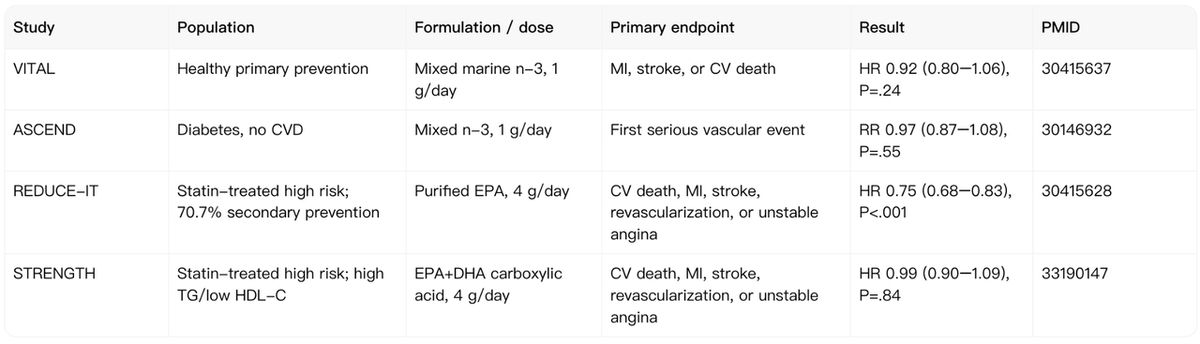
The evidence-table workflow becomes especially useful when the reader needs more columns such as follow-up, denominators, adverse events, or source provenance.
B. Cross-paper analysis without false equivalence
A better research tool should not simply notice that REDUCE-IT reported a favorable primary outcome and STRENGTH did not. It must also preserve differences in formulation, comparator oils, enrollment criteria, and clinical endpoints. Those are alternative explanations and interpretation limits—not demonstrated causes of the different findings.
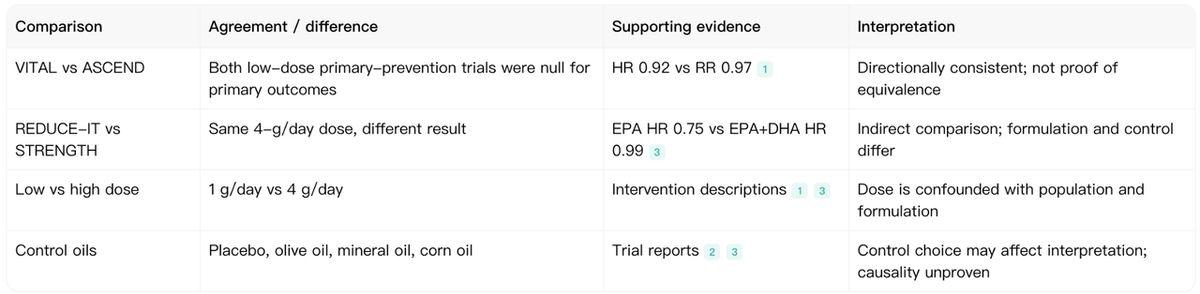
For a closer look at the limits of indirect clinical comparisons, read Best AI Tools for Cross-Trial Evidence Comparison.
C. Citation verification is more than a reference list
The third output connects each claim to its original study and numerical evidence. It also marks verification boundaries: an abstract-verified claim should not be described as an independently verified full-text or supplementary analysis.
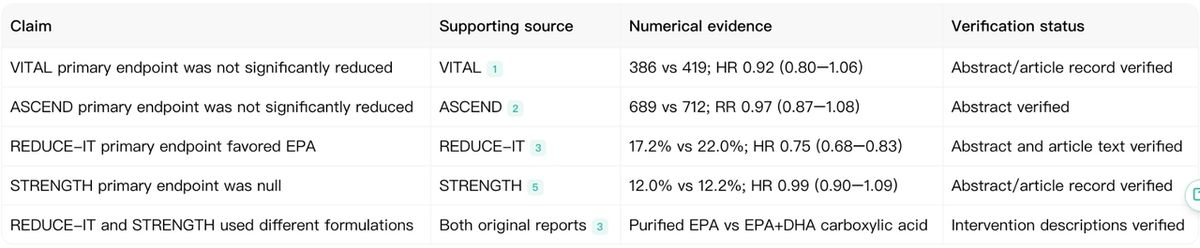
In this four-trial run, Noah produced reusable research tables and qualified the main apparent disagreement. It was not a formal systematic review, a five-tool benchmark, or a full-text audit of every supplementary appendix.
Try a Cited Multi-Paper Analysis in Noah AI
Start with a defined biomedical question, ask for a study-level evidence table, and open the references before using the conclusions in your own review.
Free credits available; no credit card required for initial signup.
2. Elicit — Repeatable Study Extraction and Review Workflows
Best for: searching, screening, extracting the same variables across papers
Elicit's documented systematic-review workflow supports screening and data extraction, including fields tied to supporting quotations or figures. Its Research Agent also describes cited structured reports and other research deliverables. That makes it relevant when a review team defines fields up front and needs to inspect the supporting text behind extracted cells.
Check before choosing: access to the papers' full texts, whether the desired fields are available in the intended plan, and the required export format. Supporting quotes are useful evidence surfaces, but the reviewer must still check that the extracted value matches the correct endpoint, arm, denominator, and time point. Elicit documentation.
3. SciSpace — Reading and Organizing Research Papers
Best for: literature discovery, understanding PDFs, and organizing research notes
SciSpace documents literature review search, AI-assisted reading of methods and findings, source libraries, research-gap investigation, and citation workflows. It is a sensible option when the difficult step is interpreting papers already found and organizing their contents before writing.
Check before choosing: whether the papers are available in full text, whether extraction can stay consistent across the entire source set, and how the exported citations map back to specific claims. A readable summary and an auditable study matrix are different outputs. SciSpace literature review guide.
4. NotebookLM — Source-Grounded Questions Across an Uploaded Notebook
Best for: discussing, studying, and checking a bounded document collection
NotebookLM is designed around sources added to a notebook. Google's documentation explains that answers can include citations that lead readers to quoted source text. This is valuable when you want to ask, "What do these four papers say about the same topic?" and then inspect the relevant passage rather than search the entire scholarly web again.
Check before choosing: whether the desired materials are already in the notebook and whether the output needs an operational review queue or a repeated field-extraction schema. A source-grounded answer is not automatically a systematic-review screening process. Google notebook chat guidance.
5. ChatGPT — Flexible Document Analysis and Structured Research Writing
Best for: mixed documents, research questions, comparison tables, and longer reports
ChatGPT supports file analysis and requests such as comparing documents or building tables. Deep Research is intended for multi-step investigation and can produce structured reports with citation or source links. The workflow depends on which files, sites, and other supported sources are actually accessible in the user's chosen mode.
Check before choosing: distinguish a quick conversational answer from a more controlled research workflow; verify each linked claim; specify extraction fields and source boundaries; and confirm the desired output format. General-purpose flexibility is useful, but not the same as an out-of-the-box, protocolized systematic-review pipeline. ChatGPT Deep Research guidance.
Which AI Tool Should You Choose?
Choose Noah AI when your main need is biomedical evidence discovery followed by a source-identified matrix or cited research brief. Choose Elicit when a repeatable search, screening, and extraction process matters most. Choose SciSpace for research-PDF reading and organization, NotebookLM for questions over a fixed source collection, and ChatGPT for flexible cross-format analysis and report drafting.
If citation accuracy is the deciding factor, do not substitute this task-fit guidance for your own evaluation. Put the same legally accessible full-text papers into each tool where supported, use the same extraction specification, and manually audit a defined set of claims.
What AI Citations Do Not Prove
A citation can be perfectly formatted while supporting the wrong claim. A source may address a secondary endpoint while the answer presents it as primary, or report a within-group improvement that does not establish a between-group treatment benefit. Trial comparisons add further problems: nonmatching populations, follow-up, intervention chemistry, and controls can all distort interpretation.
A practical four-part source audit
- Identity. Does the PMID or DOI actually identify the cited paper?
- Claim match. Does the cited passage support this exact sentence—not merely the general topic?
- Numerical fidelity. Are endpoint, analysis population, comparator, time point, estimate, CI, and denominator correctly preserved?
- Interpretation. Are null results and cross-paper differences described with appropriate uncertainty?
"Source-linked" describes a way to inspect evidence. It does not, by itself, establish that a medical statement is correct or that the underlying literature was searched comprehensively.
For a deeper extraction workflow, see Noah's guide to extracting evidence from medical research papers.
Frequently Asked Questions
Can AI analyze several research papers at once?
Yes, several tools support multi-document questions or structured analysis. The better question is whether the resulting comparison preserves source identity, matching extraction fields, and limitations. For formal reviews, human screening and source checking remain essential.
Which tool is best for evidence tables?
Elicit documents repeatable screening and data extraction; Noah AI shows a biomedical question-to-evidence workflow; SciSpace supports research-PDF analysis. Match the tool to whether you already have the paper set and how standardized the table must be.
Does an AI citation mean the finding is verified?
No. The DOI, PMID, or source passage must be checked against the actual claim. Even an accessible quotation may omit a denominator, compare different endpoints, or fail to address the conclusion drawn.
Can I use AI research analysis in a systematic review?
As an assistant for searching, screening, extraction, and organization, yes—subject to your review protocol and institutional rules. But the AI output alone is not an executed systematic review, independently adjudicated screening record, or formal risk-of-bias assessment.
Final Takeaway
The strongest paper-analysis workflow is not the one with the longest generated summary. It is the one that preserves the chain from question → paper → extracted field → cited claim → qualified synthesis. Our four-trial Noah AI example illustrates that chain through a visible evidence matrix, cross-paper comparison, and citation audit. The other tools offer different documented routes to parts of the same task; choose by your source set, verification needs, and final output.
From Papers to a Source-Traceable Research Brief
Compare multiple biomedical studies, extract consistent clinical fields, and organize findings into a cited evidence matrix with Noah AI.
Sources and Further Reading
Original trial reports used in the Noah example: