
Best AnswerThis Alternatives for Cited Medical Literature Reviews (2026)
Linda
Compare 6 AnswerThis alternatives for cited medical literature reviews in 2026. See how Noah AI organizes clinical evidence and links claims to research sources.
Compare six AI research tools for citation-backed medical literature reviews, clinical evidence extraction, and source verification—with a real Noah AI research example.
Noah AI · Free Credits Available · No Credit Card Required
A cited medical literature review should do more than attach references to an AI-generated summary.
Every important clinical claim should be traceable to an identifiable publication, supported by the correct numerical findings, and interpreted within the original study's limitations.
That can be challenging when multiple randomized trials investigate similar clinical questions but report different results.
AnswerThis offers AI-assisted research, citation-backed literature reviews, reference management, PDF analysis, and research-writing workflows.
However, researchers may want to explore alternatives that better match particular tasks, such as structured clinical trial comparison, systematic-review extraction, citation-context investigation, or biomedical evidence synthesis.
In this guide, we compare six AnswerThis alternatives and demonstrate a real Noah AI workflow involving four randomized clinical trials on the timing of kidney replacement therapy in critically ill patients with acute kidney injury.
Our emphasis is not simply whether an AI tool can produce citations. It is whether the citations help researchers inspect and verify the clinical evidence behind each conclusion.
Testing disclosure: We tested Noah AI directly using its Agent and Deep Research workflow. Other tools are described based on official product documentation and publicly available workflows. We did not perform an equivalent head-to-head benchmark of all six products.
Evidence cutoff for the demonstrated Noah AI review: October 15, 2026.
Quick Answer: What Are the Best AnswerThis Alternatives?
The most relevant AnswerThis alternative depends on the research task.
Noah AI is worth considering when a medical research question needs to become a structured evidence table, a cross-study synthesis, and a source-linked review draft.
Elicit offers structured evidence extraction and systematic-review workflows. Consensus supports research-question-based literature analysis. SciSpace provides paper investigation and PDF analysis. Scite focuses on citation context. Paperguide combines literature research, references, and review workflows.
| Tool | Best-Fitting Research Task | Important Feature |
|---|---|---|
| Noah AI | Biomedical evidence comparison and source-grounded synthesis. | Clinical evidence tables and source-verification outputs demonstrated in our test. |
| Elicit | Systematic-review workflows and structured data extraction. | Paper screening, extraction fields, and cited research reports. |
| Consensus | Research-question-based literature exploration and synthesis. | Cited research answers and deeper literature-review modes. |
| SciSpace | Paper discovery, PDF investigation, and literature comparison. | Literature Review, Deep Review, and paper-level analysis. |
| Scite | Citation-context analysis and investigating contested findings. | Smart Citations classified by supporting, contrasting, or mentioning context. |
| Paperguide | Academic reference management and literature-review workflows. | Citation-backed research, data extraction, and systematic-review tools. |
This comparison describes different research workflows. It is not an independently measured ranking of citation accuracy, speed, comprehensiveness, or review quality.
What Does AnswerThis Already Offer?
AnswerThis is a substantial academic research platform, not simply a generic chatbot with references.
Its available workflows include academic search, literature-review generation, PDF analysis, a research library, citation management, and AI-assisted writing.
The platform also emphasizes clickable citations that help users inspect the underlying research passages.
These capabilities matter because a reference list alone is not enough for scientific research. Researchers need to know what a paper actually reported and whether a generated statement accurately reflects that source.
Researchers may nevertheless compare AnswerThis with other platforms because they want a different workflow, more specialized biomedical outputs, specific review-management features, or a different approach to source checking.
The question is not whether AnswerThis supports cited literature reviews. It does.
The question is which tool best matches the evidence structure, verification process, and research deliverable required for a particular project.
What Makes a Medical Literature Review Truly Verifiable?
A citation makes a claim traceable, but it does not automatically make that claim correct.
In clinical research, several distinct layers of verification are important.
| Verification Layer | What Researchers Should Confirm |
|---|---|
| Study identity | Correct article, publication year, DOI, PMID, and study design. |
| Population | Eligibility, randomized sample, analyzed sample, and relevant subgroups. |
| Outcome | Exact primary or secondary endpoint and its assessment time. |
| Numerical evidence | Event counts, denominators, effect estimates, confidence intervals, and P values. |
| Interpretation | Whether the original result actually supports the proposed clinical statement. |
| Applicability | Whether conclusions extend beyond the patients or settings studied. |
| Publication updates | Relevant corrections, updates, follow-up studies, and evidence cutoff dates. |
A good AI-assisted medical review should help organize these checks and distinguish verified source information from interpretation or incomplete evidence.
1. Noah AI — For Structured, Source-Grounded Biomedical Evidence Reviews
Noah AI is a research Agent designed for medical, pharmaceutical, and life-science workflows.
Researchers can submit a scientific question, specify relevant study types, request consistent extraction fields, and ask for evidence synthesis with identifiable citations.
In our direct test, Noah generated a detailed comparison of randomized clinical trials and a separate claim-to-source verification matrix.
That second output is especially relevant for a cited medical literature review: it links each clinical claim to its supporting publication, numerical result, verification status, and interpretation boundary.
The following case shows what Noah actually produced, rather than relying only on a product feature description.
Real Noah AI Test: Early vs Delayed Kidney Replacement Therapy in Acute Kidney Injury
We selected the timing of kidney replacement therapy in critically ill adults with acute kidney injury because several randomized trials have produced different results.
In particular, the smaller ELAIN trial reported a survival benefit from earlier initiation, while larger trials did not consistently demonstrate that benefit.
The research question was:
Research Question
In critically ill adults with acute kidney injury and no immediate emergency indication for kidney replacement therapy, how do accelerated versus standard or delayed initiation strategies compare in mortality, dialysis dependence, adverse events, and treatment exposure?
The review focused on four major randomized trials:
- ELAIN (2016)
- AKIKI (2016)
- IDEAL-ICU (2018)
- STARRT-AKI (2020)
These studies differ in trial setting, severity of kidney injury at enrollment, initiation thresholds, emergency rescue criteria, and treatment exposure.
A scientifically defensible synthesis must preserve these differences rather than assuming all early and delayed initiation strategies are identical.
Step 1 — Define a Citation-Verifiable Medical Research Task
We entered the question into Noah AI Agent with Deep Research enabled.
The instructions requested randomized trial extraction, numerical accuracy, comparison of conflicting evidence, and a separate source-verification table.
The visible input interface also showed the selected model, 5.6 Luna · Fast.
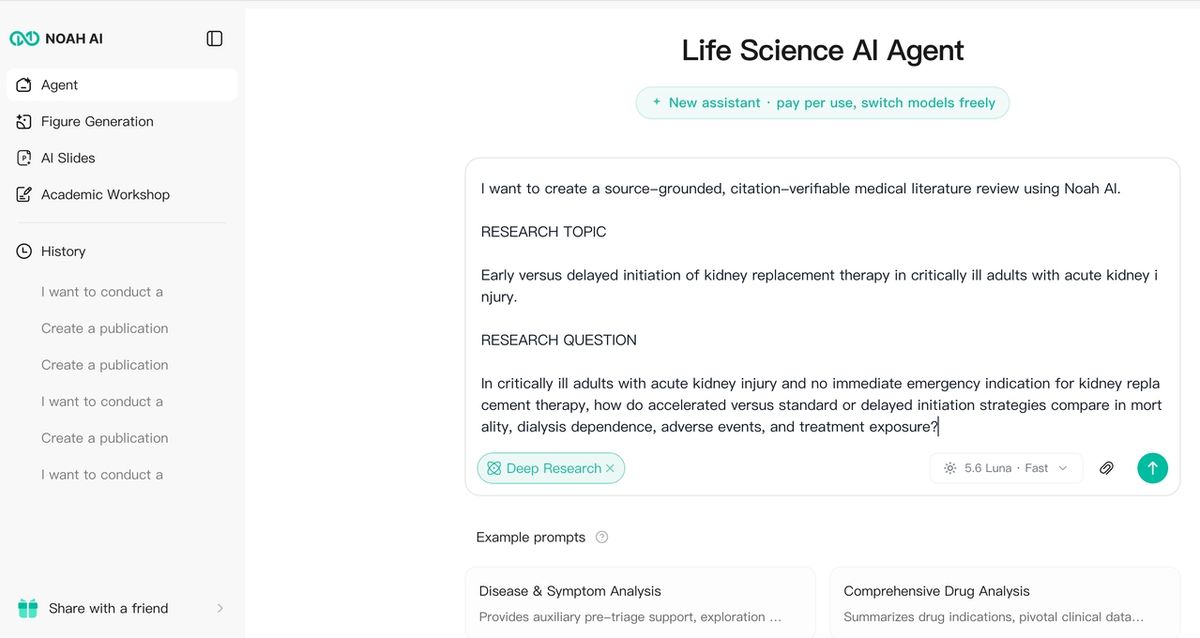
Defining the review task carefully was important because the clinical studies use different initiation criteria and outcome populations.
The instructions also required the report to distinguish primary randomized evidence from systematic reviews and meta-analyses.
A published meta-analysis containing an original trial must not be counted as another independent randomized trial.
This is a basic but important rule for trustworthy evidence synthesis.
Step 2 — Compare Four Clinical Trials with Their Original Results
Noah generated a trial-level evidence table containing seven categories:
- Trial identity
- Study design, population, and eligibility
- Treatment initiation strategies
- Primary outcome and follow-up
- Main numerical results
- Treatment exposure, recovery, and adverse events
- Study limitations and source identifiers
This structure makes the evidence easier to compare because every trial is examined through the same research questions.
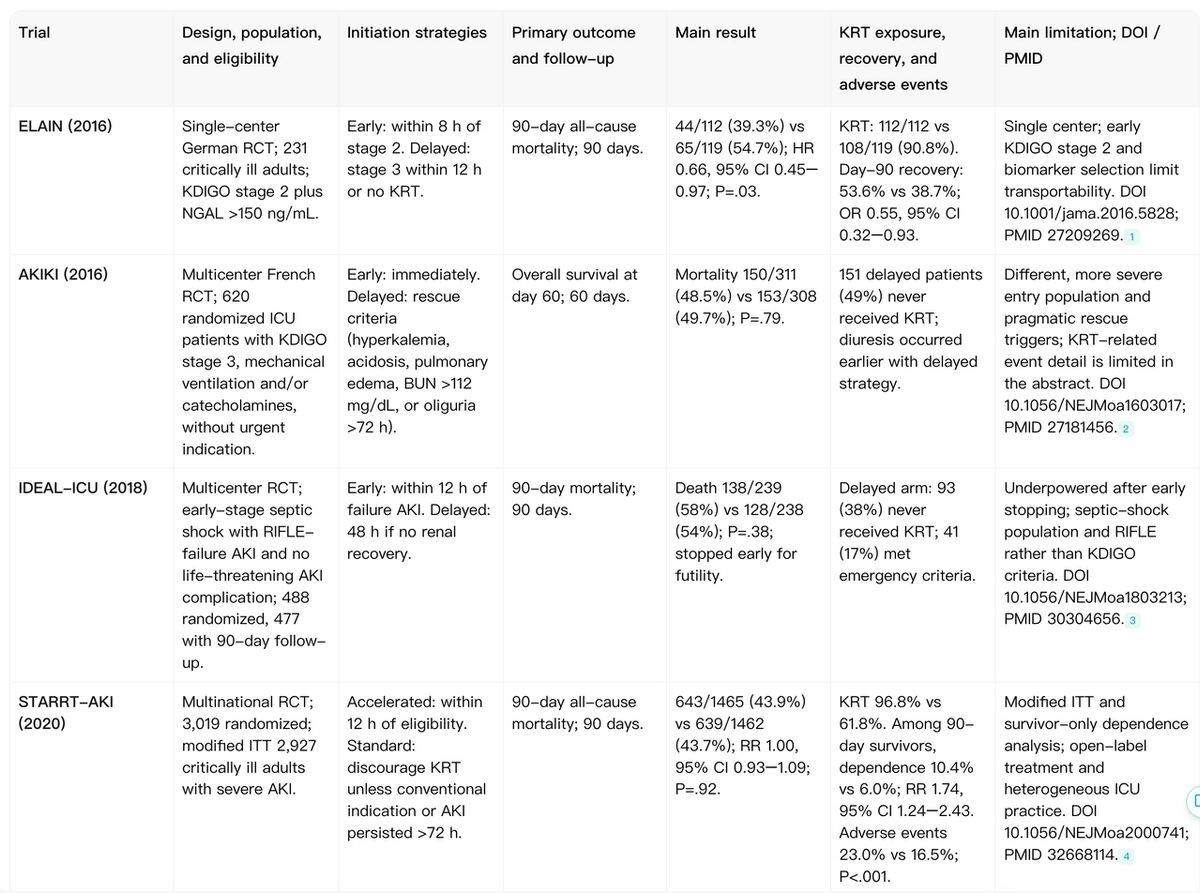
The studies illustrate why a cited review needs to preserve the trial context.
ELAIN was a single-center randomized study involving 231 critically ill adults. It reported 90-day mortality of 39.3% with earlier initiation and 54.7% with delayed initiation (HR 0.66; 95% CI 0.45–0.97; P=.03).
This was a statistically significant result in the ELAIN study population, but the trial's early kidney injury stage and biomarker-selected population limit its direct generalizability.
AKIKI randomized 620 adults with more severe acute kidney injury in a multicenter setting.
Mortality at day 60 was 48.5% with the early strategy and 49.7% with the delayed strategy (P=.79).
Importantly, 49% of patients assigned to the delayed strategy did not receive kidney replacement therapy.
A nonsignificant mortality difference does not establish that the two strategies are identical, but it does mean the trial did not demonstrate an early-treatment survival advantage.
IDEAL-ICU evaluated patients with septic shock and severe acute kidney injury.
The trial stopped early for futility. Mortality at 90 days was 58% in the early-strategy group and 54% in the delayed-strategy group (P=.38).
Its early stopping and septic-shock population are important qualifications.
STARRT-AKI provided a larger multinational randomized comparison.
In its modified intention-to-treat analysis, 90-day mortality was 43.9% with accelerated initiation and 43.7% with the standard strategy (RR 1.00; 95% CI 0.93–1.09; P=.92).
Accelerated treatment also resulted in greater kidney replacement therapy exposure and more recorded adverse events.
The significance of the Noah evidence table is not just that it lists these four studies.
It preserves the relationship between each trial's population, treatment strategy, endpoint, statistical result, and interpretation boundary.
Step 3 — Explain Why the Clinical Findings Differ
A cited medical literature review should not treat conflicting findings as a reason to choose whichever study has the most favorable result.
In this case, ELAIN reported lower mortality with earlier therapy, while AKIKI, IDEAL-ICU, and STARRT-AKI did not establish a consistent survival benefit.
The studies differed in several relevant ways:
| Trial Difference | Why It Matters |
|---|---|
| ELAIN: single-center study | A smaller and more selected population may not represent broader ICU practice. |
| AKIKI: later injury-stage enrollment | Its treatment strategies and patient eligibility differed from ELAIN. |
| IDEAL-ICU: septic shock population | The trial addressed a specific critically ill population and stopped early. |
| STARRT-AKI: multinational trial | Broader settings and different rescue thresholds affect clinical interpretation. |
These are documented study differences that help explain why direct generalization is inappropriate.
They do not prove that any single design difference caused the results to diverge.
The published individual-patient-data meta-analysis also found no overall day-28 survival advantage for early treatment (RR 1.01; 95% CI 0.91–1.13).
Review the 2020 individual-patient-data meta-analysis.
This is a useful example of evidence synthesis: the overall conclusion must reflect the totality and limitations of the evidence, not merely repeat the result of one positive trial.
Step 4 — Connect Clinical Claims to Their Supporting Sources
This was the most relevant output for our AnswerThis-alternative evaluation.
Noah generated a claim-to-source verification matrix with five fields:
- Clinical claim: The scientific statement being assessed.
- Supporting source: The original study or evidence synthesis associated with the claim.
- Reported evidence: The numerical result used to support the interpretation.
- Verification status: The status assigned by the generated research report.
- Interpretation boundary: What the study does not establish or where generalization is limited.
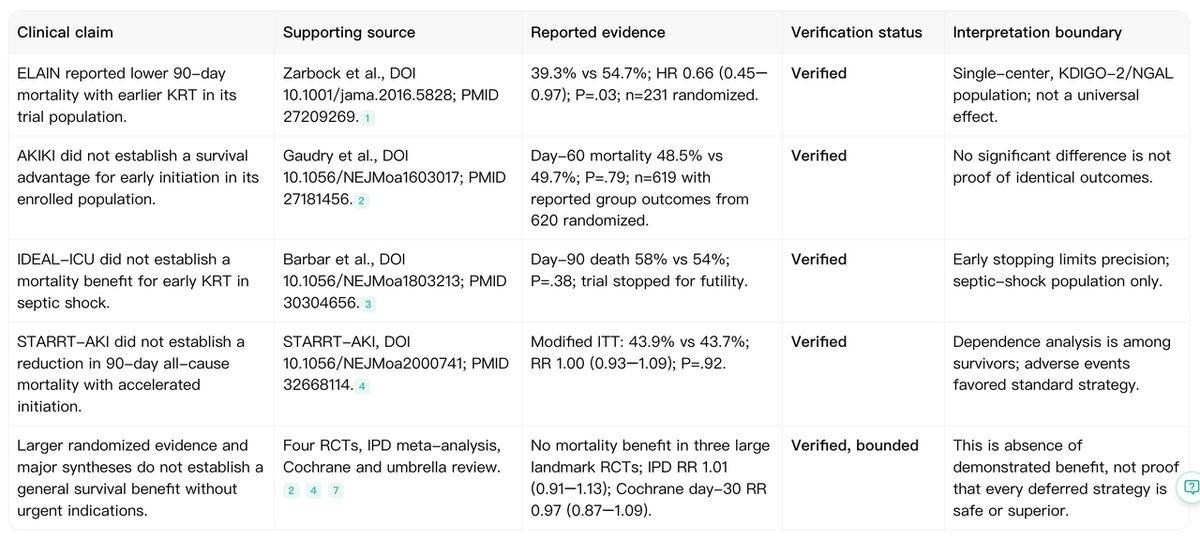
The table linked the four trial-level claims to the original ELAIN, AKIKI, IDEAL-ICU, and STARRT-AKI publications using DOI and PMID identifiers.
It also included a broader synthesis claim: the larger randomized evidence and major reviews do not establish a general survival benefit from accelerated initiation in patients without urgent indications.
The interpretation boundary is essential.
An absence of demonstrated survival benefit is not proof that every delayed strategy is safe, equivalent, or superior.
In the Noah output, the final claim was labeled "Verified, bounded" to acknowledge that distinction.
Why This Output Matters
A medical citation should connect a specific scientific claim to the correct source, reported result, and population. Noah's generated matrix makes those relationships visible in a reviewable format.
There is an important limitation: the "Verified" labels shown in the screenshot are generated within Noah's report.
They do not constitute independent verification by an external reviewer or guarantee that every publisher correction, full-text detail, or statistical issue has been audited.
In fact, the report explicitly noted that an exhaustive publisher-level correction audit had not been completed.
The appropriate conclusion is therefore that Noah produced a source-verification framework, not that its citations are automatically error-free.
What Noah AI Actually Demonstrated
The direct test showed four relevant capabilities:
- Structured clinical extraction: Four randomized trials were organized using a common evidence framework.
- Statistical context: Results were presented with relevant denominators, effect estimates, and study-specific qualifications.
- Cross-study synthesis: Differences between the positive ELAIN trial and larger randomized evidence were discussed without flattening the scientific uncertainty.
- Claim-to-source organization: Five conclusions were connected to supporting publications and explicit interpretation boundaries.
These capabilities are relevant when preparing clinical evidence briefs, biomedical literature-review drafts, or research reports that require traceable evidence.
The output still requires researcher verification, especially when results will be used for academic publication, regulatory assessment, or clinical interpretation.
Create a Source-Grounded Medical Literature Review with Noah AI
Compare clinical studies, organize biomedical evidence, and build reviewable claim-to-source tables with Noah AI.
Free Credits Available · No Credit Card Required
Free credits are usage-limited. Available credit balances and task costs depend on current plan rules.
2. Elicit — For Evidence Extraction and Systematic-Review Workflows
Elicit is an AI research platform supporting literature exploration, structured information extraction, and systematic-review workflows.
Its Research Agent can assist with finding and analyzing academic literature. Its Systematic Review workflow supports searching, screening, extracting data, and preparing reports.
For researchers who need to extract consistent fields from many publications, Elicit offers an established workflow for working with structured evidence.
Its extraction and review tools can be valuable for systematic research projects in which screening decisions, numerical outcomes, and supporting citations need to be inspected.
Best fit: Structured extraction, screening, and formal review-management workflows.
Important consideration: Extracted data and AI-assisted screening recommendations still require verification and appropriate researcher oversight.
3. Consensus — For Cited Research Answers and Deep Literature Reviews
Consensus supports academic evidence search using natural-language research questions.
Researchers can investigate a question, review relevant publications, and generate cited research analysis.
Its Deep Review capabilities can also produce more extensive literature syntheses and structured outputs, including evidence tables depending on the requested task.
Consensus can be useful when the researcher wants to investigate what published literature says about a specific scientific question before developing a more detailed review.
Best fit: Question-driven evidence exploration, cited research synthesis, and research landscape analysis.
Important consideration: A high-level summary should not replace verification of trial-specific outcomes and statistical details.
4. SciSpace — For Paper Discovery and Citation-Linked PDF Analysis
SciSpace offers an academic research workspace with literature search, paper analysis, customizable review columns, and PDF-based investigation.
Researchers can examine retrieved publications, review AI-generated insights, and investigate individual papers.
Its Literature Review and Deep Review workflows can support study comparison and literature synthesis.
SciSpace is relevant when the immediate challenge is locating the right papers, examining full-text documents, and organizing extracted research information.
Best fit: Paper-centered research, PDF investigation, and academic literature organization.
Important consideration: Verify the relationship between extracted statements, the original study design, and the exact results reported.
5. Scite — For Understanding How Scientific Papers Are Cited
Scite focuses on citation-context analysis.
Its Smart Citations help researchers understand whether later publications contain statements classified as supporting, contrasting, or mentioning earlier findings.
This is useful when exploring a disputed medical claim or determining how a research finding has been discussed in subsequent publications.
For a cited medical literature review, Scite can complement original study extraction by helping researchers locate relevant follow-up discussion and contradictory evidence.
Best fit: Citation-context investigation and locating research that supports or challenges a claim.
Important consideration: Citation classifications do not independently establish that a clinical finding is true or that a study has low risk of bias.
6. Paperguide — For Academic Literature Management and Review Workflows
Paperguide offers research and reference-management tools designed to support academic literature work.
Its available capabilities include academic paper exploration, reference organization, research writing, structured extraction, and systematic-review workflows.
Paperguide is relevant when researchers want several stages of academic research and citation handling within one platform.
It should not be characterized as a PDF-only summarizer. Its review features overlap with important parts of the workflows provided by other academic AI tools.
Best fit: Integrated academic research, literature management, and systematic-review processes.
Important consideration: Confirm current plan access and verify AI-generated extractions and citations before final submission.
Which AnswerThis Alternative Should You Choose?
The appropriate tool depends on what you need to produce and where your research workflow begins.
| Your Research Priority | Tool to Consider |
|---|---|
| Compare clinical trials and create a source-grounded biomedical review. | Noah AI |
| Extract defined data fields across many papers. | Elicit |
| Explore a scientific question and generate a cited literature overview. | Consensus |
| Investigate full-text PDFs and organize academic papers. | SciSpace |
| Inspect supporting and contrasting citation contexts. | Scite |
| Combine reference organization with literature-review workflows. | Paperguide |
Noah AI is particularly relevant when a medical research project needs a structured connection between the clinical question, randomized evidence, source identifiers, and final interpretation.
Other tools may be preferable for specific stages such as screening, PDF reading, citation-network exploration, or reference management.
How to Check AI-Generated Medical Citations
Regardless of which platform you use, a cited research report should undergo an explicit verification process before publication.
Use the following checklist:
- Confirm the original publication: Verify the exact trial title, DOI, PMID, and publication year.
- Inspect the study design: Identify whether the source is randomized, observational, or secondary evidence.
- Check analysis populations: Do not confuse randomized participants, analyzed participants, treated participants, and survivors.
- Verify numerical claims: Compare event counts, denominators, effect estimates, confidence intervals, and P values against the original source.
- Preserve endpoint definitions: Do not substitute one mortality time point or kidney outcome for another.
- Identify analysis limitations: Consider early stopping, missing data, subgroup analyses, and differences in patient eligibility.
- Check source updates: Look for corrections, subsequent analyses, and publication notices.
- Avoid double counting: Do not treat a meta-analysis and its included original trials as independent randomized datasets.
- Review clinical applicability: Confirm that conclusions are not generalized beyond the studied population.
- Label uncertainty honestly: Use "Not verified" when adequate source confirmation is unavailable.
This process is especially important when an AI system reports that it has verified a finding.
A verification status generated inside an AI report is a useful research cue, but the researcher remains responsible for confirming the underlying evidence.
Can AI Produce a Fully Verified Medical Literature Review?
AI can assist substantially with literature discovery, evidence extraction, source organization, and review drafting.
However, a cited review should not be treated as fully verified merely because the output includes DOI links, inline citations, or confidence intervals.
The system may misinterpret an analysis population, cite a secondary review instead of an original trial, or describe a statistically nonsignificant result too strongly.
A formal systematic review also requires additional methodological controls, including a predefined protocol, reproducible database searches, eligibility screening, study selection records, risk-of-bias assessment, and appropriate evidence synthesis.
An AI-generated narrative medical literature review does not automatically satisfy those requirements.
The practical role of AI is to help researchers create a clearer and more inspectable evidence workflow while preserving independent scientific judgment.
Can You Try Noah AI for Free?
Yes. Noah AI offers free signup credits through its Basic plan.
No credit card is required to get started.
This allows researchers to explore supported Agent research tasks before committing to a paid subscription.
Free credits are usage-limited. More demanding research tasks may consume credits at different rates, and the number of available tasks depends on the current plan and balance.
For current allowances and paid options, see the Noah AI pricing page.
Frequently Asked Questions
What Are the Best AnswerThis Alternatives for Medical Literature Reviews?
Noah AI, Elicit, Consensus, SciSpace, Scite, and Paperguide are relevant alternatives for different literature-review tasks. Noah AI is particularly worth considering for biomedical evidence comparison and cited synthesis drafts, while other products emphasize screening, PDF analysis, citation-context investigation, or integrated academic workflows.
Is Noah AI a Good AnswerThis Alternative?
Noah AI is a relevant alternative for medical and life-science researchers who want to organize clinical evidence into structured comparison tables and source-linked synthesis drafts. AnswerThis also offers citation-backed reviews, so the decision should reflect the research task rather than an unsupported claim of overall superiority.
Can Noah AI Generate Cited Medical Literature Reviews?
In our direct test, Noah produced a clinical evidence table and a claim-to-source verification matrix linking study findings to supporting publications and source identifiers. These outputs are useful review materials, but citations and numerical results require independent confirmation.
Does AnswerThis Provide Verifiable Citations?
AnswerThis offers citation-linked literature reviews and source inspection features. Users can review linked publications and citation details. As with other research tools, important clinical conclusions should still be verified against the original evidence.
What Is Claim-to-Source Verification?
Claim-to-source verification is the process of checking whether a scientific statement is supported by the cited publication, whether its reported values are accurate, and whether the interpretation stays within the original study's population and methods.
Can AI Compare Conflicting Randomized Clinical Trials?
AI can help organize and interpret differences across trials. In our Noah example, the report compared ELAIN, AKIKI, IDEAL-ICU, and STARRT-AKI while identifying differences in population, timing criteria, mortality outcomes, and applicability. The comparison still requires researcher verification.
Does a DOI Prove That an AI-Generated Claim Is Correct?
No. A DOI identifies a publication, but the cited paper may not support the exact numerical result or interpretation attached to it. The researcher must verify the relevant endpoint, analysis population, and evidence directly.
Can I Use Noah AI for Free?
Yes. Noah AI offers free signup credits and does not require a credit card to get started. The amount of research possible depends on available credits and current task costs.
Is an AI-Generated Cited Review the Same as a Systematic Review?
No. A formal systematic review requires protocol-driven search and screening methods, eligibility documentation, risk-of-bias assessment, and reproducible synthesis. AI-generated cited narratives may support selected stages of that process but do not replace the full methodology.
Related Reading
Explore additional Noah AI guides for source-grounded biomedical research and evidence synthesis.
- Best AI Tools for Creating Cited Literature Review Reports (2026)
- How to Conduct a Medical Literature Review with AI
- How to Create an Evidence Table for a Literature Review with AI
- How to Compare Multiple Research Papers in a Literature Review with AI
Final Takeaway: Choose an AI Tool That Makes Medical Evidence Reviewable
The strongest medical literature review is not necessarily the one with the most citations or the longest AI-generated report.
Its value depends on whether researchers can identify the original studies, verify the reported data, evaluate differences in study design, and understand how each source supports the final interpretation.
AnswerThis offers capable citation-backed research workflows. Elicit, Consensus, SciSpace, Scite, and Paperguide provide complementary approaches to evidence extraction, literature synthesis, citation analysis, and academic research management.
Noah AI is especially relevant when a biomedical research question needs to become a structured, source-linked evidence comparison.
In our real AKI example, Noah organized four randomized trials into a consistent extraction table, explained why the findings were not directly interchangeable, and produced a claim-to-source verification matrix.
The verification matrix did not remove the need for human checking. Instead, it made the claims, source identifiers, numerical results, and interpretation boundaries easier to inspect.
That is the practical value of a source-grounded biomedical research workflow: better evidence organization without treating AI-generated citations as automatically correct.
Researchers who want to explore the workflow can start with Noah AI's free signup credits without adding a credit card.
Start a Cited Medical Literature Review with Noah AI
Explore biomedical literature, compare clinical evidence, and organize important research claims with traceable sources and explicit limitations.
Free Credits Available · No Credit Card Required