
Best Avidnote Alternatives for Biomedical Literature Research (2026)
Linda
Compare 5 Avidnote alternatives for biomedical literature research in 2026, including Noah AI, Elicit, SciSpace, Consensus, and ResearchRabbit.
Searching biomedical literature is only the beginning. Researchers also need to check whether a study answers the right question, preserve its population and comparator, organize source-linked findings, and identify uncertainties without inventing evidence. This guide compares five Avidnote alternatives—and demonstrates a real Noah AI literature research workflow using randomized trials of microbiome-based therapies for recurrent Clostridioides difficile infection.
5 alternatives · Hands-on Noah AI example · Evidence cutoff: October 23, 2026
Quick takeaway
The most useful alternative depends on whether you primarily want to discover papers, interrogate PDFs, build an evidence table, or produce a source-aware biomedical research synthesis.
Noah AI — Biomedical evidence synthesis. Best suited to research-question-driven analyses that combine source identification, trial comparison, research gaps, and cautious conclusions.
Elicit — Structured paper extraction. Useful when you need consistent research fields extracted from many publications through a dedicated research workflow.
SciSpace — Literature search and close reading. Useful for finding relevant papers, reviewing PDFs, and checking how individual methods and results support extracted claims.
Consensus — Study discovery and snapshots. Useful for quickly locating scholarly evidence and inspecting core characteristics such as population, method, and outcome.
ResearchRabbit — Citation-network exploration. Useful for tracing connected papers, following references and citations, and expanding a collection beyond keywords.
Testing disclosure: Only Noah AI was directly tested for this article, using a biomedical research question about microbiome-based treatments for recurrent Clostridioides difficile infection. Avidnote, Elicit, SciSpace, Consensus, and ResearchRabbit were not independently tested. Their features and workflow suitability are described using publicly available product documentation.
The term "best" refers to suitability for specific research tasks, not a measured ranking of accuracy, citation reliability, or overall performance. No controlled head-to-head benchmark was conducted.
What Is Avidnote?
Avidnote is an academic research workspace for reading, organizing, analyzing, and writing from research materials. It supports research projects, uploaded documents, notes, AI-assisted reading, and queries across files within a project. It is more than a digital notebook or a one-click summarizer.
Avidnote's project-oriented approach can work well for researchers who already have a collection of PDFs or other documents and want reading, writing, and note organization in a single environment. However, a researcher may prefer another tool when the central task is biomedical evidence mapping, specialized paper discovery, standardized extraction, or citation-network exploration.
Is Avidnote Free?
Pricing checked: November 4, 2026.
According to Avidnote's official pricing page, Avidnote offers a free plan with 20,000 AI-generated words per month, 10 AI-reading questions per month, and 300 MB of document storage.
The published paid plans include Professional ($19/month), Premium ($59/month), and Ultimate ($99/month). Pricing, usage allowances, and feature availability may change, so researchers should verify the current terms before subscribing.
Fair comparison: Avidnote already supports multiple-document research and source-aware workflows. This article does not claim it lacks these features. The relevant question is which tool best matches a particular biomedical research task.
5 Best Avidnote Alternatives for Biomedical Literature Research
1. Noah AI — For source-grounded biomedical research
Noah AI is relevant when a literature project starts with a biomedical research question rather than an existing document folder. In the hands-on case below, its Agent Deep Research workflow produced a source-linked evidence matrix, a traceable description of search and study selection, and a research gap map.
Choose it for: focused biomedical evidence mapping, clinical study comparison, research interpretation, and structured cited reports. Verify important claims against the original papers before using them in a manuscript or decision.
2. Elicit — For structured evidence extraction
Elicit offers research workflows for finding and extracting information from academic papers. Its Research Agent integrates paper discovery, paper-level questions, and extraction tasks. Its separate Systematic Review workflow supports more controlled screening and review steps on eligible plans.
Choose it for: repeated extraction of trial design, participants, interventions, outcomes, and other fields across a larger evidence set. As of September 30, 2026, Elicit integrated its former standalone Find Papers, Extract Data, and Chat with Papers tools into Research Agent.
3. SciSpace — For AI-assisted reading and literature review
SciSpace supports literature discovery, paper comparison, and follow-up analysis of research documents. Its published literature review guidance emphasizes documenting the search question, building a consistent evidence matrix, and verifying extracted claims against original passages.
Choose it for: literature searches that involve substantial PDF reading, method interpretation, and checking details in source documents.
4. Consensus — For finding and scanning scientific evidence
Consensus helps researchers find published evidence from natural-language questions. Its Study Snapshot feature surfaces structured information such as methods, sample size, and results for individual papers.
Choose it for: early-stage question exploration, candidate study identification, and quick checks before in-depth extraction. A study snapshot is not a substitute for reading the original methods and results.
5. ResearchRabbit — For citation network discovery
ResearchRabbit takes a different approach: begin with selected "seed" papers, then explore papers connected through references, citations, and related research. Collections and visual citation maps help researchers trace a topic as it develops.
Choose it for: discovering foundational or adjacent papers that might be missed by keywords alone. Citation proximity does not establish clinical quality or relevance by itself.
Side-by-Side Workflow Comparison
| Tool | Starting point | Primary workflow strength | What still requires verification |
|---|---|---|---|
| Noah AI | Biomedical research question | Structured evidence synthesis, citations, research gap framing | Source coverage, extraction accuracy, interpretation |
| Elicit | Research question or paper set | Consistent study data extraction and review workflows | Extraction fields, screening rationale, full-text support |
| SciSpace | Search query or paper/PDF | Literature discovery and interactive reading | Original passage, endpoint and numeric details |
| Consensus | Natural-language question | Paper discovery and study snapshots | Complete study methods and strength of evidence |
| ResearchRabbit | Seed papers / collection | Citation-network expansion and organization | Clinical relevance and methodological quality of related papers |
Comparison criteria describe documented use cases, not proven differences in precision, recall, citation accuracy, or output quality. We ran Noah AI for this article; the other tools were reviewed using their official descriptions.
What Makes Biomedical Literature Research Different?
A medically useful literature research workflow needs more than a long list of papers. It should show how each source relates to a question, what was extracted, and where direct comparisons break down.
- Scope: Define the population, clinical context, intervention, comparator, outcomes, and evidence cutoff before searching.
- Discovery: Record search terms and source locations rather than implying an exhaustive search from a few retrieved articles.
- Selection: Distinguish original randomized studies from reviews, follow-up analyses, and mechanistic papers.
- Extraction: Preserve trial-specific denominators, follow-up, endpoint wording, and statistical approach.
- Synthesis: Separate direct within-trial findings from hypotheses inferred across different studies.
- Research gaps: Link any proposed gap to actual limitations in the evidence, not merely to an AI-generated suggestion.
Hands-On Noah AI Test
Noah AI case study: microbiome-based treatments for recurrent C. difficile infection
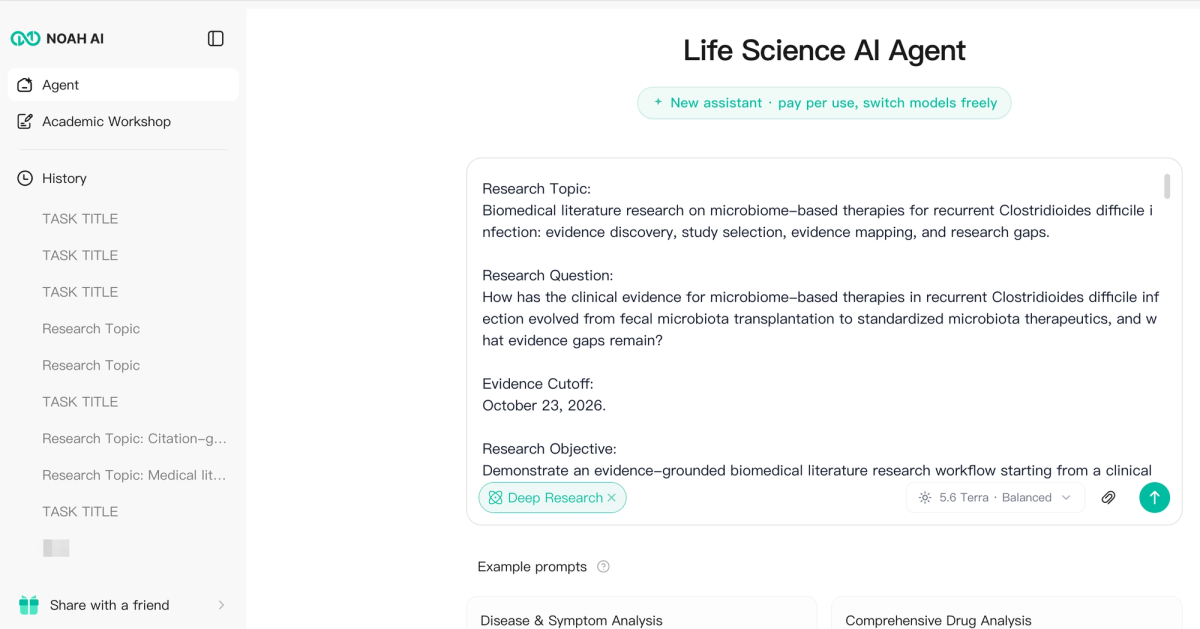
We tested Noah AI directly using a focused biomedical research question: how clinical evidence evolved from donor fecal microbiota transplantation (FMT) to standardized microbiota products for recurrent Clostridioides difficile infection (rCDI), and which evidence gaps remain.
The research protocol specified an evidence cutoff of October 23, 2026. It centered on four original randomized trials and requested a source-aware account of literature discovery, study selection, an evidence matrix, cross-study interpretation, and a research gap map. This was a focused evidence-mapping exercise, not a systematic review or meta-analysis.
Step 1 — Find and select relevant original studies
The generated report described exact-title and PMID-oriented PubMed searches for four priority clinical trials, alongside focused searches for additional FMT and microbiota-product trials. It distinguished the priority studies from additional randomized studies, follow-up publications, and secondary analyses.
Importantly, it also documented what it could not establish: no exhaustive search, independently duplicated screening, search-result counts, or PRISMA-compliant systematic review. That limitation matters when users interpret a report as a map of available evidence rather than a complete inventory.
Step 2 — Turn the literature into a structured evidence matrix
Rather than generate four isolated paragraphs, Noah organized the priority trials by study population, sample size, intervention, comparator, main finding, and PMID.
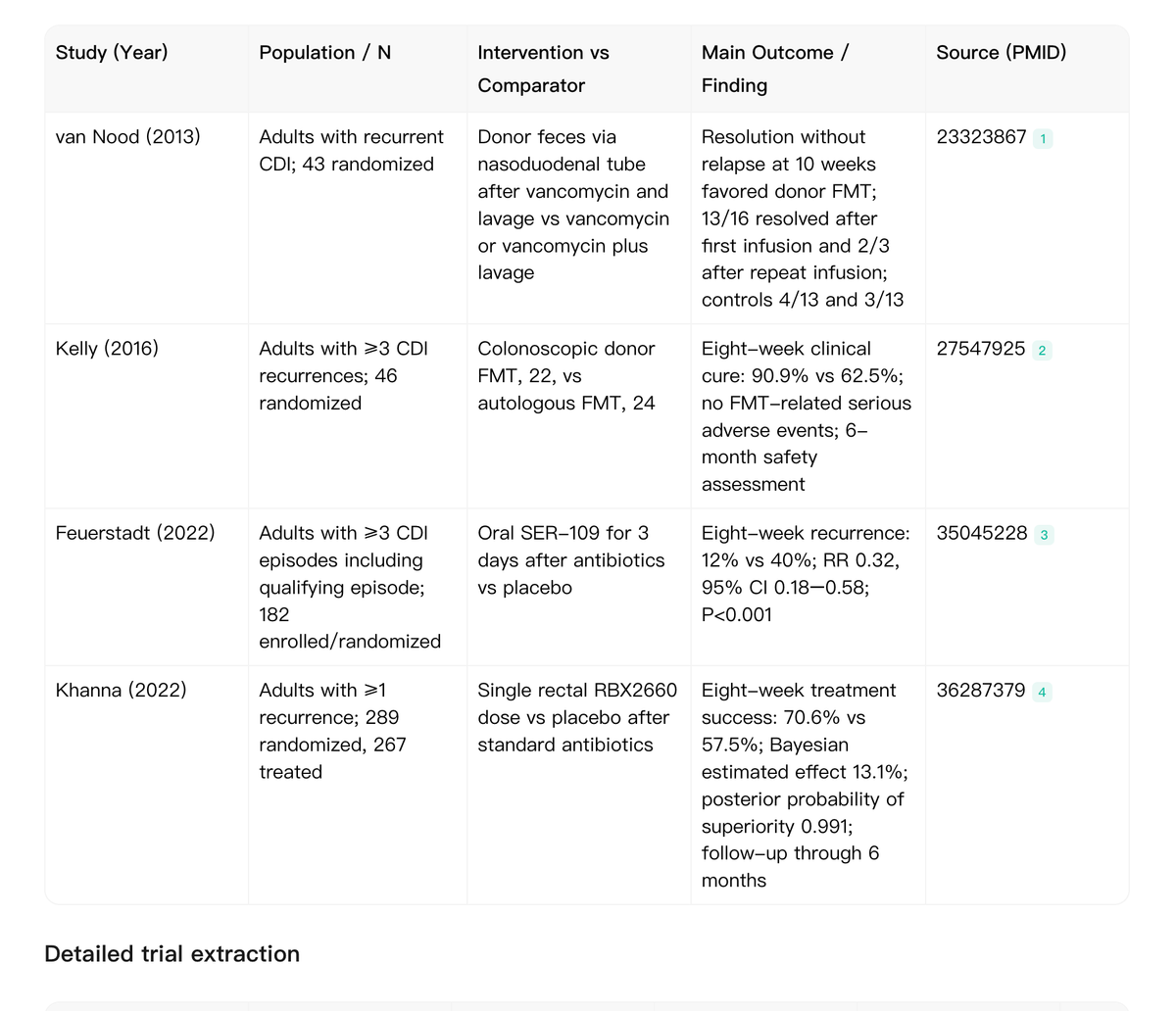
Evidence Matrix: Four Randomized Trials in Recurrent CDI
The following source-checked matrix summarizes the four studies examined in the Noah AI demonstration. It is an editorial verification table accompanying the original Noah screenshot, not a verbatim transcription of every screenshot cell.
| Study | Population / Sample | Intervention vs Comparator | Primary Outcome and Result | Source |
|---|---|---|---|---|
| van Nood et al. (2013) | 42 randomized patients with recurrent CDI | Donor FMT after vancomycin and bowel lavage vs vancomycin-based controls | Diarrhea resolution without relapse at 10 weeks: 13/16 (81%) after the first donor infusion vs 4/13 (31%) with vancomycin alone and 3/13 (23%) with vancomycin plus lavage | [PMID 23323867](https://pubmed.ncbi.nlm.nih.gov/23323867/) |
| Kelly et al. (2016) | 46 patients with multiply recurrent CDI | Donor FMT vs autologous FMT | Clinical cure at 8 weeks: 20/22 (90.9%) vs 15/24 (62.5%) | [PMID 27547925](https://pubmed.ncbi.nlm.nih.gov/27547925/) |
| Feuerstadt et al. (2022) | 182 patients with recurrent CDI | Oral SER-109 vs placebo after antibiotics | CDI recurrence through 8 weeks: 12% vs 40%; RR 0.32 (95% CI 0.18–0.58) | [PMID 35045228](https://pubmed.ncbi.nlm.nih.gov/35045228/) |
| Khanna et al. (2022), PUNCH CD3 | 289 randomized; 267 received blinded treatment | RBX2660 vs placebo after antibiotics | Model-estimated treatment success at 8 weeks: 70.6% vs 57.5%, using a Bayesian primary analysis | [PMID 36287379](https://pubmed.ncbi.nlm.nih.gov/36287379/) |
Interpretation: These trials evaluate different microbiota interventions, controls, endpoints, and populations. Their numerical findings should not be interpreted as a direct comparative effectiveness ranking.
| Original trial | Question and comparator | Selected source-reported result | PMID |
|---|---|---|---|
| van Nood (2013) | Donor FMT after antibiotics and lavage vs vancomycin-based controls | 13/16 resolved after first infusion; control arms reported 4/13 and 3/13 resolution; 10-week endpoint | [23323867](https://pubmed.ncbi.nlm.nih.gov/23323867/) |
| Kelly (2016) | Donor FMT vs autologous FMT delivered by colonoscopy | Eight-week clinical cure 90.9% vs 62.5% | [27547925](https://pubmed.ncbi.nlm.nih.gov/27547925/) |
| Feuerstadt (2022) | Oral SER-109 vs placebo after standard antibiotics | Eight-week recurrence 12% vs 40%; RR 0.32 (95% CI 0.18–0.58) | [35045228](https://pubmed.ncbi.nlm.nih.gov/35045228/) |
| Khanna (2022) | Rectally administered RBX2660 vs placebo after antibiotics | Bayesian model-estimated eight-week treatment success 70.6% vs 57.5% | [36287379](https://pubmed.ncbi.nlm.nih.gov/36287379/) |
These figures should not be treated as a ranking of donor FMT, oral SER-109, and RBX2660. The studies enrolled different populations, used different controls and endpoints, and did not directly compare the products with one another.
Step 3 — Preserve endpoint and statistical differences
The report made several distinctions necessary for biomedical interpretation. van Nood measured diarrhea resolution without relapse at 10 weeks; Kelly measured clinical cure at eight weeks; SER-109 measured recurrence prevention through eight weeks; and RBX2660 used a treatment-success definition and a Bayesian primary analysis borrowing information from a prior trial.
For example, 70.6% versus 57.5% for RBX2660 describes a model-estimated treatment-success comparison, while 12% versus 40% for SER-109 describes recurrence proportions. These are different estimands—not an indirect head-to-head demonstration of superiority.
Explore a source-grounded biomedical research workflow
Use Noah AI to start from a research question, organize clinical studies into a source-linked evidence matrix, and examine where study findings agree or differ. Check the current signup page for available free credits and billing requirements.
Step 4 — Map research gaps instead of just summarizing papers
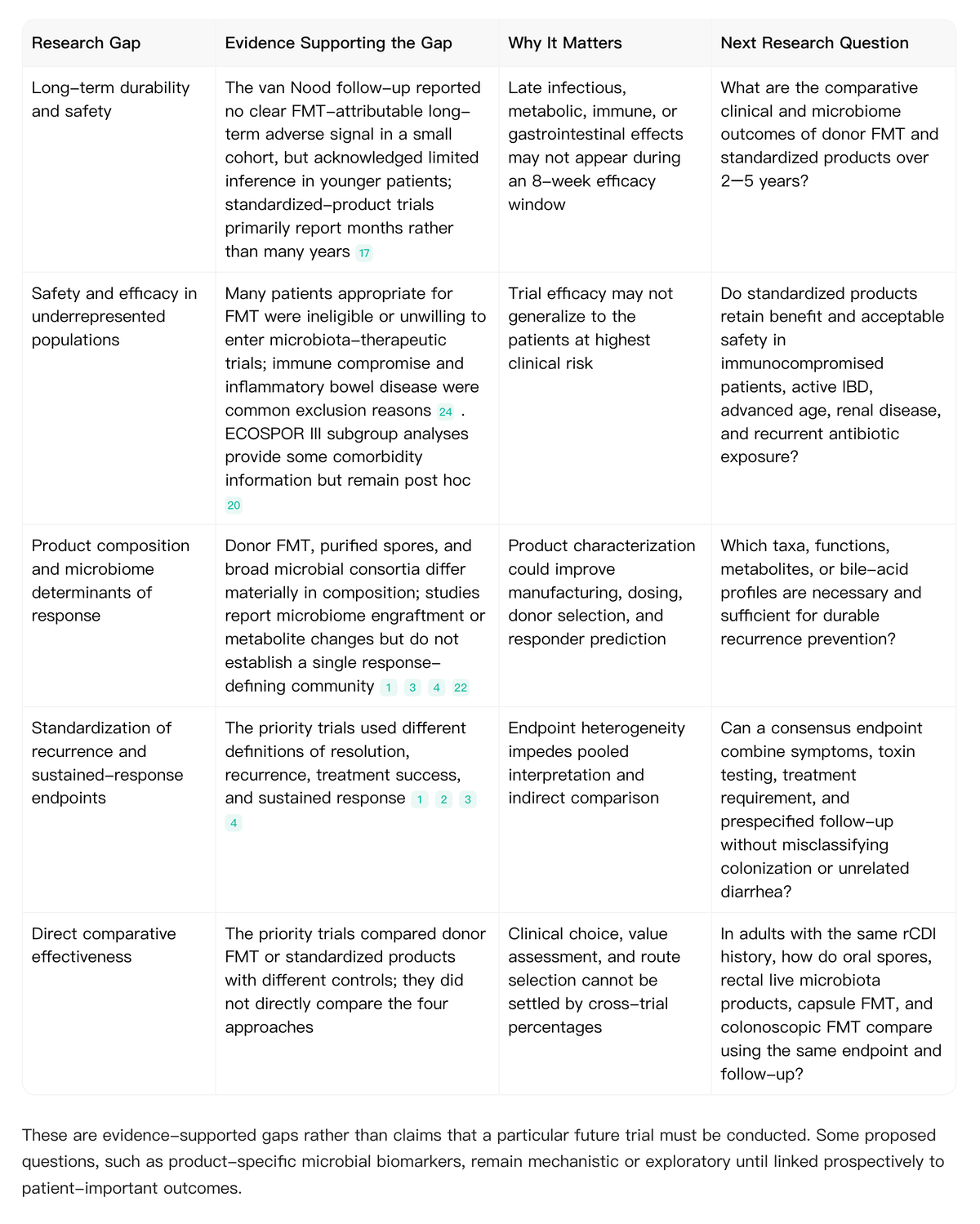
A distinct part of this Noah report was its Biomedical Research Gap Map. It converted limitations of the selected evidence into concrete questions that researchers could use for a further literature search or a study proposal.
| Evidence gap | Why the selected research does not settle it | Research question to investigate next |
|---|---|---|
| Long-term durability and safety | Core efficacy windows were short, while longer follow-up was less uniform across interventions | How durable are clinical and microbiome outcomes over several years? |
| Underrepresented populations | Eligibility and exclusion criteria limit inference for immunocompromised people and patients with complex comorbidities | How do outcomes vary in higher-risk groups under real-world care? |
| Microbiome composition | Donor FMT, purified spores, and broad microbial consortia are biologically different products | Which microbial functions are associated with durable response? |
| Endpoint harmonization | Trials define recurrence, cure, treatment success, and sustained response differently | Can future studies use consistent clinically meaningful definitions? |
| Direct comparative effectiveness | The four priority trials had different controls and no head-to-head product comparison | Which approaches perform best under a shared population, endpoint, and follow-up? |
These are questions motivated by the mapped evidence, not proof that no additional research exists. Each proposed gap still needs an updated, targeted search before being described as an unanswered question in a publication.
What the Case Study Demonstrates—and What It Does Not
This case documents that one Noah Agent Deep Research run produced a focused research-scope statement, study-selection account, cited evidence matrix, cross-study interpretation, research gap map, and source-audit notes. It does not prove complete retrieval of all relevant biomedical literature, independent verification of every full-text claim, or superiority to Avidnote or other platforms in a controlled benchmark.
How to Choose the Right Avidnote Alternative
| Your immediate task | Tools to consider | Selection criterion |
|---|---|---|
| Turn a biomedical question into a cited evidence report | Noah AI | Source traceability and careful cross-study interpretation |
| Extract consistent fields from many research papers | Elicit | Customizable fields, source evidence and review control |
| Search for papers and read their details closely | SciSpace | PDF access, method explanation and evidence checks |
| Screen a topic quickly using paper characteristics | Consensus | Relevant study discovery and snapshot clarity |
| Trace influential, citing and related articles | ResearchRabbit | Network exploration, collections and seed-paper relevance |
| Keep papers, notes and writing in one project workspace | Avidnote | Project organization and document-based note workflow |
For formal systematic reviews, prioritize reproducible protocols, documented searches, independent screening where required, transparent exclusions, and validated extraction. An AI-generated evidence map alone is not a systematic review.
Final Takeaway
Avidnote is worth considering for document-oriented research and note-taking, but it is not the only approach to academic research. Noah AI fits a research-question-to-evidence workflow, Elicit emphasizes structured extraction, SciSpace supports literature search and detailed reading, Consensus helps surface and scan studies, and ResearchRabbit specializes in connected-literature discovery.
The Noah microbiome example shows why an effective biomedical literature workflow should include more than text summarization: it needs explicit population and comparator definitions, original source identifiers, non-equivalent endpoint warnings, and research gaps anchored to the available studies.
Start your own literature research workflow
Try a focused biomedical question in Noah AI and inspect the original sources behind each extracted finding. Check your account's current free-credit availability and payment requirements before running a large task.
- van Nood E, et al. Duodenal infusion of donor feces for recurrent C. difficile. N Engl J Med. 2013. PMID 23323867.
- Kelly CR, et al. Donor versus autologous FMT in multiply recurrent CDI. Ann Intern Med. 2016. PMID 27547925.
- Feuerstadt P, et al. SER-109, an oral microbiome therapy for recurrent CDI. N Engl J Med. 2022. PMID 35045228.
- Khanna S, et al. Efficacy and safety of RBX2660 in PUNCH CD3. Drugs. 2022. PMID 36287379.
- Avidnote — AI for Researchers; Avidnote plans.
- Elicit workflow documentation.
- SciSpace literature review tutorial.
- Consensus Study Snapshot documentation.
- ResearchRabbit citation-network guide.
Research disclaimer: Educational workflow comparison only; not individualized medical advice. The Noah example describes one real run, whose cited sources require independent verification. The selected research is illustrative, not an exhaustive review of recurrent CDI therapy or a current clinical guideline. Product features and plan limits can change.