
Best Enago Read Alternatives for Clinical Paper Analysis (2026)
Linda
Explore five Enago Read alternatives for clinical paper analysis in 2026. Compare Noah AI, SciSpace, Elicit, Scholarcy, and Consensus with a real RCT example.
Quick takeaway
Best overall for biomedical evidence analysis — Noah AI is the strongest fit when you want a research-question-driven workflow that turns a clinical paper into structured evidence, interpretation, and cautious conclusions.
Best for PDF-centric paper reading — SciSpace is a strong choice when your workflow begins with a paper PDF and a series of follow-up questions about methods, results, and terminology.
Best for structured evidence extraction — Elicit is useful when you want to compare multiple papers across fields such as intervention, population, and outcomes.
Best for fast single-paper summaries — Scholarcy is a practical option for quickly digesting a paper's sections, claims, and headline limitations.
What is Enago Read?
Enago Read is a paper reading and analysis tool designed to help researchers summarize, annotate, question, and critique academic articles. Its appeal comes from combining several reading-oriented functions in one place: section-based summarization, key insights, critique workflows, notes, and an AI copilot for follow-up questions.
That makes it useful for literature reading, especially when a researcher wants help understanding a paper quickly. But clinical paper analysis often requires a deeper layer of interpretation: endpoint definitions, statistical meaning, generalizability, comparative context, and the difference between study findings and clinical inference. That is where some researchers may want an alternative.
Important framing: this article does not treat Enago Read as "just a summarizer." Instead, it compares alternatives based on how well they support clinical paper analysis, especially around evidence interpretation and critical appraisal.
Best Enago Read Alternatives for Clinical Paper Analysis
| Tool | Best for | Why researchers may choose it |
|---|---|---|
| Noah AI (Editor's pick) | Clinical evidence analysis and interpretation | Turns a clinical question into structured evidence tables, critical appraisal, and source-aware interpretation. |
| SciSpace | Interactive reading of PDFs | Good when you want to ask targeted questions about a paper's methods, design, or terminology while reading the article itself. |
| Elicit | Multi-paper extraction | Useful for extracting and comparing research attributes across multiple studies in a structured way. |
| Scholarcy | Single-paper summaries | Fast and convenient for generating digestible summaries, highlights, and flashcard-like overviews. |
| Consensus | Study-level question answering | Helpful for quickly finding relevant papers and understanding their top-level findings and study snapshots. |
Need a clinical-paper workflow instead of a generic summary?
Noah AI is designed for source-grounded biomedical research workflows. If you need to analyze a trial, compare context studies, and keep interpretation boundaries explicit, start with the same workflow used in this guide.
Side-by-Side Comparison
| Comparison area | Noah AI | SciSpace | Elicit | Scholarcy | Consensus |
|---|---|---|---|---|---|
| Starting point | Research question | Paper or PDF | Research question / evidence extraction task | Single paper upload or import | Natural-language research query |
| Clinical trial interpretation | Strong | Moderate | Moderate to strong | Basic to moderate | Basic to moderate |
| Critical appraisal structure | Strong | Variable | Moderate | Basic | Limited |
| Multi-study context | Strong | Moderate | Strong | Limited | Moderate |
| Best workflow fit | Clinical evidence interpretation | Paper reading and Q&A | Evidence mapping | Fast summaries | Rapid paper discovery |
What Makes Clinical Paper Analysis Difficult?
Reading a clinical paper is not the same as summarizing it. Researchers often need to answer harder questions:
- What exactly was the primary endpoint?
- Did the paper show a statistically significant result for the main question, or only for secondary or component outcomes?
- How large was the observed effect in absolute and relative terms?
- How much does generalizability depend on the study population and exclusion criteria?
- Do the study's strengths and limitations change how the result should be applied?
Those questions matter even more when the trial is being compared against related studies. A good tool for clinical paper analysis should preserve endpoint definitions, effect estimates, safety data, and interpretation boundaries rather than flattening everything into a generic "positive" or "negative" summary.
Why We Used BPROAD
BPROAD is a good test case because it is clinically important and methodologically rich. It evaluates an intensive blood-pressure strategy in adults with type 2 diabetes, while related trials such as ACCORD BP, SPRINT, and STEP provide useful—but non-interchangeable—context.
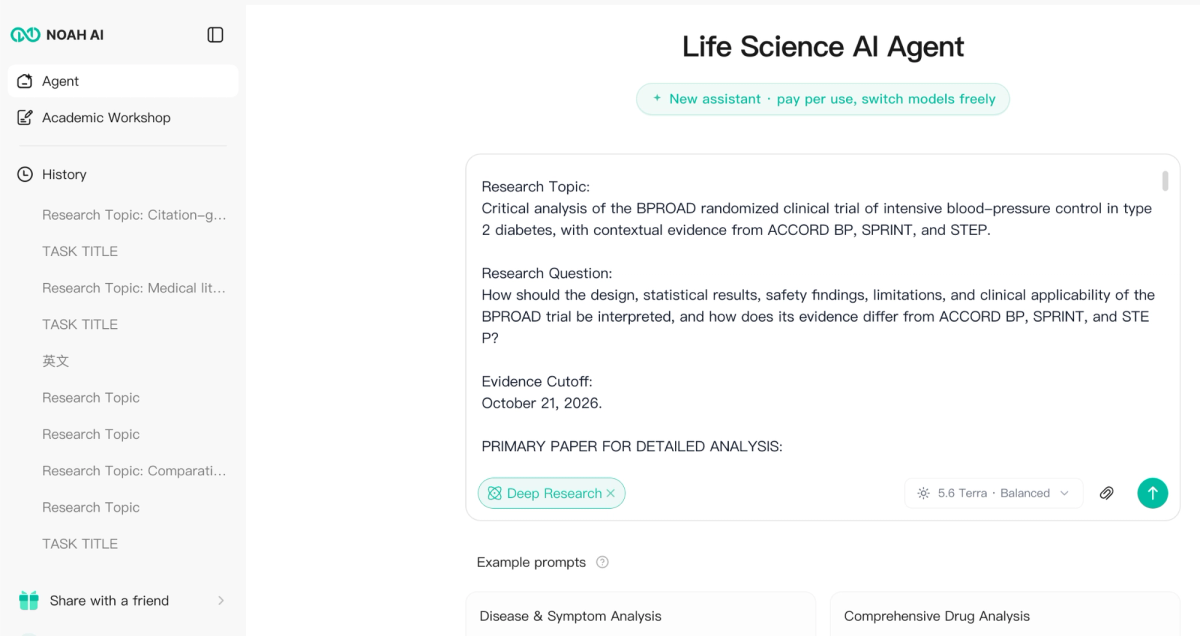
The Noah workflow below does not just summarize BPROAD. It interprets study design, endpoint meaning, primary efficacy, safety, and what researchers should still verify before generalizing the result.
Noah AI Real Clinical Paper Analysis Example
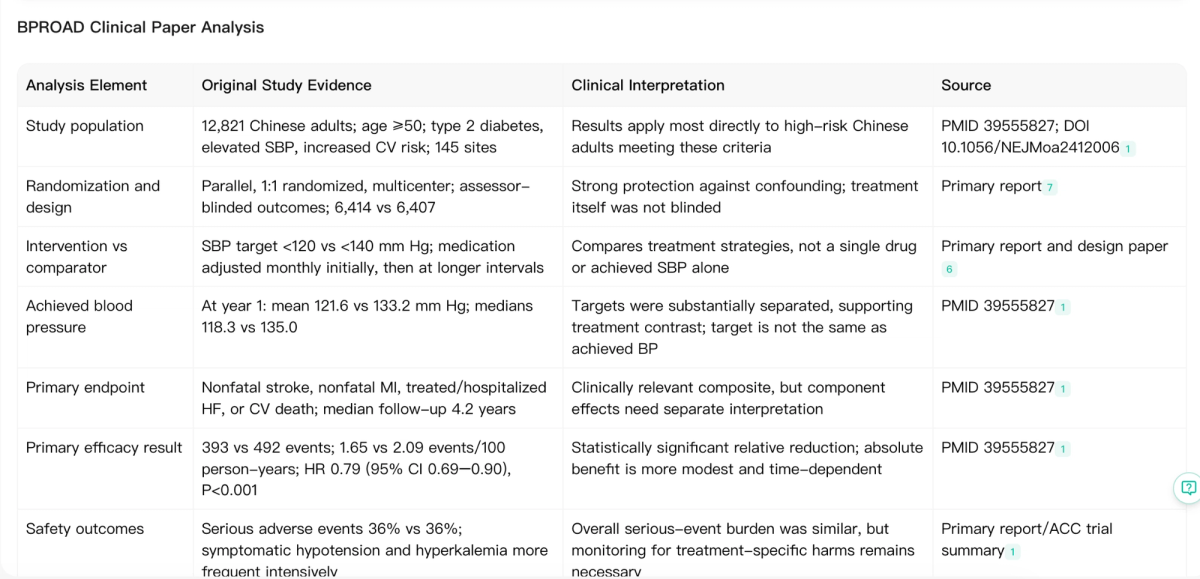
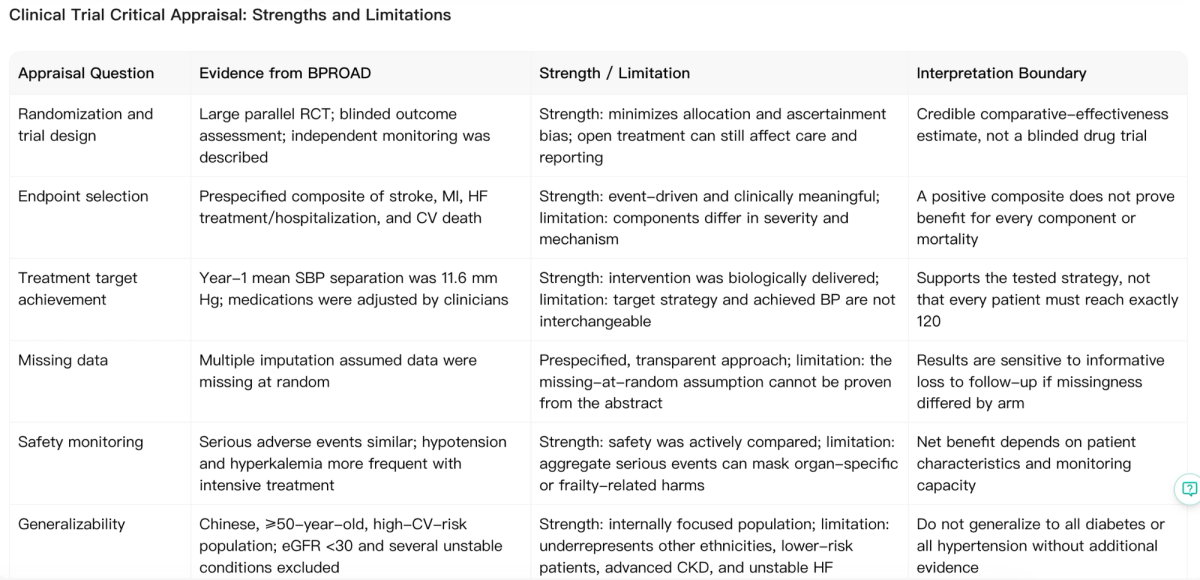
To test a realistic clinical-paper workflow, we asked Noah AI to perform a detailed analysis of the BPROAD randomized trial and use ACCORD BP, SPRINT, and STEP only as contextual comparators. The goal was not to create a generic four-paper review. Instead, it was to evaluate whether Noah could produce a useful trial-analysis workflow similar to what researchers often want from an Enago Read alternative.
What Noah AI Did Well in This Example
| Analysis need | What Noah AI showed | Why it matters |
|---|---|---|
| Preserving the trial population | Noah kept the core BPROAD population explicit: high-risk Chinese adults aged 50 or older with type 2 diabetes and elevated systolic blood pressure. | This supports correct interpretation of generalizability rather than implying the result applies to all hypertensive patients. |
| Separating target from achieved blood pressure | The report distinguished the treatment target (<120 vs <140 mm Hg) from the achieved year-1 blood pressures. | This is a common interpretation pitfall in blood-pressure trials and is essential for accurate clinical reading. |
| Keeping the primary endpoint intact | Noah preserved the composite endpoint definition instead of reducing the result to a vague statement about "cardiovascular benefit." | Composite endpoints require careful interpretation; not every component necessarily moves in the same way. |
| Retaining the main effect estimate | The report kept the 393 vs 492 events, HR 0.79, 95% CI 0.69–0.90, and P<0.001 visible in the main analysis section. | Clinical paper analysis should preserve the quantitative result, not replace it with a generic conclusion. |
| Making interpretation boundaries explicit | The appraisal table repeatedly separated strengths from limitations and added "interpretation boundary" language. | This helps avoid overgeneralization, especially when comparing BPROAD with ACCORD BP, SPRINT, and STEP. |
Interpreting BPROAD in Context
The Noah output is useful not because it says BPROAD was "positive," but because it shows how the trial should be read. In this case, several interpretation boundaries matter:
- BPROAD is not identical to ACCORD BP. Both involve type 2 diabetes and intensive blood-pressure control, but they differ in size, timing, context, and endpoint behavior.
- SPRINT is informative but not directly interchangeable. It supports the biological plausibility of lower-SBP strategies, yet it excluded patients with diabetes.
- STEP adds older-population context. It is clinically relevant, but its population and composite outcome differ from those in BPROAD.
- A significant composite endpoint is not the same as a universal mortality benefit. Researchers still need to examine component outcomes, adverse events, and applicability to their target population.
That kind of nuanced reading is where a tool can move from "paper summary" into genuine clinical paper analysis.
Want to replicate this workflow with your own trial?
You can use Noah AI to analyze a clinical paper, preserve the primary endpoint, extract key effect estimates, and organize strengths, limitations, and interpretation boundaries into a readable output.
Create a Noah account · Start a clinical analysis task
When Should You Choose Each Tool?
| If you need to… | Best fit | Why |
|---|---|---|
| Interpret the design, endpoint, and main efficacy result of a clinical trial | Noah AI | Best when you want a research-question-driven output with interpretation and critical appraisal. |
| Read a single PDF closely and ask follow-up questions about details | SciSpace | Strong for interactive reading workflows that begin from the paper itself. |
| Compare many studies across structured fields | Elicit | Well suited for multi-paper extraction and evidence comparison workflows. |
| Get a fast synopsis of one paper | Scholarcy | Good for quickly generating a digestible overview and highlight set. |
| Explore relevant papers and their high-level findings quickly | Consensus | Useful for question-first research discovery and study snapshots. |
Final Takeaway
Enago Read remains a useful reading and critique tool, especially for paper-centric workflows. But if your main goal is clinical paper analysis—not just a summary—then a stronger alternative is one that can preserve endpoint definitions, effect estimates, safety findings, and interpretation boundaries.
Among the tools compared here, Noah AI is the best fit for that workflow. It performed well on a real clinical trial example, structured the paper into an interpretable evidence table, and generated a critical-appraisal view that is directly relevant to how biomedical researchers read trials.
SciSpace, Elicit, Scholarcy, and Consensus all remain useful depending on whether your emphasis is PDF reading, multi-paper extraction, summary speed, or research discovery. The best choice depends on whether you need a summary, a comparison, or a clinical interpretation.
FAQ
What is the best Enago Read alternative for clinical paper analysis?
Noah AI is the strongest choice in this guide when the job requires interpreting a clinical paper rather than simply summarizing it. It is particularly useful for extracting endpoint definitions, effect estimates, safety findings, and strengths or limitations.
Is Enago Read mainly a paper summarizer?
No. Enago Read also supports insight extraction, critique workflows, notes, and AI-assisted reading. This article compares alternatives specifically for deeper clinical paper analysis.
Can AI tools replace formal critical appraisal by a researcher?
No. AI tools can accelerate reading and organize evidence, but researchers still need to verify core claims, especially around statistical results, safety findings, and study applicability.
Why was BPROAD used in this article?
BPROAD is a clinically important randomized trial with enough methodological detail to test whether a tool can move beyond summary into actual interpretation. It also has meaningful contextual comparators in ACCORD BP, SPRINT, and STEP.
Which alternative is best for quickly reading one paper?
Scholarcy and SciSpace are strong options when speed and paper-level reading are the priority. Noah AI is more useful when the task becomes structured evidence interpretation.
Can I use Noah AI for literature review work as well?
Yes. Noah AI can also support broader biomedical evidence synthesis, literature review generation, and comparative study analysis workflows beyond single-paper appraisal.
Research disclaimer
This article is intended for research workflow evaluation and educational use. The Noah AI example is based on a real generated report using the BPROAD randomized trial as the primary paper and ACCORD BP, SPRINT, and STEP as contextual studies. It is not individualized medical advice. Researchers should verify important claims against the original trial publications and, where needed, the full article and supplement.