
Best OpenRead Alternatives for Understanding Clinical Papers (2026)
Linda
Compare 5 OpenRead alternatives for understanding clinical papers in 2026. See a real Noah AI PREVENT CLOT study on noninferiority, endpoints and claim verification.
AI paper reading · Biomedical research · 2026
A useful AI paper reader should do more than shorten a clinical trial into a few bullet points. It should explain what the study tested, why its statistical design matters, and where a confident-sounding conclusion goes beyond the evidence. Here are five OpenRead alternatives for different paper-reading tasks, followed by a real Noah AI clinical paper interpretation example.
Evidence and product information reviewed: October 29, 2026 · Case study: PREVENT CLOT (NEJM, 2023)
What Matters When Reading a Clinical Paper?
Clinical papers combine questions that are easy to mix up: who was enrolled, which treatment was compared, what the primary endpoint measured, and which statistical claim was actually tested. A reader who misses any one of these can misinterpret a study despite copying its numbers correctly.
That distinction becomes especially important for randomized noninferiority trials. If a treatment meets a prespecified noninferiority boundary for mortality, that does not show it is superior, equivalent for every endpoint, or appropriate for every patient. A good AI-assisted reading workflow should make those boundaries visible rather than hide them.
What Is OpenRead?
OpenRead is an AI research and paper-reading platform. Its publicly described reading features include Paper Espresso, Paper Q&A, Paper Compare, related-paper exploration, and notes. These features are relevant to researchers who want help navigating a paper, explaining unfamiliar material, and comparing findings.
OpenRead is not simply a static PDF summarizer. The question for a clinical researcher is whether a given workflow makes it easy to verify the original trial's methods, endpoint hierarchy, effect estimates, and the limits of the answer. Different alternatives emphasize different parts of that task.
Five OpenRead Alternatives Worth Considering
1. Noah AI — For Question-Driven Clinical Evidence Interpretation
Noah AI is designed around biomedical research questions and source-linked research outputs. A user can specify a trial, its PMID, and a reading question, then ask for an interpretation of design, outcomes, statistical uncertainty, and limits. In the PREVENT CLOT example below, Noah produced a noninferiority explanation and a claim-correction table that can be checked against the original report.
Good fit: Researchers who need a structured clinical paper brief, not just a quick paraphrase. Trade-off: A question-driven agent does not necessarily reproduce the page-by-page experience of reading an uploaded PDF. Verify important statements in the original paper and its supplement.
2. SciSpace — For Asking Questions Inside a Paper
SciSpace offers Chat with PDF, section-linked answers, highlighted-text explanations, and ways to work through unfamiliar passages. Its document-centered interface is relevant when the paper itself is open and the immediate task is to understand a specific method, figure, or discussion paragraph.
Good fit: Interactive PDF reading and follow-up questions. Trade-off: A convenient explanation of a paragraph still needs checking against the study's complete endpoint and statistical plan.
3. Explainpaper — For Simplifying Difficult Passages
Explainpaper focuses on selecting unfamiliar text and receiving a simpler explanation in context. Its documentation also describes adjustable explanation complexity, document questions, and paper summaries.
Good fit: Dense terminology, unfamiliar methods, and quick conceptual clarification. Trade-off: Simplifying one passage is not the same task as formally appraising an entire randomized trial or validating every result.
4. Scholarcy — For Structured Paper Summaries
Scholarcy converts academic documents into interactive summary flashcards, extracts key findings, and supports notes and organized research libraries. Its format can help users identify the question, methods, results, and references before a deeper read.
Good fit: Screening papers and quickly orienting to their major sections. Trade-off: A structured summary should be treated as a reading aid, not as a substitute for examining the numerical methods or supplementary analysis.
5. ChatPDF — For PDF-Centered Questions and Citations
ChatPDF lets users ask questions about uploaded PDFs and provides references back to the document. It also supports working with document collections, which is useful for locating where a statement appears.
Good fit: Rapid document Q&A with navigable source passages. Trade-off: Page-level grounding improves auditability but does not by itself ensure a statistically correct interpretation.
Quick Comparison: Which Tool Fits the Reading Task?
| Tool | Typical starting point | Best-matched task | What still needs checking |
|---|---|---|---|
| Noah AI | Biomedical question, trial citation, or research brief | Structured trial explanation and source-linked interpretation | Original methods, endpoint estimates, source access |
| SciSpace | Opened or uploaded academic PDF | Section-specific PDF questions and highlighted text | Claims outside the selected passage |
| Explainpaper | Highlighted difficult passage | Plain-language explanation | Whether simplification preserves statistical nuance |
| Scholarcy | Article or document | Structured summary and key findings | Underlying numerical and methodological details |
| ChatPDF | PDF file or document collection | Document-grounded answers and passage lookup | Whether the linked passage supports the interpretation |
This table compares documented workflow positioning, not measured accuracy, pricing, speed, or a controlled benchmark. Only the Noah clinical case below was run for this article.
A Real Clinical Paper-Reading Example: PREVENT CLOT
To make the comparison concrete, we used Noah AI's Agent / Deep Research workflow to examine [Aspirin or Low-Molecular-Weight Heparin for Thromboprophylaxis after a Fracture](https://pubmed.ncbi.nlm.nih.gov/36652352/) (2023; PMID 36652352, DOI 10.1056/NEJMoa2205973).
PREVENT CLOT is a randomized, pragmatic noninferiority trial in orthopedic trauma. It is a strong reading exercise because its primary conclusion is easy to exaggerate: aspirin met the prespecified noninferiority threshold for 90-day all-cause mortality, yet its deep-vein thrombosis (DVT) estimate was numerically higher than with low-molecular-weight heparin (LMWH).
The exercise was not a controlled head-to-head test of five AI products. We directly observed the Noah output shown in the screenshots and independently checked its important trial statistics against the original NEJM publication and PubMed abstract.
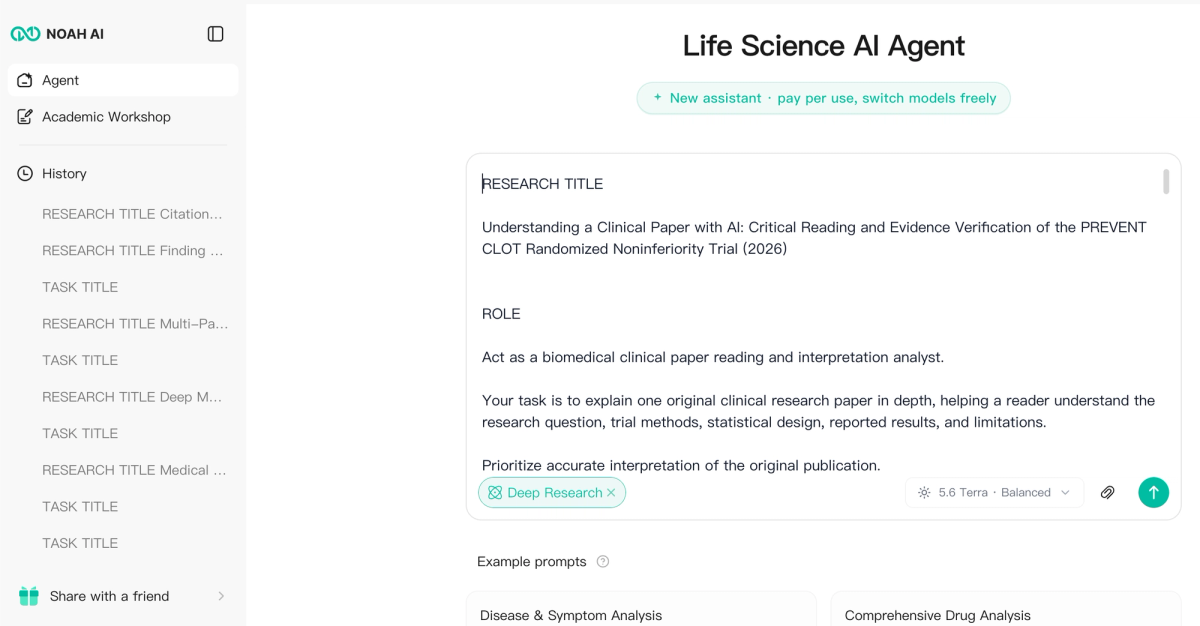
Step 1. Define a Source-Specific Reading Question
The Noah prompt named PREVENT CLOT, supplied its PMID and DOI, and asked for its trial methods, noninferiority margin, confidence interval, primary and secondary endpoints, and common misinterpretations. The run used Noah Agent with Deep Research selected.
Step 2. Interpret Noninferiority Rather Than Repeat the Headline
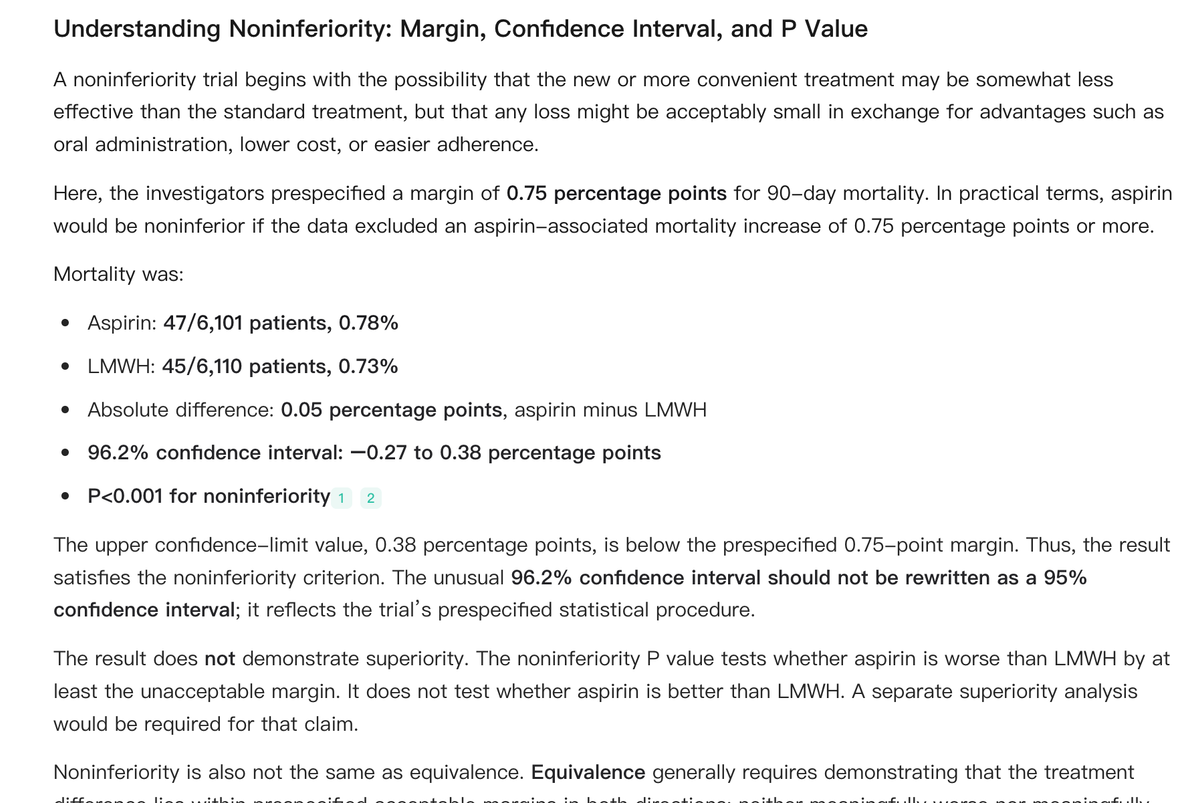
The central statistic is a 0.75-percentage-point noninferiority margin for 90-day all-cause mortality. The trial observed mortality estimates of 0.78% for aspirin and 0.73% for LMWH. The difference was 0.05 percentage points, with a 96.2% confidence interval of −0.27 to 0.38. Its upper bound was below the prespecified 0.75-point margin. This is why the trial met its noninferiority criterion (P<0.001 for noninferiority).
The 96.2% interval is not a typo. It reflects the study's statistical plan and interim analyses. The separate superiority analysis did not show superiority (P=0.63). Nor is noninferiority the same as proving equivalence in both directions.
Try a Source-Linked Clinical Paper Reading Workflow
Ask Noah AI to explain a clinical trial's methods, effect estimates, and interpretation limitations. You can start with free credits, and no credit card is required to sign up.
Important statistics should still be checked against the original publication.
Step 3. Check Each Endpoint Separately
A paper-reading assistant should not carry the mortality finding over to other outcomes. The original PREVENT CLOT publication reported the following 90-day estimates:
| Outcome | Aspirin | LMWH | What it supports |
|---|---|---|---|
| All-cause mortality (primary) | 0.78% | 0.73% | Noninferiority met within the prespecified 0.75-point margin; 96.2% CI for difference −0.27 to 0.38. |
| Deep-vein thrombosis (secondary) | 2.51% | 1.71% | Observed DVT was higher in the aspirin group; risk difference 0.80 points (95% CI 0.28 to 1.31). |
| Pulmonary embolism (secondary) | 1.49% | 1.49% | The reported PE estimates were the same; this is not a separate demonstration of formal equivalence. |
| Bleeding complications (secondary) | 13.72% | 14.27% | The study reported similar bleeding estimates, not proof that bleeding risks were identical. |
Source: the original NEJM trial report. The secondary-outcome intervals were not adjusted for multiple comparisons; they should not be treated as definitive proof of between-group differences for every secondary endpoint.
Step 4. Correct Tempting but Inaccurate Statements
The Noah output also assessed six claims about the paper. It supported the outcome-specific noninferiority claim with qualification, but rejected claims that both drugs were proven equivalent for all thrombotic events, that DVT rates were the same, or that a noninferiority P value established superiority. It also cautioned against automatically generalizing results from selected fracture-trauma patients to elective joint replacement populations.
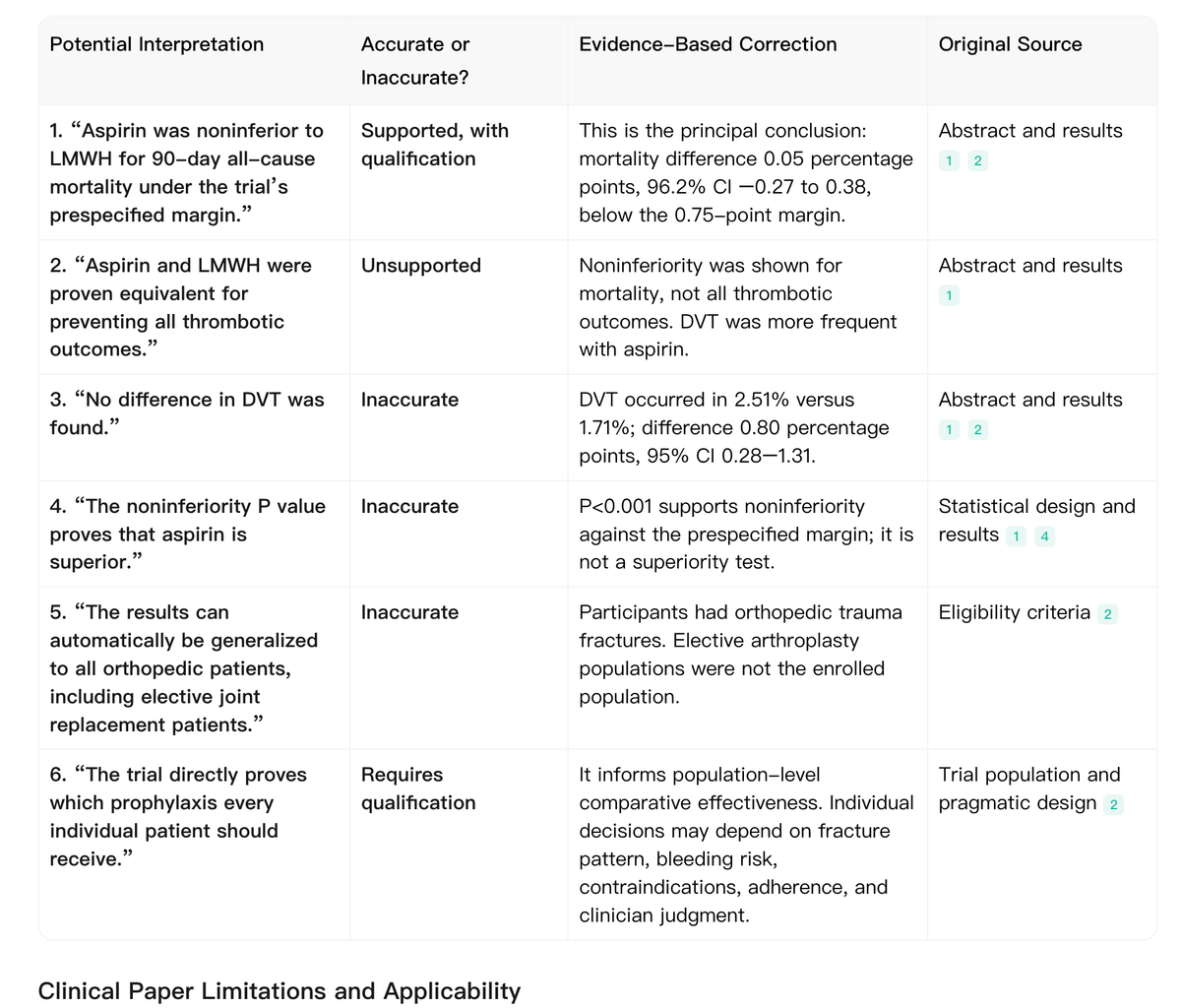
What the observed Noah run demonstrates: The output did not stop at an abstract summary. It explicitly addressed the prespecified noninferiority margin, the unusual 96.2% confidence interval, endpoint-specific differences, and inaccurate conclusions. These screenshots document one task, not a general accuracy guarantee.
What This Case Teaches About AI-Assisted Clinical Reading
- Read the primary endpoint before the abstract conclusion. PREVENT CLOT's primary question concerned death from any cause within 90 days. DVT, PE, and bleeding were secondary outcomes. A phrase such as "aspirin was as effective" can be misleading unless the outcome is named.
- Preserve the statistical question. Noninferiority, superiority, and equivalence use different hypotheses and decision rules. The fact that an interval meets one trial's margin does not automatically answer a different question.
- Separate observed contrasts from definitive inference. The DVT estimate was higher for aspirin. However, the original study did not adjust confidence intervals for the multiplicity of secondary outcomes. A careful reader should describe the observed result and its uncertainty without overstating its inferential status.
- Check what was actually available to the AI. Noah's report described source verification and its limits. It reported access to the original paper and other design sources, but did not claim that every supplementary table had been independently examined. Readers should check that claimed page-level or table-level details match the accessible source.
- Do not generalize to everyone. This pragmatic fracture-trauma population is not identical to elective arthroplasty or every high-risk orthopedic patient population. A paper-specific interpretation cannot substitute for individualized medical judgment.
How to Choose Among OpenRead Alternatives
Choose Explainpaper when the immediate barrier is a difficult sentence or unfamiliar technical idea. Choose Scholarcy when you need a consistent first-pass summary of many readings. Choose SciSpace or ChatPDF when a PDF is already in hand and you want to question a passage while retaining document context.
Consider Noah AI when the deliverable is a research-question-led analysis of a clinical publication, including source checks, endpoint interpretation, and statements that require qualification. The PREVENT CLOT run provides one concrete example of that workflow. None of these choices removes the need to consult the original trial.
Frequently Asked Questions
What is the best OpenRead alternative for reading medical research papers?
It depends on the reading task. SciSpace and ChatPDF focus on document-centered interaction; Explainpaper emphasizes difficult passages; Scholarcy emphasizes structured summaries; Noah AI is relevant for question-driven biomedical trial interpretation and evidence reporting.
Can AI explain noninferiority trials?
Yes, AI can help explain a noninferiority margin, point estimate, confidence interval, and endpoint. Verify the exact numbers and the prespecified analysis against the original publication and statistical plan.
Does noninferior mean two treatments are equivalent?
No. Noninferiority assesses whether a treatment is not worse than a comparator beyond a predefined margin for a specified outcome. Equivalence is a different statistical claim.
Why does PREVENT CLOT report a 96.2% confidence interval?
The original trial used a prespecified statistical procedure accounting for two interim analyses. Its primary mortality difference therefore has a two-sided 96.2% confidence interval, not the usual 95% interval.
Can an AI summary replace reading the original clinical paper?
No. AI can help orient the reader and identify questions to check, but conclusions about clinical efficacy, safety, or statistical significance should be verified in the original article, figures, tables, protocol, and supplement when available.
Were OpenRead, SciSpace, Explainpaper, Scholarcy, and ChatPDF tested on PREVENT CLOT here?
No. This article documents a Noah AI run and describes the other tools using their public product information. It does not report comparative hallucination rates, reading speed, or accuracy rankings.
Final Takeaway
The most useful OpenRead alternative is not necessarily the tool that produces the shortest summary. For clinical papers, a good workflow must keep the research question, original endpoint, uncertainty, and interpretation limits attached to every conclusion.
PREVENT CLOT shows the difference. The trial met a noninferiority threshold for 90-day mortality, while the secondary thrombotic outcomes still required separate scrutiny. In the observed example, Noah AI made these distinctions visible and flagged common interpretation errors. Researchers should apply the same standard when reviewing outputs from any AI paper reader.
Read clinical evidence with its limitations intact
Use Noah AI to investigate a paper, structure its findings, and check which conclusions the original research supports. Free credits are available and no credit card is required to get started.