
Best Paper Digest Alternatives for Medical Literature Summaries (2026)
Linda
Explore the best Paper Digest alternatives for medical literature summaries in 2026. Compare Noah AI, Scholarcy, SciSpace, Elicit, and Consensus.
Compare Noah AI, Scholarcy, SciSpace, Elicit, and Consensus for summarizing medical research papers—without losing the study population, comparator, clinical endpoints, numerical findings, or citations.
Updated: October 20, 2026 · Evidence cutoff: October 20, 2026 · Biomedical AI research workflows
Medical literature summaries are most useful when they make a paper easier to understand without changing what the study found. A brief overview can be misleading if it drops the sample size, combines unlike endpoints, overlooks missing follow-up data, or turns a statistically significant result into an unsupported clinical recommendation.
Paper Digest is a genuine research platform with academic reading, topic-based literature reviews, research digests, and literature matrices. Researchers looking for alternatives may want a different way to read individual papers, organize summaries, extract structured evidence, or connect medical findings back to original publications.
Below we compare five relevant tools by documented workflow and show a direct Noah AI research example summarizing four randomized trials of digital cognitive behavioral therapy for insomnia (dCBT-I). Competitor descriptions come from their official materials, not from a five-tool performance benchmark.
Quick Takeaway
Use Noah AI when a medical summary needs to preserve clinical study design, exact outcomes, and source traceability within a research report. Use Scholarcy for compact, paper-centered summary flashcards. Use SciSpace when reading and interrogating PDF sections is central. Use Elicit for structured evidence research and cited analytical outputs. Use Consensus for rapid literature discovery and study-level snapshots.
These are workflow recommendations, not claims that one tool has been independently proven more accurate than another.
What Is Paper Digest, and Why Look for an Alternative?
Paper Digest offers more than short article digests. Its Academic Reader can summarize papers and answer questions alongside the document. Its Literature Review workflow organizes topic-based research around indexed source documents, and its Literature Matrix provides paper-by-paper extraction supported by source passages.
That makes it a legitimate option for staying current and organizing academic literature. However, a medical researcher may prefer an alternative when the primary deliverable is one of the following:
- A concise summary of an individual clinical trial's population, comparator, primary endpoint, main numerical result, and limitations.
- A standardized overview of several studies in a particular disease or intervention area.
- A source-grounded research report that goes beyond a quick digest.
- An interactive PDF reading environment or structured paper-extraction workspace.
The right choice depends on the output you actually need, not merely whether a platform can generate a summary.
5 Paper Digest Alternatives Worth Considering in 2026
These selections prioritize practical relevance to medical paper reading and summarization rather than an invented universal ranking.
01 Noah AI — for Biomedical Evidence Summaries
Best fit: medical research questions requiring structured, cited evidence summaries
Noah AI Agent can be used to investigate biomedical questions and prepare structured findings across multiple papers. In the direct example below, Noah produced a four-study comparison and a detailed digest of an individual randomized trial, retaining patient counts, intervention details, primary endpoints, quantitative findings, and interpretation limits.
Consider it when: the goal is an evidence-focused medical research brief rather than just a quick reading note. Keep in mind: AI-generated study summaries still require checking against primary sources; a report generated from abstracts is not equivalent to complete full-text verification.
02 Scholarcy — for Paper Summary Flashcards
Best fit: understanding and organizing individual papers
Scholarcy transforms papers and other documents into concise summary flashcards. Its documented workflow surfaces key points, methods, findings, tables, and references, with customizable summary formats and a searchable library.
Consider it when: you already have the papers and want fast, repeatable study-by-study reading notes. For medical use, verify whether each flashcard retains the original endpoint definitions and numerical details.
03 SciSpace — for Interactive PDF Summaries
Best fit: asking questions about specific sections of a research paper
SciSpace Chat with PDF supports section-level summaries, paper-specific questions, and citation-linked answers. SciSpace also provides broader literature-review and data-extraction workflows.
Consider it when: you want to move between the source document and an explanation of methods or results. Check any extracted numbers against the relevant table, figure, or passage in the original PDF.
04 Elicit — for Structured Research and Extraction
Best fit: evidence extraction, research reports, and cross-source analysis
Elicit Research Agent can collect evidence from scientific literature and other relevant data sources, then create cited outputs including reports and tables. This reflects its 2026 Research Agent direction rather than describing the platform only as an older standalone paper-search tool.
Consider it when: you need consistent extraction fields and an auditable body of evidence across several publications. The relevant plan and feature availability should be checked before starting a large project.
05 Consensus — for Quick Study Snapshots
Best fit: finding relevant studies and reviewing key methodological attributes
Consensus Study Snapshot helps researchers see a paper's study details—such as methods, participants, and outcomes—while navigating search results. Other Consensus tools support research-question summaries and evidence exploration.
Consider it when: you need a fast first-pass assessment of which publications merit closer reading. A snapshot is a starting point, not a replacement for examining the full study's endpoints, limitations, and context.
Paper Digest vs Alternatives: Side-by-Side Comparison
This table compares each tool's documented workflow emphasis. It does not imply that untested products lack a feature or that all plans expose identical capabilities.
| Tool | Starting Point | Typical Summary Output | Especially Useful For | Review Before Reuse |
|---|---|---|---|---|
| Paper Digest | Document or research topic | Reader answers, digests, topic reviews, literature matrix | Academic reading and ongoing research discovery | Claim accuracy and original passages |
| Noah AI | Biomedical research question | Structured, cited study digests and synthesis | Clinical study context and evidence interpretation | Source fidelity and clinical claims |
| Scholarcy | Paper, PDF, or imported article | Summary flashcards and extracted key sections | Fast single-paper reading | Missing endpoint or statistical context |
| SciSpace | PDF or literature query | Interactive paper summaries and cited answers | PDF-centered understanding | Passage-level evidence and tables |
| Elicit | Research question and sources | Evidence tables, structured analyses, cited reports | Repeatable evidence extraction | Eligibility and extraction consistency |
| Consensus | Scientific research question | Study snapshots and literature answers | Rapid discovery and paper triage | Primary study methods and applicability |
Basis: publicly documented product workflows, checked October 20, 2026. Only the Noah case presented below was run directly for this article.
What Makes a Medical Literature Summary Reliable?
A useful clinical research summary is not necessarily the shortest one. Five details should survive compression:
- Population and sample: who was enrolled, how many participants were randomized, and what population the result can reasonably inform.
- Intervention and comparator: for example, whether a digital treatment was compared with patient education, sleep hygiene advice, or a wait-list.
- Primary endpoint and timepoint: insomnia severity at nine weeks is not the same outcome as sleep-related quality of life at 24 weeks.
- Effect and uncertainty: exact scales, between-group differences, confidence intervals, and significance where available.
- Limitations and source: missing follow-up data, selection biases, access to full text, and a verifiable PMID or DOI.
To illustrate these principles, we asked Noah AI to summarize four original randomized studies of digital cognitive behavioral therapy for insomnia (dCBT-I). This is a focused illustration of summarization—not a systematic review of every dCBT-I trial.
Real Noah AI Example: Four Clinical Studies of Digital CBT-I
Directly tested in Noah AI · October 20, 2026
Research question: What do randomized controlled trials report about digital CBT-I in adults, and how can their designs, measured outcomes, quantitative findings, limitations, and sources be summarized accurately?
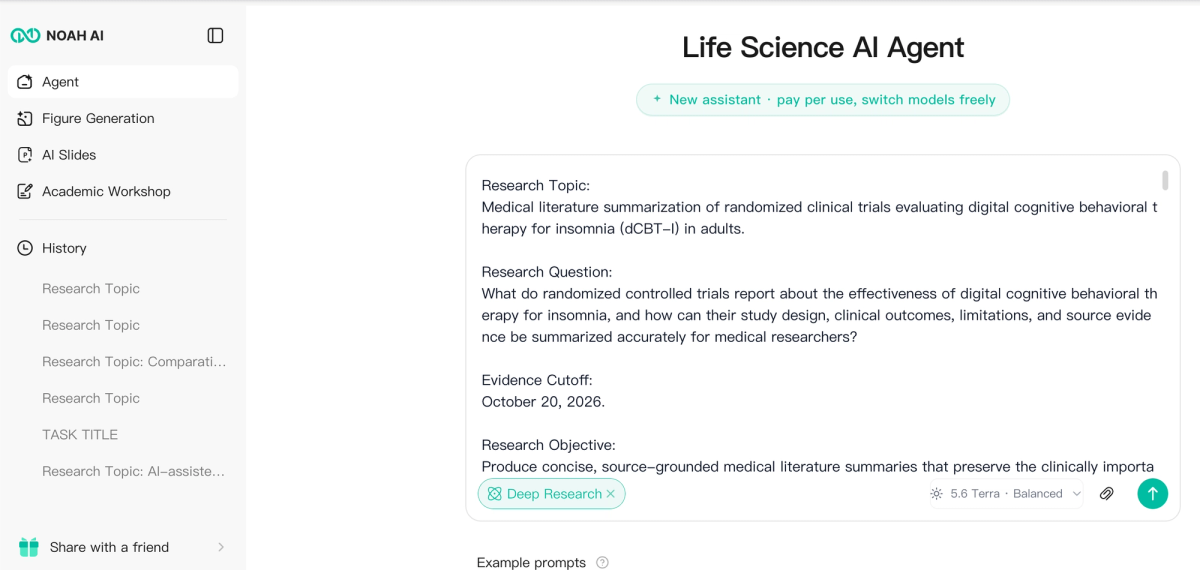
The prompt specified four original studies and requested both short paper-level summaries and a detailed digest of one trial. The visible interface used Agent · Deep Research with 5.6 Terra · Balanced selected. The screenshots below are from the actual Noah run.
Output 1: Structured Summaries of Four Randomized Trials
Noah organized the selected studies into a table with the study name, patient population, design and comparator, main findings, and PMID. That makes it easier to see which result came from which study without treating the four trials as interchangeable.
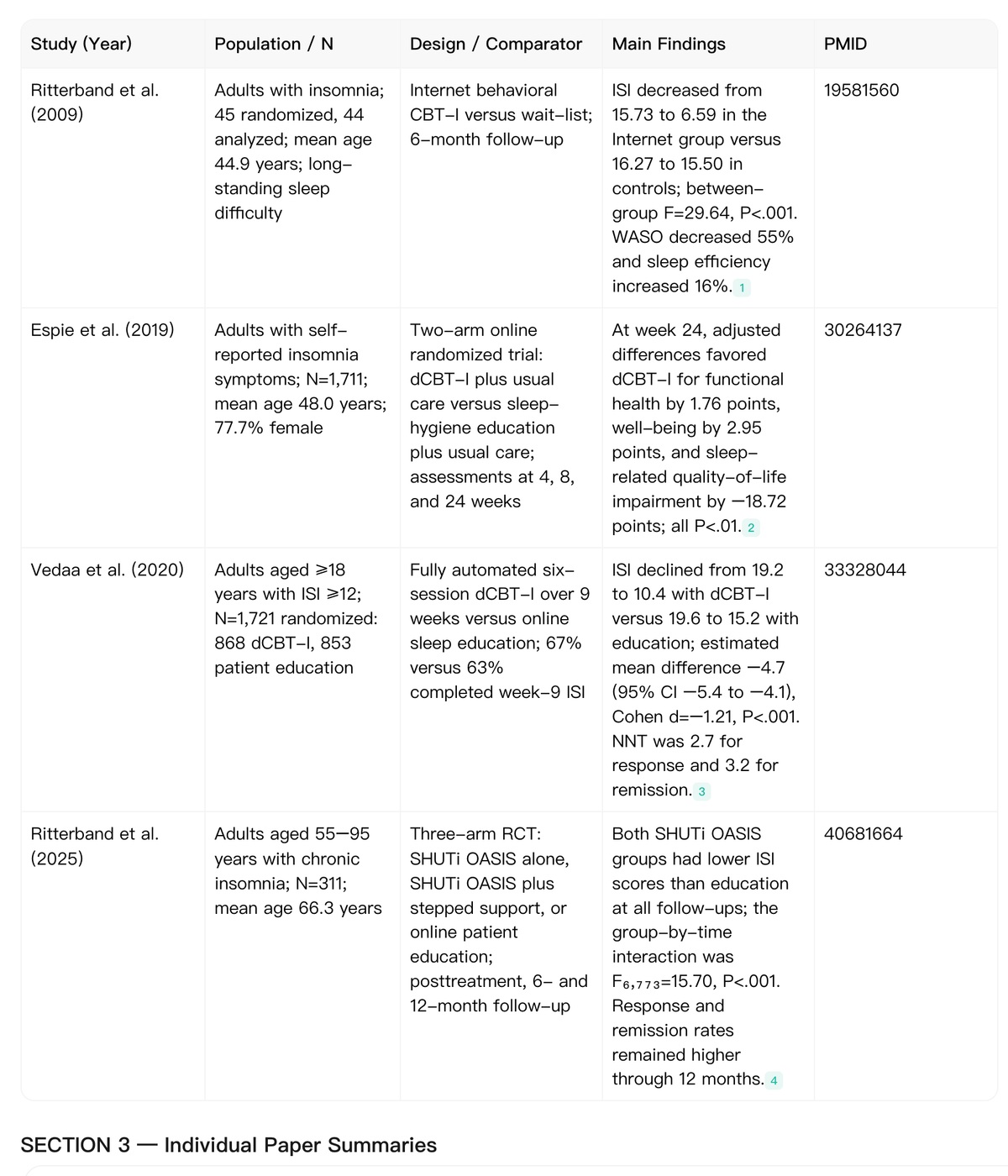
The four selected studies illustrate different summarization needs:
- Ritterband et al. (2009) — early Internet CBT-I trial — Forty-five adults were randomized, with 44 included in the analysis. The insomnia severity score improved from 15.73 to 6.59 in the intervention group, versus 16.27 to 15.50 in the wait-list group. The small sample and wait-list comparator matter when interpreting the finding. PMID 19581560.
- Espie et al. (2019) — daytime and quality-of-life outcomes — Among 1,711 participants, the trial assessed functional health, psychological well-being, and sleep-related quality of life. At week 24, the adjusted difference for sleep-related quality-of-life impairment favored digital CBT-I by 18.72 points on its reported scale. This should not be relabeled as a remission rate. PMID 30264137.
- Vedaa et al. (2020) — insomnia severity and missing follow-up — Of 1,721 randomized participants, digital CBT-I led to a larger reduction in nine-week Insomnia Severity Index scores than online sleep education: an estimated between-group difference of −4.7 points (95% CI −5.4 to −4.1). Follow-up ISI data were available for 67% and 63% of participants in the respective groups. PMID 33328044.
- Ritterband et al. (2025) — older adults and longer follow-up — In 311 adults aged 55–95 years, both SHUTi OASIS intervention groups showed greater improvement in insomnia severity than online education across posttreatment, six-month, and 12-month follow-up. These data specifically inform the studied older-adult population. PMID 40681664.
Output 2: A Detailed Digest of One Medical Paper
For the Vedaa et al. (2020) trial, Noah produced a focused digest with labeled sections covering the research question, design, population, intervention and comparator, primary endpoint, quantitative result, interpretation, and limitations.
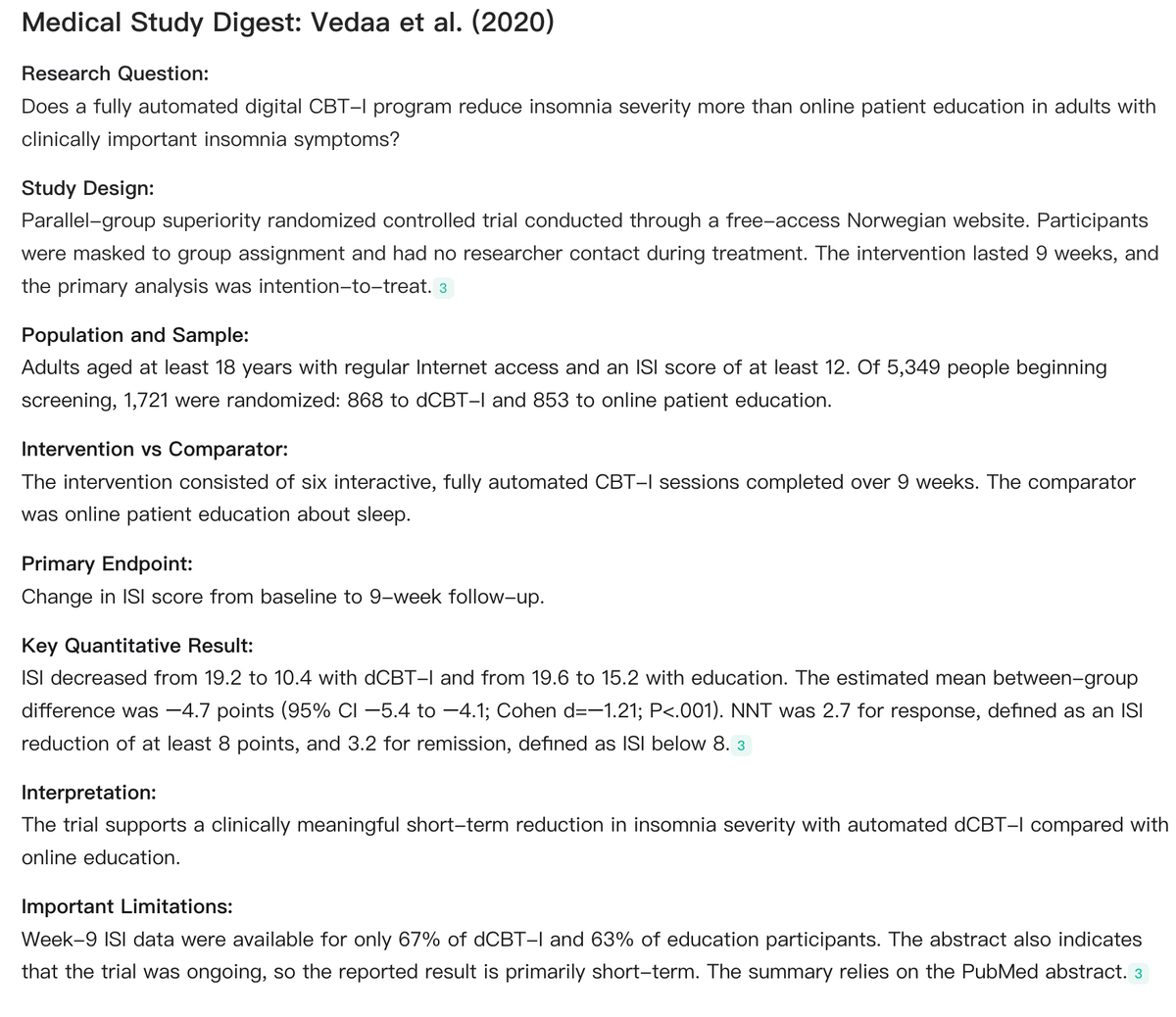
The practical benefit of this format is that it preserves context around the headline finding. The Vedaa trial's estimated −4.7-point between-group ISI difference is useful, but the summary also identifies the nine-week endpoint, the patient education comparator, and incomplete follow-up reporting. These details affect how researchers interpret and reuse the result.
Likewise, the Espie study emphasizes daytime health and sleep-related quality of life, whereas the Vedaa study's primary analysis evaluates insomnia severity. A summary that collapses both into a single undifferentiated claim of "better sleep" would conceal a clinically important difference.
Verification boundary: In the Noah report, Vedaa et al. (2020) was summarized primarily using its PubMed abstract; not all full-text details were independently checked. The screenshots demonstrate the output structure and the results of this one run, not a measured accuracy advantage over Paper Digest or other tools.
Medical Summary Accuracy Checklist
| Information to Retain | Why It Changes Interpretation | Example From This Case |
|---|---|---|
| Eligibility | Defines who the evidence applies to | Ritterband 2025 enrolled adults aged 55–95. |
| Comparator | Wait-list and active education controls answer different questions | Ritterband 2009 used a wait-list; Vedaa 2020 used patient education. |
| Primary endpoint | Prevents swapping quality-of-life and symptom claims | Vedaa measured nine-week ISI change; Espie emphasized daytime outcomes. |
| Numerical precision | Maintains scale and statistical context | Vedaa: −4.7 ISI points, 95% CI −5.4 to −4.1. |
| Missing data | Signals uncertainty about follow-up estimates | Vedaa: 67% versus 63% provided week-nine ISI data. |
These checks reflect the actual issues in the case. They are better criteria for a useful medical digest than simply counting how many paragraphs an AI system generates.
Turn Clinical Papers into Reviewable Medical Summaries
Start with a biomedical question and use Noah AI to organize study design, outcomes, numerical findings, and source references into a structured research brief.
Free Credits Available · No Credit Card Required. Research use may exceed free-credit limits.
How to Choose the Right Paper Digest Alternative
Choose based on the work that follows the first summary. For routine reading of individual PDFs, Scholarcy or SciSpace may be convenient starting points. For fast academic search and screening, Consensus is worth considering. For extraction-heavy evidence work, Elicit offers dedicated research-agent workflows. For a biomedical question requiring structured, cited interpretation, Noah AI is a relevant option to evaluate.
Paper Digest should remain on the shortlist when its academic reader, frequent digests, topic reviews, or source-backed literature matrix align with the task. None of these tools should be treated as an automatic substitute for critical appraisal, especially when a clinical claim depends on precise endpoint definitions or missing data.
Final Takeaway
The best Paper Digest alternative for medical literature summaries depends on whether the priority is rapid paper reading, study snapshots, interactive PDF questions, structured extraction, or a biomedical evidence brief.
Our direct Noah AI example shows one practical approach: use a focused medical question to generate both a multi-study summary and a detailed paper digest that keeps population, comparator, outcomes, citations, and uncertainty visible. That is the standard researchers should apply when assessing any AI paper summarizer—regardless of its brand.
Explore Source-Grounded Biomedical Summaries with Noah AI
Test a question from your own research area and check the generated digest against the original clinical publications.
Start Researching with Noah AI →
Free Credits Available · No Credit Card Required.
FAQ: Paper Digest Alternatives for Medical Research
What is the best Paper Digest alternative for medical research?
There is no universally best tool. Noah AI is relevant for biomedical evidence summaries; Scholarcy suits paper-centered reading notes; SciSpace supports PDF questioning; Elicit supports structured research; and Consensus helps with study discovery and snapshots. Choose according to the required output and available plan.
Can AI summarize a clinical research paper accurately?
AI can assist, but accuracy must be checked. At minimum, verify the population, randomized sample, intervention and comparator, primary endpoint, numerical results, follow-up, and limitations against the original source.
Does Paper Digest only produce short summaries?
No. Paper Digest's official products include Academic Reader, topic-based Literature Review, and a Literature Matrix in addition to digest services.
What is the difference between a medical paper summary and a literature review?
A paper summary describes an individual study. A literature review selects, connects, and interprets multiple studies. Neither automatically qualifies as a systematic review without a documented reproducible methodology.
Why are citations important in medical literature summaries?
A traceable PMID, DOI, or publication link lets the reader confirm whether a summary accurately represents its study and whether results are primary, secondary, statistically significant, or limited to a particular population.
Can AI compare outcomes across medical studies?
It can organize differences and common themes, but direct comparisons require caution. Different populations, endpoints, controls, timepoints, and study designs can make numerical results non-interchangeable. Automated summaries are not pooled clinical effect estimates.
Research and medical disclaimer: This article concerns research-reading workflows, not diagnosis or treatment. The Noah case is a focused summary of four specified randomized studies, not an exhaustive systematic review or meta-analysis. Source links lead to the original PubMed records. Clinical data and AI outputs require human verification before scientific or clinical use.
Comparison methodology: Noah AI was tested directly using the case shown in Figures 1–3. Paper Digest, Scholarcy, SciSpace, Elicit, and Consensus were reviewed from their public product documentation rather than run in a controlled head-to-head benchmark. Product features and access limits may change after the evidence cutoff.