
Best Paperguide Alternatives for Biomedical Literature Synthesis (2026)
Linda
Compare 6 Paperguide alternatives for biomedical literature synthesis in 2026. Explore Noah AI's clinical evidence tables, research synthesis, and free credits.
Compare six AI research tools for biomedical literature synthesis, clinical evidence extraction, and source-grounded reviews—with a real Noah AI example.
Noah AI · Free Credits Available · No Credit Card Required
Paperguide is a capable AI research platform. It combines literature search, reference management, AI-assisted data extraction, research agents, and systematic-review workflows.
But researchers looking for Paperguide alternatives may have different priorities.
Some need a dedicated screening platform. Others want to investigate individual PDFs, examine how scientific findings are cited, or turn a focused biomedical question into a structured evidence synthesis.
For medical and life-science researchers, the distinction is especially important.
A literature synthesis should not simply collect article summaries. It must preserve differences in study populations, treatment strategies, primary endpoints, statistical methods, and the strength of the available evidence.
In this guide, we compare six Paperguide alternatives and demonstrate how Noah AI handled a real biomedical synthesis task involving randomized trials of antibiotic treatment duration for Gram-negative bloodstream infections.
The example shows how Noah organized clinical trials, compared their findings, identified uncertainty, and highlighted an important correction in the published literature.
Testing disclosure: We tested Noah AI directly using its Agent and Deep Research workflow. Other tools are discussed based on their official product documentation and published workflows. This article does not claim that all six tools were tested under identical conditions.
Evidence cutoff for the Noah AI demonstration: October 13, 2026.
Quick Answer: What Are the Best Paperguide Alternatives?
The best Paperguide alternative depends on which part of the literature-review process matters most.
For researchers focused on biomedical evidence comparison and synthesis, Noah AI is a useful option to evaluate. Elicit and SciSpace offer substantial research and extraction workflows, while Consensus, Scite, and Rayyan address other important stages of scientific evidence review.
| AI Tool | Best-Fitting Use Case | Key Consideration |
|---|---|---|
| Noah AI | Biomedical evidence comparison and research synthesis. | Structured medical research outputs; free credits available. |
| Elicit | Paper discovery, structured extraction, and systematic-review workflows. | Useful for predefined extraction and screening processes. |
| SciSpace | Literature discovery, PDF analysis, and paper comparison. | Dedicated literature and document-reading workspace. |
| Consensus | Research-question-based evidence search and deep review. | Useful for exploring scientific agreement and disagreement. |
| Scite | Citation-context analysis and checking contested claims. | Shows supporting, contrasting, and mentioning citations. |
| Rayyan | Systematic-review screening, organization, and collaboration. | Useful for managing review decisions and research teams. |
This is a workflow-based comparison, not a ranking based on measured accuracy, speed, or literature coverage.
What Does Paperguide Already Do?
Paperguide is an AI-native academic research platform supporting literature discovery, reference management, research agents, data extraction, and writing.
Its systematic-review product also includes protocol development, title and abstract screening, full-text screening, structured extraction, and PRISMA reporting.
Researchers can define extraction fields, review AI-extracted values against citations, confirm the data, and use the confirmed material to generate a synthesis.
That makes Paperguide a substantial evidence-review platform rather than merely a PDF summarizer.
A researcher might still evaluate alternatives because they prefer a different user interface, need a particular research workflow, want to compare specialist tools, or wish to explore a biomedical Agent without committing to a paid subscription.
The central question is therefore not whether Paperguide can perform literature synthesis. It can.
The better question is which platform fits the specific kind of biomedical evidence work you need to produce.
What Makes a Good Biomedical Literature Synthesis Tool?
Medical literature synthesis places particular demands on AI-generated research outputs.
Consider a set of randomized clinical trials studying the same broad treatment strategy.
Different trials may enroll different populations, use different endpoints, apply different statistical margins, and report results over different follow-up periods.
A useful tool should help researchers preserve those differences instead of hiding them in a generalized conclusion.
| Review Capability | What Researchers Should Look For |
|---|---|
| Relevant evidence retrieval | Identification of original research and appropriate secondary evidence. |
| Structured extraction | Consistent fields for population, design, endpoints, results, and limitations. |
| Cross-study comparison | Recognition of differences between trial designs and outcome definitions. |
| Evidence synthesis | A conclusion supported by several studies, not just separate summaries. |
| Source traceability | Claims and numerical findings that can be checked against original publications. |
| Uncertainty handling | Explicit limitations, missing information, and boundaries of applicability. |
These criteria are particularly important when the review involves clinical outcomes, noninferiority trials, treatment comparisons, or potentially conflicting statistical interpretations.
1. Noah AI — For Biomedical Evidence Comparison and Synthesis
Noah AI is a research Agent focused on medical, pharmaceutical, and life-science workflows.
Researchers can describe a biomedical question, specify the evidence they need, and request structured outputs such as clinical comparison tables, source-grounded analyses, and research summaries.
In our direct test, Noah generated two particularly useful outputs:
- Structured Trial Evidence Matrix: A common comparison of four randomized trials, including their populations, treatment strategies, primary endpoints, results, and limitations.
- Final Evidence Synthesis Matrix: An outcome-based summary showing what the evidence supports, what remains uncertain, and which studies support the interpretation.
Rather than describing Noah as a fully automated systematic-review system, the following example shows the specific research-assistance workflow we actually tested.
Real Noah AI Test: 7 vs 14 Days of Antibiotics for Gram-Negative Bloodstream Infection
We selected an evidence question involving antibiotic treatment duration because it requires more than summarizing whether one treatment strategy produced favorable results.
The relevant studies use different populations, clinical eligibility criteria, endpoints, and noninferiority margins.
Our research question was:
In adults with Gram-negative bloodstream infections, how do 7-day and 14-day antibiotic treatment strategies compare in mortality, clinical failure, infection recurrence, and safety?
The objective was to produce an AI-assisted biomedical evidence synthesis using original randomized trials and a published systematic review as contextual evidence.
It was not a request for individual treatment advice or a new statistical meta-analysis.
Step 1 — Begin with a Focused Medical Research Question
We entered the research topic into Noah AI Agent using Deep Research and the 5.6 Terra · Balanced model.
The task specified the research question, evidence cutoff, relevant primary trials, key outcome measures, and rules for distinguishing verified results from missing information.
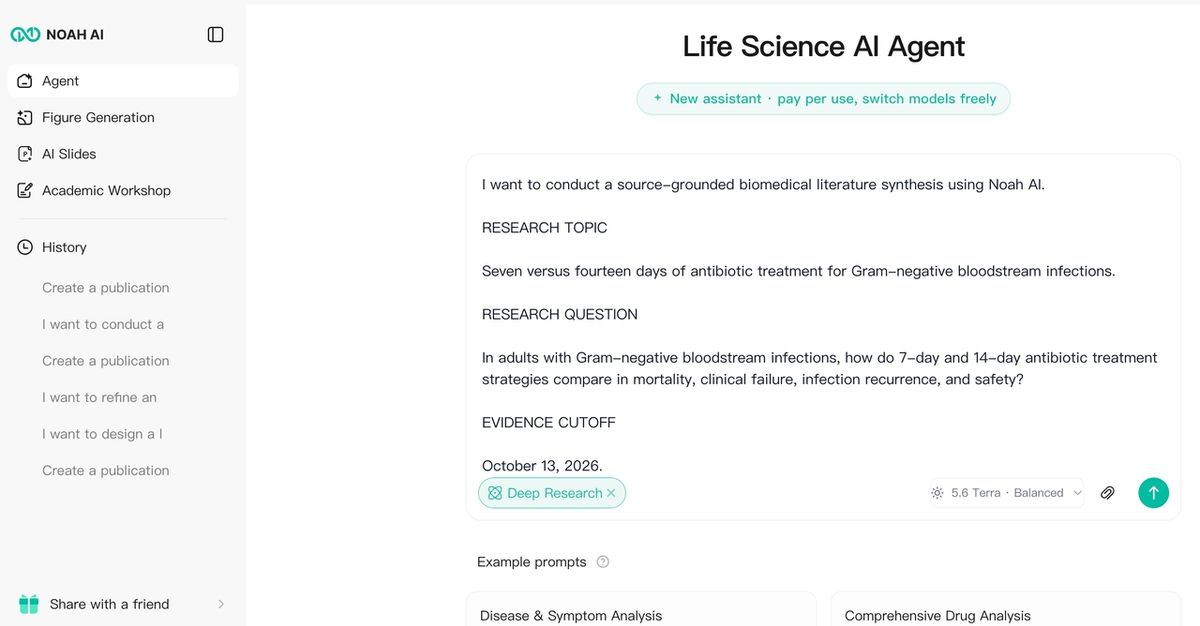
The prompt asked Noah to compare the trial evidence while preserving differences between noninferiority and superiority, overall trial populations and subgroups, and original trial findings and secondary meta-analyses.
These requirements were important because the research question concerns whether a shorter treatment strategy meets the studies' prespecified noninferiority criteria—not whether shorter treatment is universally superior.
Step 2 — Extract Evidence Across Four Randomized Clinical Trials
Noah generated a structured comparison of four randomized studies:
- Yahav 2019: Seven versus fourteen days in clinically stable adults with uncomplicated Gram-negative bacteremia.
- von Dach 2020: Fixed treatment durations and a separate CRP-guided strategy for uncomplicated Gram-negative bacteremia.
- Molina/SHORTEN 2022: Shorter versus longer antibiotic exposure in source-controlled Enterobacterales bloodstream infections.
- BALANCE 2024: A larger randomized trial involving hospitalized adults with bacterial bloodstream infections, with a relevant Gram-negative subgroup.
These studies are related, but they do not all use the same primary endpoint.
The Noah output made this easier to inspect by placing population, comparison, primary endpoint, main result, and key limitation into consistent columns.
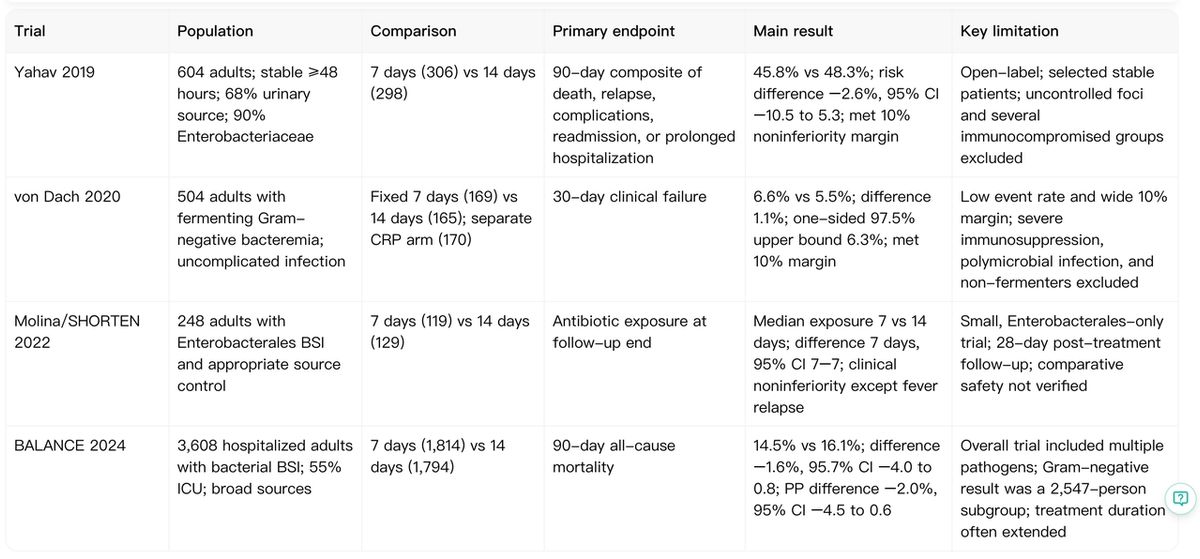
The table reveals why comparing these trials requires methodological care.
For example, Yahav 2019 primarily evaluated a 90-day composite endpoint covering mortality, relapse, complications, readmission, and prolonged hospitalization.
Von Dach 2020 evaluated 30-day clinical failure. SHORTEN prioritized antibiotic exposure, while BALANCE used 90-day all-cause mortality as its primary endpoint.
These endpoints are not interchangeable.
In addition, the BALANCE trial randomized 3,608 participants with bacterial bloodstream infections overall. Its Gram-negative population used in the 2025 meta-analysis was a subgroup, not the entire trial population.
A scientifically useful synthesis must preserve that distinction.
What Noah Demonstrated
Noah organized different clinical trials into one comparison framework while preserving important differences in population, endpoint selection, study results, and limitations.
This is more useful for a medical research workflow than a series of paper-by-paper summaries that never explains whether the studies can be compared directly.
Step 3 — Move from Individual Trial Results to Evidence Synthesis
A clinical evidence table is only the beginning of a literature synthesis.
The next step is to understand what the trials collectively support and which conclusions remain limited by differences in study design, population, and outcome reporting.
Noah generated an outcome-level synthesis organized around mortality, clinical failure, infection recurrence, safety, and applicability.
Each outcome included a summary of the available evidence, a description of the main uncertainty, and relevant source studies.
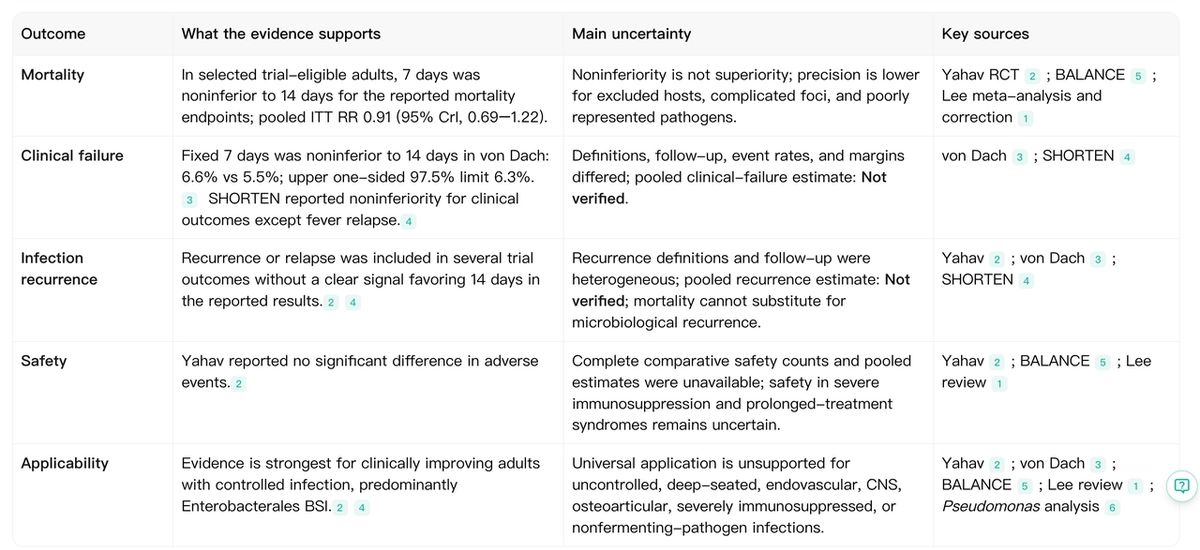
The synthesis separated the noninferiority evidence for mortality from less completely verified evidence concerning recurrence and safety.
It also identified an important applicability boundary: the strongest randomized evidence applies to patients resembling the trial populations, particularly those showing clinical improvement with an adequately controlled infection source.
The evidence should not be treated as a universal treatment-duration rule for complicated infections, uncontrolled infection sources, severe immunosuppression, or poorly represented pathogens.
These qualifications are essential to an evidence-grounded biomedical synthesis.
Step 4 — Identify a Published Correction Before Repeating the Numbers
One particularly useful result from our Noah test concerned a published correction.
The 2025 systematic review and noninferiority meta-analysis by Lee and colleagues included four randomized trials involving 3,729 participants in the intention-to-treat analysis.
The original article mistakenly reported the 90-day mortality percentage in the seven-day group as 12.8%.
An official correction published on April 24, 2025, changed that percentage to 12.0%.
Noah's generated report recognized the correction and used the corrected comparison.
| Evidence Detail | Correct Interpretation |
|---|---|
| Originally reported percentage | 12.8% in the seven-day group — subsequently corrected. |
| Corrected percentage | 12.0% in the seven-day group. |
| Pooled ITT effect | RR 0.91; 95% Bayesian credible interval 0.69–1.22. |
| Noninferiority interpretation | 97.8% posterior probability of noninferiority using the prespecified RR threshold of 1.25. |
| Superiority | Not established by the reported credible interval. |
The important point is not merely that one number was corrected.
The case demonstrates why researchers need to consider corrections, source dates, statistical intervals, and the distinction between noninferiority and superiority.
The corrected results can be checked in the published JAMA Network Open analysis.
Recognition of this correction in one Noah output does not guarantee that an AI system will identify every correction or extraction error. Researchers must still verify important numerical claims.
What This Noah AI Test Actually Demonstrated
The real test demonstrated an evidence-oriented workflow involving:
- Study-level comparison: Four randomized trials aligned under common extraction fields.
- Methodological interpretation: Differences in populations, endpoints, noninferiority margins, and trial eligibility identified.
- Evidence synthesis: Findings reorganized by clinical outcome rather than publication order.
- Uncertainty reporting: Missing pooled estimates and clinical applicability limits explicitly identified.
- Source correction awareness: The reported 2025 mortality correction incorporated into the analysis.
These results show the potential value of using a biomedical-focused research Agent to move from individual clinical papers toward a structured synthesis draft.
They do not establish that Noah has independently validated every finding, completed an auditable systematic review, or produced a new meta-analysis.
Turn Biomedical Papers into Structured Evidence with Noah AI
Explore medical literature, compare clinical studies, and develop evidence-informed synthesis drafts with Noah AI.
Try Noah AI for free. Free credits available. No credit card required.
Free credits are usage-limited. Credit availability and task costs depend on the current plan.
2. Elicit — For Structured Literature Extraction and Review Workflows
Elicit supports AI-assisted academic research, structured paper analysis, and systematic-review workflows.
Its Research Agent can help researchers explore literature and work with paper information. Its dedicated Systematic Review workflow supports processes such as gathering studies, screening, extracting data, and preparing a review report.
Elicit is a relevant alternative when a researcher wants to define extraction fields and systematically compare information from multiple publications.
The main consideration is methodological verification. Extracted outcomes, denominators, analysis populations, and statistical results must be checked against the original publications.
Best fit: Researchers conducting structured literature extraction or controlled review workflows.
3. SciSpace — For Literature Search and Full-Paper Investigation
SciSpace provides a research workspace for literature search, paper comparison, and PDF analysis.
Its Literature Review interface supports natural-language searches, paper listings, filters, AI-generated insights, and customizable comparison columns.
SciSpace also provides deeper review workflows and a dedicated Chat with PDF experience.
These capabilities are valuable when researchers need to examine individual studies before building a cross-paper synthesis.
SciSpace can also support evidence comparison, so it should not be described as only a paper-search tool.
Best fit: Researchers who prefer a paper-centered interface for reading, investigating, and organizing academic sources.
4. Consensus — For Research-Question-Based Evidence Exploration
Consensus is an academic evidence-search platform supporting natural-language research questions and deeper literature analysis.
Its Deep Review workflow can break a research question into targeted searches, investigate relevant publications, and organize the results into a structured synthesis.
Consensus can be useful when a researcher needs an initial overview of what the scientific literature supports, what remains contested, and which papers are especially relevant.
As with any AI-generated literature review, the researcher must inspect the original source material before adopting specific scientific or clinical conclusions.
Best fit: Research-question-driven literature exploration and identifying areas of scientific agreement or uncertainty.
5. Scite — For Citation Context and Scientific Claim Checking
Scite approaches scientific literature through citation context.
Its Smart Citations classify citing statements as supporting, contrasting, or mentioning previous research.
This can help researchers investigate how findings have been discussed in later publications and whether important claims are contested.
For biomedical synthesis, that capability can complement study-level evidence extraction by showing how a key result has been interpreted or challenged.
However, citation classifications should not be treated as an automated risk-of-bias assessment or a definitive measure of whether a clinical claim is true.
Best fit: Citation-context investigation, scientific claim checking, and exploring conflicting literature.
6. Rayyan — For Systematic Review Screening and Collaboration
Rayyan focuses on workflows for reviewing, organizing, screening, and synthesizing research references.
It supports systematic-review activities such as duplicate management, screening decisions, eligibility criteria, collaboration, and extraction.
Rayyan may be particularly relevant when a project involves several reviewers who must apply consistent inclusion and exclusion criteria.
Its strengths are different from using a research Agent to draft a focused narrative medical evidence synthesis.
Best fit: Teams managing screening and review decisions across a larger literature set.
Which Paperguide Alternative Should You Choose?
Different evidence-review tasks benefit from different tools.
| Your Main Research Task | Tool to Consider |
|---|---|
| Compare medical trials and synthesize clinical outcomes. | Noah AI |
| Run structured evidence extraction or systematic review workflows. | Elicit |
| Search, read, and compare individual academic papers. | SciSpace |
| Investigate a scientific question across many publications. | Consensus |
| Investigate how later studies discuss or challenge an important finding. | Scite |
| Manage screening and review collaboration. | Rayyan |
Paperguide may remain appropriate when a researcher wants integrated reference management, extraction, formal screening stages, and systematic-review reporting within one platform.
Noah AI is worth evaluating when the immediate goal is to turn a focused biomedical question into a structured comparison and a reviewable evidence synthesis.
Can You Try Noah AI for Free?
Yes. Noah AI offers a free Basic plan with signup credits, allowing new users to explore its research Agent without an upfront payment.
No credit card is required to get started.
Free credits provide a way to explore the product before deciding whether a paid plan is appropriate.
The available balance and cost of a specific research task depend on the current credit and plan rules. Free credits should not be interpreted as unlimited access to Deep Research.
Researchers can check current credits and subscription options on the Noah AI pricing page.
Biomedical Literature Synthesis Quality Checklist
Before using any AI-generated synthesis in an academic, medical, or regulatory context, verify the details that determine the scientific interpretation.
- Study identity: Check title, publication year, DOI, PMID, and the original study design.
- Population: Confirm who was included, excluded, randomized, and analyzed.
- Endpoint: Verify whether the reported outcome was primary, secondary, exploratory, or subgroup-based.
- Statistical framework: Distinguish superiority, noninferiority, equivalence, and descriptive findings.
- Effect estimate: Confirm event counts, denominators, effect size, and confidence or credible intervals.
- Corrections: Check errata, corrected analyses, and updated publications.
- Missing data: Label unavailable results as not verified instead of estimating unsupported values.
- Double counting: Do not count a trial and a meta-analysis containing that trial as independent studies.
- Applicability: Preserve the trial population and avoid extending findings to unrepresented patient groups.
- Source traceability: Ensure each important claim can be checked against the original evidence.
These checks are especially important when the analysis will influence scientific writing, evidence assessment, or clinical research decisions.
What AI Literature Synthesis Tools Cannot Guarantee
AI research tools can make evidence organization more efficient, but their output should not be assumed to be scientifically correct merely because it includes citations.
An AI-generated narrative synthesis is not automatically a completed systematic review.
A formal systematic review requires a transparent and reproducible search strategy, predefined eligibility criteria, documented screening, assessment of study quality or risk of bias, and an appropriate synthesis methodology.
Likewise, an AI-generated comparison table does not establish that every extracted result is correct or that different studies can be combined statistically.
The value of AI assistance lies in helping researchers organize and inspect evidence while retaining human responsibility for verification and interpretation.
Frequently Asked Questions
What Are the Best Paperguide Alternatives for Biomedical Literature Synthesis?
Noah AI, Elicit, SciSpace, Consensus, Scite, and Rayyan are all relevant options, but they serve different research needs. Noah AI is especially worth considering for structured biomedical evidence comparison and synthesis drafts, while other tools may better fit screening, PDF analysis, or citation-context investigation.
Is Noah AI a Good Alternative to Paperguide?
Noah AI is a relevant alternative for researchers who want to investigate medical research questions, organize clinical evidence, and produce a reviewable synthesis. Paperguide also offers substantial extraction and systematic-review capabilities, so the best choice depends on the workflow.
Can Noah AI Compare Multiple Clinical Studies?
Yes. In our tested example, Noah generated a structured comparison of four randomized trials covering population, treatment comparison, primary endpoint, main results, and limitations. Researchers must still verify extracted details against the original publications.
Can Noah AI Generate a Biomedical Evidence Synthesis?
In our direct test, Noah generated an outcome-based synthesis covering mortality, clinical failure, recurrence, safety, and applicability. The result was an AI-assisted synthesis draft, not a newly conducted statistical meta-analysis.
Does Paperguide Support Systematic Reviews?
Yes. Paperguide provides structured systematic-review workflows including protocol definition, screening, extraction, verification, and PRISMA reporting. It should not be described as a PDF-only summarization tool.
Which Tool Is Best for Systematic Review Screening?
Rayyan, Elicit, and Paperguide all provide review-related screening workflows with different features and controls. Researchers should choose according to their review methodology, collaboration requirements, verification needs, and available plan.
Is Noah AI Free to Use?
Noah AI offers free signup credits through its Basic plan, and a credit card is not required to get started. Usage is subject to the available credit balance and the cost of the selected research tasks.
Can AI Replace a Researcher in Biomedical Literature Synthesis?
No. AI can help retrieve, organize, compare, and summarize evidence, but researchers must verify original sources, check methods and statistics, and evaluate whether conclusions are scientifically justified.
Related Reading
Explore related Noah AI guides on medical literature synthesis and research evidence.
- How to Conduct a Medical Literature Review with AI: Step-by-Step Guide
- How to Create an Evidence Table for a Literature Review with AI
- How to Compare Multiple Research Papers in a Literature Review with AI
- Best AI Tools for Medical Literature Review and Evidence Synthesis (2026)
Final Takeaway: Choosing the Right Paperguide Alternative
The best AI literature synthesis tool is not necessarily the one that retrieves the greatest number of papers or generates the longest report.
For biomedical research, useful evidence synthesis requires consistent extraction, careful interpretation of study differences, accurate citation handling, and explicit recognition of uncertainty.
Paperguide remains a capable platform for integrated academic research and systematic-review workflows.
Elicit, SciSpace, Consensus, Scite, and Rayyan offer alternative approaches to literature discovery, extraction, evidence analysis, and screening.
Noah AI is especially worth evaluating when the main deliverable is a structured biomedical evidence comparison and synthesis draft.
In our real test, Noah compared four randomized clinical trials, separated different endpoint definitions, organized outcome-level evidence, identified applicability limits, and incorporated a published numerical correction.
The example demonstrates how a focused medical research question can be transformed into a more organized and reviewable evidence set.
Researchers should still verify the original literature and retain responsibility for all final conclusions.
For those exploring medical research workflows, Noah AI offers a way to start without an upfront payment: free credits are available and no credit card is required.
Start Your Biomedical Literature Synthesis with Noah AI
Compare clinical evidence, organize research findings, and create structured biomedical literature synthesis drafts with Noah AI.
Free Credits Available · No Credit Card Required