
Best Petal Alternatives for Biomedical Study Comparison (2026)
Linda
Comparing medical papers takes more than extracting summaries. Here are five alternatives to Petal for structured study comparison, evidence synthesis, and citation verification, plus a real Noah AI case involving four randomized stroke trials.
Comparing medical papers takes more than extracting summaries. Here are five alternatives to Petal for structured study comparison, evidence synthesis, and citation verification, plus a real Noah AI case involving four randomized stroke trials.
Evidence and product-information cutoff: October 19, 2026 · Review type: workflow comparison · No cross-platform accuracy benchmark
Petal helps researchers organize academic papers and query multiple documents. Its AI Table feature is directly relevant to comparing studies: researchers can look across papers for reported outcomes, methods, and limitations. But the best Petal alternative depends on the part of the biomedical research workflow that matters most: extracting fields from PDFs, exploring a research question, assessing study-level evidence, or checking how results have been cited.
This guide compares Noah AI, Elicit, SciSpace, Consensus, and Scite by their documented workflows. We also include a directly run Noah AI example on four landmark randomized trials of dual antiplatelet therapy after minor ischemic stroke or high-risk transient ischemic attack (TIA). The competitor descriptions come from official product documentation, not from a controlled head-to-head test.
Quick Takeaway
Choose Noah AI if your starting point is a biomedical question and you want a structured, source-traceable comparison of clinical evidence with explicit interpretation limits.
Choose Elicit or SciSpace if you need configurable extraction across a paper set. Elicit also offers a dedicated systematic-review process; SciSpace emphasizes extraction and comparison from research PDFs.
Choose Consensus for paper discovery and rapid study snapshots, or Scite to examine supporting, contrasting, and mentioning citation contexts.
Stay with Petal if its document library, multi-document questions, and AI Table already match your PDF-centered research workflow.
What Is Petal, and When Do You Need an Alternative?
Petal is a research-document and reference-management environment with AI-supported reading and cross-document analysis. Its AI Table is designed to compare information found inside multiple papers, including measurements, influencing factors, and potential weaknesses. It would be inaccurate to say that Petal only summarizes one PDF at a time.
The reason to consider alternatives is instead workflow fit. A medical evidence reviewer may need a dedicated screening record, paper-to-paper extraction fields, original-trial endpoint checks, or citation-context analysis. Those needs are not interchangeable.
Is Petal Free in 2026?
According to Petal's published pricing, the Free plan has a $0 entry price, 1 GB of storage, and 400 non-replenishing AI credits. Its AI Table and multi-document chat are listed as seven-day trials on the Free tier. Availability, credit consumption, and paid-plan pricing can change, so check the live pricing page before relying on a specific allowance. A trial feature is not the same as unlimited free access.
Five Petal Alternatives for Biomedical Study Comparison
1. Noah AI — For Biomedical Evidence Research and Cross-Trial Synthesis
Best fit: focused medical research questions, trial-level comparison, cited evidence briefs
Noah AI Agent can be used to move from a focused biomedical research question to a structured research report. In the direct test shown later in this article, its Deep Research workflow produced a Clinical Trial Design Comparison and an Efficacy and Safety Across Trials table using four named randomized studies and PubMed identifiers.
Consider Noah when: it is important to preserve the distinction between study populations, randomized comparators, efficacy endpoints, adverse outcomes, and the limits of cross-study interpretation. A generated report still requires expert review; this example does not establish completeness or superior accuracy against other tools.
2. Elicit — For Structured Extraction and Systematic-Review Workflows
Best fit: screening papers against explicit criteria and extracting predefined study fields
Elicit documents workflows for refining review protocols, gathering literature, screening, extraction, and source-supported synthesis. Researchers can review and correct extracted information against original source passages. Its dedicated Systematic Review is particularly relevant when eligibility decisions and auditability are as important as the finished comparison table.
Elicit reorganized certain paper-search and extraction functions into its Research Agent in September 2026, so older tutorials may use different navigation labels. Access to systematic-review features depends on the subscribed tier.
3. SciSpace — For Research-PDF Extraction Tables
Best fit: comparing methods, measurements, and reported findings across PDFs
SciSpace Extract Data offers configurable fields to compare information extracted from research papers, with source-linked answers and export options. This is useful when the research team already has a set of relevant full-text papers and wants a reusable comparison table rather than only a narrative answer.
As with other extraction tools, users should check whether an extracted value belongs to the correct treatment arm, assessment time point, and analysis population.
4. Consensus — For Research Discovery and Study Snapshots
Best fit: exploring a question and checking the key attributes of individual papers
Consensus provides evidence-oriented academic search. Its Study Snapshot helps users identify population, sample size, methods, outcomes, and findings for individual studies.
Consensus can help build a relevant paper shortlist and investigate methodological differences. A snapshot is a starting point for comparison, not a substitute for verifying detailed effect estimates and safety definitions in the original report.
5. Scite — For Citation-Context Checks
Best fit: investigating how later publications discuss or challenge a study
Scite focuses on scientific citation context. Its Smart Citations classify citation statements as supporting, contrasting, or mentioning. This can help a researcher see whether newer literature reinforces or questions an earlier result, or identifies reasons that apparently conflicting findings differ.
Those labels are signals for further reading—not formal risk-of-bias grades, independent replication guarantees, or direct estimates of clinical effectiveness.
Petal Alternatives: Side-by-Side Workflow Comparison
| Tool | Primary comparison workflow | Strongest use case | What to verify |
|---|---|---|---|
| Petal | Multi-document questions and AI Table | Comparing papers within a document library | Trial access, source details, extracted fields |
| Noah AI | Research question to structured biomedical synthesis | Clinical evidence interpretation and trial comparisons | Endpoint alignment, citations, original results |
| Elicit | Screening, field extraction, review synthesis | Controlled evidence extraction and systematic review | Extraction accuracy, eligibility decisions, plan access |
| SciSpace | Custom comparison fields across research PDFs | PDF-centered structured data tables | Values in full text, treatment-arm attribution |
| Consensus | Search and study-level snapshots | Paper discovery and initial study characterization | Snapshot completeness and detailed outcomes |
| Scite | Supporting / contrasting citation context | Checking how findings are discussed later | Meaning and methodological quality of citing studies |
Comparison methodology: Noah AI was tested directly in the biomedical case below. Other tool capabilities are described from their official documentation, not from a common experimental benchmark. "Best fit" denotes task suitability, not a measured ranking.
Why Biomedical Study Comparison Is Harder Than Comparing Abstracts
Clinical studies can appear similar while answering materially different questions. A comparison needs to preserve at least five dimensions:
- Population: diagnosis, disease severity, treatment history, genetics, and geography.
- Intervention and comparator: drug regimen, dose, duration, control group, and co-interventions.
- Endpoints: the exact primary outcome and whether a reported finding was secondary or exploratory.
- Safety: the original definition of bleeding or adverse events, with assessment periods and denominators.
- Traceability: original publications, trial identifiers, and the availability of full-text confirmation.
These distinctions matter especially when a table might tempt readers to rank treatments using event percentages from studies with different designs.
Noah AI Real Example: Comparing Four Stroke Prevention Trials
To demonstrate a concrete alternative workflow, we directly ran a Noah AI Agent Deep Research task asking for a structured comparison of CHANCE, POINT, THALES, and CHANCE-2. These are randomized trials of antiplatelet strategies after minor ischemic stroke or high-risk TIA, but they do not all test the same drugs, patients, treatment durations, or primary outcomes.
Research question: How do these trials differ in study population, regimen, comparator, primary efficacy endpoint, duration, stroke outcomes, bleeding risks, and interpretation limitations?
Evidence cutoff: October 19, 2026. The task was a focused four-trial comparative review, not an exhaustive systematic review, meta-analysis, or PRISMA-audited screening exercise.
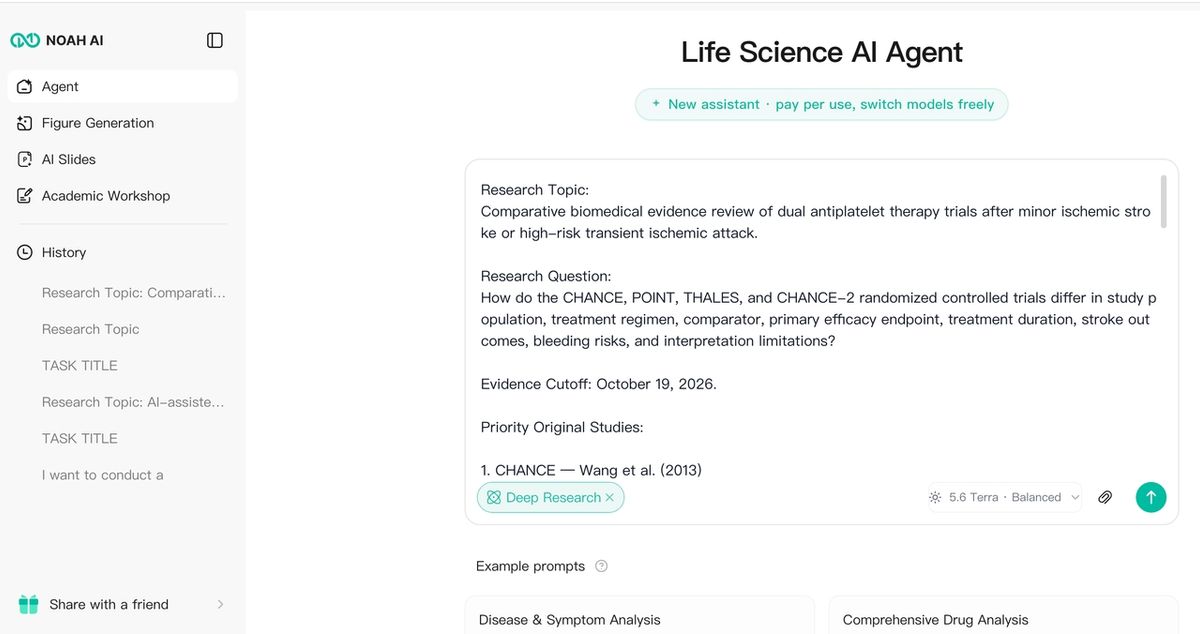
Output 1: Clinical Trial Design Comparison
The first output organized the four randomized trials by sample, intervention, comparator, duration, endpoint, and PMID. This makes an important difference visible before considering any outcome percentages: CHANCE-2 is a genotype-selected active-drug comparison, whereas CHANCE, POINT, and THALES compare an intensified antiplatelet regimen with aspirin-based control.
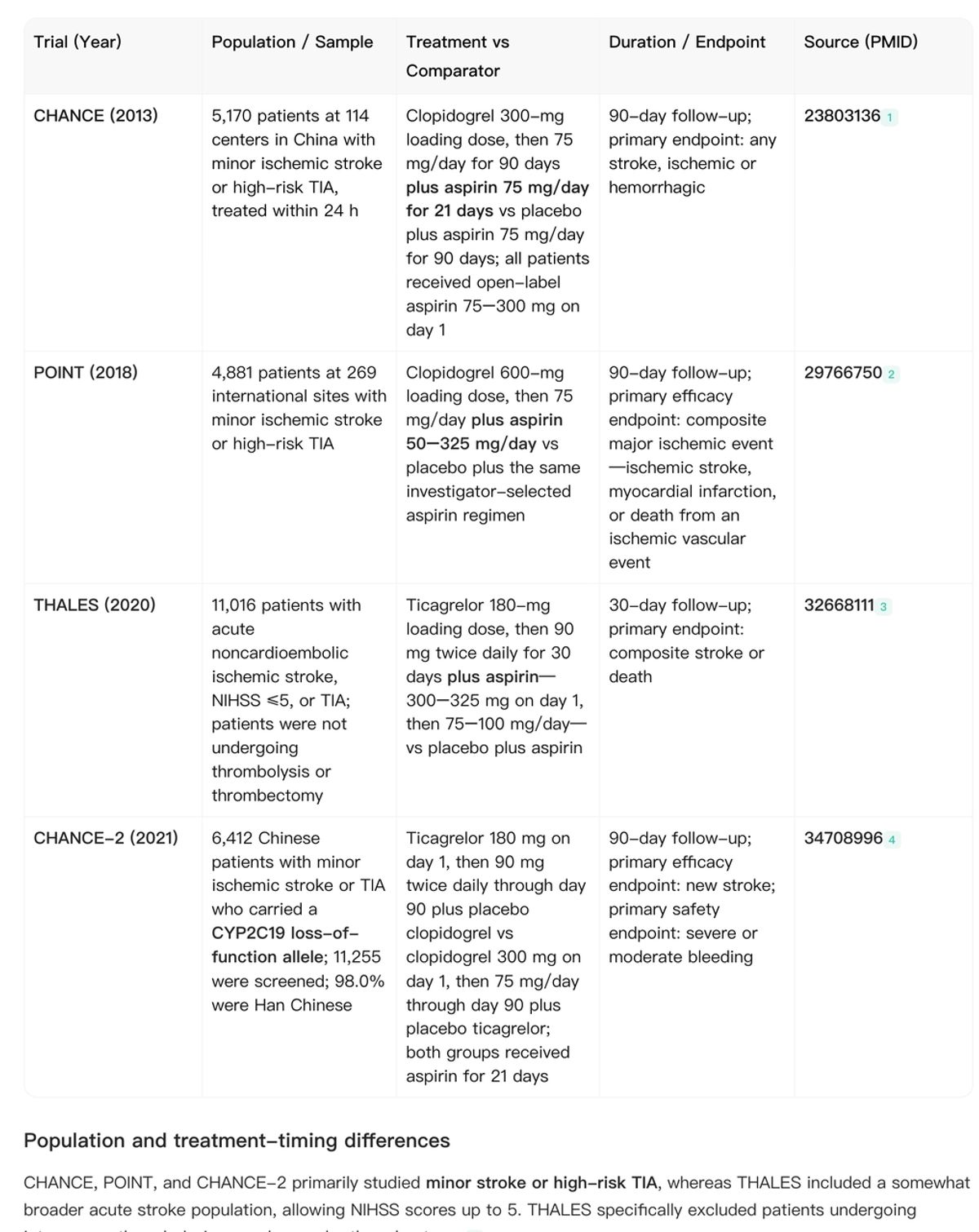
The source records show that CHANCE enrolled 5,170 patients in China, POINT enrolled 4,881 internationally, THALES enrolled 11,016 patients with somewhat broader stroke-severity eligibility, and CHANCE-2 enrolled 6,412 Chinese patients carrying a CYP2C19 loss-of-function allele. The different populations and comparators limit direct cross-trial inferences. Verify the original trial details in CHANCE, POINT, THALES, and CHANCE-2.
Output 2: Efficacy and Safety Across Trials
The second output placed the original efficacy and bleeding findings alongside trial-specific qualifications. Four distinctions from the source-checked comparison are especially useful:
| Trial | Reported within-trial efficacy result | Reported bleeding result |
|---|---|---|
| CHANCE | 90-day stroke: 8.2% vs 11.7% (HR 0.68) | Moderate or severe hemorrhage: 0.3% vs 0.3% |
| POINT | 90-day major ischemic events: 5.0% vs 6.5% (HR 0.75) | Major hemorrhage: 0.9% vs 0.4% |
| THALES | 30-day stroke or death: 5.5% vs 6.6% (HR 0.83) | Severe bleeding: 0.5% vs 0.1% |
| CHANCE-2 | 90-day stroke: 6.0% vs 7.6% (HR 0.77) | Severe or moderate bleeding: 0.3% vs 0.3%; any bleeding: 5.3% vs 2.5% |
Each percentage compares randomized arms within its own trial. These rows have different interventions, endpoints, safety definitions, and follow-up periods; they are not a pooled result or between-trial treatment ranking. Details: CHANCE, POINT, THALES, CHANCE-2.
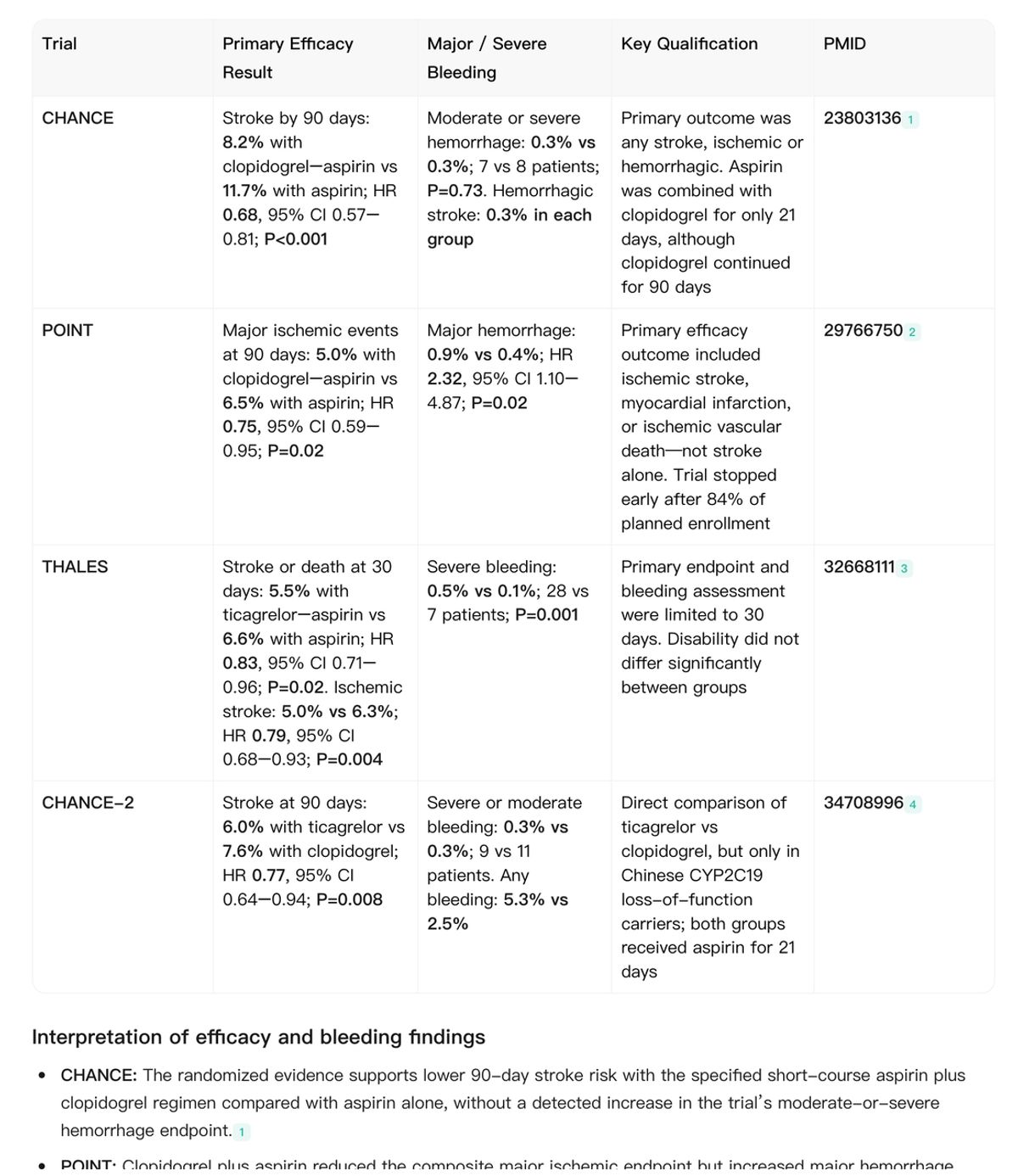
What the Noah Output Supports—and What It Does Not
The output illustrates a useful biomedical comparison workflow: start from named sources, extract study-level design fields, separate efficacy from adverse events, and explain why apparently comparable percentages should not be naively ranked.
- CHANCE used a 21-day aspirin combination phase and measured stroke over 90 days.
- POINT measured a broader major-ischemic-event endpoint, with an accompanying increase in major hemorrhage.
- THALES used a 30-day intervention and reported stroke or death together with a severe-bleeding safety endpoint.
- CHANCE-2 is a direct ticagrelor-versus-clopidogrel comparison, but only within its genetically selected Chinese trial population and a common 21-day aspirin background.
Verification boundary. The four primary trial results above are supported by their PubMed-indexed original abstracts. Noah's report did not establish a complete protocol-level or full-supplement audit, and its focused comparison should not be described as a formal systematic review or used to guide individual prescriptions.
Compare Biomedical Studies with Noah AI
Start from a medical research question and explore a structured, cited comparison of study populations, endpoints, efficacy, and safety—then verify the generated findings against the original papers.
Free Credits Available · No Credit Card Required. Available credits may not cover every Deep Research task.
When Should You Choose Each Petal Alternative?
Choose based on the next step you need to complete—not on an unsupported "best overall" score. If you already have a collection of PDFs and want a flexible extraction grid, compare Petal AI Table with SciSpace and Elicit's relevant extraction workflow. If you have a specific biomedical evidence question and want a structured analytical brief, the Noah Agent workflow above provides an example of the output to evaluate. If you are still finding studies, consider Consensus; if you are checking how results have been received in subsequent literature, use Scite.
These tools can also complement one another without any claimed automatic integration. A researcher might discover candidate studies in Consensus, extract standardized fields with Elicit or SciSpace, interpret a focused medical question with Noah, and examine citation context using Scite. Each transfer still requires checks against original publications.
Final Takeaway
Petal remains relevant for AI-assisted reading and cross-document comparison; its AI Table should not be overlooked. The case for using another tool is stronger when a task demands a different workflow rather than simply another chat interface.
Among the alternatives discussed here, Noah AI fits question-led biomedical evidence synthesis, Elicit fits structured review and extraction processes, SciSpace fits comparison across research PDFs, Consensus fits discovery and study snapshots, and Scite fits citation-context investigation.
The four-trial Noah example demonstrates a report that retained important differences among CHANCE, POINT, THALES, and CHANCE-2. It does not prove that Noah is more accurate than Petal or any other platform.
Turn a Biomedical Question into a Reviewable Evidence Brief
Explore Noah AI for trial comparisons and cited research synthesis, with source verification built into your own review process.
Start Researching with Noah AI →
Free Credits Available · No Credit Card Required
Frequently Asked Questions
What are the best Petal alternatives for biomedical research?
Noah AI, Elicit, SciSpace, Consensus, and Scite each address a different research need. Noah is useful for structured biomedical synthesis, Elicit and SciSpace for evidence extraction, Consensus for study discovery, and Scite for analyzing citation context.
Can Petal compare multiple research papers?
Yes. Petal documents multi-document querying and AI Table functionality for comparing information across papers. An alternative may be more appropriate for a specific screening, extraction, or evidence-audit workflow.
Is there a free Petal alternative?
Several research platforms offer free entry points or credits, but what is included and how much a workflow consumes varies. Petal itself has a Free tier; its AI Table is currently listed as a seven-day trial. Check each provider's current plan before assuming that a full comparison is free.
Which alternative is useful for comparing clinical trials?
Noah AI can support question-led clinical evidence comparisons, as illustrated by the four-stroke-trial example. Elicit and SciSpace are relevant when the task starts from structured extraction across a defined paper set. Neither approach removes the need to check trial endpoints and source data.
Can AI compare efficacy and safety findings across separate trials?
AI can organize each trial's reported outcomes, but efficacy and adverse-event numbers should not be treated as directly comparable if populations, comparators, endpoints, or follow-up periods differ. Comparisons require research-methods judgment.
Does an AI-generated study comparison count as a systematic review?
No. A formal systematic review requires a documented search strategy, explicit screening process, methodological assessment, and reproducible reporting. The Noah example here is a focused comparative review of four selected original trials.