
Best R Discovery Alternatives for Biomedical Research Discovery (2026)
Linda
Compare 5 R Discovery alternatives for biomedical research in 2026, including Noah AI, Elicit, Semantic Scholar, ResearchRabbit, and Litmaps.
The best literature discovery tool depends on whether you want a personalized stream of new papers, a visual citation map, or a focused set of original biomedical studies that can be checked against primary sources. This guide compares five alternatives to R Discovery and shows one real Noah AI research workflow using randomized lupus nephritis trials.
Updated: October 30, 2026 · Clinical evidence cutoff: October 30, 2026 · Test scope: Noah AI only; competing products assessed from public documentation.
Quick Answer: Which R Discovery Alternative Fits Your Research?
| Tool | Best-fit use case | Primary workflow | Useful distinction |
|---|---|---|---|
| Noah AI | Question-driven biomedical research discovery | Investigate a medical question; locate and organize source-linked evidence | Structured clinical research outputs |
| Elicit | Finding and extracting academic evidence | Research Agent with search, extraction and reporting skills | Flexible paper tables and evidence workflows |
| Semantic Scholar | Broad scholarly search and alerts | Search literature, explore citations, build research feeds | General academic discovery and saved-paper recommendations |
| ResearchRabbit | Exploring a literature network from seed papers | Seed articles → similar papers, references and citations | Visual navigation of connected research |
| Litmaps | Mapping a topic and following its citation landscape | Start with papers; visualize connected publications | Citation-based literature maps |
This table summarizes published product workflows, not results from a five-tool benchmark. Availability and usage limits may depend on the plan.
What Is R Discovery?
R Discovery is a research discovery and reading platform focused on finding relevant scholarly content. It offers personalized research feeds, topic-based recommendations, newly published paper alerts, search filters, bookmarks and reading lists. Its broader product offering also includes features such as Ask R Discovery, paper summaries, audio reading, translation and reference-manager integrations, with access depending on the feature and plan.
Those features make R Discovery a reasonable choice for researchers who want to monitor their fields and maintain a regular reading habit. An alternative becomes relevant when the task changes—for example, from "show me papers related to lupus nephritis" to "identify original randomized add-on therapy trials, distinguish a provided seed from other publications, and document what was verified."
5 R Discovery Alternatives Worth Considering
1. Noah AI — For Biomedical Questions and Source-Grounded Research
Noah AI is oriented toward biomedical questions and structured research workflows. In the case documented below, a researcher provided one original lupus nephritis trial, requested additional randomized studies, and received a discovery table with publication identifiers and a separation between seed, additional studies and historical evidence.
This is useful when discovery is only the first step toward screening, reading and comparing clinical evidence. It is not the same as a validated systematic-review search, and the returned papers still need human verification.
2. Elicit — For Search, Extraction and Research Reports
Elicit combines paper finding, structured extraction and research reporting. Since September 30, 2026, its formerly separate Find Papers and Extract Data tools have been incorporated into the Research Agent workflow. Researchers can request relevant papers, ask for extraction columns and refine tables within a session.
Consider it when: you need systematic organization of study attributes or want to move from search results into repeatable evidence-extraction tables. Access to larger systematic-review workflows depends on the subscription tier.
3. Semantic Scholar — For Broad Search, Research Feeds and Alerts
Semantic Scholar supports academic literature search and discovery. Its Research Feeds recommend papers using saved library folders and user feedback, while alerts can notify researchers about new papers and citations.
Consider it when: you want a general-purpose academic search engine with ongoing recommendations and citation-related updates, rather than a disease-specific evidence report as the starting output.
4. ResearchRabbit — For Exploring Related Publications
ResearchRabbit centers on seed-paper exploration. Researchers can examine related work, the references cited by a seed, and newer publications that cite it. Its visual exploration makes connections among papers easier to inspect.
Consider it when: you already have a relevant study and want to understand neighboring papers and the surrounding literature network. A citation connection alone does not establish that a study meets a clinical review's eligibility criteria.
5. Litmaps — For Visual Citation Mapping
Litmaps helps researchers build citation-based maps from starting publications and explore related articles. The map presents connections among studies, which can help reveal older foundations and more recent work in a research area.
Consider it when: your task is to visualize how publications are connected and expand a reading collection. Researchers still need to verify original study designs and clinically relevant outcomes separately.
Researching a biomedical question?
Explore a source-linked research workflow in Noah AI. Free starting access may be available; check the current signup terms.
Real Biomedical Research Discovery Example: Lupus Nephritis
To illustrate what question-driven medical literature discovery looks like in practice, Noah AI was given one known randomized controlled trial: Two-Year, Randomized, Controlled Trial of Belimumab in Lupus Nephritis (BLISS-LN, 2020; PMID 32937045). The task was to find other original randomized studies of add-on therapies for active lupus nephritis, check their publication identities, and distinguish original trials from follow-up analyses.
The seed-paper rule matters. BLISS-LN was provided in the prompt. It should not be reported as a study newly discovered by the tool. The evidence cutoff was October 30, 2026.
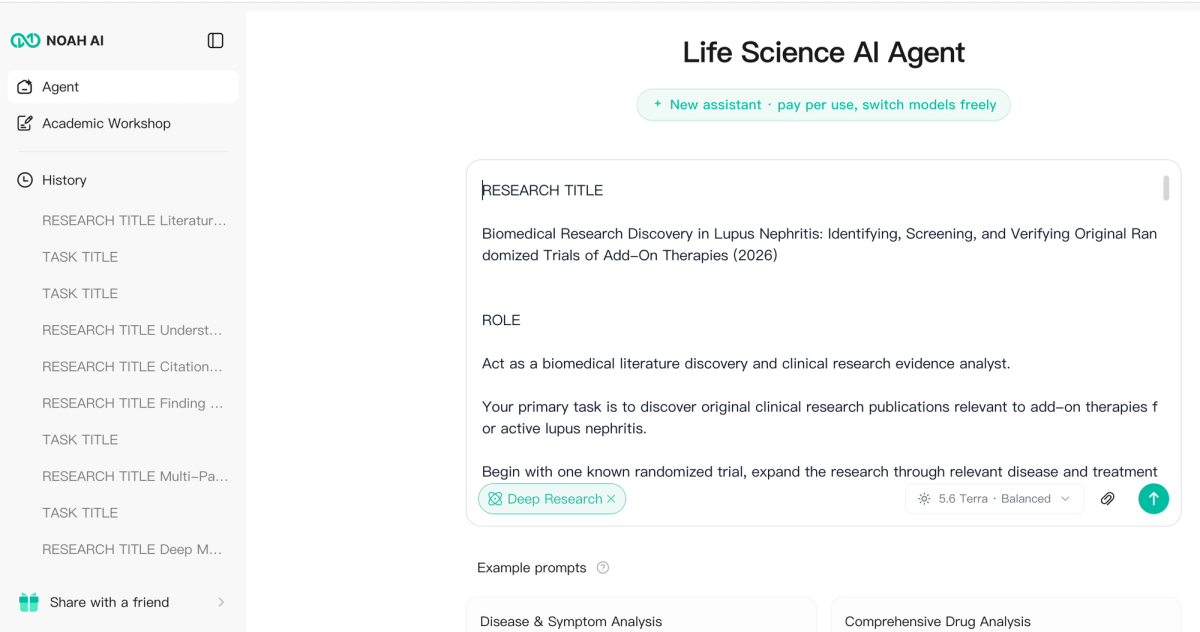
What Noah Identified From the Seed Study
The generated discovery matrix included the provided BLISS-LN study, three additional post-2020 original trial publications, and four earlier foundational randomized trials. The main recent studies shown in the report are summarized below.
| Original study | Discovery status in this task | Intervention and population | PMID |
|---|---|---|---|
| BLISS-LN (2020) | Provided seed | Belimumab plus standard therapy in active biopsy-proven lupus nephritis | [32937045](https://pubmed.ncbi.nlm.nih.gov/32937045/) |
| NOBILITY (2021) | Newly discovered in Noah report | Obinutuzumab plus mycophenolate/corticosteroids; phase 2 proliferative lupus nephritis | [34615636](https://pubmed.ncbi.nlm.nih.gov/34615636/) |
| AURORA 1 (2021) | Newly discovered in Noah report | Voclosporin plus mycophenolate and low-dose steroids; phase 3 lupus nephritis | [33971155](https://pubmed.ncbi.nlm.nih.gov/33971155/) |
| REGENCY (2025) | Newly discovered in Noah report | Obinutuzumab plus standard therapy; phase 3 active lupus nephritis | [39927615](https://pubmed.ncbi.nlm.nih.gov/39927615/) |
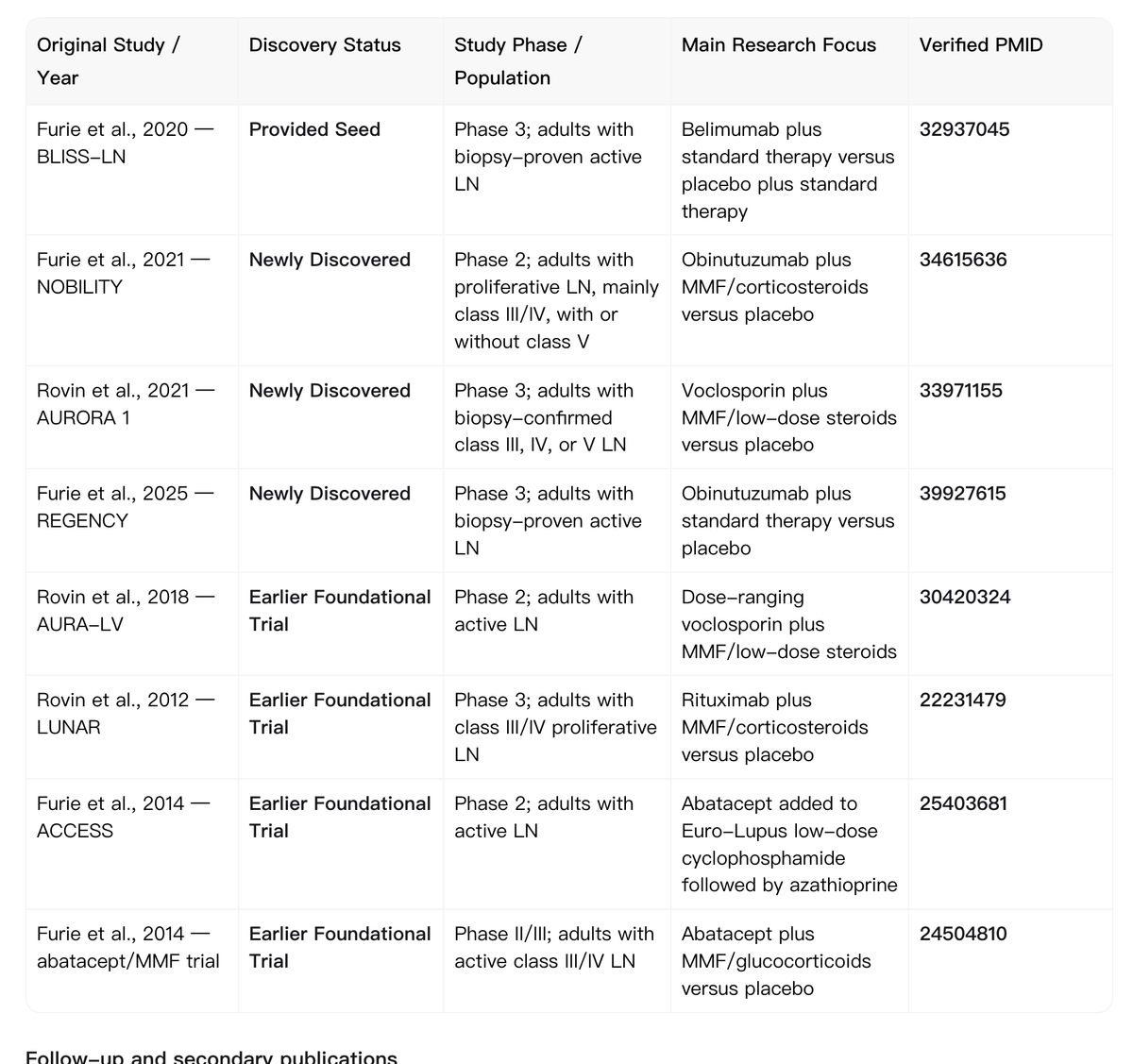
All four core study identifiers can be checked through their original PubMed records. Finding a valid PMID is a useful first check, but it does not by itself confirm that every endpoint detail was verified from full text.
Earlier Research Matters, Too
The same Noah output surfaced older randomized studies that help explain how the field developed. These are not 2026 discoveries or newly published trials; they are prior evidence relevant to the clinical research landscape.
| Trial | Year | Why it belongs in the reading set | Original PMID |
|---|---|---|---|
| AURA-LV | 2018 | Earlier phase 2 voclosporin program | [30420324](https://pubmed.ncbi.nlm.nih.gov/30420324/) |
| LUNAR | 2012 | Phase 3 rituximab add-on trial in proliferative disease | [22231479](https://pubmed.ncbi.nlm.nih.gov/22231479/) |
| ACCESS | 2014 | Abatacept with a cyclophosphamide/azathioprine background regimen | [25403681](https://pubmed.ncbi.nlm.nih.gov/25403681/) |
| Abatacept/MMF trial | 2014 | Abatacept added to mycophenolate and glucocorticoids | [24504810](https://pubmed.ncbi.nlm.nih.gov/24504810/) |
These earlier trials are valuable context precisely because not every add-on strategy met its prespecified primary renal endpoint. An informative literature discovery workflow should retain pertinent negative or inconclusive original trials, rather than return only favorable studies.
Why Endpoint Definitions Matter After Literature Discovery
Identifying related clinical trials is not the end of the research workflow. To use them in a review, researchers need to understand what each publication actually measured. The lupus nephritis trials illustrate why a list of apparently similar studies should not be converted directly into an efficacy ranking.
| Trial | Relevant original primary renal outcome | Assessment | Interpretation issue |
|---|---|---|---|
| BLISS-LN | Primary efficacy renal response (including proteinuria, kidney-function and rescue-therapy conditions) | Week 104 | Different response composite and longer follow-up |
| NOBILITY | Complete renal response | Week 52 | Phase 2 study; distinct renal criteria and statistical framework |
| AURORA 1 | Complete renal response | Week 52 | Includes kidney function, rescue therapy and steroid-exposure conditions |
| REGENCY | Complete renal response | Week 76 | Different eGFR threshold and rules for intercurrent events |
BLISS-LN reported primary efficacy renal response at week 104 in 43% of the belimumab group and 32% of the placebo group. AURORA 1 reported complete renal response at week 52 in 41% and 23%, respectively. REGENCY reported complete renal response at week 76 in 46.4% and 33.1%, respectively. These values come from separate trials with different study populations and outcome definitions; comparing them as if they were a randomized head-to-head test would be inappropriate.
Clinical interpretation: "renal response" is not one standardized variable across these trials. Proteinuria cutoffs, kidney-function requirements, concomitant treatment, rescue rules and follow-up durations differ. A higher unadjusted response percentage in one study does not establish superior drug efficacy.
How to Verify Discovered Medical Sources
Before moving a discovered paper into a biomedical evidence table, the reviewer should check publication identity and design, not only topical relevance. For the main four studies in this example, the original PubMed records support their trial identity, publication year and core design. Verification depth was not uniform across the Noah report: some attributes came from PubMed abstracts and indexed records, while selected sources contained more accessible article detail.
| Verification question | What to check | Reason |
|---|---|---|
| Is it an original study? | Original randomized publication versus review, post hoc analysis or extension | Avoid counting the same trial more than once |
| Does the population match? | Active biopsy-proven lupus nephritis and specified histologic classes | Exclude unrelated systemic lupus studies |
| What was the comparator? | Background immunosuppression and placebo or active comparator | Understand the actual randomized contrast |
| Which outcome was primary? | Exact renal response definition and evaluation week | Avoid misleading cross-study comparisons |
| What was actually read? | PubMed record, abstract, full text, tables or supplement | Match the strength of each claim to the inspected evidence |
Additional analyses of NOBILITY or AURORA should be labeled as secondary evidence associated with their underlying trial programs, not counted as separate independent randomized comparisons. This distinction prevents an inflated evidence count.
What This Test Does—and Does Not—Show
What is visible: Noah received a seed-based lupus nephritis research question and generated a structured discovery matrix identifying the provided BLISS-LN trial, three more recent trial publications, and earlier foundational studies with PubMed identifiers. A longer report also discussed verification methods and the limits of different renal endpoints.
What is not established: The case was not a blinded retrieval benchmark, an exhaustive systematic search, or a controlled comparison with R Discovery, Elicit, Semantic Scholar, ResearchRabbit or Litmaps. The discovery labels are taken from Noah's report. No claim is made about comparative recall, precision, hallucination rate or speed.
Importantly, the reported search used biomedical keyword exploration; it did not document a complete formal backward- and forward-citation analysis from the seed. Literature discovery therefore remains a useful preliminary research stage, not a replacement for protocol-driven systematic review methods.
How to Choose the Right Alternative
Use R Discovery if you prioritize personalized reading feeds, topic alerts and keeping up with new papers. Choose Semantic Scholar for broad search and ongoing paper or citation alerts. Use ResearchRabbit or Litmaps when visualizing how a set of papers is connected is the central task. Consider Elicit when you need search and paper extraction within a configurable research workflow.
For a biomedical research question requiring a sourced trial list, source verification and a structured clinical evidence brief, Noah AI may be a relevant fit. Regardless of the platform, researchers should verify important primary-source claims and avoid direct drug rankings from separate trials.
Frequently Asked Questions
What is the best alternative to R Discovery for biomedical research?
There is no universal winner. Noah AI is relevant for question-driven biomedical research briefs, Elicit for paper search and extraction, Semantic Scholar for broad academic discovery, and ResearchRabbit or Litmaps for citation-centered exploration.
Does R Discovery support more than paper recommendations?
Yes. Its published features include searching, reading lists, summaries and access to AI-assisted research and reading functions such as Ask R Discovery, subject to plan and feature availability.
Can I start medical literature discovery from one seed paper?
Yes. A known study can anchor searches for related clinical concepts and publications. ResearchRabbit and Litmaps offer seed-based citation exploration; question-driven research tools can also use a supplied publication as the starting reference.
Is a PubMed PMID enough to verify a paper's clinical results?
No. A PMID helps confirm publication identity. Researchers should inspect the original abstract or full text and verify the exact outcome, denominator, timepoint and analysis before relying on quantitative findings.
Why not compare the renal response percentages of BLISS-LN, AURORA 1 and REGENCY directly?
They used different eligibility criteria, background treatments, assessment times and renal response definitions. Separate placebo-controlled trial results do not constitute a randomized head-to-head efficacy comparison.
Can an AI literature discovery exercise replace a systematic review search?
No. A formal systematic review generally needs an explicit reproducible search strategy, eligibility assessment, careful handling of duplicates and independent quality checks. AI can help with parts of that process without establishing completeness.
Final Takeaway
R Discovery has a clear role in personalized academic reading and paper discovery. Other tools emphasize different tasks: structured extraction, broad search, or citation-network visualization. In the documented Noah AI example, one provided BLISS-LN paper led to a source-linked lupus nephritis trial discovery table that separated recent original reports from earlier foundational research.
The valuable outcome is not simply a longer paper list. It is a research set whose publication identity, trial design and limits can be checked before the literature is used in evidence synthesis.
Explore source-grounded biomedical research with Noah AI.
Start from a medical research question and review the original references behind the findings. Check current free access and usage terms when signing up.