
Best ScholarAI Alternatives for Biomedical Literature Discovery (2026)
Linda
Discover five ScholarAI alternatives for biomedical literature research in 2026, with AI paper search, citation verification, and an RSV clinical trial example.
Looking beyond ScholarAI? Compare five tools for finding, organizing, and verifying biomedical papers—and see what a real RSV clinical-trial discovery workflow revealed in Noah AI.
Updated October 2026 · Evidence cutoff: October 25, 2026 · Product documentation + one Noah AI workflow
Biomedical literature discovery is not simply a matter of asking an AI to list papers. Researchers need to identify original studies, distinguish trial reports from secondary analyses, check PMIDs and DOIs, and preserve the exact population and endpoint behind a claim. ScholarAI offers broad academic search and citation-related assistance, but researchers may prefer other workflows for structured evidence discovery, natural-language synthesis, or citation-network exploration.
This guide compares Noah AI, Elicit, Consensus, ResearchRabbit, and Litmaps as ScholarAI alternatives. We tested Noah AI directly using a focused respiratory syncytial virus (RSV) prevention literature-discovery task. The competitor descriptions below are based on their official product documentation, not on a five-tool head-to-head benchmark.
01 / Comparison — Best ScholarAI Alternatives at a Glance
| Tool | Best for | Discovery approach | Important consideration |
|---|---|---|---|
| Noah AI | Multi-step biomedical research tasks | Research-question-driven agent workflow with source-backed reports | Verify the retrieved studies and metadata before reuse |
| Elicit | Structured paper finding and screening | Research Agent, reports, and systematic-review workflows | Advanced systematic-review workflow depends on plan |
| Consensus | Finding research-backed answers quickly | Natural-language search and multi-step research agent | Verify synthesized claims against original papers |
| ResearchRabbit | Discovering papers connected to known papers | Seed-paper and citation-network exploration | Not a substitute for endpoint-level clinical appraisal |
| Litmaps | Visual citation mapping and monitoring | Maps of citing/related papers, ongoing discovery | Citation links do not establish study quality |
Tool capabilities are based on official vendor documentation reviewed in October 2026. This table is a workflow guide, not an accuracy, speed, or recall ranking.
02 / Baseline — What Is ScholarAI—and Why Look for Alternatives?
ScholarAI supports natural-language academic search, paper summarization, citation-related workflows, and research assistance. Its official materials describe access to scholarly sources that include biomedical literature, preprints, and patents, alongside writing and citation integrations.
ScholarAI is a credible starting point for discovering papers. Choosing an alternative is more about the workflow you want than assuming the original tool lacks search capabilities. Biomedical researchers may need a structured trial-selection table, an iterative research agent, a transparent citation graph, or a system designed for formal review screening.
Key distinction: finding a real paper is not the same as confirming that it is a randomized trial, that its endpoint matches your question, or that the cited passage supports a specific clinical claim.
03 / Alternatives — Five ScholarAI Alternatives Worth Considering in 2026
01 / Biomedical Agent — Noah AI
Best for: question-to-evidence biomedical research workflows
Noah AI is designed for life-science research tasks. A user can define a biomedical question, provide seed papers, and request a report organized around search strategy, study eligibility, clinical findings, and citation provenance.
In the RSV example below, Noah generated an explicit distinction between supplied seed references and publications reported as newly discovered. It also described which sources were not directly searched. This makes the workflow useful for organizing an evidence-finding exercise—provided the citations and study classifications are independently reviewed.
The official Noah pricing page currently lists a free Basic tier with signup credits; usage varies by mode and plan.
Our evidence: one directly observed Noah Agent Deep Research run, not a benchmark against ScholarAI.
02 / Structured Screening — Elicit
Best for: evidence search, filtering, and extraction
Elicit combines academic literature search with a Research Agent. Its separately named Find Papers and Extract Data functions were integrated into the Agent in September 2026. A more controlled Systematic Review workflow is available on eligible paid plans.
Consider Elicit when the task needs explicit paper screening and structured extraction rather than only a narrative research answer.
Official workflow documentation
03 / Research Questions — Consensus
Best for: fast research-backed answers
Consensus searches scientific papers through natural-language questions. Its Research Agent can explore related papers, apply research filters, inspect citations, and synthesize evidence.
It may fit an early-stage question such as "Which randomized trials tested RSV prevention in infants?" When decisions depend on exact denominators or safety endpoints, the underlying original studies still matter.
04 / Citation Network — ResearchRabbit
Best for: expanding from seed papers
ResearchRabbit follows citation and authorship relationships to surface connected studies. Start from known papers and iteratively explore their research neighborhood.
It is a useful complement when a keyword search risks missing related studies with different terminology. Its core recommendation process is network-based rather than a generative clinical-evidence appraisal.
05 / Research Mapping — Litmaps
Best for: visual maps and new-paper monitoring
Litmaps builds citation-based research maps and helps discover connected papers. Its mapping interface is useful for tracing how an area develops and monitoring new publications over time.
For biomedical studies, use the map as a discovery aid; verify study design, eligibility, and results directly in each primary publication.
Start with a biomedical research question
Use Noah AI to organize literature discovery, identify relevant papers, and prepare source-linked evidence tables. The free Basic plan currently includes signup credits; check the live pricing page for current limits.
Free signup credits · No upfront payment on the Basic plan · Research outputs still require source verification
04 / Methodology — How to Discover Biomedical Literature Without Losing Source Traceability
A useful literature-discovery workflow should distinguish the act of searching from the subsequent steps of assessing relevance and checking evidence. In clinical research, those steps have different failure modes.
Define a precise clinical question. Specify the population, intervention, comparator, endpoint, and study design. For RSV prevention, pregnancy-based vaccination is not the same intervention as antibodies administered directly to infants.
Start with known publications and expand. Supply a small number of reliable seed studies, then look for additional eligible trials. Distinguish supplied seeds from papers retrieved later.
Screen study type and population. Separate original randomized trials from pooled analyses, follow-up publications, reviews, and registration records.
Verify identifiers and clinical endpoints. Open PubMed or the original publisher record. Confirm PMID, DOI, outcome definition, follow-up period, and relevant denominators.
Preserve search limitations. Document databases actually searched and those not accessed. AI-generated trial lists are not automatically exhaustive or systematic.
05 / Real Biomedical Example — We Tested Noah AI Directly: Finding RSV Prevention Trials in Infants
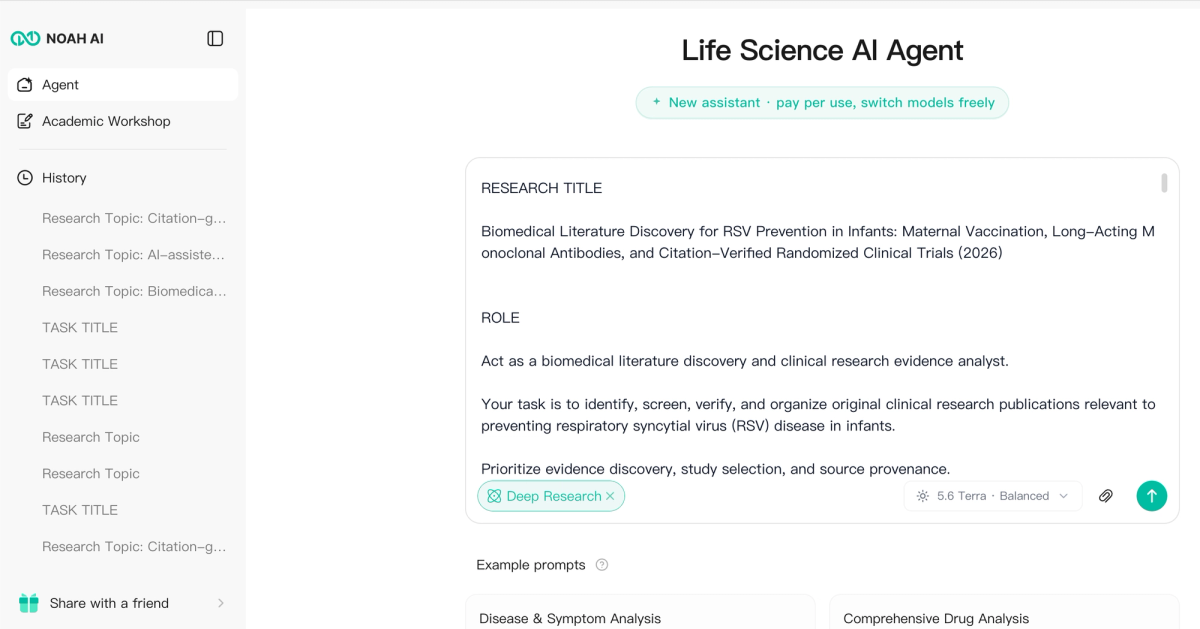
We ran Noah AI Agent in Deep Research mode to explore original randomized trials of maternal RSV vaccination and long-acting monoclonal antibody prophylaxis. The evidence cutoff was October 25, 2026. We supplied two published seed papers: the maternal vaccine MATISSE report by Kampmann et al. (PMID 37018474) and the nirsevimab MELODY trial by Hammitt et al. (PMID 35235726).
The prompt asked Noah to record its search strategy, distinguish supplied and newly identified records, classify original clinical trials, and verify bibliographic details. The task deliberately emphasized discovery and selection, not automated treatment advice or a systematic-review claim.
What the Discovery Report Contained
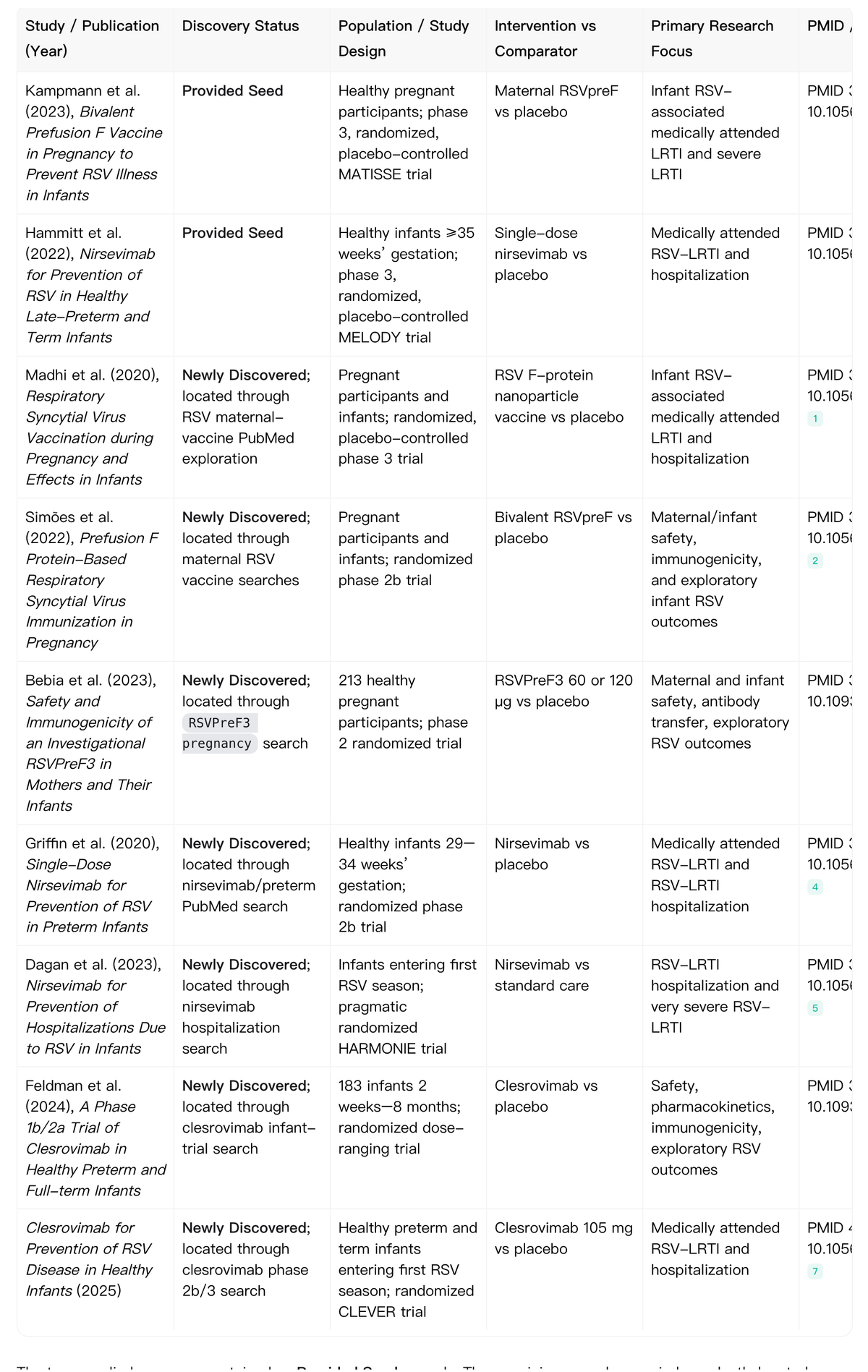
The Noah AI report listed nine publication records: two labeled "Provided Seed" and seven labeled "Newly Discovered." These labels describe how records appeared in the research workflow, not whether each represents an independent randomized trial.
For accurate study selection, researchers must distinguish original trial publications from secondary or follow-up analyses of existing trials and from ClinicalTrials.gov registration records. Multiple publications associated with the same trial should not be counted as separate independent patient cohorts.
These are categories assigned by the Noah report. They establish what appeared in this test output, but without an independently retained database search log, they do not by themselves prove complete coverage or reproducible recall.
Clinical Papers We Could Trace to Original Records
| Original study | Year | Role in test | Research context | Primary source |
|---|---|---|---|---|
| MATISSE — Kampmann et al. | 2023 | Provided seed | Maternal RSVpreF vaccine; infant lower respiratory tract outcomes | [PMID 37018474](https://pubmed.ncbi.nlm.nih.gov/37018474/) |
| MELODY — Hammitt et al. | 2022 | Provided seed | Nirsevimab in healthy late-preterm and term infants | [PMID 35235726](https://pubmed.ncbi.nlm.nih.gov/35235726/) |
| RSV maternal nanoparticle vaccine — Madhi et al. | 2020 | Reported new | Maternal randomized trial; distinct vaccine candidate | [PMID 32726529](https://pubmed.ncbi.nlm.nih.gov/32726529/) |
| Nirsevimab preterm trial — Griffin et al. | 2020 | Reported new | Monoclonal prophylaxis in preterm infants | [PMID 32726528](https://pubmed.ncbi.nlm.nih.gov/32726528/) |
| HARMONIE — Drysdale et al. | 2023 | Reported new | Pragmatic trial with RSV hospitalization as a primary endpoint | [PMID 38157500](https://pubmed.ncbi.nlm.nih.gov/38157500/) |
| Clesrovimab phase 1b/2a — Madhi et al. | 2024 online | Reported new | Infant safety, pharmacokinetics, and exploratory outcomes | [PMID 39601265](https://pubmed.ncbi.nlm.nih.gov/39601265/) |
| CLEVER — Zar et al. | 2025 | Reported new | Randomized infant clesrovimab efficacy study | [PMID 40961446](https://pubmed.ncbi.nlm.nih.gov/40961446/) |
Selected records from the nine-publication report. "Reported new" describes the Noah run's label, not independently confirmed search completeness. The 2024 clesrovimab report was published online in 2024 and appears in a 2025 journal issue.
Why Source Verification Was Necessary
The report also produced a study-selection table with inclusion rationales and source-verification notes. It generally separated PubMed record or abstract verification from direct publisher full-text review and noted that ClinicalTrials.gov was not directly searched in this workflow.
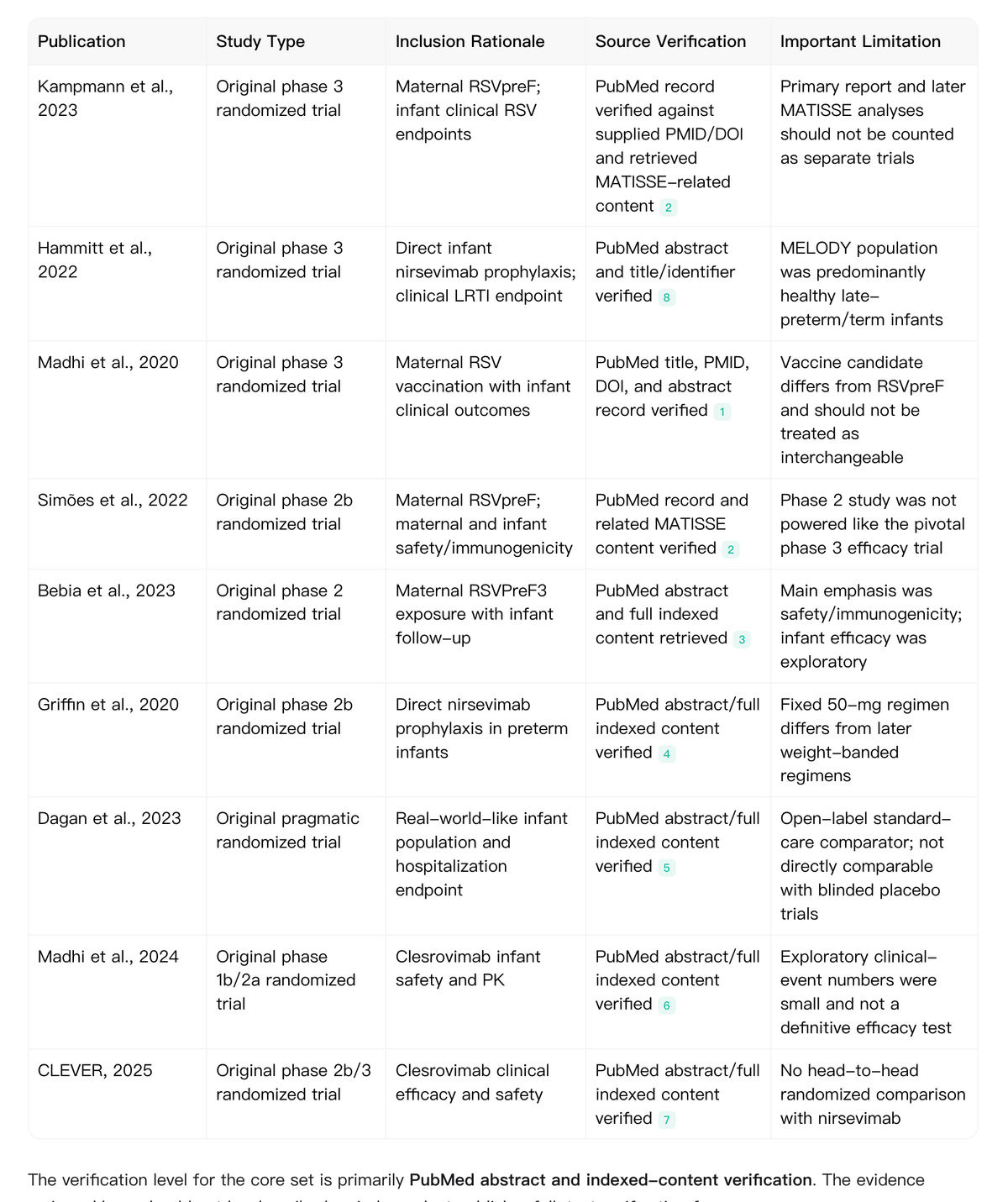
Manual checking also matters because generated bibliographic tables can contain mistakes. For example, the HARMONIE article is authored by Drysdale et al., not Dagan et al.; the early clesrovimab study with PMID 39601265 lists Madhi et al. as authors, not Feldman et al. We use the original PubMed records for the corrected names above.
What this test supports: Noah produced a structured search-and-selection report with source-linked records, status labels, and verification notes. What it does not prove: that every eligible RSV trial was found, that every full text was independently reviewed, or that Noah outperforms ScholarAI or the other alternatives.
06 / Decision Guide — Which ScholarAI Alternative Should You Choose?
| Your next research task | Consider starting with | Why |
|---|---|---|
| Turn a clinical question into a source-linked evidence report | Noah AI | A multi-step, topic-to-study workflow is useful when you need structured clinical evidence |
| Screen articles systematically and extract fields | Elicit | Designed workflows for screening and structured extraction |
| Ask which evidence supports an initial scientific claim | Consensus | Natural-language research searching and synthesis |
| Expand a set of known, relevant papers | ResearchRabbit | Iterative citation-network recommendations |
| Visualize a field or track newly linked publications | Litmaps | Maps and citation-based monitoring |
These approaches can be complementary. For example, a biomedical researcher could develop the first trial list in Noah or Elicit, use a citation-network tool to look for related studies, and then verify every included trial in PubMed and the original report.
Limitations to Keep in Mind
- Search access: databases and full-text coverage differ; an AI tool should not imply it accessed sources it did not search.
- Trial identity: secondary analyses and extensions can refer to the same underlying randomized trial.
- Clinical meaning: medically attended RSV-LRTI, hospitalization, and severe disease are different endpoints.
- Safety: a favorable efficacy estimate does not erase maternal or infant safety concerns, including preterm-birth findings reported for a distinct RSVPreF3 maternal vaccine trial.
- Methodology: this exploratory test is not a PRISMA systematic review, a diagnostic validation study, or a fair five-platform recall benchmark.
Explore biomedical literature with Noah AI
Start with a defined research question and ask for traceable original studies, screening rationales, and source links. Noah's Basic plan currently lists free signup credits and does not require an upfront paid subscription.
Free credits available on signup · Check live usage allowances before a deep research run
07 / Frequently Asked — FAQ: ScholarAI Alternatives for Biomedical Literature Discovery
What is the best ScholarAI alternative for biomedical literature discovery?
The best choice depends on the workflow. Noah AI may suit multi-step biomedical research reports; Elicit focuses on structured research screening, Consensus on research-backed questions, and ResearchRabbit or Litmaps on related-paper discovery. There is no validated winner from this single-platform case study.
Can Noah AI find original medical research papers?
In our RSV prevention exercise, Noah produced a report with original clinical-trial publications, bibliographic identifiers, and a distinction between supplied seed records and papers labeled newly discovered. Each important source should still be checked against PubMed or the original paper.
Is ScholarAI only a paper summarizer?
No. ScholarAI officially offers academic search and discovery, citation-related workflows, and paper summaries. An alternative may be preferable for a particular screening, agent-based research, or citation-mapping workflow rather than because ScholarAI lacks search.
Which AI tool is useful for citation-network discovery?
ResearchRabbit and Litmaps both offer citation-based exploration. ResearchRabbit emphasizes seed-paper recommendations, while Litmaps emphasizes visual citation maps and related-paper monitoring.
Can AI literature search replace PubMed for a systematic review?
No single AI-produced paper list should be assumed exhaustive. Formal systematic reviews need a documented, reproducible search strategy, eligibility criteria, screening, deduplication, and source verification across appropriate databases.
How do I verify an AI-generated medical citation?
Open the PMID or DOI, confirm the title, authors, publication date, study type, population, comparator, endpoint, and result. Do not assume a real citation necessarily supports the specific sentence in which it appears.