
Best Sourcely Alternatives for Finding Medical Research Sources (2026)
Linda
Compare five Sourcely alternatives for finding medical research sources in 2026, with a real Noah AI claim-to-source verification case and original trial citations.
Finding a paper about a medical topic is not the same as finding a paper that supports a specific clinical claim. Here are five Sourcely alternatives to consider, with a real Noah AI source-verification exercise using chronic migraine randomized trials.
Updated October 28, 2026 · Research evidence cutoff: October 28, 2026 · Product descriptions from official documentation; Noah screenshots from one recorded workflow
Sourcely helps researchers paste text, find relevant academic sources, and organize citations. For medical and life-science writing, however, source discovery often requires extra checks: Is the source an original randomized trial? Does it study the right population? Does its endpoint match the sentence being cited? Does it support the statement—or merely mention the topic?
This guide compares Noah AI, Elicit, Consensus, Scite, and Semantic Scholar. The tools have different strengths, from biomedical evidence workflows to paper extraction, question-based search, citation context, and broad academic discovery.
Quick Comparison: Five Sourcely Alternatives
| Tool | Most relevant use case | What to verify |
|---|---|---|
| Noah AI | Biomedical question-to-evidence research and structured claim/source audits | Check every clinical claim against the linked original publication |
| Elicit | Finding papers, structured screening and information extraction within its Research Agent | Review inclusion rules, full-text access, and extracted fields |
| Consensus | Searching research questions, including a medical-focused corpus, and exploring evidence summaries | Inspect underlying papers and how their findings were summarized |
| Scite | Examining how later papers cite a study: supporting, contrasting, or mentioning contexts | Citation-context labels are not a substitute for full clinical appraisal |
| Semantic Scholar | Free broad scholarly discovery, citation trails, and related-paper recommendations | Confirm metadata, study type and source relevance independently |
Important: This is a task-fit comparison, not a head-to-head retrieval benchmark. The Sourcely and other competitor capabilities below are based on published product materials; the only actual workflow documented with screenshots is Noah AI.
What Is Sourcely—and Why Look for an Alternative?
Sourcely positions itself as an AI academic source finder: paste an essay or paragraph, search for related publications, insert citations, summarize selected papers, and export references. Its website also describes deep academic search, search filters, a citation library, and source credibility checks. These are meaningful functions; Sourcely is not merely a basic search box.
Medical researchers may nevertheless need a different workflow when the question is narrower than "find references for this text." A statement about prevention in chronic migraine should not automatically be sourced to a trial in episodic migraine. A claim about superiority to other medicines requires actual comparative evidence, not merely several positive placebo-controlled trials. And an article that reports monthly headache days may not directly support a sentence about monthly migraine days.
The right alternative therefore depends on whether the goal is rapid references, repeatable data extraction, examining citation context, or a source-linked biomedical research brief.
1. Noah AI — For Biomedical Source Discovery and Claim Verification
Noah AI is designed around biomedical and life-science research questions. Its Agent workflow can be asked to locate primary studies, organize source evidence, flag unsupported statements and explain the interpretation limits of the cited research. Its PubMed-focused search tools also help connect biomedical questions with identifiable source records.
Best fit: a medical research claim that needs more than a plausible citation. In the workflow shown below, Noah was asked to inspect five claims about CGRP-pathway monoclonal antibodies for preventing chronic migraine.
Limitation: an AI-generated verdict is a starting point, not independent proof. The researcher still needs to check original publications and any important eligibility or endpoint details. This example does not establish Noah's retrieval recall, hallucination rate, or superiority over Sourcely.
2. Elicit — For Literature Search and Structured Paper Extraction
Elicit can search academic literature, gather papers, screen evidence and build extraction tables. Its current Research Agent combines functions that were previously offered as separate Find Papers, Extract Data and Chat with Papers tools; the former standalone tools were consolidated in September 2026.
Best fit: research questions that require selecting a defined paper set and extracting the same fields—population, intervention, study design, endpoint or outcome—from each publication.
Watch for: whether a field was read from the original full text or inferred from an abstract; whether included papers are actually relevant; and whether a formal systematic-review workflow is necessary.
3. Consensus — For Searching Scientific Questions
Consensus accepts natural-language research questions and offers paper search as well as modes for summarizing collections of scientific studies. Its documentation describes a medical-source subset alongside its broader research corpus.
Best fit: exploring which publications address a question and getting a research-oriented starting overview before closely reading the pivotal papers.
Watch for: questions whose interpretation depends on differences between endpoint definitions, study populations or the strength of statistical evidence. A synthesized answer should be traced back to the included papers.
4. Scite — For Checking Citation Context
Scite is particularly relevant when a paper has already been found and the next question is how other studies cite it. Its Smart Citations classify citation statements into categories including supporting, contrasting and mentioning, and its reference-checking capabilities can flag items such as retractions or editorial notices.
Best fit: researching the citation history and surrounding debate of an important paper, and identifying potentially conflicting follow-up evidence.
Watch for: the distinction between a classified citation statement and an independently validated medical conclusion. Clinical interpretation still requires reading study methods and results.
5. Semantic Scholar — For Free Paper Discovery and Citation Trails
Semantic Scholar offers free AI-assisted scholarly search, paper metadata, citations and research recommendations. Features described in its product documentation include Research Feeds, a personal library, paper summaries and contextual paper-reading tools.
Best fit: quickly locating original publications and following related literature without first committing to a paid research workflow.
Watch for: relevance rather than only search rank or citation count. Broad academic discovery alone does not decide whether a clinical statement is justified.
Real Medical Source-Finding Example: Chronic Migraine Claims
To show what claim-level source verification looks like, we ran a focused Noah Agent Deep Research task on CGRP-pathway monoclonal antibodies used for chronic migraine prevention. The evidence cutoff was October 28, 2026. The report described drug-specific searches for original randomized placebo-controlled trials and a separate check for direct head-to-head evidence.
The exercise supplied five claims, including one deliberately overstated statement: "Eptinezumab has been proven superior to all other CGRP monoclonal antibodies in head-to-head randomized trials." Noah was asked to find real original sources, preserve endpoint terminology and mark claims as supported, qualified or unsupported.
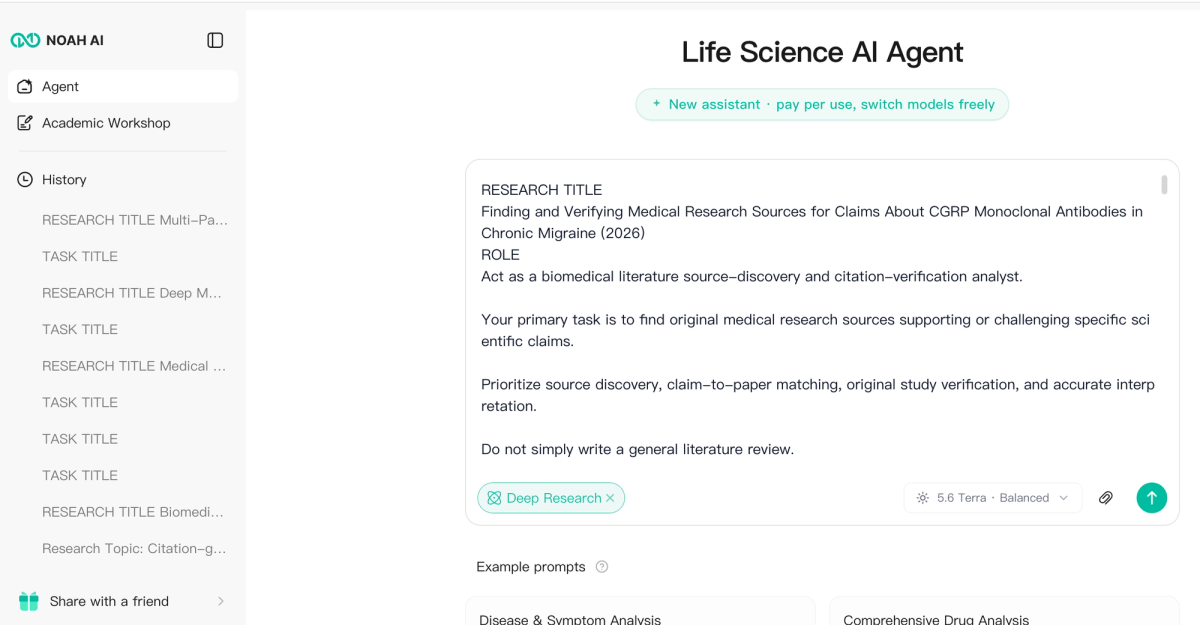
The output is a focused source-finding exercise, not an exhaustive systematic review. In particular, the screenshot establishes the research prompt and selected mode; it does not by itself measure the platform's overall clinical accuracy.
From Clinical Claims to Supporting Sources
Noah created a five-row claim-to-source matrix. Four statements were categorized as supported; the unqualified head-to-head superiority claim was categorized as unsupported. The distinction matters because a citation can be topical without demonstrating the assertion placed beside it.
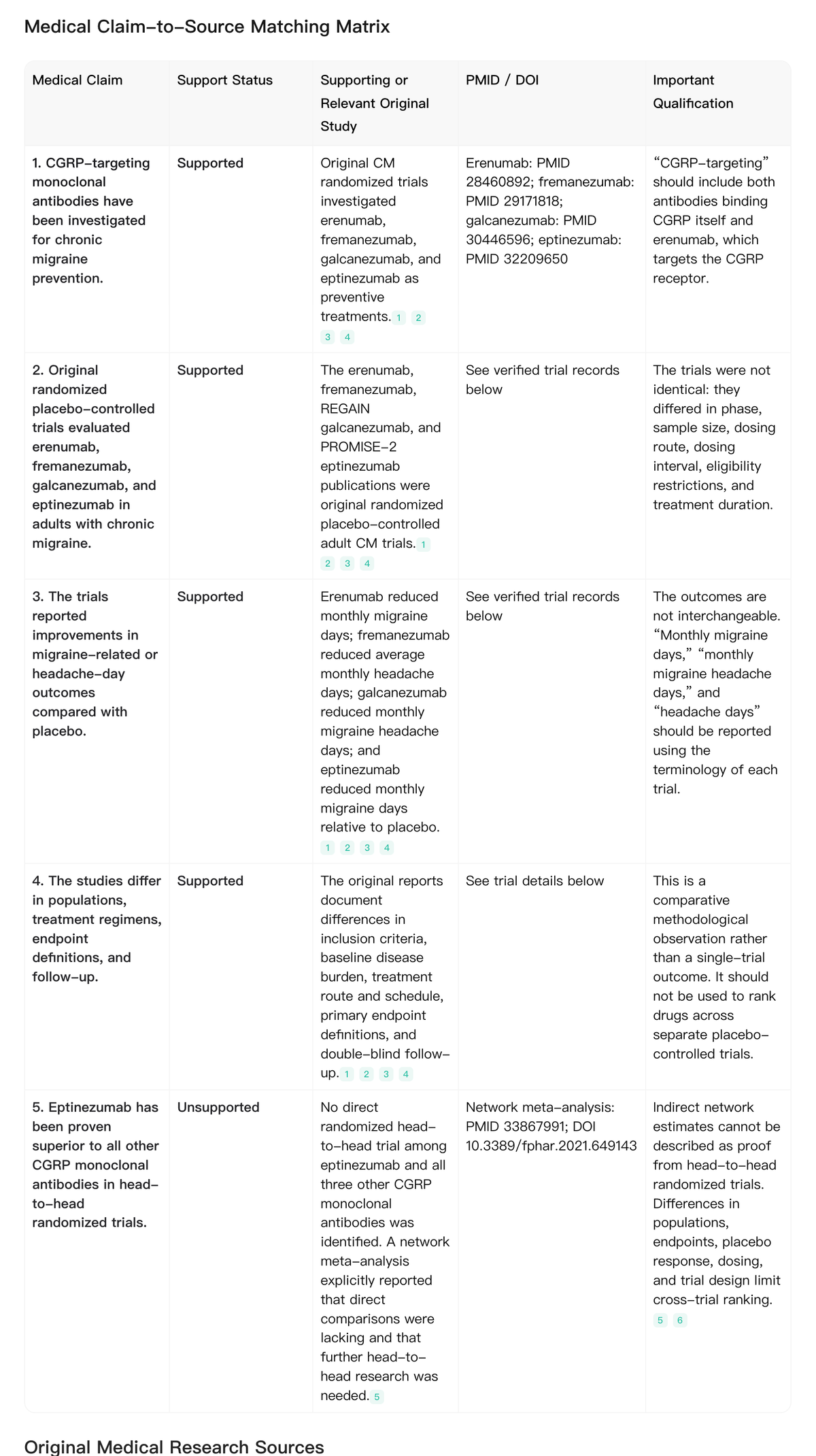
| Draft claim | Finding in this Noah report | Why the distinction matters |
|---|---|---|
| CGRP-pathway antibodies have been studied in chronic migraine | Supported | Includes antibodies against CGRP itself and erenumab, which targets its receptor |
| Four named antibodies were evaluated in placebo-controlled CM trials | Supported | Trials had different populations, designs and dosing schedules |
| Trials showed improvement in migraine- or headache-related outcomes | Supported, with endpoint qualifications | Headache days and migraine days must not be treated as identical |
| Trials differed in methods and follow-up | Supported | Differences limit informal cross-study rankings |
| Eptinezumab is proven superior to all others in head-to-head randomized trials | Unsupported by evidence identified in this search | Indirect evidence is not direct head-to-head proof |
This classification represents what the documented search supported, not a guarantee that every possible publication had been found. That qualification is especially important for claims about the absence of evidence.
Check medical claims against identifiable studies. Use Noah AI to start a source-linked biomedical research workflow, with free credits available and no credit card required to get started.
Which Original Clinical Trials Were Identified?
The Noah output named pivotal adult chronic migraine trial publications for erenumab, fremanezumab, galcanezumab and eptinezumab. The full record identifiers can also be checked independently in PubMed.
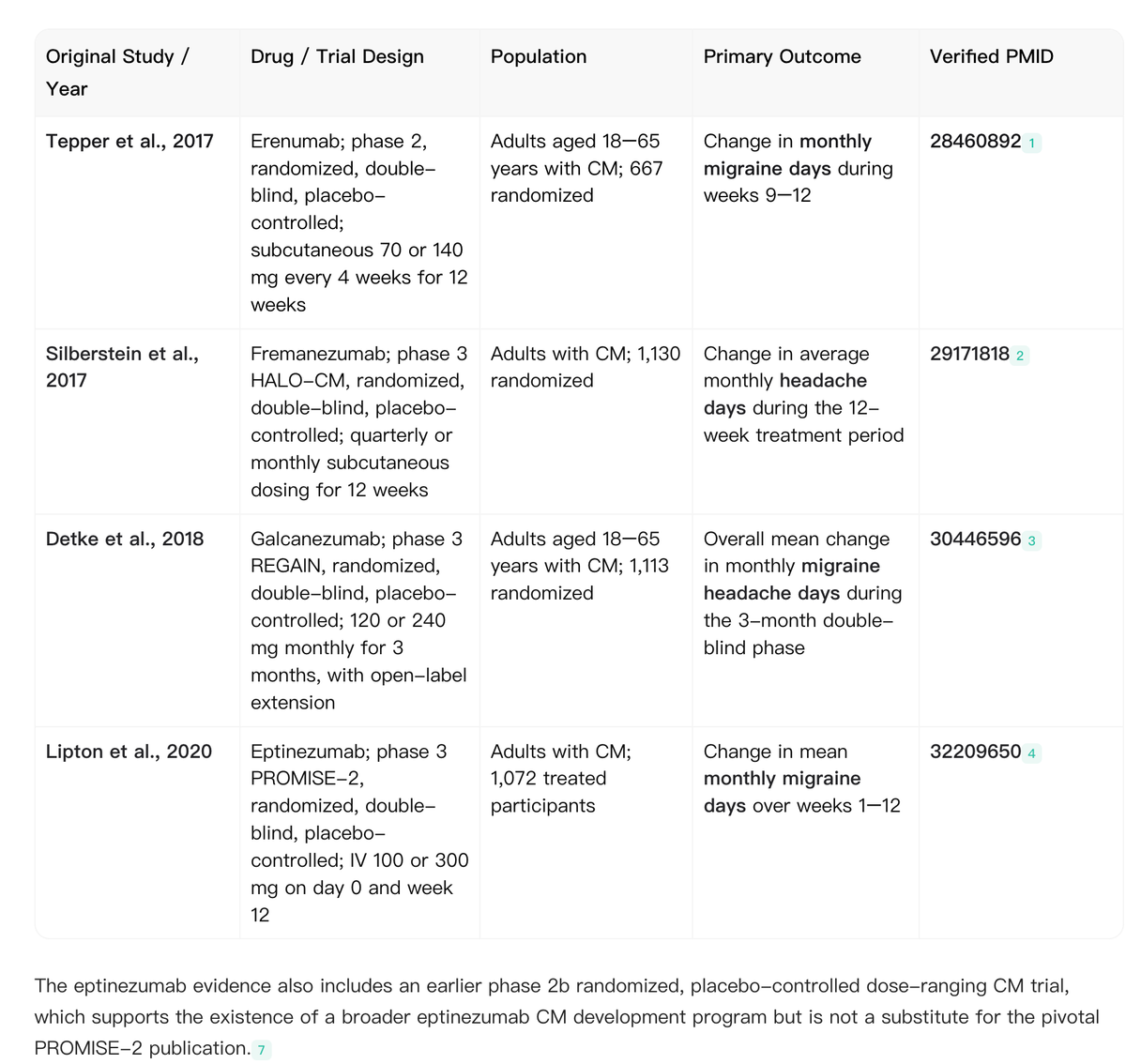
| Trial / publication | Medicine | Primary outcome wording | Original source |
|---|---|---|---|
| Tepper et al. (2017), phase 2 | Erenumab | Change in monthly migraine days during weeks 9–12 | [PMID 28460892](https://pubmed.ncbi.nlm.nih.gov/28460892/) |
| HALO-CM, Silberstein et al. (2017) | Fremanezumab | Change in average monthly headache days over 12 weeks | [PMID 29171818](https://pubmed.ncbi.nlm.nih.gov/29171818/) |
| REGAIN, Detke et al. (2018) | Galcanezumab | Mean change in monthly migraine headache days during the blinded phase | [PMID 30446596](https://pubmed.ncbi.nlm.nih.gov/30446596/) |
| PROMISE-2, Lipton et al. (2020) | Eptinezumab | Change in monthly migraine days over weeks 1–12 | [PMID 32209650](https://pubmed.ncbi.nlm.nih.gov/32209650/) |
The four publications concern adults with chronic migraine, but they do not use interchangeable efficacy measures. The original fremanezumab publication measures qualifying headache days, whereas the erenumab and eptinezumab reports focus on monthly migraine days. REGAIN uses monthly migraine headache days under its trial definition. Rewriting all four as the same endpoint would make the citations less precise.
There is also an important mechanistic detail: erenumab targets the CGRP receptor, while the other named antibodies bind the CGRP ligand. "CGRP-pathway therapies" is therefore more precise than a statement suggesting every medicine binds the same target.
What Happens When a Claim Is Unsupported?
The most informative part of the Noah example was its handling of an overstated sentence claiming that eptinezumab was proven superior to all competing CGRP antibodies in direct randomized trials.
The report did not attach a superficially relevant placebo-controlled trial to justify the statement. Instead, it cited a 2021 network meta-analysis (PMID 33867991) as indirect comparative evidence, while explaining that the identified evidence did not establish the stated head-to-head superiority. The meta-analysis itself called for further direct comparisons.
That is a useful model for writing medical claims: replace unsupported certainty with accurately bounded evidence. A defensible revision is:
Randomized placebo-controlled trials report benefits of several CGRP-pathway monoclonal antibodies for prespecified chronic migraine outcomes, but cross-trial differences and the lack of direct randomized comparative evidence identified in this focused search do not establish that eptinezumab is superior to all alternatives.
This example illustrates claim checking, not a formal systematic demonstration that no such trial exists anywhere. It also does not imply that Noah will detect every unsupported claim in every future research task.
How to Verify a Medical Source Before Citing It
- Identify the claim type. Is the sentence about efficacy, harm, prevalence, mechanism, or comparative superiority?
- Prefer the appropriate original design. A treatment effect usually calls for the relevant primary trial; a direct superiority claim calls for a valid direct comparison, not unrelated placebo-controlled studies.
- Confirm the population. Chronic and episodic migraine are related but distinct eligibility categories.
- Preserve the endpoint's exact name. Monthly headache days, migraine headache days and migraine days may have different operational definitions.
- Check PMID, DOI and article type. Verify that the cited record exists and distinguish primary publications from extensions, reviews and meta-analyses.
- Inspect the conclusion's boundaries. An outcome at 12 weeks does not automatically establish long-term effects, and an indirect ranking is not randomized head-to-head proof.
For formal systematic reviews or regulatory decisions, researchers must go beyond this kind of focused AI search, including protocol-defined retrieval, screening and manual source appraisal.
Which Sourcely Alternative Should You Choose?
Choose Noah AI when the job is a biomedical evidence brief or a claim-level audit that needs original research links and an explicit discussion of uncertainty. The chronic migraine screenshots show one such workflow.
Choose Elicit when a key requirement is screening a literature set and extracting consistent information across many papers. Choose Consensus when the entry point is a scientific question and you want to inspect an evidence-focused literature response.
Choose Scite when you already have a paper and want to examine how it has been cited, including potentially contrasting contexts. Choose Semantic Scholar when accessible academic discovery, citation paths and paper recommendations are the first priority.
If the task is primarily adding references to an essay paragraph with minimal setup, Sourcely's own paste-and-find workflow may remain a practical fit. No platform should be considered a replacement for direct verification of the medical sources that support consequential claims.
Frequently Asked Questions
What is the best Sourcely alternative for medical research?
There is no universal winner. Noah AI is a relevant option for question-driven biomedical research and claim verification; Elicit is useful for structured screening and extraction; Scite is particularly useful for citation contexts. The best fit depends on the research deliverable and the needed evidence trail.
Can an AI tool find PubMed sources for a medical statement?
Yes, some tools can locate indexed biomedical publications and return identifiers such as PMIDs. However, the researcher must check that the indexed paper actually supports the specific wording of the statement.
Is a related paper automatically a valid citation?
No. A paper may discuss the same disease or drug without studying the relevant population, endpoint or comparison. In the Noah exercise, the unsupported eptinezumab superiority statement illustrates why this distinction matters.
Do I need to upload PDFs to find medical sources?
Not always. Question-driven search tools can begin with a topic or a draft claim. Full texts become important when confirming detailed methods, subgroup results and limitations not included in an abstract.
Can Scite tell me whether a medical study is true?
Scite provides useful citation-context signals, including supporting, contrasting and mentioning citation statements. Those signals are not themselves proof that a clinical result is true or generalizable.
Can I cite a network meta-analysis to prove head-to-head superiority?
No. Network meta-analyses may offer indirect comparisons, but they should not be described as direct randomized head-to-head evidence unless such trials actually form the basis for the specific claim.
Final Verdict
When choosing among Sourcely alternatives for medical research, prioritize source relevance, original study provenance, endpoint accuracy and honest uncertainty rather than the sheer number of papers or citations found.
The documented Noah AI exercise identified original chronic migraine trials and flagged an overconfident head-to-head superiority claim as unsupported by the evidence located in that focused search. That is the correct kind of question to ask of any medical source-finding assistant: not just "Can you find a citation?", but "Does the cited study actually justify this claim?"
Try a citation-grounded medical research workflow. Noah AI offers a free starting option with credits and no credit card required to begin.
Methodology note: Only the Noah workflow shown in Figures 1–3 was run for this article. Other tools were described using published official information. Evidence identification was focused and is not a PRISMA-compliant systematic review. This is research-method information, not individual clinical advice.