
Best Undermind Alternatives for Deep Medical Literature Research (2026)
Linda
Compare 5 Undermind alternatives for medical literature research in 2026, with a real Noah AI MASH study, trial evidence, and citation verification.
Undermind is built for extensive academic literature exploration. But researchers investigating clinical trials, histological endpoints, and source provenance may need a different combination of tools. This guide compares five Undermind alternatives and walks through one documented Noah AI deep-research run on metabolic dysfunction-associated steatohepatitis (MASH).
Evidence cutoff: October 27, 2026 · Product descriptions from publicly available provider documentation · Noah AI workflow tested using a real MASH research prompt and output
Quick Comparison: Which Undermind Alternative Fits Your Research?
| Tool | Primary strength | Best fit | Important limitation |
|---|---|---|---|
| Noah AI | Structured biomedical research workflows and cited synthesis | Comparing clinical trials, endpoints, evidence maturity, and source records | Generated findings still require validation against the underlying papers |
| Elicit | Research Agent, structured evidence extraction, and systematic-review workflows | Searching, screening, and extracting study-level data | Systematic Review access depends on the plan; model-extracted data need checking |
| SciSpace | Paper discovery, reading assistance, and literature review features | Understanding specific articles and developing an initial topic overview | A readable explanation does not guarantee a correct interpretation of a trial endpoint |
| Scite | Smart Citations and citation-context analysis | Checking how subsequent papers cite, support, or contrast earlier findings | Citation labels are not substitutes for evaluating the study design and primary data |
| ResearchRabbit | Citation-network exploration and related-paper discovery | Expanding outward from known seed papers and mapping a field | Network discovery alone does not produce a clinically validated evidence synthesis |
The table compares types of workflow, not experimentally established precision, recall, cost efficiency, or clinical accuracy. Only Noah AI was run for the MASH example below. Descriptions of the other products come from their published documentation.
What Is Undermind—and When Would You Look for an Alternative?
Undermind positions itself as an AI co-researcher for extensive scientific literature discovery. According to its website, users can describe a complex research goal, let the system explore and evaluate related papers, inspect the citations supporting a report, and continue refining the results. It also offers paper-library and research-monitoring workflows.
Those are substantive research capabilities. It would be misleading to characterize Undermind as a basic keyword search engine. The practical reason to choose an alternative is workflow fit: one researcher may prioritize source-traceable biomedical tables, another screening and extraction, and another discovery of related work through citation networks.
Five Undermind Alternatives Worth Considering in 2026
1. Noah AI — For Structured Biomedical Deep Research
Noah AI offers search and Agent-based workflows for medical and life-science questions. In Agent Deep Research, a researcher can supply a clinical question, an evidence cutoff, candidate studies, endpoints, exclusions, and a requested report structure. In the real run used for this article, Noah generated a literature discovery map and a cross-trial histological evidence matrix, identifying both provided seed papers and additional studies.
Why consider it: it can connect publication discovery to the details required for a biomedical evidence review: phase, population, histological endpoints, source identifiers, and research limitations. This does not demonstrate superiority to Undermind, which was not run on the same question here.
2. Elicit — For Screening and Structured Extraction
Elicit is designed around research questions, paper discovery, and evidence extraction. Its documentation distinguishes the flexible Research Agent from dedicated Research Reports and a guided Systematic Review workflow. The latter is suited to projects that require controlled screening and structured data extraction. For a clinical review with a prespecified inclusion protocol, these structured steps may be important.
Choose it when: the main job is to assemble a paper set, apply inclusion criteria, and extract fields for review. Any extracted values—especially denominators, endpoints, and effect sizes—still need checks against the original records.
3. SciSpace — For Reading and Interpreting Individual Papers
SciSpace provides AI-assisted literature discovery, document reading, and paper-oriented explanation tools. It can be useful when a topic is unfamiliar and a researcher needs help interpreting terminology or navigating individual publications.
Choose it when: understanding papers and constructing a literature overview are the immediate priorities. Clinical claims still require a separate check of each trial's endpoint definitions and statistical analysis.
4. Scite — For Citation Context and Claim Checks
Scite uses Smart Citations to show how a publication is mentioned in later literature, including contexts classified as supporting, contrasting, or mentioning. Its search, Assistant, and reporting tools can help researchers examine how a finding has been received and discussed.
Choose it when: you already have a pivotal paper or scientific claim and want to explore the subsequent citation record. A "supporting" citation should not be mistaken for independent replication of a clinical trial.
5. ResearchRabbit — For Citation Mapping and Discovery Beyond Keywords
ResearchRabbit builds on relationships between publications, authors, references, and citing papers. Researchers can start from known studies, explore earlier work and newer citing papers, and visualize clusters across a field.
Choose it when: discovering adjacent research or building a connected reading list matters more than generating a finished clinical synthesis. Its network-based recommendation approach is different from a full clinical evidence-review process.
Try a biomedical research workflow in Noah AI
Start with free credits; Noah's published signup information says no credit card is required to get started. Specify your clinical question, outcomes, and evidence cutoff before running an Agent task.
Real Test: Deep Medical Literature Research on MASH
We tested Noah AI directly with a focused question about incretin-based and related dual-agonist therapies for biopsy-confirmed MASH (previously NASH). The requested output was not simply a list of papers: it included discovery status, randomized-trial design, histological endpoints, fibrosis outcomes, safety, evidence maturity, and verifiable PMIDs.
The research prompt supplied two seed publications: the phase 2 semaglutide study (PMID 33185364) and SYNERGY-NASH tirzepatide (PMID 38856224). The output reported PubMed searching and identified three additional randomized trial publications: LEAN, survodutide phase 2, and the ESSENCE phase 3 interim report. These are findings from the visible report, not an independently audited search log or a formal systematic review.
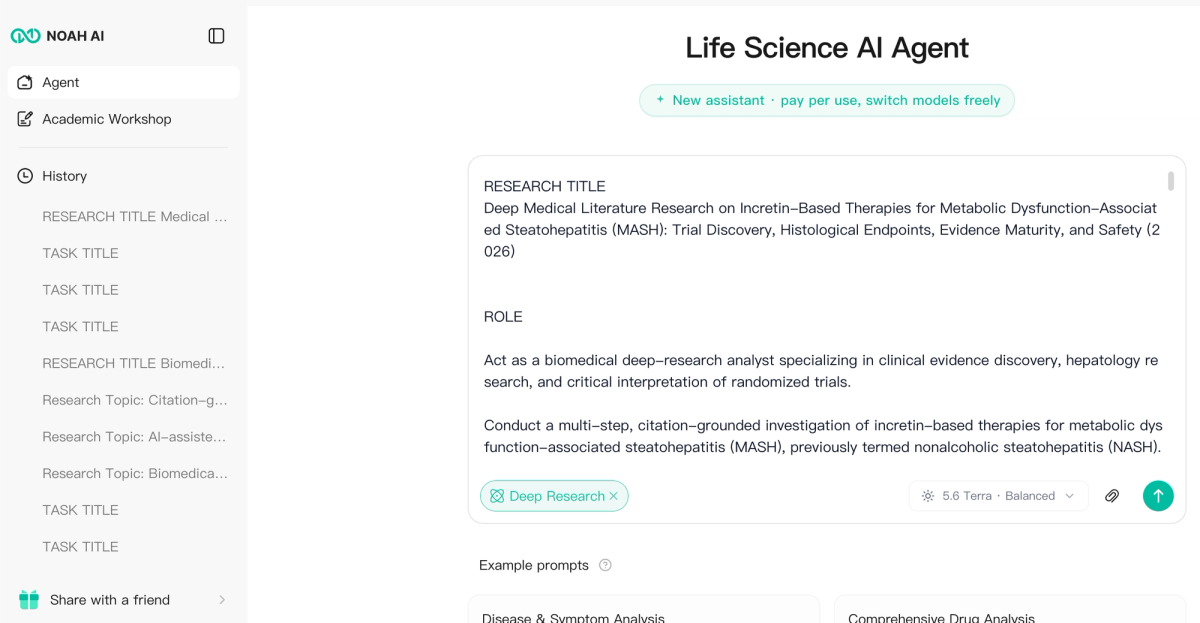
The test used an evidence cutoff of October 27, 2026. The report stated that verification relied mainly on PubMed abstracts; it did not claim a comprehensive multi-database search or independent full-text checking of every trial. This distinction matters for any publication-quality research process.
Step 1: Discover and Classify the Clinical Literature
The generated discovery map distinguished the two papers supplied to the Agent from later papers identified in its reported search. That separation makes it easier to assess whether an AI system did more than reorganize references given in the prompt.
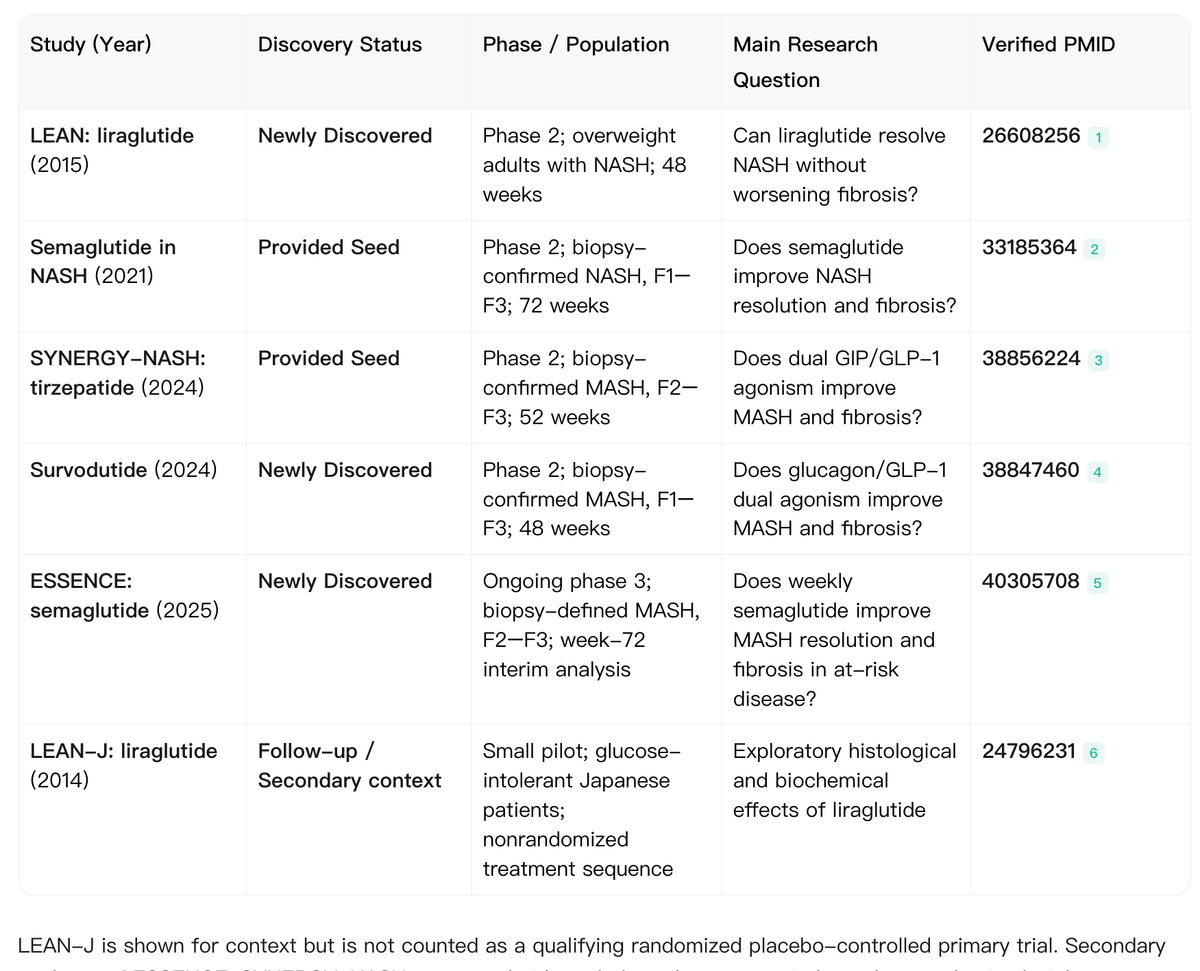
Scope note: The screenshot also includes LEAN-J (PMID 24796231), a small nonrandomized pilot labeled "Follow-up / Secondary context" in the generated table. It is not part of the five-trial randomized evidence set, and "nonrandomized contextual study" would be the more precise label.
| Original trial | Role in Noah test | Population / stage | Primary source |
|---|---|---|---|
| LEAN, liraglutide (published online 2015) | Reported newly discovered | Small phase 2 NASH trial, 48 weeks | [PMID 26608256](https://pubmed.ncbi.nlm.nih.gov/26608256/) |
| Semaglutide phase 2 (2021 journal publication) | Provided seed | NASH with F1–F3 fibrosis; 72 weeks | [PMID 33185364](https://pubmed.ncbi.nlm.nih.gov/33185364/) |
| SYNERGY-NASH, tirzepatide (2024) | Provided seed | MASH with F2–F3 fibrosis; 52 weeks | [PMID 38856224](https://pubmed.ncbi.nlm.nih.gov/38856224/) |
| Survodutide phase 2 (2024) | Reported newly discovered | MASH with F1–F3 fibrosis; 48 weeks | [PMID 38847460](https://pubmed.ncbi.nlm.nih.gov/38847460/) |
| ESSENCE, semaglutide phase 3 (2025) | Reported newly discovered | MASH with F2–F3 fibrosis; week-72 interim analysis | [PMID 40305708](https://pubmed.ncbi.nlm.nih.gov/40305708/) |
LEAN appeared online in 2015 and in a 2016 journal issue. ESSENCE's 2025 paper described a prespecified interim analysis of an ongoing 240-week study; it should not be described as a completed long-term outcome trial.
Step 2: Compare Histological Outcomes Without Misreading Them
Deep medical literature research requires more than extracting favorable percentages. In MASH trials, resolution of steatohepatitis without worsening fibrosis and improvement in fibrosis without worsening steatohepatitis are distinct outcomes. Trial populations, doses, schedules, and analysis methods also differ.
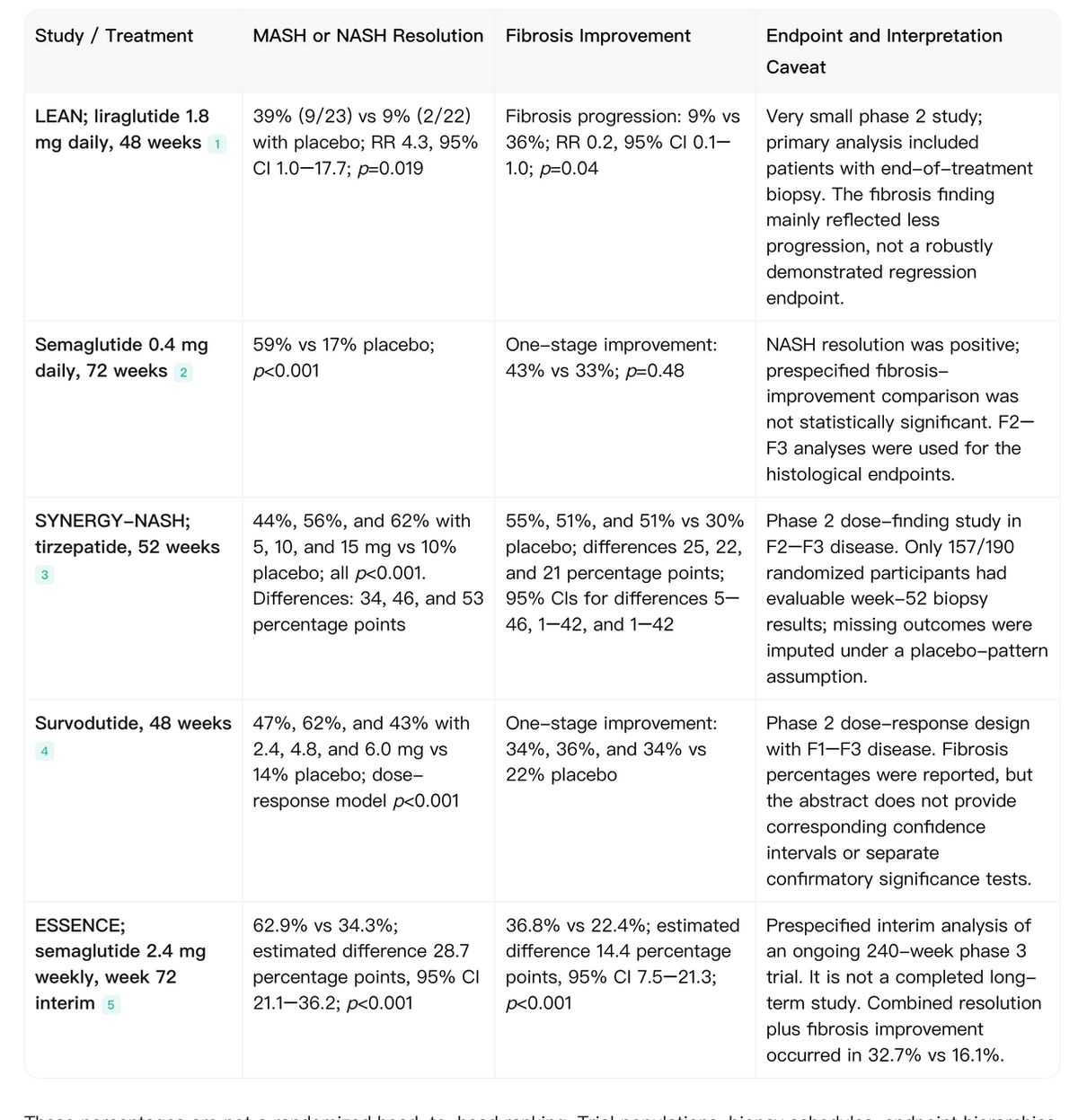
| Study | Reported histology result | Fibrosis finding | How to interpret |
|---|---|---|---|
| LEAN (liraglutide) | NASH resolution: 39% vs 9% placebo | Less fibrosis progression: 9% vs 36% | Very small biopsy-evaluable sample; less progression should not be rewritten as proven regression |
| Semaglutide phase 2 | NASH resolution: 59% vs 17% placebo at the 0.4-mg daily dose | One-stage improvement: 43% vs 33%; not significant (P=0.48) | Resolution benefit did not establish a statistically positive fibrosis endpoint |
| SYNERGY-NASH (tirzepatide) | MASH resolution: 44%, 56%, 62% across doses vs 10% placebo | One-stage improvement: 55%, 51%, 51% vs 30% | Phase 2 dose-finding; 157 of 190 randomized participants had evaluable week-52 biopsies |
| Survodutide phase 2 | MASH histological improvement: 47%, 62%, 43% vs 14% placebo | One-stage improvement: 34%, 36%, 34% vs 22% | Primary endpoint was MASH improvement, not necessarily the same resolution endpoint used elsewhere |
| ESSENCE phase 3 interim | MASH resolution: 62.9% vs 34.3% placebo | Improvement: 36.8% vs 22.4%; both histological outcomes significant | 72-week interim analysis, not final 240-week clinical-event evidence |
These numbers are within-study comparisons with placebo. They cannot be used to rank semaglutide, tirzepatide, liraglutide, and survodutide as if patients had been randomized between those drugs in one head-to-head trial.
Step 3: Evaluate Evidence Maturity and Clinical Relevance
The trial sequence illustrates why an evidence review should separate proof of concept from more mature results. LEAN enrolled a small number of participants. The semaglutide phase 2 trial reported a positive NASH-resolution finding without significant fibrosis improvement. SYNERGY-NASH and the survodutide trial examined dual-agonist strategies in phase 2 populations, while ESSENCE provided statistically significant week-72 histological data in a phase 3 program.
But improvements on biopsy do not, by themselves, establish fewer episodes of liver decompensation, lower transplant rates, fewer hepatocellular carcinomas, or a mortality benefit. The visible Noah report recognized the lack of mature long-term liver-event evidence in the selected original trials.
Safety must also be considered. Across several trials, gastrointestinal adverse effects were common. Trial-specific rates and discontinuations should be verified before making treatment comparisons, and no cross-trial drug safety ranking was established by this case.
What the visible test does show is a structured research output combining a discovery map, histological endpoints, and interpretation caveats. What it does not show is an independently measured retrieval benchmark against Undermind or every accessible clinical paper on MASH.
How to Choose Between Undermind and Its Alternatives
| Your research task | Consider first | Reason |
|---|---|---|
| Explore an unfamiliar scientific field through iterative deep searching | Undermind | Its published workflow emphasizes iterative retrieval, citation exploration, and ongoing refinement |
| Turn biomedical papers into a clinical endpoint and evidence maturity review | Noah AI | The MASH run produced a relevant structured discovery and evidence comparison |
| Conduct controlled screening and data extraction | Elicit | Dedicated workflow for paper selection and study-level fields |
| Read and interpret individual research papers | SciSpace | Reading assistance and literature discovery features |
| Examine how later papers cite a result | Scite | Smart Citation contexts and citation reports |
| Expand from seed papers through an academic citation graph | ResearchRabbit | Reference, citing-paper, and related-work exploration |
These are workflow recommendations rather than a controlled comparison. Depending on the project, more than one tool may be useful. Formal systematic reviews additionally require a documented search strategy, human screening, deduplication, risk-of-bias evaluation, and reproducible study selection.
Limitations of This Comparison
- Only Noah AI was tested for the MASH example. Undermind, Elicit, SciSpace, Scite, and ResearchRabbit were not run on identical prompts or evaluated for retrieval quality.
- Source verification was bounded. The Noah report described PubMed-based retrieval and abstract-level checks, not independent full-text evaluation of every publication.
- The discovery log was not independently reproduced. "Newly Discovered" reflects the Agent's report labels, not an external audit of the complete query history.
- Study endpoints differ. Survodutide's MASH improvement outcome should not be relabeled as the same MASH-resolution outcome used in other trials.
- Clinical maturity differs. ESSENCE's publication covers the planned week-72 interim analysis, not final 240-week clinical outcomes.
- No medical advice is offered. Research evidence synthesis cannot determine treatment for an individual patient.
Frequently Asked Questions
What is the best Undermind alternative for medical literature research?
It depends on the work. Noah AI is an option for structured biomedical deep-research reports; Elicit is well suited to study screening and extraction; Scite helps with citation contexts; ResearchRabbit explores citation networks; and SciSpace offers paper-oriented research assistance. No universal winner was established by this article.
Is Noah AI the same as Undermind?
No. Both can support research across scientific publications, but they describe different primary workflows. Undermind emphasizes iterative deep literature exploration; Noah AI emphasizes medical evidence search and structured Agent-based research outputs. Feature availability can change.
Can AI tools conduct a systematic review without human checking?
No AI-generated report should be presented as a complete systematic review solely because it includes tables and citations. A formal review requires documented retrieval, inclusion decisions, critical appraisal, and independent validation.
Why do MASH resolution and fibrosis improvement need separate columns?
They measure different aspects of liver pathology and are reported under distinct trial definitions. An improvement in one does not guarantee a significant improvement in the other.
Did Noah AI discover clinical papers beyond the two supplied references?
The report labeled LEAN, survodutide phase 2, and ESSENCE as newly discovered beyond the semaglutide and tirzepatide seeds. Their PMIDs correspond to real original studies, but the underlying database search sequence was not independently audited.
Does the ESSENCE trial prove long-term reductions in liver failure or mortality?
No. The cited 2025 ESSENCE publication reported a prespecified 72-week histological interim analysis from a trial planned for longer follow-up. Histological effects are not equivalent to demonstrated reductions in long-term clinical events.
Build a source-traceable medical evidence review
Explore Noah AI Agent for deep research on clinical trials, endpoint differences, and evidence limitations. Free signup credits are available, and the published product information states that no credit card is required to start.