
BIRC5/Survivin Target Evaluation: Mechanisms, Clinical Evidence & R&D Strategy (2026)
Linda
Explore BIRC5/survivin biology, YM155 clinical trials, LY2181308, SurVaxM immunotherapy, and R&D opportunities in this evidence-based target evaluation.
Survivin sits at the intersection of chromosome segregation and tumor-cell survival. Its biology is compelling; translating that biology into a selective anticancer therapy has been far more difficult.
Evidence Cutoff: October 21, 2026
This evidence-led assessment evaluates BIRC5/survivin biology, target validation, YM155 clinical results, RNA-based therapeutic strategies, survivin-directed immunotherapy, and potential R&D opportunities using a source-grounded Noah AI research workflow.
1. Executive Summary: Is BIRC5 a Promising Oncology Target?
BIRC5 encodes survivin, a small inhibitor-of-apoptosis-family protein with a well-established role in the chromosomal passenger complex (CPC). Survivin helps localize the Aurora B–INCENP–Borealin machinery during mitosis.
Its association with cancer cell survival is important, but the often-repeated description of survivin as a direct caspase-3/7 inhibitor overstates the mechanistic certainty. The most reproducible evidence concerns survivin's role in chromosome segregation, mitotic progression, and cytokinesis. 1, 2
Overexpression in tumors and successful gene depletion in experimental models are not equivalent to demonstrating that a drug can safely exploit a cancer-specific dependency.
The clinical histories of YM155 and LY2181308 illustrate the gap between an appealing molecular rationale, measurable target modulation, and improved patient outcomes. YM155-associated DNA damage involves transporter biology beyond survivin suppression, while LY2181308 achieved measurable human target engagement without demonstrating improved efficacy in randomized testing. 3, 4, 5
Survivin-directed immunotherapy offers another development route. SurVaxM demonstrated immunogenicity in an early glioblastoma study, and preliminary randomized phase IIb findings were reported in October 2026. However, the overall survival endpoint did not reach conventional statistical significance in the overall population, despite a positive prespecified younger subgroup signal.
Key takeaway: BIRC5 remains a credible biological and investigational oncology target. A differentiated R&D program would need a mechanism-specific intervention, tumor-selective exposure, an evidence-supported response biomarker, and clinical testing that distinguishes target engagement from patient benefit.
2. BIRC5 Target Biology: Mitosis and Apoptosis
Survivin is a 142-amino-acid protein encoded by BIRC5 and classified within the inhibitor of apoptosis protein (IAP) family.
Its clearest causal function is in mitosis. Survivin, INCENP, Borealin, and Aurora B form the chromosomal passenger complex, which coordinates chromosome–microtubule attachments, kinetochore correction, chromosome segregation, and cytokinesis. 1, 2
Mitotic Control: The Strongest Mechanistic Evidence
Survivin helps position the CPC at centromeres during early mitosis and contributes to its relocation during cell division.
Disruption of CPC function can result in chromosome misalignment, abnormal segregation, and cytokinesis failure. These effects provide a causal biological rationale for evaluating survivin-dependent tumor-cell fitness.
However, the same mitotic machinery is important in normal proliferating cells. A molecule that disrupts survivin's core CPC function may therefore affect both malignant and healthy dividing tissues.
Apoptosis Regulation: A More Complex Mechanism
Survivin has also been associated with mitochondrial survival signaling, XIAP activity, and Smac/DIABLO-related apoptosis regulation.
These pathways may contribute to resistance against chemotherapy and other cellular stresses. Nevertheless, the evidence does not justify treating direct inhibition of caspase-3 or caspase-7 as a universally established survivin mechanism. 15
This distinction matters for drug discovery. A compound that induces DNA damage and subsequently reduces survivin expression does not necessarily validate direct BIRC5 inhibition.
Similarly, high BIRC5 expression may reflect rapid tumor proliferation without proving that the tumor is uniquely dependent on survivin.
Why the Therapeutic Window Is Challenging
Many tumors express survivin at elevated levels, but normal progenitor and renewing-cell populations also depend on mitotic regulation.
Potential selectivity strategies include targeted RNA delivery, tumor-associated antigen recognition, and interventions designed around molecular dependencies that are stronger in malignant cells.
Each strategy introduces additional questions about tissue distribution, delivery efficiency, biomarker reliability, and safety.
3. Target Validation: Strong Biology Does Not Guarantee Clinical Benefit
Genetic depletion and RNA-interference experiments establish that survivin contributes to processes required by many cancer cells.
Preclinical xenograft studies have also reported tumor-growth inhibition following survivin-directed interventions.
The translational question is whether a therapeutic candidate can engage the intended mechanism in patients and improve clinically meaningful outcomes without unacceptable toxicity.
| Evidence Tier | What the Evidence Supports | What Remains Unproven |
|---|---|---|
| Mechanistic and genetic studies | Survivin contributes to CPC localization and successful mitosis. | A selective therapeutic window between tumors and healthy dividing cells. |
| Small-molecule pharmacology | YM155 uptake through SLC35F2 can produce DNA-damage toxicity. | Whether its antitumor effects are specifically mediated by BIRC5 suppression. |
| Human target engagement | LY2181308 accumulated in tumors and reduced survivin expression by approximately 20% in sampled tissue. | Whether that level of suppression is sufficient to improve patient outcomes. |
| Randomized clinical trials | YM155 and LY2181308 combinations have undergone controlled evaluation. | The tested regimens did not establish superior clinical outcomes. |
Sources: CPC biology, YM155 mechanism, LY2181308 pharmacodynamics, YM155 clinical trial.
An evidence-based target assessment should distinguish four separate stages: biological target identity, molecular dependency, pharmacodynamic target engagement, and demonstrated clinical benefit.
Confusing these stages can make an oncology target appear more clinically validated than the data support.
4. YM155: Clinical Evidence and Mechanistic Limitations
Sepantronium bromide (YM155) was originally investigated as a small-molecule suppressant of survivin expression.
Its early development reflected the hypothesis that reducing survivin-associated cellular protection could enhance tumor-cell death, including alongside chemotherapy.
Survivin-expression suppressant with additional pharmacological mechanisms, including SLC35F2-dependent uptake and DNA-damage effects. 3
YM155 Clinical Development Results
| Clinical Setting | Reported Outcome | Interpretation |
|---|---|---|
| HER2-negative metastatic breast cancer | Randomized phase II: YM155 plus docetaxel versus docetaxel; median PFS 8.4 versus 10.5 months, HR 1.53, p = 0.176. | No significant improvement in the primary PFS endpoint. |
| Refractory non-small-cell lung cancer | Single-arm phase II: 2 confirmed partial responses among 37 patients; reported ORR 5.4%. | Limited activity without a randomized comparator. |
| Refractory diffuse large B-cell lymphoma | Single-arm phase II: one complete remission in a 41-patient study. | Modest activity that does not establish mechanism-specific efficacy. |
Sources: YM155 breast cancer trial, NSCLC trial, DLBCL trial.
The randomized breast cancer study is especially important because it directly tested whether adding YM155 improved outcomes over chemotherapy alone.
The failure to demonstrate a significant improvement challenges that particular combination strategy.
However, these results do not establish that every possible BIRC5-directed therapy will fail. YM155 has pharmacological properties that extend beyond survivin-expression suppression.
What YM155 Teaches Drug Developers
Future small-molecule programs should measure drug uptake, SLC35F2 expression, DNA-damage signaling, survivin-specific pharmacodynamic effects, and tumor response separately.
Without this mechanistic separation, a clinical response may be incorrectly attributed to BIRC5 inhibition, while a negative study may be incorrectly interpreted as definitive failure of the target itself.
5. LY2181308: RNA-Based Targeting and Clinical Translation
LY2181308 is an antisense oligonucleotide designed to reduce survivin mRNA expression.
Unlike YM155, which has additional pharmacological mechanisms, antisense approaches provide a more direct way to investigate whether reducing BIRC5 expression produces meaningful therapeutic effects.
In a first-in-human study involving 40 patients, tumor biopsies and imaging demonstrated LY2181308 accumulation in tumor tissue.
At the 750 mg dose, investigators reported approximately 20% reductions in survivin gene and protein expression, alongside changes in apoptosis-related signaling. 6
This provided human pharmacodynamic evidence that BIRC5 expression could be reduced through an antisense strategy.
However, target knockdown alone is not evidence of meaningful clinical benefit.
Randomized Clinical Evidence
A randomized phase II study in non-small-cell lung cancer evaluated LY2181308 combined with docetaxel against docetaxel alone.
The study enrolled 162 patients and did not demonstrate a significant improvement in the evaluated efficacy outcomes.
The tumor-size ratios were 1.05 versus 1.00 (p = 0.200), and median progression-free survival was 2.83 versus 3.35 months (p = 0.191). 5
A separate randomized study involving prostate cancer also did not establish an efficacy advantage for its tested LY2181308 combination. 17
Implications for Future RNA Therapeutics
These findings highlight a major challenge in RNA-based drug development: measurable delivery and target reduction do not necessarily produce a sufficient biological effect.
A future BIRC5 RNA program should investigate the magnitude and durability of knockdown, intracellular delivery, distribution across heterogeneous tumor regions, and exposure in normal proliferating tissues.
Delivery technologies such as targeted lipid nanoparticles and other experimental carriers may offer opportunities, but their advantages must be demonstrated through direct comparative evidence.
6. SurVaxM: Survivin-Directed Cancer Immunotherapy
Survivin-directed immunotherapy offers a different therapeutic approach from small-molecule or RNA-mediated expression suppression.
Rather than attempting to inhibit survivin throughout tumor tissue, immunotherapy seeks to stimulate immune recognition of survivin-associated tumor antigens.
SurVaxM is a peptide-mimic immunotherapy investigated in glioblastoma.
Phase IIa: Immunogenicity and Early Clinical Evidence
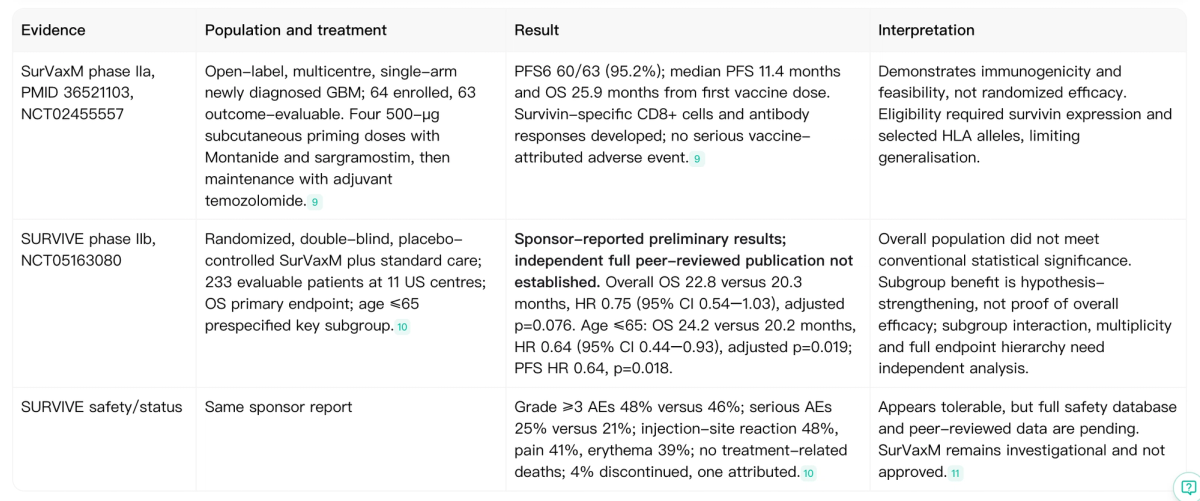
A phase IIa study evaluated SurVaxM alongside adjuvant temozolomide in newly diagnosed glioblastoma.
The open-label, single-arm study enrolled 64 patients, with 63 evaluable for the reported outcomes.
The study reported a median progression-free survival of 11.4 months and median overall survival of 25.9 months measured from the first vaccine dose.
Survivin-specific cellular and antibody responses were observed, and the investigators reported no serious adverse events attributed to the vaccine. 7
These findings support the feasibility and immunogenicity of survivin-directed vaccination.
However, a single-arm study cannot establish whether SurVaxM improves survival compared with standard treatment.
Phase IIb SURVIVE: October 2026 Preliminary Results
On October 7, 2026, MimiVax and Roswell Park announced preliminary results from the randomized, double-blind, placebo-controlled phase IIb SURVIVE trial, NCT05163080.
The sponsor reported results from 233 evaluable patients.
For the overall study population, median overall survival was 22.8 months with SurVaxM versus 20.3 months in the control group.
The reported hazard ratio was 0.75 (95% CI 0.54–1.03), with an adjusted p-value of 0.076.
Therefore, the overall-population primary survival endpoint did not meet the conventional p = 0.05 threshold.
In a prespecified subgroup of patients aged 65 years or younger, the sponsor reported median overall survival of 24.2 versus 20.2 months, HR 0.64, and adjusted p = 0.019. 8
The subgroup finding is relevant to future study design, but it does not replace the nonsignificant overall primary result.
These findings should be described as preliminary sponsor-reported evidence, rather than independently established efficacy from a complete peer-reviewed trial publication.
SurVaxM Clinical Evidence Comparison
How Should the SurVaxM Results Be Interpreted?
Several questions remain important for the clinical development of survivin-directed vaccines.
These include whether the observed subgroup effect reflects a genuine treatment interaction, how multiple comparisons were handled, and whether longer follow-up supports the preliminary findings.
Biomarkers may also be important. Survivin expression, HLA presentation, immune-cell activity, and antigen heterogeneity could influence which patients respond to an antigen-directed intervention.
The broader field of survivin immunotherapy also faces challenges involving immune escape, tumor antigen loss, and potential activity against normal tissues expressing survivin.
SurVaxM remained investigational as of the October 21, 2026 evidence cutoff. Its preliminary phase IIb findings should not be presented as evidence of regulatory approval.
Researchers can use Noah AI to organize the underlying publications, trial records, and reported findings while keeping study design and evidence limitations visible.
Start Your Next Target Evaluation with 300 Free Credits
From target biology and clinical validation to therapeutic strategies and R&D opportunities, Noah AI helps researchers turn complex biomedical evidence into structured, source-linked research outputs.
New to Noah AI? Get 300 free credits when you sign up — no credit card required.
Sign Up Free & Claim 300 Credits →
7. Comparing BIRC5 Therapeutic Strategies with Noah AI
BIRC5 target evaluation becomes more useful when therapeutic approaches are assessed separately rather than treated as interchangeable methods of survivin inhibition.
Small molecules, antisense oligonucleotides, and cancer vaccines operate through different mechanisms and face different translational challenges.
For this case study, Noah AI organized the research evidence into four decision-oriented dimensions:
- Mechanism: What biological process or molecular target is being addressed?
- Therapeutic Strategy: How does the proposed intervention act?
- Clinical Evidence: What has been demonstrated in human studies?
- Limitations: Which uncertainties constrain clinical development?
BIRC5/Survivin Target Evaluation Results
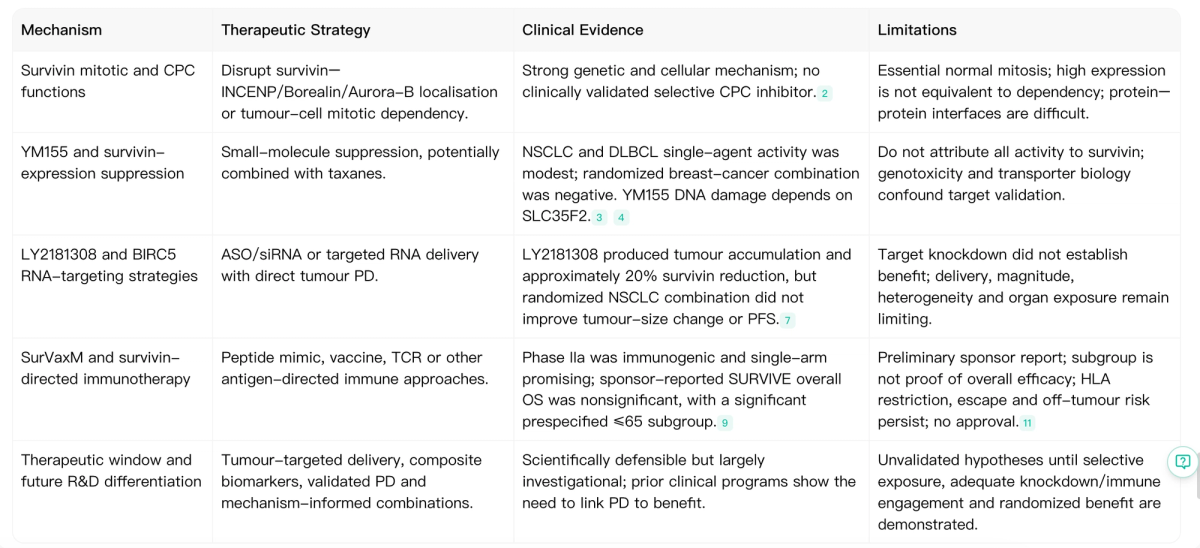
The value of this comparison is its ability to preserve differences between biological rationale, target engagement, clinical activity, and demonstrated efficacy.
The YM155 experience emphasizes pharmacological specificity.
The LY2181308 experience illustrates the limitations of partial target knockdown.
The SurVaxM experience introduces a distinct antigen-directed mechanism, alongside uncertainty about whether preliminary subgroup findings will translate into confirmed clinical benefit.
What Can Researchers Learn from This Comparison?
First, a strong biological rationale does not automatically translate into a successful therapeutic strategy.
Second, target engagement must be measured using mechanism-appropriate methods.
Third, negative clinical findings should remain visible in a target evaluation rather than being excluded in favor of positive preclinical results.
Finally, potential development opportunities should be framed as hypotheses requiring experimental or clinical validation.
An evidence-based comparison helps researchers identify the next question to test, rather than generating a numerical target score unsupported by validated methodology.
8. Therapeutic Window and Translational Development Barriers
The most important challenge for BIRC5-directed treatment is achieving a useful therapeutic effect while limiting harm to normal tissues.
Survivin is associated with tumor proliferation, but its role in CPC-dependent mitosis is not exclusive to malignant cells.
Consequently, interventions affecting core survivin function could also disrupt healthy proliferating compartments.
Pharmacological Specificity
YM155 illustrates why apparent suppression of a target does not establish that the target mediates the drug's therapeutic effects.
Alternative mechanisms, including transporter-dependent drug uptake and DNA damage, can complicate interpretation.
Future development requires evidence that connects the intended BIRC5 intervention to downstream biological consequences and clinical outcomes.
RNA Delivery and Target Suppression
The experience with LY2181308 demonstrates that systemic administration can achieve tumor exposure and measurable survivin reduction.
However, the depth, uniformity, and duration of suppression may be insufficient.
A new RNA-targeting strategy should evaluate intracellular payload delivery, tumor heterogeneity, normal-tissue exposure, and the relationship between knockdown and tumor response.
Immunotherapy and Antigen Selection
Survivin-directed immunotherapy faces a different group of limitations.
HLA restriction, antigen presentation, intratumoral heterogeneity, and immune escape may affect treatment applicability and efficacy.
Patient selection based on validated immune and molecular characteristics could improve future trial design, but these biomarkers require prospective testing.
Clinical Trial Design
Early-phase and single-arm studies can establish feasibility, safety observations, and preliminary activity.
They cannot reliably establish comparative treatment benefit.
Randomized studies with prespecified endpoints, suitable comparators, and transparent subgroup analyses remain essential for determining whether a BIRC5-directed strategy improves outcomes.
9. BIRC5 R&D Opportunities and Differentiation Strategy
The available evidence supports continued investigation of BIRC5, but not an unrestricted development program based solely on elevated survivin expression.
More credible opportunities involve a defined mechanism, a plausible route to selectivity, and a study capable of testing the proposed advantage.
| R&D Opportunity | Scientific Rationale | Required Validation | Main Risk |
|---|---|---|---|
| Tumor-directed RNA delivery | Achieve deeper and more localized BIRC5 suppression than historical antisense approaches. | Paired biopsies, intracellular delivery measurements, knockdown durability, and tumor-versus-normal exposure. | Inefficient delivery and normal-tissue toxicity. |
| CPC or protein-directed interventions | Target an established mitotic mechanism rather than nonspecific cellular stress. | Chemical-genetic rescue, target-selectivity profiling, and normal-cell testing. | Difficult protein interactions and a narrow therapeutic window. |
| Biomarker-guided immunotherapy | Improve selection for survivin-directed immune recognition. | HLA status, antigen expression, immune-response biomarkers, and randomized confirmation. | Immune escape, patient heterogeneity, and uncertain subgroup effects. |
| Mechanism-informed combinations | Combine therapies where BIRC5 dependency and partner-drug mechanisms are supported by evidence. | Pharmacodynamic measurements, exposure-response analysis, and controlled clinical trials. | Overlapping toxicity and historical combination failures. |
Improved RNA Delivery
A next-generation RNA therapeutic could be differentiated by more effective intracellular delivery or stronger tumor-selective exposure.
However, improved delivery must be demonstrated rather than assumed from the choice of carrier technology.
Studies should measure the concentration of active payload reaching relevant cellular compartments and link this exposure to a reproducible biological response.
More Selective Protein-Level Intervention
Survivin's established participation in the CPC provides a clear mechanistic framework for experimental discovery.
Potential strategies involving disruption of protein interactions or other selective interventions require extensive validation.
The central question is whether meaningful inhibition in malignant cells can be separated from disruption of essential functions in healthy dividing cells.
Biomarker-Defined Immunotherapy
Survivin-directed immune therapies may benefit from improved patient selection.
Potentially relevant characteristics include antigen expression, HLA status, immune-cell activity, and markers of antigen-processing capacity.
The preliminary SURVIVE subgroup finding strengthens the rationale for investigating patient-level heterogeneity, but it does not establish a validated predictive biomarker.
Rational Combination Therapy
Combining BIRC5-directed strategies with existing anticancer agents may be scientifically attractive where survivin-dependent survival mechanisms contribute to resistance.
Nevertheless, historical YM155 and LY2181308 combination results demonstrate why preclinical synergy is insufficient.
Future studies should require mechanism-specific pharmacodynamic evidence and a clearly defined clinical hypothesis.
Intellectual Property and Freedom-to-Operate Considerations
BIRC5 drug discovery also requires modality-specific intellectual property diligence.
Relevant areas may include small-molecule composition and use claims, antisense and siRNA sequences, chemical modifications, delivery systems, peptide antigens, vaccine formulations, engineered T-cell constructs, and combination-treatment claims.
A target name alone does not determine freedom to operate.
A comprehensive assessment would require jurisdiction-specific searches, patent-family analysis, claim interpretation, and qualified legal review.
This article does not claim to establish patent availability, ownership, or freedom to operate.
10. How to Conduct a BIRC5 Target Evaluation with Noah AI
This case study uses an actual Noah AI-generated target evaluation report and two real output screenshots.
The research workflow focuses on source-grounded analysis rather than assigning arbitrary target scores.
Researchers can reproduce a similar evaluation by defining the target, selecting representative therapeutic programs, examining primary scientific literature, and requiring a comparison of clinical outcomes and limitations.
Step 1: Define the Target and Research Question — Begin with BIRC5/survivin, UniProt O15392. The central question is whether survivin's established biological importance can be translated into a selective and clinically effective oncology treatment. The analysis should distinguish the protein's mitotic function from its more context-dependent apoptosis-associated mechanisms.
Step 2: Collect Target Validation Evidence — Review genetic, cellular, animal, and human studies. Separate evidence establishing survivin's biological function from evidence demonstrating therapeutic selectivity. Avoid treating elevated tumor expression as proof of a druggable dependency.
Step 3: Review Representative Therapeutic Programs — Include mechanistically distinct examples: YM155 for small-molecule expression suppression and mechanism-specificity concerns; LY2181308 for antisense targeting and clinical pharmacodynamics; and SurVaxM for antigen-directed immunotherapy. Each program should be evaluated using its actual clinical design, published outcomes, and major limitations.
Step 4: Verify Positive and Negative Findings — Check clinical study identifiers, patient populations, endpoints, treatment results, and evidence maturity. For randomized studies, report the comparator and primary outcome. For uncontrolled studies, avoid implying comparative efficacy. For sponsor-reported results, identify the source and distinguish preliminary findings from independently peer-reviewed evidence.
Step 5: Generate the Four-Column Target Evaluation — Ask Noah to organize the completed evidence into: Mechanism | Therapeutic Strategy | Clinical Evidence | Limitations. This format makes it easier to compare therapeutic approaches without collapsing them into a single unsupported target ranking.
11. Frequently Asked Questions
Is BIRC5 the same as survivin? Yes. BIRC5 is the gene name, while survivin is the encoded protein. Its role in the chromosomal passenger complex is particularly well established. 1
Is survivin a clinically validated cancer drug target? Survivin's biological role is strongly supported, and several survivin-directed strategies have entered clinical research. However, this is different from demonstrating broad and selective clinical benefit from BIRC5 inhibition in randomized trials.
Does YM155 selectively inhibit survivin? YM155 was developed as a survivin-expression suppressant, but subsequent research demonstrated an important role for SLC35F2-mediated uptake and DNA-damage toxicity. Therefore, YM155 activity cannot automatically be attributed to selective BIRC5 inhibition. 3
Did LY2181308 reduce survivin expression in patients? Early human research reported approximately 20% reductions in survivin gene and protein expression in sampled tumors. However, randomized combination studies did not demonstrate a clear clinical efficacy advantage. 6, 5
Did SurVaxM succeed in the 2026 SURVIVE trial? The October 7, 2026 sponsor announcement reported a nonsignificant overall-population survival result, adjusted p = 0.076, alongside a positive prespecified subgroup finding for patients aged 65 or younger, adjusted p = 0.019. These preliminary findings do not establish confirmed benefit in the full study population or regulatory approval. 8
What are the major barriers to BIRC5-targeted therapy? Major challenges include survivin's essential function in normal dividing cells, pharmacological selectivity, RNA delivery, incomplete target suppression, tumor heterogeneity, and uncertain predictive biomarkers. Different therapeutic modalities may face different combinations of these obstacles.
Can AI help evaluate oncology targets such as BIRC5? AI-assisted research tools can help organize publications, compare therapeutic approaches, extract clinical evidence, and structure research limitations. However, investigators must still verify primary sources and distinguish experimentally established findings from hypotheses or unsupported claims.
Conclusion: From Survivin Biology to a Testable R&D Strategy
BIRC5/survivin remains an important oncology research target because of its established role in mitosis and its association with tumor-cell survival.
Nevertheless, the history of survivin-directed therapeutic development demonstrates that strong molecular biology is not sufficient to establish clinical success.
YM155 illustrates the difficulty of attributing pharmacological effects to a specific molecular target. LY2181308 demonstrates that measurable human target suppression may not produce improved outcomes. SurVaxM provides a distinct immunotherapy pathway, although randomized efficacy remains unresolved in the available preliminary evidence.
Future BIRC5 programs should prioritize selective intervention, mechanism-specific pharmacodynamic evidence, biomarker-informed patient selection, and clinical trial designs capable of establishing meaningful benefits.
A source-grounded workflow can help researchers compare these dimensions while preserving negative findings and scientific uncertainty.
Evaluate Your Next Oncology Target with Noah AI
Organize biomedical literature, examine clinical evidence, and build a structured target evaluation around the next candidate in your research pipeline.
Start Your Next Target Evaluation with 300 Free Credits
From target biology and clinical validation to therapeutic strategies and R&D opportunities, Noah AI helps researchers turn complex biomedical evidence into structured, source-linked research outputs.
New to Noah AI? Get 300 free credits when you sign up — no credit card required.