
Colorectal Cancer Indication Strategy (2026): EGFR, KRAS, Clinical Competition & R&D Opportunities
Linda
Explore colorectal cancer indication strategy in 2026, covering EGFR, KRAS, BRAF, biomarker-defined treatments, clinical competition, and R&D opportunities.
Evidence cutoff: October 22, 2026 · Focus: United States regulatory landscape and international disease evidence · Estimated reading time: 12 minutes
Colorectal cancer (CRC) is a major oncology development area, but it is not a single therapeutic market. A treatment strategy that makes sense for left-sided, RAS-wild-type metastatic disease may have little relevance to KRAS G12C-mutant disease, BRAF V600E tumors, immune-responsive MSI-H/dMMR cancer, or locally advanced rectal cancer. Molecular segment, disease stage, tumor sidedness, prior therapy, and endpoint choice all change the competitive question.
This report uses a real Noah AI research workflow to organize the CRC evidence into a clinical-competition matrix and a development-opportunity matrix. We reviewed key regulatory and published clinical sources alongside the generated report. The goal is an evidence-grounded indication strategy, not a prediction of investment returns or an attempt to recreate a proprietary drug-deal database.
Executive Summary: Prioritize Biomarker-Defined CRC Opportunities
The most defensible strategy is to identify a precise patient group and a clear treatment failure before selecting a modality. Established treatment classes already occupy several molecular segments. Differentiation increasingly depends on overcoming acquired resistance, delivering durable benefit, improving tolerability, or expanding effective treatment into carefully selected settings.
The distinction between localized rectal cancer and metastatic CRC is especially important. As of the evidence cutoff, a new U.S. accelerated approval for dostarlimab applied to eligible stage II/III MSI-H/dMMR locally advanced rectal cancer. It must not be treated as a metastatic comparator merely because the disease shares the CRC umbrella label. FDA, October 19, 2026.
Strategic readout: strong validated benchmarks in selected RAS/BRAF-wild-type, KRAS G12C, BRAF V600E, and MSI-H/dMMR settings; major but difficult unmet need in MSS/pMMR disease; promising research hypotheses, rather than clinically proven new opportunities, in ctDNA-guided resistance strategies, allele-specific KRAS programs, and selected perioperative or liver-metastasis settings.
1. Disease Background: Why CRC Must Be Segmented
The World Health Organization estimates that approximately 1.9 million new colorectal cancer cases and more than 900,000 deaths occurred worldwide in 2022. These figures describe the global disease burden, not the U.S. treatment-eligible population or the addressable market for a particular therapy.
Geographic and regulatory scope: This report uses international epidemiological data and clinical research to characterize colorectal cancer biology, disease burden, and therapeutic evidence. Drug approval status, however, refers specifically to the United States and is based on FDA regulatory decisions available through October 22, 2026.
Clinical evidence from international trials does not automatically establish FDA approval, approval in other jurisdictions, or identical treatment availability across countries. Indication strategies must distinguish scientific evidence, regulatory authorization, disease stage, molecular eligibility, and local treatment standards.
A useful indication definition must separate four levels of clinical context:
- Colon vs rectal primaries: local anatomy, surgery, radiation, organ preservation, and perioperative endpoints differ.
- Localized vs metastatic disease: potentially curative strategies use recurrence, event-free survival, or organ-preservation endpoints; metastatic programs commonly assess response, progression-free survival, and overall survival.
- Tumor sidedness: left-sided RAS-wild-type metastatic tumors generally derive greater benefit from EGFR-directed strategies than right-sided tumors, although sidedness never replaces molecular testing.
- Molecular genotype and treatment history: RAS, BRAF, mismatch repair, MSI, HER2, previous exposure, and resistance all shape the appropriate comparator.
A broad claim such as "CRC is a large market" is therefore insufficient for drug-development prioritization. A development team should first define a treatable molecular population, its current standard of care, and an endpoint that would materially change management.
2. Clinical Competition by Biomarker
Our Noah AI case study organized five practical CRC groups: RAS/BRAF-wild-type, KRAS G12C, BRAF V600E, MSI-H/dMMR, and MSS/pMMR. These are useful strategy categories, not a mutually exclusive molecular taxonomy. For example, mismatch-repair status should be assessed alongside oncogenic driver alterations, rather than inferred from them.
Real Noah AI Output: Clinical Competition by Biomarker
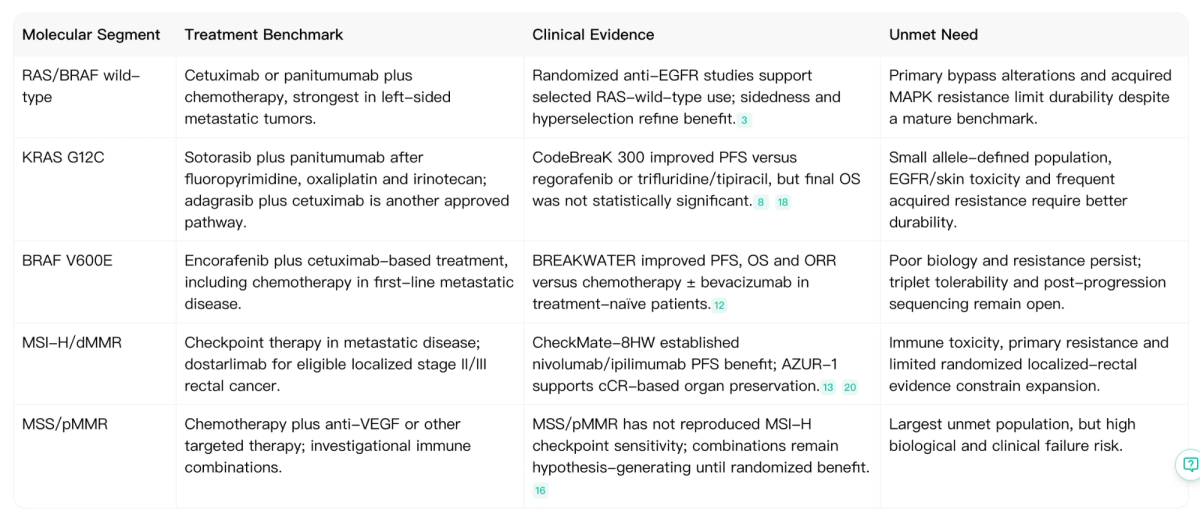
The matrix helps keep four questions connected: which patients are being treated, what the benchmark is, what clinical evidence supports it, and what limitation a new entrant would need to overcome.
RAS/BRAF wild-type. EGFR antibodies such as cetuximab or panitumumab are established components of treatment for appropriately selected metastatic patients. Tumor sidedness, broader negative-selection biomarkers, and prior anti-EGFR exposure matter. A new therapy cannot rely on EGFR biology alone; it needs a resistance or selection advantage. Anti-EGFR evidence.
KRAS G12C. This allele has authorized U.S. combination pathways, including sotorasib plus panitumumab and adagrasib plus cetuximab in specified previously treated populations. Neither label makes other KRAS alleles interchangeable with G12C. FDA: sotorasib · FDA: adagrasib.
BRAF V600E. Upstream feedback biology and validated treatment combinations make this a competitive targeted-therapy segment. On February 24, 2026, the FDA granted traditional approval to encorafenib with cetuximab and fluorouracil-based chemotherapy for eligible metastatic BRAF V600E CRC. FDA approval.
MSI-H/dMMR. Checkpoint therapy has an established role in eligible unresectable or metastatic disease. The October 2026 dostarlimab approval adds a separate localized rectal indication, with different treatment objectives and evidence standards. FDA: nivolumab/ipilimumab · FDA: dostarlimab.
MSS/pMMR. This is a broad population with substantial unmet need, but checkpoint monotherapy has not established the same treatment benchmark as in MSI-H/dMMR CRC. Immune-sensitization programs require mechanistic biomarkers and controlled evidence, not just promising activity in a small single-arm study. Immunotherapy review.
3. EGFR and KRAS: Connected Biology, Different Clinical Strategies
EGFR activation can stimulate the RAS–RAF–MEK–ERK cascade and other growth or survival pathways. When oncogenic RAS signals independently downstream, EGFR blockade may no longer suppress pathway output sufficiently. This explains the importance of RAS testing before conventional anti-EGFR treatment in metastatic CRC.
For KRAS G12C, feedback activation helps explain why combining mutant-specific KRAS inhibition with EGFR blockade has clinical value. For BRAF V600E, EGFR-mediated adaptive signaling is another reason that single-node pathway inhibition can be inadequate. Although these mechanisms are related, response to one drug or allele cannot simply be extrapolated to a different KRAS genotype. KRAS G12C review · Combination evidence.
Acquired resistance may involve RAS/RAF pathway reactivation, alterations in MAP2K1 or EGFR, amplification of bypass receptors, or alternative survival signaling. The value of a serial ctDNA strategy depends on correctly identifying resistance-defined clones and validating that molecular selection leads to improved outcomes. Detecting an alteration alone does not prove that a proposed next-line treatment will work.
4. Clinical Evidence: Benchmark Regimens and What They Establish
Comparing CRC therapies requires more than listing response rates. A phase III randomized PFS result in previously treated metastatic disease is not directly equivalent to a single-arm clinical-complete-response endpoint in untreated localized rectal cancer.
| Clinical program | Molecular / treatment setting | Key evidence | Interpretation |
|---|---|---|---|
| Cetuximab or panitumumab with chemotherapy | Selected RAS-wild-type metastatic CRC; sidedness matters | Multiple randomized studies and biomarker analyses support anti-EGFR use in defined groups. | An established comparator; resistance and toxicity remain important. |
| Adagrasib + cetuximab | Previously treated KRAS G12C locally advanced/metastatic CRC | KRYSTAL-1 expansion: 94 patients, ORR 34%, median response duration 5.8 months. | FDA accelerated approval in June 2024; single-arm evidence does not establish a randomized survival advantage. |
| Sotorasib + panitumumab | KRAS G12C mCRC after relevant chemotherapy | CodeBreaK 300: median PFS 5.6 vs 2.0 months with standard comparator, HR 0.48. | FDA approval January 2025; the reported final OS analysis was not statistically significant. |
| Encorafenib + cetuximab + fluorouracil-based chemotherapy | BRAF V600E treatment-naïve metastatic CRC | BREAKWATER: median PFS 12.8 vs 7.1 months; median OS 30.3 vs 15.1 months in the specified comparison. | FDA traditional approval February 2026; sequencing and combination tolerability remain relevant. |
| Nivolumab + ipilimumab | MSI-H/dMMR unresectable/metastatic CRC | CheckMate-8HW: first-line median PFS not reached vs 5.8 months with chemotherapy in the analyzed population. | Approved April 2025; immune-related toxicity and patient selection matter. |
| Dostarlimab | Eligible stage II/III MSI-H/dMMR locally advanced rectal cancer | AZUR-1 single-arm study; independent-review sustained clinical complete response at 12 months reported as 47% of evaluable patients. | FDA accelerated approval October 19, 2026; not a randomized metastatic comparison. |
Primary sources: FDA KRYSTAL-1, FDA CodeBreaK 300, CodeBreaK OS analysis, FDA BREAKWATER, FDA CheckMate-8HW, and FDA AZUR-1.
The strategic implication is not that one regimen is universally best. It is that a new program must choose the correct molecular, line-specific and stage-specific clinical comparator before development begins.
5. Unmet Need: Resistance, Immune Exclusion, and Disease Setting
Three forms of unmet need recur across the evidence.
Acquired resistance after targeted therapy
EGFR-directed and allele-specific pathway therapies can provide meaningful clinical benefit, but resistant populations emerge. Proposed opportunities include ctDNA-selected EGFR re-challenge, resistance-interception combinations, and next-generation allele-specific inhibitors. These require prospective eligibility rules, a measurable pharmacodynamic mechanism, and randomized validation.
MSS/pMMR immune sensitization
The appeal is substantial because MSS/pMMR comprises a large proportion of CRC, but biological difficulty and negative clinical experience make it a high-risk research area. A promising concept should demonstrate a change in antigen presentation, immune infiltration, or another relevant mechanism before it is advanced as a clinical differentiation thesis.
Liver-dominant and perioperative care
In selected patients with liver metastases or localized high-risk disease, the meaningful objective may be conversion to resection, recurrence prevention, or organ preservation—not a transient increase in tumor-response rate. Multidisciplinary selection, ctDNA minimal residual disease measurements, and prospectively defined endpoints are particularly important.
6. Indication Strategy: From Molecular Segment to Development Hypothesis
The second real Noah AI result moves from existing clinical treatment to a more decision-oriented question: where could a new program be different, and what evidence would prove that advantage?
Real Noah AI Output: Indication Strategy and R&D Opportunities
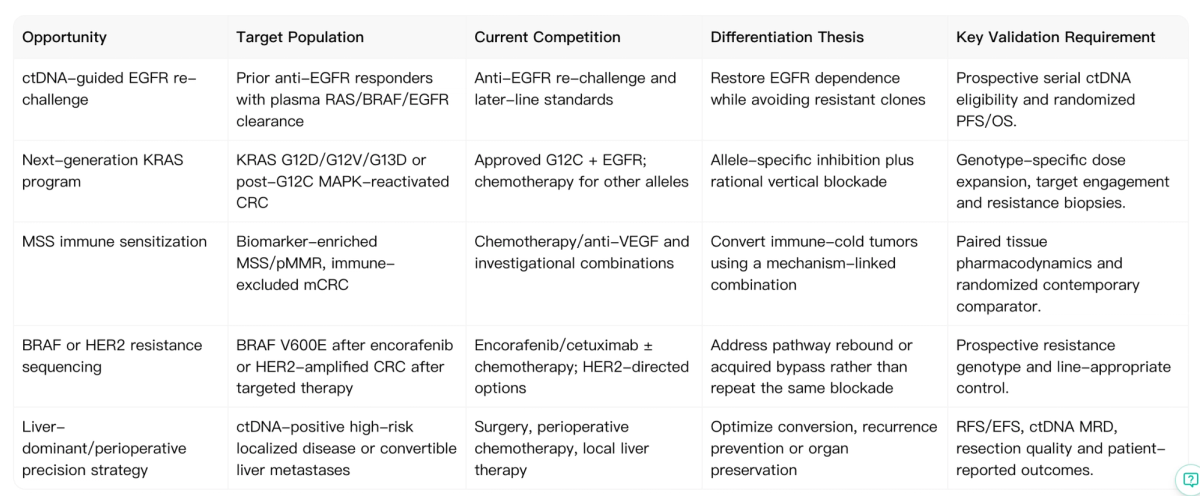
The five rows in the report should be interpreted as R&D hypotheses, not as already validated therapies or ranked investment recommendations.
ctDNA-guided EGFR re-challenge. Select patients with previous EGFR benefit and a molecular profile suggesting decline of resistant clones. The crucial validation is whether prospectively defined plasma criteria improve outcomes against a relevant later-line comparator.
Next-generation KRAS programs. KRAS G12D, G12V and other alleles require their own pharmacology and clinical evidence. Post-G12C resistance is a distinct possible setting. A credible program must show allele-specific target engagement and account for EGFR or downstream reactivation.
MSS immune sensitization. A combination should be tied to measurable immune biology and tested against contemporary care. Unselected checkpoint combinations are insufficient as an evidence-based strategy.
BRAF/HER2 sequencing. Treatment after prior molecularly directed therapy is a possible niche, but resistance mechanisms, assay thresholds, and control arms must be specified before interpreting efficacy.
Liver-dominant or perioperative precision strategies. Potential differentiation lies in durable resection eligibility, recurrence-free survival, molecular residual-disease clearance, or organ-preserving outcomes—not treating all metastatic and localized populations as one market.
What a CRC Target Product Profile Should Specify
For a new program, define the patient population and disease stage first, then specify the molecular test and cutoff, prior treatment exposure, comparator, primary clinical endpoint, expected durability, and tolerability margin. A prospective resistance-monitoring plan is helpful only when its biomarker is analytically valid and linked to a treatment decision.
Use Noah AI for a similar evidence review. Sign up for 300 free credits on the Basic plan, with no payment required to start. Get 300 Free Credits →
7. Clinical Trial Landscape: Avoid False Precision
The underlying Noah report describes a representative set of trials, not a complete real-time inventory. It lists BREAKWATER (NCT04607421), CodeBreaK 300 (NCT05198934), CheckMate-8HW (NCT04008030), AZUR-1 (NCT05723562), and a CodeBreaK 101 combination cohort (NCT04185883).
| Trial | Why it matters | Evidence boundary |
|---|---|---|
| [BREAKWATER — NCT04607421](https://clinicaltrials.gov/study/NCT04607421) | BRAF V600E first-line targeted combination benchmark. | Approved regimen does not eliminate questions about later-line sequencing. |
| [CodeBreaK 300 — NCT05198934](https://clinicaltrials.gov/study/NCT05198934) | Randomized KRAS G12C plus EGFR evidence. | Final OS evidence should be read separately from the PFS finding. |
| [CheckMate-8HW — NCT04008030](https://clinicaltrials.gov/study/NCT04008030) | MSI-H/dMMR immune-treatment benchmark. | The results do not generalize to MSS/pMMR CRC. |
| [AZUR-1 — NCT05723562](https://clinicaltrials.gov/study/NCT05723562) | Localized MSI-H/dMMR rectal cancer with organ-preservation endpoints. | Single-arm endpoint and follow-up differ from metastatic OS trials. |
| [CodeBreaK 101 — NCT04185883](https://clinicaltrials.gov/study/NCT04185883) | Explores an additional KRAS G12C-based combination. | Early-phase study; not an independent standard of care. |
Trial registrations can change, and the research report did not independently retrieve every live registry status. The table therefore does not label all these studies as currently recruiting, nor does it claim that it counts unique active CRC assets across the entire trial database.
8. Competition, Partnering, and Deal Outlook
The original inspiration for this format included commercial transactions and proprietary asset counts. Noah's research run did not produce a sufficiently verified set of CRC-specific asset deals to support a reliable total or valuation comparison. It would be misleading to copy another provider's transaction count into this article.
A disciplined deal screen should distinguish drug-asset licensing from broad oncology or platform collaborations; upfront cash from contingent milestones; geography-specific rights from worldwide rights; and public primary disclosures from inferred indication relevance.
Company partnerships can indicate interest in an approach, but a transaction does not establish clinical validation or commercial success. Without adequately documented CRC-asset-specific transactions, the appropriate conclusion is insufficient evidence for a numerical CRC deal outlook, not zero deals.
9. How We Used Noah AI for This CRC Indication Analysis
We used Noah AI to generate a structured report dated October 22, 2026. The research question required disease context, EGFR/KRAS pathway interpretation, biomarker-defined clinical standards, representative trials, unmet needs, and R&D options.
The resulting report contained two compact outputs reproduced above: Clinical Competition by Biomarker and Colorectal Cancer Indication Strategy and R&D Opportunities. These are screenshots of the actual output, not recreated competitor interfaces or synthetic data graphics.
Our working approach was to inspect the original citations, preserve explicit evidence limitations, and cross-check material U.S. approval claims with FDA announcements. The report itself noted that some registry statuses and transactions were not fully verifiable within its search environment. We have retained that limitation rather than claim exhaustive surveillance.
This is a reproducible pattern for early strategic research: establish the segment; identify an approved or late-stage comparator; connect known biology and resistance; define a falsifiable development hypothesis; then verify the source trail. It is not a substitute for expert clinical review, full landscape diligence, or a formal commercial forecast.
10. Frequently Asked Questions
Is colorectal cancer one drug-development market?
No. Colon versus rectal site, disease stage, tumor sidedness, molecular genotype, mismatch-repair status and treatment history substantially change appropriate therapy, endpoint choice and competitive expectations.
What does EGFR have to do with KRAS in CRC?
EGFR is an upstream receptor that activates RAS–RAF–MEK–ERK signaling. Oncogenic KRAS can sustain downstream signaling despite upstream blockade. In KRAS G12C CRC, combined mutant-KRAS and EGFR inhibition can address adaptive feedback in the appropriate treatment setting.
Which CRC biomarkers are most important for this strategy?
RAS and BRAF alterations, MSI/MMR status, sidedness, KRAS allele, and selected additional alterations such as HER2 amplification matter. Their clinical significance depends on setting and the regimen under consideration.
Is MSS/pMMR CRC an attractive immunotherapy opportunity?
It is an important area of unmet need but also a difficult development problem. A proposed immune-sensitizing combination needs convincing mechanistic pharmacodynamics and randomized clinical benefit; checkpoint results in MSI-H/dMMR disease cannot be assumed to apply.
Can clinical response rates be compared directly across CRC trials?
Not reliably when populations, stages, prior treatment, design and endpoints differ. A single-arm ORR or cCR result and a randomized PFS or OS finding answer different questions.
Can AI replace a dedicated drug pipeline or deal-intelligence database?
No. AI-assisted research can assemble and structure publicly available evidence, but unverified transaction counts, current recruitment inventories and freedom-to-operate conclusions should not be invented or inferred from incomplete sources.
Final Takeaway: An Indication Strategy Must Be Biomarker First
CRC has mature clinical standards in several molecularly selected groups, but meaningful development opportunities remain wherever existing therapies leave a well-defined resistance problem or unaddressed patient population. The strongest programs will pair molecular selection with a relevant comparator, a directly measurable mechanism and a clinically meaningful endpoint.
Noah AI can help structure that initial evidence review by placing therapeutic benchmarks, clinical limitations and potential R&D directions in one source-linked research workflow. The scientific conclusions still depend on checking the underlying studies and updating regulatory evidence before decisions are made.
Start your next oncology indication analysis with Noah AI. New users can sign up for 300 free credits on the Basic plan. No payment required to get started.