
Common Literature Review Mistakes and How to Fix Them with AI (2026)
Linda
Learn 6 common literature review mistakes and how to fix them with AI. Improve evidence synthesis, research structure, source quality, and citations using Noah AI.
Learn how to detect weak claims, compare studies fairly, fix descriptive writing, and check citations using a real Noah AI research example.
Evidence cutoff: October 20, 2026 · Practical step-by-step guide · Case study: time-restricted eating
A literature review can cite real, peer-reviewed papers and still reach a misleading conclusion. The common failure is not always the absence of sources: it is a mismatch between what the cited research actually tested and what the writing claims. Reviews also become weaker when they list studies without comparing them, rely on a narrow search, or announce that research gaps have disappeared.
This guide follows a real Noah AI demonstration built around four randomized trials of time-restricted eating (TRE). We supplied an intentionally flawed teaching paragraph, asked Noah to check it against identifiable publications, and reviewed three outputs: an error audit, a revised paragraph, and a citation-verification table. The aim is to demonstrate a review-quality workflow, not to offer personalized weight-loss guidance.
Testing and evidence boundary. We tested Noah AI directly using the screenshots in this article. The exercise drew primarily on verified PubMed abstracts for four trials. It is not an exhaustive literature search, a completed systematic review, a full-text risk-of-bias assessment, or evidence of automated editing of a user's manuscript without review.
Why Literature Reviews Go Wrong
A paper-by-paper summary tells readers which studies exist. A literature review should do more: explain what studies collectively establish, where their findings diverge, and which methodological differences limit the conclusions. Two randomized trials investigating the same broad topic may use different populations, intervention windows, comparison groups, and outcomes. Treating them as interchangeable creates false consensus.
Three linked errors often follow. First, a claim is drafted before a comparison framework is defined. Second, supportive sentences are selected from abstracts without checking between-group effects or uncertainty. Third, the review is organized by author rather than by a question that the evidence can answer. An AI assistant can surface these errors, but researchers still need to verify each source and decide how far the evidence supports the claim.
Six Common Literature Review Mistakes
- Weak, selective, or outdated sources — Missing pivotal trials or prioritizing a convenient subset can distort the entire review. The solution is not simply to cite newer papers: include foundational studies when relevant, record what was searched, examine the study design, and actively look for results that challenge the emerging argument. A publication's age alone does not establish its quality.
- Summarizing instead of synthesizing — Writing "Lowe studied TRE; Liu studied TRE; Lin studied TRE" describes a bibliography. It does not explain what those trials collectively mean. A stronger paragraph asks whether they evaluated the same TRE schedule, whether calorie restriction was prescribed in both arms, and whether their primary comparisons showed superiority. The review should follow the evidence question, not publication order.
- A flawed or undocumented search strategy — One broad search phrase can miss synonyms, intervention subtypes, null trials, or relevant follow-up publications. For this case, a review should distinguish "time-restricted eating," "early time-restricted eating," "intermittent fasting," and related terms, while documenting databases and search dates. Asking Noah to propose terms is useful; it is not evidence that those searches were actually executed or exhaustive.
- Missing, overstating, or inventing research gaps — Declaring "no research gaps remain" is rarely defensible from a small collection of papers. But the opposite extreme—calling every limitation a field-wide gap—is equally weak. A prospective gap needs support from the existing evidence, a clear explanation of why it matters, and a search for newer or contrary work. In this example, long-term maintenance and the independent effect of meal timing are candidates for further verification, not proven absences across the literature.
- Disorganized structure and inconsistent comparisons — Readers lose the argument when the review jumps between studies, mechanisms, and recommendations without clear transitions. Group evidence by meaningful themes—for example, TRE versus usual eating patterns, TRE added to calorie restriction, and early TRE timing. Within each theme, compare methods, results, and limitations before advancing to a conclusion.
- Citation–claim mismatch — A real citation can be attached to a claim the paper does not support. For example, a statistically significant change within one group does not prove that group performed better than its randomized comparator. Similarly, failing to show superiority is not proof of equivalence. Verification must check the exact endpoint, between-group estimate, confidence interval, population, and follow-up, rather than merely confirming that the PMID exists.
A Real Research Example: Four Trials of Time-Restricted Eating
To make the errors concrete, we used a focused research question:
Research question: Does time-restricted eating provide additional weight-loss benefit over conventional eating patterns or daily calorie restriction in adults with overweight or obesity?
The four anchor publications covered contrasting designs: ad libitum TRE versus consistent meal timing (Lowe et al., 2020), early TRE added to calorie restriction versus calorie restriction alone (Liu et al., 2022), early TRE plus energy restriction versus a longer eating window plus energy restriction (Jamshed et al., 2022), and TRE without calorie counting versus both calorie restriction and a control eating window (Lin et al., 2023).
| Trial | Relevant comparison | Reported primary takeaway |
|---|---|---|
| Lowe (TREAT), 2020 | 12-week ad libitum TRE versus consistent meal timing | Between-group weight difference −0.26 kg (95% CI −1.30 to 0.78; P=.63); superiority not demonstrated. |
| Liu, 2022 | 12-month TRE + calorie restriction versus calorie restriction alone | Difference −1.8 kg (95% CI −4.0 to 0.4; P=.11); no significant additional weight-loss benefit established. |
| Jamshed, 2022 | 14-week early TRE + energy restriction versus longer eating window + energy restriction | Greater short-term weight loss: −2.3 kg between groups (95% CI −3.7 to −0.9; P=.002). |
| Lin, 2023 | 12-month TRE without calorie counting versus restriction and control arms | Benefit versus control, but no significant difference versus daily calorie restriction (0.81 kg; 95% CI −3.07 to 4.69). |
Numbers above reflect the reported trial abstracts used in this demonstration; they have not been newly pooled or independently reanalyzed. Outcomes and comparators differ, so the figures must not be treated as a treatment ranking.
How to Check and Fix a Literature Review with Noah AI
Instead of asking a model to "make the writing better," give it the exact research question, the draft paragraph, a defined source list, and a checklist of mistakes to test. This allows the output to be audited against the actual papers.
Step 1: Define the question and source boundaries
Write down the population, intervention, comparator, outcome, and review scope. Specify the publication cutoff and whether the AI has actual PDFs or abstract-only records. In the TRE exercise, different calorie prescriptions were central to interpreting the trials, so the comparator had to be explicit before writing.
Step 2: Verify the papers before judging the draft
Use PubMed records, accurate PMIDs or DOIs, and available original publications to confirm study design, randomized denominators, intervention, control, primary endpoint, follow-up, and estimates. If the full text was not retrieved, label deeper methodological details as requiring verification. Noah can help structure this checklist, but a verified citation identifier alone is not sufficient to certify a claim.
Step 3: Run a claim-by-claim mistake audit
We provided an intentionally flawed paragraph asserting that TRE was "clearly the best method" and worked better "in every study." The goal was to test whether Noah would challenge the claims rather than adopt them. It identified overgeneralization, differences between trial protocols, unsupported population-wide recommendations, and the failure to distinguish positive from nonsignificant results.
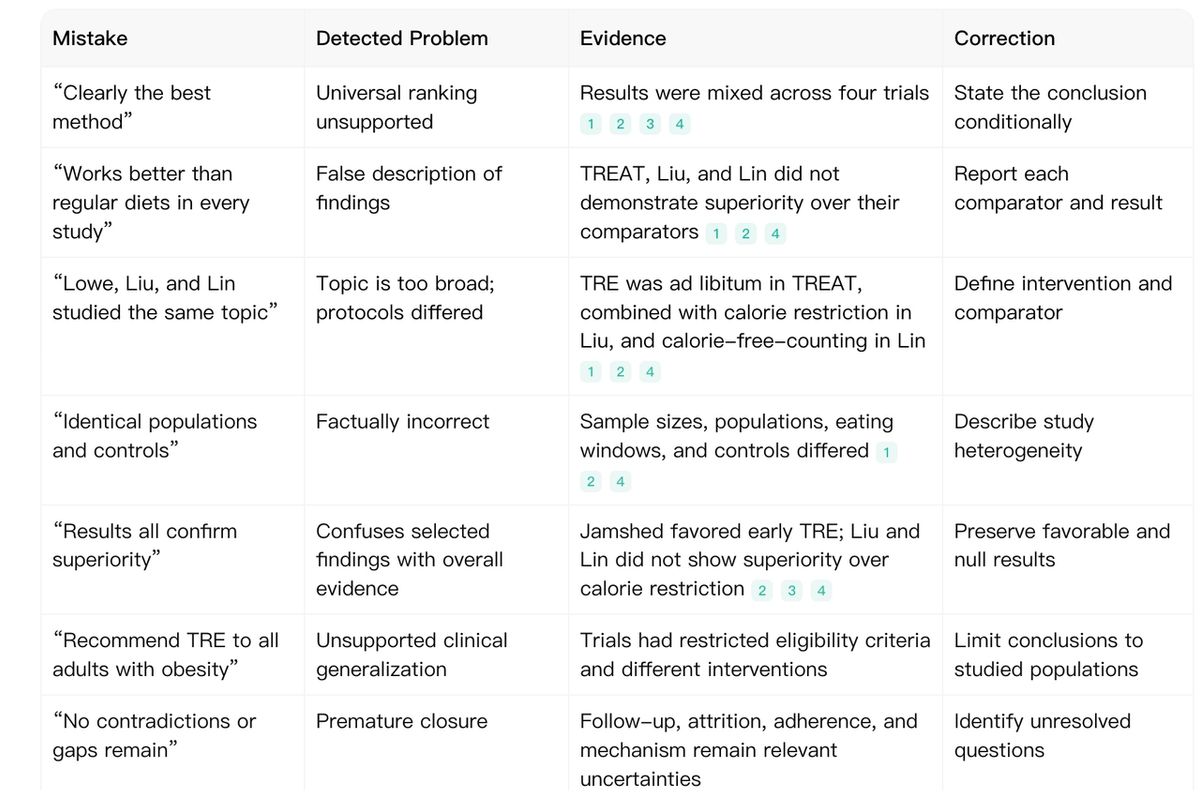
The output is more useful than a generic writing score because each proposed revision has a reason. A reviewer can inspect whether the model's criticism is itself supported before accepting the edit. For a complementary research workflow, see how to critically appraise a clinical research paper with AI.
Audit a literature review with Noah AI
Use a focused research question and traceable sources to check biomedical research claims. Get free credits to explore the workflow; no credit card required.
Step 4: Compare studies before rewriting sentences
Do not just swap "proved" for "suggests" and leave the logic untouched. First, group the trials by what they actually compared. Lowe compared TRE with consistent meal timing without prescribed calorie restriction. Liu tested whether TRE added to calorie restriction improved weight loss beyond calorie restriction alone. Jamshed tested an early eating window alongside energy restriction. Lin included both calorie restriction and a control eating window. These are related questions, not interchangeable randomized comparisons.
A good synthesis can state that some trials report benefits under particular protocols while others do not demonstrate added benefit over calorie restriction. It should not infer that a nonsignificant comparison proves identical effects. For a deeper treatment of comparison logic, see comparing multiple research papers in a literature review.
Step 5: Rewrite weak paragraphs using verified evidence
Once comparisons are aligned, rewrite the draft around the research question. The revised paragraph should identify the relevant comparator, explain where findings agree or differ, acknowledge shorter follow-up and trial limitations, and cite the papers supporting each important statement.
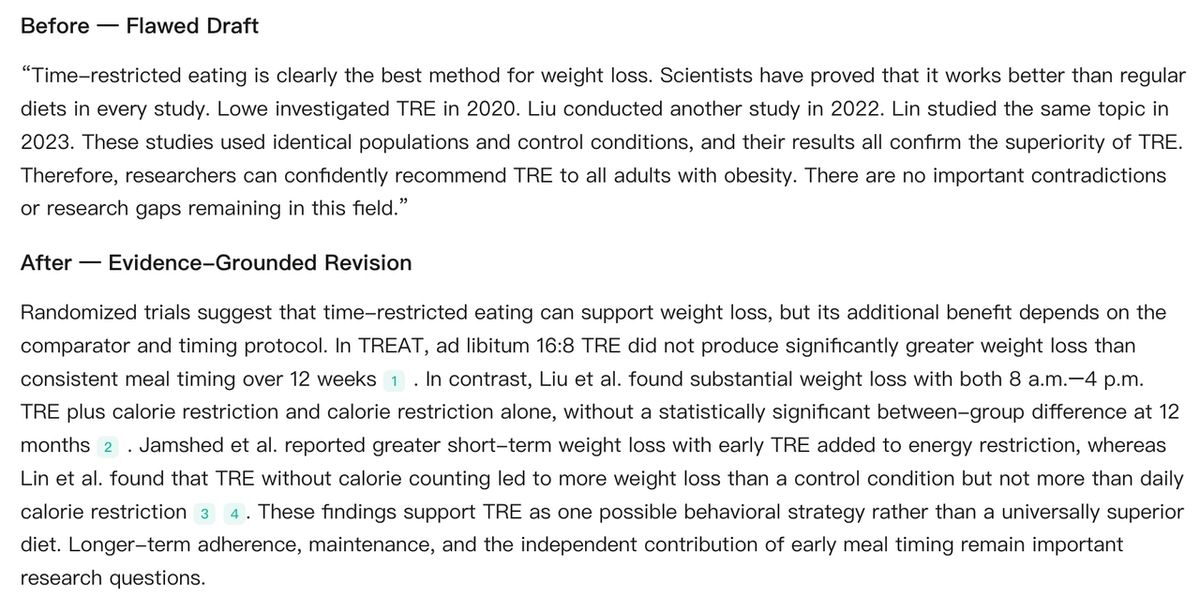
Notice the change in structure: the corrected version leads with an evidence-proportionate conclusion, then compares the studies and preserves the unresolved questions. It does not merely replace individual words with more academic vocabulary.
Step 6: Check citations against claims before publication
For each sentence, ask which cited study supports it and what the study actually measured. If the answer is unclear, mark the claim as unsupported or requiring full-text verification. In this exercise, Noah correctly distinguished an abstract-confirmed intervention description from an unsupported statement that the same trial demonstrated superiority.
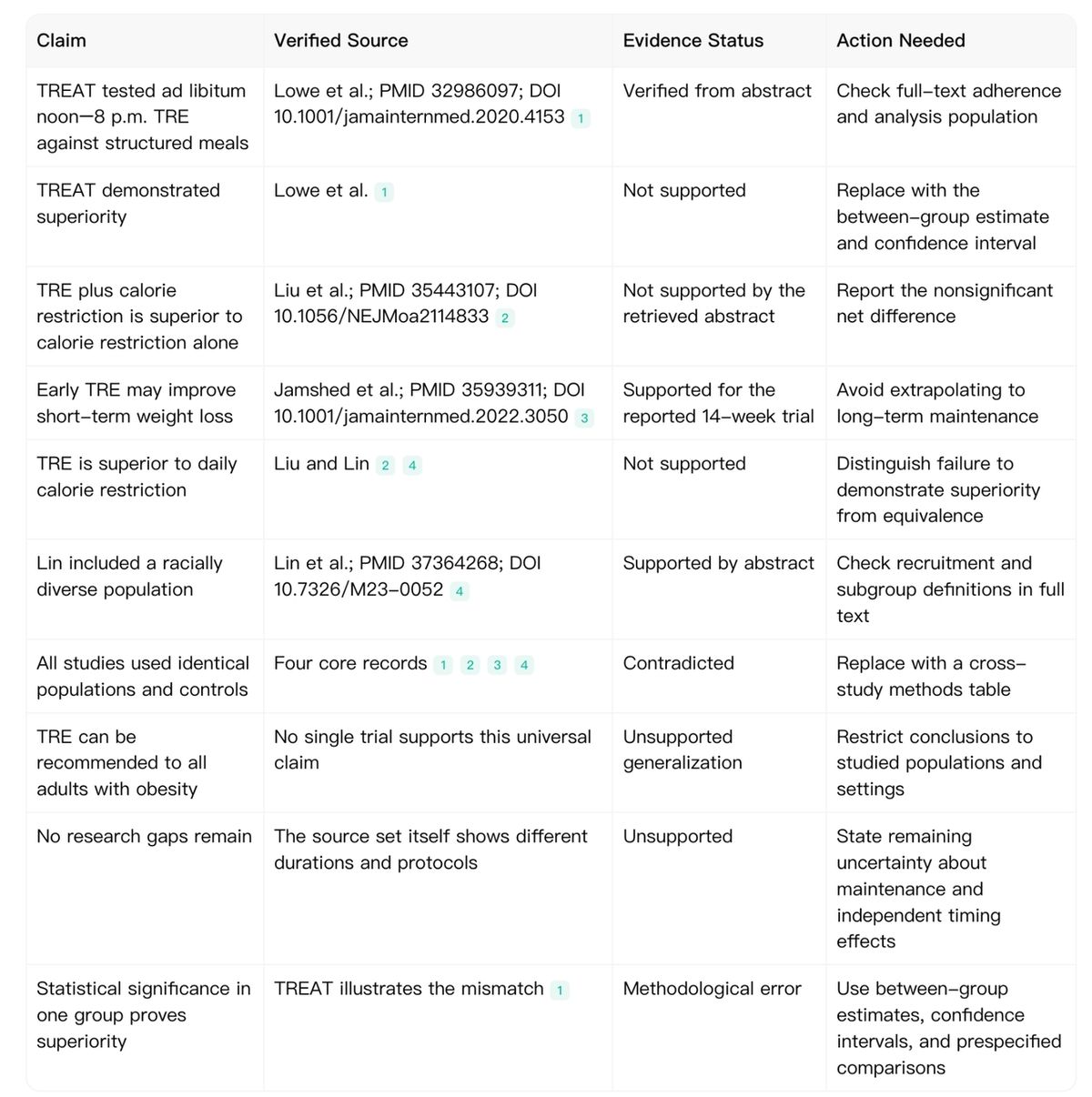
The central lesson is citation–claim alignment. Referencing Lowe et al. is insufficient when the statement attributes a between-group effect to the paper that its reported result does not show. For a complete methodology that starts before writing, read how to conduct a medical literature review with AI.
What a Strong Literature Review Paragraph Looks Like
Weak reasoning: "Several trials studied TRE. Therefore, TRE is more effective than all conventional diets."
Stronger reasoning: "Trials of TRE differ in eating-window timing and control conditions; additional weight-loss benefits over calorie restriction were not established uniformly."
The improved argument is not stronger because it sounds cautious; it is stronger because the wording maps more closely to the evidence. It preserves the relevant comparison and does not pretend that short-term, long-term, ad libitum, and energy-restricted interventions answer exactly the same question.
Best Practices for Reviewing and Revising Literature
Start with a thematic outline — A practical order for the TRE topic is: review question and definitions; intervention and comparator differences; findings grouped by comparison; methods and limitations; implications and unresolved research questions. This avoids an author-by-author catalog and lets conflicting results appear within the correct methodological context.
Look for negative results and selection bias — A review written entirely around favorable studies may reflect selective sourcing rather than the state of evidence. Run deliberate searches for negative or null trials and avoid excluding relevant papers merely because their results are inconvenient. When the source set is intentionally small, state that it is illustrative rather than comprehensive.
Separate academic style from scientific validity — Editing sentence flow cannot repair a false comparison. Prioritize methodological and numerical accuracy first, then revise structure, transitions, readability, and citation style. Academic writing is clearest when claims are specific, uncertainty is stated where material, and citations appear where they actually support the argument.
Preserve a human verification step — AI can help extract fields, challenge claims, and suggest a more coherent paragraph. It cannot certify that all relevant studies were found or that abstract-only evidence is equivalent to reviewing full methods, supplementary appendices, registered outcomes, and all follow-up publications. Researcher review remains essential.
Literature Review Quality Checklist
Use this checklist after editing each major section, not only at the end of the paper:
- Question: Is the population, intervention, comparator, and outcome clearly defined?
- Coverage: Are relevant positive, negative, foundational, and recent studies considered?
- Source verification: Can every key claim be traced to a real original source?
- Comparison: Are interventions, controls, outcome definitions, and follow-up periods aligned before interpretation?
- Synthesis: Does each section explain patterns across papers rather than list abstracts?
- Uncertainty: Are nonsignificant findings, limitations, and missing data handled without exaggeration?
- Research gaps: Are candidate gaps supported, qualified, and checked against additional literature?
- Final review: Has a researcher checked the manuscript, citation details, and institutional writing requirements?
In Noah's final audit, most checklist items passed for this focused demonstration, while research-gap language still required wider searching and full-text evaluation. That distinction matters: a well-edited illustrative review is not proof that a field has been mapped comprehensively.
Advanced Challenges: Interdisciplinary Studies and Large Source Sets
Large reviews may contain different definitions of the same exposure, inconsistent outcome scales, heterogeneous populations, and overlapping publications from a single research cohort. The same audit principles still apply, but additional work is needed: map outcome definitions explicitly, connect secondary publications to parent studies, keep a transparent screening log, and separate direct results from hypotheses about why outcomes differ.
Organizing papers in a reference manager such as Zotero can reduce citation management errors, but it does not independently validate the scientific meaning of a citation. Similarly, a polished AI-generated summary can make unsupported conclusions seem more authoritative. Reviewers should judge the actual evidence trail, not the fluency of the text.
Frequently Asked Questions
What is the most common literature review mistake?
Summarizing each paper separately without comparing methods, findings, and limitations is a frequent problem. It produces a list of studies instead of a synthesis tied to one research question.
Can AI find mistakes in a literature review?
AI can help identify unsupported claims, weak structure, mismatched citations, and omitted comparisons when it has a clearly defined task and reliable sources. Its judgments still need verification against the primary research.
How do I fix a literature review that is mostly summaries?
Reorganize by theme or research question. Compare papers within each section, explain why results agree or differ, and use citations to support the synthesis rather than simply narrating publication order.
Does a nonsignificant result mean two treatments are equivalent?
No. A failure to reject a null hypothesis does not establish equivalence. Equivalence or noninferiority requires an appropriate design, prespecified margin, and sufficiently informative confidence intervals.
Can Noah AI replace a systematic review or peer reviewer?
No. Noah can assist with source-grounded drafting and checking, but systematic review methods, complete screening, methodological appraisal, and final publication decisions still require appropriate human review.
References
- Lowe DA, et al. Effects of Time-Restricted Eating on Weight Loss and Other Metabolic Parameters in Women and Men With Overweight and Obesity: The TREAT Randomized Clinical Trial. JAMA Internal Medicine, 2020. PMID 32986097. DOI: 10.1001/jamainternmed.2020.4153.
- Liu D, et al. Calorie Restriction with or without Time-Restricted Eating in Weight Loss. New England Journal of Medicine, 2022. PMID 35443107. DOI: 10.1056/NEJMoa2114833.
- Jamshed H, et al. Effectiveness of Early Time-Restricted Eating for Weight Loss, Fat Loss, and Cardiometabolic Health in Adults With Obesity. JAMA Internal Medicine, 2022. PMID 35939311. DOI: 10.1001/jamainternmed.2022.3050.
- Lin S, et al. Time-Restricted Eating Without Calorie Counting for Weight Loss in a Racially Diverse Population. Annals of Internal Medicine, 2023. PMID 37364268. DOI: 10.7326/M23-0052.
Try an evidence-grounded literature review workflow
Use Noah AI to check research claims, compare studies, and organize verified evidence. Start with free credits—no credit card required.
Research and screenshots: Noah AI demonstration, evidence cutoff October 20, 2026. The deliberately flawed paragraph is an instructional input, not a quotation from an authentic published review. We tested Noah AI directly. Other services mentioned are described as complementary workflows, not as directly tested products.