
How to Identify Research Gaps in Heart Failure Remote Monitoring with AI (2026)
Linda
Explore research gaps in heart failure remote monitoring using AI. Compare Tele-HF, BEAT-HF, and TIM-HF2 to identify methodological, evidence, and implementation gaps.
A focused case study of research gaps in heart failure remote patient monitoring, using Tele-HF, BEAT-HF, and TIM-HF2 to examine differences in clinical outcomes, monitoring workflows, patient populations, and unresolved evidence with Noah AI.
Reading the limitations section of a paper is an easy way to collect ideas for future research. It is not enough to establish a research gap. A limitation identified in one study may already have been addressed in a newer trial, and two papers with different conclusions may not be studying comparable populations or outcomes.
A defensible research gap requires an evidence trail: what the existing studies answer, what they leave unresolved, whether newer research challenges the apparent omission, and why the remaining question matters. AI can help researchers organize that trail, provided the underlying sources and judgments are checked.
This walkthrough uses Noah AI to examine remote patient monitoring (RPM) for adults with heart failure. We compare landmark randomized trials, trace a published reporting problem, classify five types of candidate gaps, and interpret a real AI-generated Research Gap Table. The example is a targeted evidence-mapping exercise, not a completed systematic review.
Quick answer: To find research gaps with AI, define a narrow question, collect verifiable studies, align their methods and outcomes, classify unresolved issues, test those issues against newer or contrary evidence, and produce a source-linked Research Gap Table. Treat each row as a candidate until its supporting and limiting evidence has been evaluated.
What Is a Research Gap?
A research gap is an important unanswered or insufficiently resolved question in the existing evidence. It may concern the amount of direct evidence, how studies are designed, who is represented, why results appear inconsistent, or whether a practically important aspect of a topic has received adequate investigation.
Not every problem is a research gap. An abstract that omits an outcome may be shorter than the full article. A small study does not establish that larger studies do not exist. A statistically nonsignificant result does not automatically contradict a significant result from another trial. Research-gap claims need a defined search scope and an explicit verification status.
Five Types of Research Gaps to Look For
| Gap type | Question to ask |
|---|---|
| Evidence gap | Which clinically or scientifically important question still lacks sufficiently consistent, direct, or mature evidence? |
| Methodological gap | Which recurring design, measurement, reporting, or implementation weaknesses limit interpretation or replication? |
| Population gap | Which relevant patient groups, settings, or contexts may be underrepresented in the available studies? |
| Conflicting evidence | Which results seem to disagree, and are the populations, interventions, endpoints, and follow-up actually comparable? |
| Understudied areas | Which important implementation, patient, equity, or economic questions may not yet have an adequate body of research? |
The categories overlap. Missing workflow information, for example, may be a methodological reporting problem and may also suggest an understudied implementation question. They are useful analytic labels, not a validated scoring system. They also do not replace theoretical and conceptual gap categories used in other research disciplines.
The Real Research Example: Remote Monitoring in Heart Failure
Consider the question: What remains uncertain about the effectiveness of remote patient monitoring for adults with heart failure? The phrase "remote monitoring" covers substantially different care models—from automated calls about symptoms and weight, to connected measurements reviewed by nurses, to structured clinical management that triggers treatment changes.
Three pivotal studies make the problem visible. Tele-HF found no significant improvement in its 180-day composite of readmission or death. BEAT-HF did not significantly lower 180-day all-cause readmissions with its combined coaching and monitoring program. In contrast, TIM-HF2 reported fewer days lost to unplanned cardiovascular hospital admissions or all-cause death with structured remote patient management. These studies differ in important ways; their results should not be flattened into "two negative trials versus one positive trial."
How to Find Research Gaps with AI: Seven Steps
Step 1: Define a Question Narrowly Enough to Compare Evidence
Start with population, intervention, comparison, outcomes, and clinical context. For this example, the population is adults with heart failure; the intervention is noninvasive remote monitoring or structured RPM; the comparison is usual care; and the outcomes include readmission, hospitalization, mortality, quality of life, adherence, and workflow performance.
Crucially, keep noninvasive monitoring, telephone support, remote medication titration, and invasive pulmonary-artery pressure monitoring distinguishable. They may belong to a broader field, but they do not necessarily represent the same treatment exposure.
Step 2: Collect Relevant Studies and Record What Was Actually Verified
Use PubMed, original trial reports, accessible full texts, and relevant systematic reviews. Begin with known anchor studies and identify newer evidence that may resolve an older limitation. For each record, capture the author, year, PMID or DOI, study type, intervention, population, outcome, and whether the extraction is based on the abstract or full text.
Our working report used Tele-HF, BEAT-HF, TIM-HF2, a 2025 workflow-reporting review, and additional trial/review context. Reviews help assess patterns across a field, but the trials included within those reviews must not be counted as new, independent patient cohorts.
Search completeness matters. A targeted set can support a carefully labeled candidate gap, but it cannot prove that no relevant publication exists anywhere in the literature.
Step 3: Compare Methods, Populations, Endpoints, and Findings
Before asking what is missing, make the existing evidence comparable. Ask Noah to align study design, sample, monitoring modality, clinical-response process, primary endpoint, effect estimate, follow-up, and limitations. Require source identifiers and preserve null results.
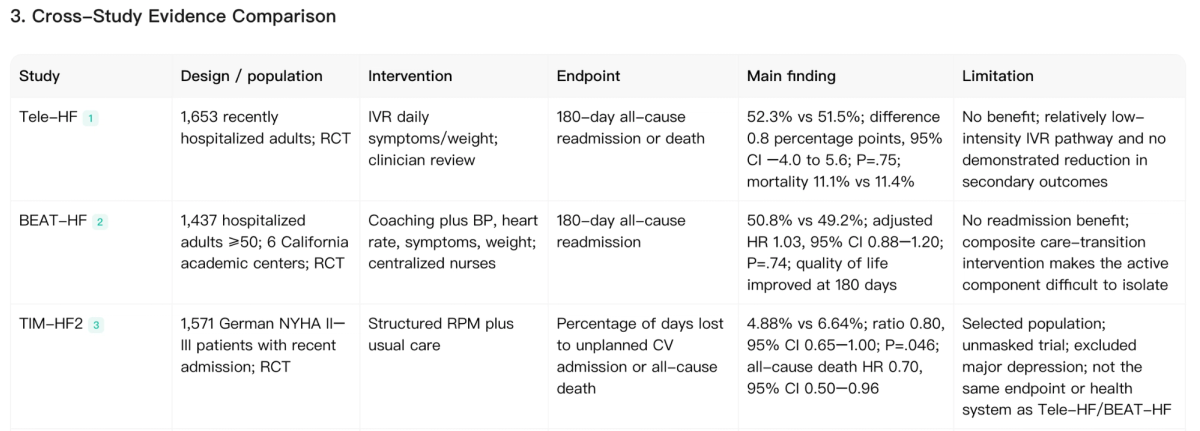
For example, TIM-HF2 measured the percentage of days lost due to unplanned cardiovascular hospitalization or all-cause death, while BEAT-HF focused on all-cause readmission within 180 days. That difference is central to the interpretation: it is evidence of heterogeneity in what was tested, not proof that the studies are mutually contradictory.
For a more detailed explanation of this distinction, read how to identify conflicting evidence in medical literature with AI.
Step 4: Classify Five Candidate Gap Types
Once studies are aligned, label potential gaps by type. In the heart failure example, five candidate lines of inquiry emerged:
- Evidence: Which combination of monitoring signals and clinical intervention produces reproducible benefit?
- Methodology: Are response protocols, review frequency, escalation thresholds, and clinician response times consistently reported?
- Population: Does the evidence apply equally across heart failure phenotypes, locations, connectivity levels, and different care settings?
- Conflicting evidence: Can apparent trial disagreement be explained by endpoint and workflow differences?
- Understudied areas: What do the reviewed publications establish about burden, cost, implementation, and long-term equity outcomes?
A candidate must have a traceable reason for inclusion. Do not convert a paper's "further work is needed" sentence into a field-wide claim without checking the broader literature.
Step 5: Test Each Gap Against Supporting and Contrary Evidence
This is where the method becomes more than automatic gap generation. Ask which papers support a proposed gap, which studies limit it, whether recent work has addressed it, and how broad the original search was. Then mark the gap supported by reviewed evidence, provisional, or not established.
One relatively well-supported issue is incomplete reporting of clinical workflows. In a published review of 63 noninvasive heart failure RPM studies, the frequency of data review was unreported in 48% of studies, escalation criteria in 24%, and provider response time in 97%. The authors reported that insufficient workflow details prevented their intended analysis of those components. [4] This demonstrates a reporting problem; it does not prove that clinicians did not follow a workflow.
Population and equity questions require more restraint. A few selected trials cannot establish that rural, digitally disadvantaged, or particular heart failure subgroups have never been studied. The correct label for such a claim is provisional—requires targeted literature search until broader coverage is checked.
Organize Biomedical Evidence with Noah AI
Use free credits to compare medical papers, trace their references, and build a structured working map of candidate research gaps. No credit card required.
Step 6: Build a Source-Linked Research Gap Table
Ask Noah to produce one row per gap category, with the specific unanswered question, supporting studies, evidence limitation, missing knowledge, validation status, and possible next research question. The validation field is essential: it prevents a neatly formatted output from presenting speculation as established absence.
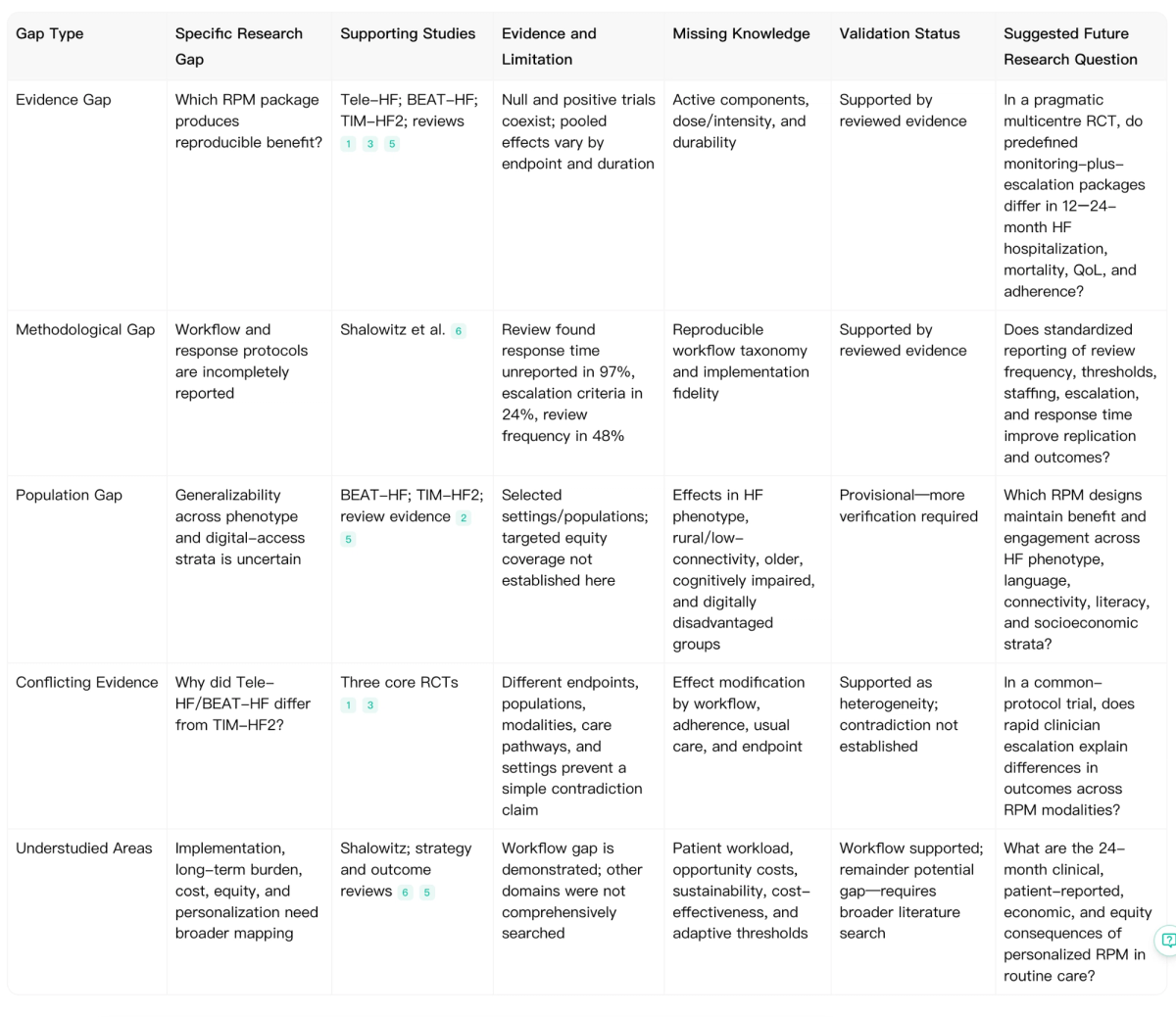
The table is not a list of five confirmed discoveries. It distinguishes supported workflow-reporting deficits from provisional population coverage questions and from apparent contradictions that cannot be established as true conflicts. For reproducible research, that uncertainty is a feature, not a defect.
Researchers who need a standard way to capture individual paper details before gap analysis can also use an evidence table for a literature review.
Step 7: Turn a Validated Gap Into a Testable Research Question
A useful gap should be narrow enough to support a follow-up research design. For the supported workflow-reporting problem, a possible next question is: Would standardized reporting of data review frequency, escalation rules, staffing, and response times improve replication and the interpretation of outcomes across RPM programs?
For the unresolved intervention-component question, researchers might investigate whether a specified monitoring-plus-clinician-escalation protocol outperforms monitoring without a comparable response pathway. That would require a carefully designed trial; cross-trial differences alone cannot show which component causes benefit.
A research gap is not automatically a feasible project. Before planning recruitment or a protocol, check data availability, outcome measurement, sample-size assumptions, operational resources, and whether another trial already addresses the question. See how to check whether a research gap is feasible to study.
What Makes an AI-Identified Research Gap Reliable?
A practical validation checklist
- Can the gap be stated as one precise research question?
- Do identifiable primary studies or syntheses support it?
- Is the claim about missing evidence, rather than simply missing abstract details?
- Have newer, contrary, and potentially overlapping studies been considered?
- Are intervention, population, endpoint, and follow-up differences explicit?
- Is the status labeled supported, provisional, or not established?
- Does the proposed next study address something important and feasible?
Common Mistakes When Using AI to Find Research Gaps
- Claiming "no studies exist" from a small source set. A targeted map is not a comprehensive absence search.
- Equating paper limitations with literature gaps. A later trial may already have addressed the limitation.
- Calling different trial endpoints contradictory. First establish the degree of comparability.
- Ignoring null findings. Non-significant results are crucial for assessing the evidence, not material to discard.
- Inventing certainty scores. Use source-linked qualitative status labels unless a formal, appropriate assessment has been performed.
- Confusing reporting gaps and implementation gaps. Missing descriptions do not show that a process never existed in practice.
Frequently Asked Questions
Can AI identify research gaps automatically?
AI can identify potential patterns, contradictions, missing populations, and recurrent limitations in a selected evidence set. But the conclusion that a gap remains unresolved requires source verification and a sufficiently broad search for newer or contrary evidence.
What is the difference between an evidence gap and a methodological gap?
An evidence gap concerns what the research has not adequately answered. A methodological gap concerns recurring weaknesses in how evidence was generated, measured, or reported. The same topic may involve both.
Does conflicting evidence always indicate a research gap?
No. Results can look inconsistent because studies used different patient populations, interventions, endpoints, or follow-up periods. A meaningful unresolved comparison requires an explicit assessment of these differences.
How many papers should I give an AI research agent?
Use enough papers to cover the focused question and important competing findings; there is no universal minimum that proves a gap. Three core trials can demonstrate the workflow, but validating a literature-wide gap may require far more sources, structured searching, and independent appraisal.
Can I publish the Research Gap Table as definitive evidence?
Not without checking the original studies and the search coverage. Treat the AI-generated table as a working map, retain the evidence cutoff, and disclose which conclusions remain provisional.
How does Noah AI fit into the process?
Noah can be prompted to organize biomedical research questions, retrieve and structure source-linked evidence, compare study characteristics, and draft a gap table. It does not replace researcher-led screening, critical appraisal, or verification of whether a gap remains open.
Conclusion
Finding a meaningful research gap is not an exercise in generating five plausible "future research" topics. It is a sequence of evidence decisions: define the question → verify studies → compare evidence → identify candidate gaps → challenge them → document validation → frame the next question.
In this heart failure case, the clearest demonstrated issue concerned incomplete clinical-response workflow reporting, whereas population and broader implementation questions required additional verification.
Evidence cutoff: October 19, 2026. This is an educational evidence map, not a registered or completed systematic review. It does not establish exhaustive database coverage, independent duplicate screening, a formal risk-of-bias assessment, or the absence of relevant publications. Primary studies cited through reviews were not treated as new independent trial cohorts.
Build a Research Gap Table with Noah AI
Get free credits to compare biomedical papers, identify candidate evidence gaps, and organize cited findings in a review-ready table. No credit card required.
References
- Chaudhry SI et al. (2010). Telemonitoring in Patients with Heart Failure. New England Journal of Medicine. PMID 21080835.
- Ong MK et al. (2016). Effectiveness of Remote Patient Monitoring After Discharge of Hospitalized Patients With Heart Failure: The BEAT-HF Randomized Clinical Trial. JAMA Internal Medicine. PMID 26857383.
- Koehler F et al. (2018). Efficacy of Telemedical Interventional Management in Patients with Heart Failure (TIM-HF2). The Lancet. PMID 30153985.
- Shalowitz EL et al. (2025). Where's the Remote? Failure to Report Clinical Workflows in Heart Failure Remote Monitoring Studies. Journal of Cardiac Failure. PMID 39694453.
- Ding H et al. (2020). Effects of Different Telemonitoring Strategies on Chronic Heart Failure Care: Systematic Review and Subgroup Meta-Analysis. PMID 33185554.
- Umeh CA et al. (2022). Telemonitoring in Heart Failure Patients: Systematic Review and Meta-Analysis of Randomized Controlled Trials. PMID 36605424.
- Additional evidence synthesis: Non-invasive Telemonitoring Programs for Patients with Chronic Heart Failure: A Systematic Review and Meta-Analysis of Randomized Controlled Trials. PMID 39676453.