
How to Assess Drug Target Safety with AI: Step-by-Step (2026)
Linda
Learn how to assess drug target safety with AI using IRAK4. Explore human genetics, clinical adverse events, on-target risks, and Go/No-Go decisions.
A practical IRAK4 case study: connect human genetics, MyD88/TLR signaling, preclinical evidence and actual clinical adverse events before making an early drug-development decision.
Evidence cutoff: October 26, 2026 · Illustrative target: IRAK4 · Evidence-based research tutorial
Choosing a drug target is not only about whether changing its activity could help patients. The harder early question is whether a candidate can engage that target without creating unacceptable risks—and whether researchers have enough evidence to distinguish target-related liabilities from molecule-specific toxicity.
The evidence is rarely found in one place. Human genetic disorders can identify essential biological functions, laboratory studies can establish mechanism, and early clinical trials can report actual adverse events. Each source answers a different question. An effective AI-assisted safety review connects them without treating the absence of a reported event as proof of safety.
This tutorial uses IRAK4 (interleukin-1 receptor-associated kinase 4), a drug-development target in inflammatory diseases, as a real example. We tested Noah AI directly with an IRAK4 target-safety research workflow and used its source-linked output to examine kinase inhibition, targeted protein degradation and the evidence needed for a conditional go/no-go decision. The two figures below are real Noah research-output screenshots rather than reconstructed interfaces.
Quick answer: What should a target safety assessment include?
Start with a target's normal biological role and human loss-of-function phenotypes. Then evaluate the intended pharmacological modality, clinical events reported for related compounds, dose and duration, mechanistic plausibility, and important evidence gaps. Finally, turn the results into candidate-specific studies and risk-mitigation conditions—not a made-up safety score.
For IRAK4, the clearest target-linked warning comes from congenital deficiency associated with serious childhood bacterial infections. But this does not prove that a reversible IRAK4 inhibitor taken by an adult has the same risk. Published early-phase drug trials offer useful, shorter-duration safety observations; they cannot exclude uncommon or chronic adverse effects. Human genetic cohort · IRAK4 inhibitor phase 1 · IRAK4 degrader phase 1.
Step 1. Define the target, modality and safety question
IRAK4 is a serine/threonine kinase encoded by IRAK4 (UniProt Q9NWZ3). It helps organize the MyD88-dependent signaling complex known as the Myddosome. IRAK4 has a catalytic kinase function and a structural or scaffolding role. These distinct functions matter because inhibiting the kinase domain and degrading the entire protein can produce different patterns of pathway suppression.
Before retrieving safety evidence, specify the intended use. An oral inhibitor for chronic hidradenitis suppurativa is a different development problem from a short-course intervention in another population. Route, duration, background immune-modifying medications and the degree of sustained target suppression change what constitutes an adequate safety package.
Research question used for this case: What human and experimental evidence suggests an IRAK4-related safety liability, which adverse events have actually been observed with IRAK4 drugs, and which studies are still necessary to evaluate long-term treatment?
Step 2. Use human genetics to identify possible on-target risks
Inherited loss of IRAK4 function is a valuable natural experiment. In a landmark cohort evaluating 48 people with IRAK4 deficiency and 12 with MyD88 deficiency, invasive pneumococcal and other pyogenic bacterial infections were prominent in childhood. The analysis documented 24 deaths across the combined cohort; weak or delayed inflammatory signs could accompany infection. The phenotype generally became less severe with age in the reported patients. Picard et al., 2010.
These data point to an important pathway liability: profound disruption of IRAK4/MyD88 signaling can impair host defense against certain bacteria. They do not provide an adverse-event rate for a modern IRAK4 inhibitor or degrader. The comparison involves different ages, lifelong versus temporary perturbation, potentially complete versus partial loss of function, and differences in compensatory biology.
In the Noah workflow, human genetic evidence is therefore labeled as a strong mechanistic warning, not a demonstrated drug-class incidence estimate. A credible development plan would translate that warning into infection surveillance, functional immune assays and longer exposure data.
Step 3. Map IRAK4 pathway biology and preclinical safety evidence
Many Toll-like receptors (TLRs) and IL-1-family receptors signal through MyD88 and IRAK4, activating downstream NF-κB and MAPK programs that regulate inflammatory cytokines and innate immune responses. However, not every TLR uses the same adaptor pathway; for example, TLR3 signaling is MyD88 independent. Myddosome structural study · Human genetic review.
For a practical target-safety analysis, ask whether preclinical work measured only decreased inflammatory cytokines or also investigated the ability of treated cells to respond to pathogen-like stimulation. A change in IL-6 or a related biomarker supports pharmacological activity; it does not, on its own, quantify clinical infection risk.
Useful preclinical questions include whether TLR- and IL-1R-specific responses recover after washout; whether normal innate immune cell functions remain adequate at therapeutic exposures; whether the candidate has off-target kinase or proteomic effects; and whether repeated dosing changes tissue responses. Publicly unavailable or incomplete GLP toxicology information must be marked as not verified, rather than assumed normal.
Step 4. Extract clinical adverse events from inhibitor and degrader trials
Human clinical data help identify which findings are observed events, which may be background events, and which are too rare or delayed for a particular study to detect. For IRAK4, two useful treatment modalities are kinase inhibition and targeted degradation.
PF-06650833 (zimlovisertib): a kinase-inhibition example
Two phase 1 studies in healthy adults evaluated single and multiple doses of PF-06650833. Headache, gastrointestinal disorders and acne were among the most commonly reported treatment-emergent events. The publication reported no dose-limiting treatment-emergent adverse events, serious adverse events or deaths, although these were short studies in selected volunteers. Danto et al., 2019; PMID 31805989.
A later 16-week phase 2a hidradenitis suppurativa trial enrolled 47 patients in the zimlovisertib arm and 48 in the placebo arm. Treatment-emergent adverse events occurred in 55.3% (26/47) and 47.9% (23/48), respectively; many events were mild. The study did not demonstrate a meaningful clinical-response advantage for zimlovisertib over placebo (HiSCR 34.0% versus 33.3%). A negative efficacy finding is not the same as a toxicity-related termination. Kimball et al., 2024; PMID 38335032.
KT-474 (SAR444656): a targeted-degradation example
KT-474 is a heterobifunctional IRAK4 degrader that removes the target protein rather than only blocking catalytic activity. A phase 1 trial included 105 healthy volunteers and an open-label cohort of 21 patients with hidradenitis suppurativa or atopic dermatitis. The study reported marked IRAK4 degradation in blood and skin. Headache and gastrointestinal events were reported, and no drug-related infections were reported over the observed study periods. Ackerman et al., 2023; PMID 37957373.
The published report also included observations requiring assessment of QTcF in its study data. Such an ECG observation should not automatically be described as proven clinically significant arrhythmia. Importantly, dosing lasted only up to 14 days in the healthy-volunteer multiple-dose cohorts and 28 days in the patient cohort—insufficient to establish long-term immune safety.
KT-485: separate development status from observed toxicity
In June 2025, Sanofi and Kymera prioritized the next-generation IRAK4 degrader KT-485 (SAR447971) and ended further advancement of KT-474. A Kymera corporate filing reported first dosing of KT-485 in a phase 1 trial in June 2026. That corporate decision is not evidence that a specific safety event caused KT-474 discontinuation; publicly verified KT-485 clinical safety outcomes were not established in the source set at this article's cutoff. Kymera, June 2025 · Kymera 2026 Form 10-Q.
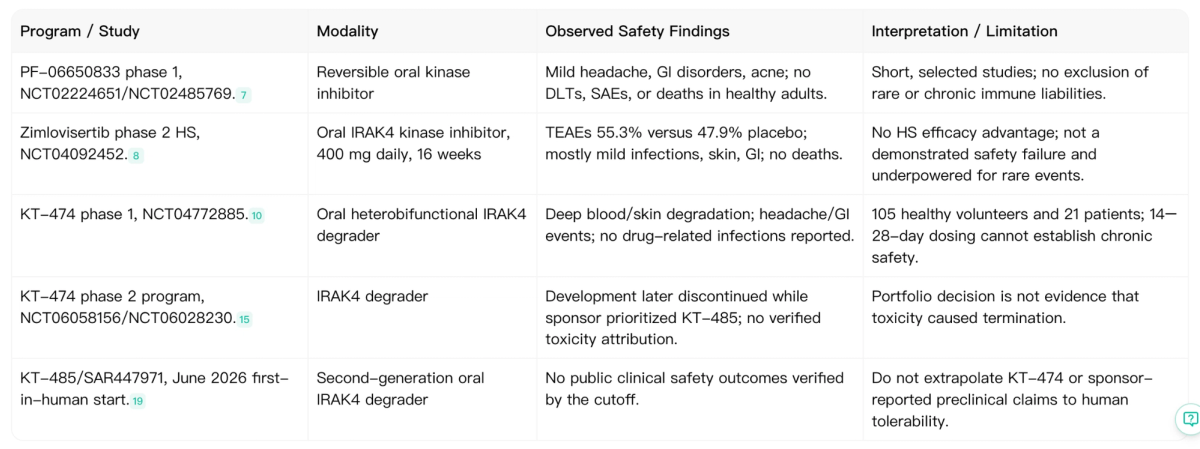
The comparison illustrates why trial duration, denominator, modality, adverse-event definition and development status must remain visible together. An early trial with no reported drug-related infections does not have sufficient power or follow-up to exclude infections during chronic treatment.
Turn scattered target-safety research into structured evidence
Use Noah AI to organize human genetics, primary publications, clinical adverse events and unresolved safety questions for your next target review.
Get 300 free credits when you sign up. No credit card required.
Get 300 Free Credits with Noah AI →
Step 5. Separate on-target risk, off-target findings and uncertain causality
Not every adverse event observed in a clinical trial results from the target mechanism. Nor should a biologically plausible event be presented as an observed drug toxicity. For IRAK4, the most useful classification is by source and strength of evidence:
- Human target-linked evidence: congenital IRAK4 deficiency and severe childhood bacterial susceptibility.
- Observed drug-trial events: headache, gastrointestinal complaints, acne and other reported trial findings, with actual denominators and comparators where available.
- Mechanistic hypothesis: persistent pathway suppression could alter infection responses, especially with prolonged dosing or concurrent immunosuppression.
- Candidate-specific uncertainty: degrader neosubstrates, metabolite effects or QTcF changes require direct follow-up before attributing causality.
One important distinction is that degradation may remove both IRAK4 kinase and scaffolding activity, whereas kinase inhibition can leave noncatalytic protein functions intact. This is a mechanistic distinction; it is not evidence that either modality necessarily has better long-term clinical safety.
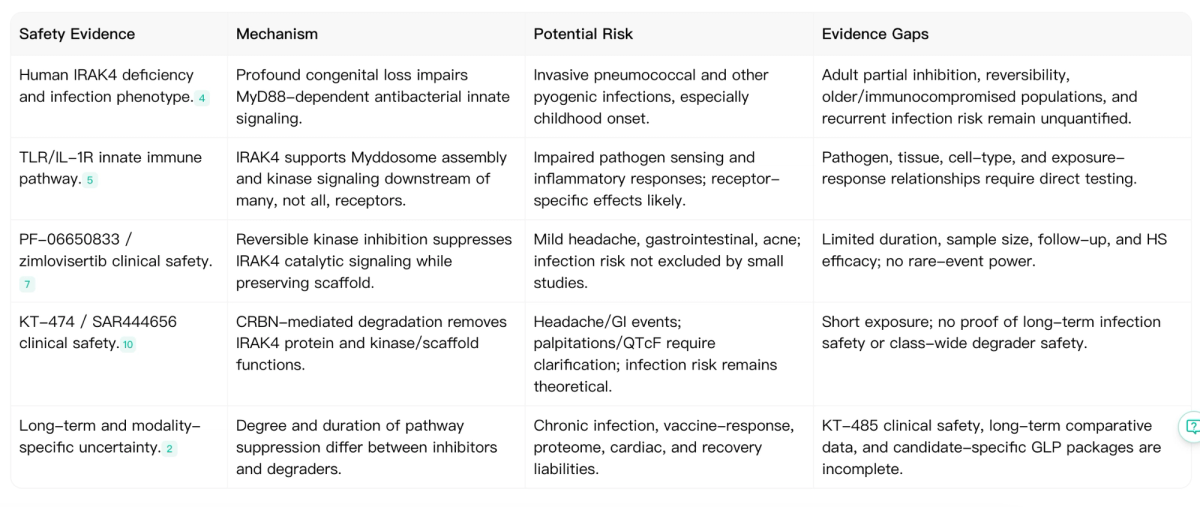
In this evidence matrix, "Potential Risk" and "Evidence Gaps" are deliberately separate columns. That prevents a missing chronic-infection dataset from becoming an unsupported claim that the drug causes chronic infection—or that no risk exists.
Step 6. Turn missing evidence into a safety-study plan
The next step in an AI-assisted assessment is not a generic recommendation to "conduct more studies." It is a prioritized list of experiments and measurements capable of resolving a decision-changing uncertainty.
| Open question | Evidence needed | Why it changes the decision |
|---|---|---|
| Innate immune function | Concentration-dependent human whole-blood TLR/IL-1R stimulation; receptor-specific pathogen-response assays. | Quantifies functional reserve at intended drug exposures. |
| Duration and reversibility | Matched inhibitor-versus-degrader time-course and washout studies. | Tests whether signaling suppression persists beyond circulating drug exposure. |
| Infection during chronic therapy | Larger and longer clinical exposure with adjudicated serious, recurrent and opportunistic infection events. | Addresses events too uncommon to evaluate in short phase 1 studies. |
| Degrader specificity | Candidate-specific global proteomics, relevant neosubstrate testing and metabolite studies. | Separates intended IRAK4 loss from other protein-level effects. |
| Cardiac electrophysiology | Concentration-QTc analysis and repeat ECG evaluation where a signal persists. | Clarifies whether an observed QTcF change is clinically meaningful. |
| General and reproductive toxicity | Candidate-appropriate GLP toxicology and safety-pharmacology packages. | Supplies molecule-specific evidence that cannot be borrowed from another IRAK4 program. |
The required study sequence depends on intended population, route, duration and regulatory stage. This table is a research-planning framework rather than a replacement for formal nonclinical or clinical safety requirements.
Step 7. Build an evidence-based early Go/No-Go framework
A final safety assessment should state what is known, what remains uncertain, and what would change the decision. In the Noah IRAK4 case study, the report's illustrative development gate was "Proceed with conditions." This was a conditional research judgment, not an unconditional finding that IRAK4 is safe or a candidate-specific regulatory recommendation.
Conditions for advancement could include a quantified immune pathway exposure-response relationship, candidate-specific selectivity and repeat-dose toxicology, sufficient infection-monitoring plans, and clinical proof of benefit in the intended disease. A clearly observed, exposure-linked serious safety problem may instead justify pausing the program pending investigation.
A go/no-go decision should never rest on a single safety score generated by an AI system. It should be supported by traceable studies, candidate-specific data, and specialist review across toxicology, clinical pharmacology, immunology and regulatory functions.
How to Reproduce the IRAK4 Assessment with Noah AI
The research case shown here used an IRAK4 safety-assessment report with an evidence cutoff of October 26, 2026. The report synthesized human genetic phenotypes, IRAK4 pathway functions, PF-06650833 clinical findings, KT-474 degrader evidence, corporate development updates and safety gaps. The two screenshots above show real analytical output. They do not demonstrate that Noah independently performed GLP studies or had access to unpublished regulatory dossiers.
For a similar task, submit a detailed research question asking for primary-source PMIDs, ClinicalTrials.gov identifiers, exact safety denominators, negative results and a distinction between theoretical risks and observed adverse events. A concise starting instruction is:
Researchers should check the original publications and trial records before using any generated analysis in an internal program decision. A well-structured AI report makes review more efficient; it does not remove the need for source verification or domain expertise.
Frequently Asked Questions
What is target safety assessment in drug discovery?
It is an early evaluation of whether changing a biological target might create harmful effects, informed by its normal function, human genetics, preclinical experiments, related drug programs and clinical safety observations.
Does inherited IRAK4 deficiency prove IRAK4 inhibitors cause infections?
No. Inherited profound IRAK4 deficiency provides strong human evidence of a pathway-level antibacterial defense liability. It does not quantify the risk of partial, time-limited pharmacological inhibition in adults.
Are IRAK4 degraders safer than IRAK4 kinase inhibitors?
The evidence does not establish a class-wide safety ranking. The modalities affect IRAK4 differently, and the available clinical studies have different durations, populations and designs. Candidate-specific comparisons are needed.
Why was KT-474 discontinued?
Kymera reported that Sanofi prioritized development of the next-generation degrader KT-485. The cited announcement did not identify a confirmed KT-474 toxicity event as the reason. The distinction between a portfolio decision and a safety failure is important.
Can Noah AI make a final drug-development go/no-go decision?
No AI-generated table substitutes for candidate-specific toxicology, clinical evidence, regulatory assessment or expert governance. AI can organize evidence and document conditions for a decision, but a formal development decision requires qualified review.
Conclusion: Use AI to Expose Safety Uncertainty, Not Conceal It
IRAK4 provides a useful example of how an attractive inflammation target can carry a genuine biological safety warning without a proven corresponding adverse-event rate for every drug. Human deficiency establishes an important host-defense role; inhibitor and degrader trials provide limited-duration clinical observations; and the next development steps require candidate-specific evidence.
A useful target-safety report does not simply label a target "safe" or "risky." It separates biological mechanism, observed events, competing explanations and missing studies so researchers can make a more defensible early decision.
Start your next target safety assessment with Noah AI
Review original scientific studies, organize clinical safety findings and build source-linked evidence tables for your next drug-development question.
Sign up to receive 200 free credits — no credit card required.
This material is for scientific education and research planning, not medical advice or a regulatory safety determination.