
How to Audit PRISMA 2020 Reporting Gaps with AI (2026)
Linda
Learn how to audit PRISMA 2020 reporting gaps with AI. Check systematic review manuscripts, identify missing checklist items, and verify abstract reporting.
A practical, source-grounded workflow for checking the main manuscript, reviewing the abstract separately, and drafting corrections without inventing missing research details.
October 30, 2026 · Medical systematic reviews · Worked example: SGLT2 inhibitors in heart failure
A systematic review can describe its research question, search, data extraction, and findings yet still leave important questions unanswered. A database might be named without its complete search strategy. A flow diagram might identify included studies but use inconsistent terminology for records and reports. An abstract may summarize pooled results while omitting limitations or registration information.
These are reporting problems worth detecting before submission. The PRISMA 2020 statement provides a framework for transparent reporting. An AI research assistant such as Noah AI can help researchers map checklist requirements to source passages, organize possible gaps, and propose wording for verification. It cannot determine whether unpublished methods were actually performed, fill in undocumented facts, or certify PRISMA compliance.
This guide follows a three-prompt workflow, demonstrated with a real open-access heart-failure meta-analysis. The screenshots show the actual Noah evidence tables—not a fabricated interface, an invented manuscript, or a benchmark of screening accuracy.
What Is PRISMA?
PRISMA stands for Preferred Reporting Items for Systematic Reviews and Meta-Analyses. The PRISMA 2020 statement contains a 27-item main manuscript checklist with additional sub-items, an expanded explanation of reporting requirements, an abstract checklist, and flow-diagram templates. It helps readers understand what the authors did, what information they used, what results were reported, and where uncertainty remains.
PRISMA should not be confused with a methodological appraisal tool. A review could accurately report that it used limited searching or did not evaluate certainty of evidence; that disclosure may improve transparency without making the underlying method stronger. Conversely, a carefully conducted process that is not explicitly reported can still leave a reporting gap. The audit asks "Can the reader locate and understand the relevant information?" rather than "Is this review scientifically valid?"
The distinction becomes especially important with supplementary material. If a study-selection flow diagram or search strategy is provided in an accessible supplement, its presence should be recorded. An AI assistant should not mark the item missing simply because it is not reproduced in the manuscript body. The correct conclusion depends on whether all applicable reporting details can be verified.
What Does the PRISMA 2020 Checklist Cover?
The main PRISMA checklist spans seven reporting sections. Several numbered items contain multiple sub-items, so checking only whether the author mentions a topic is not enough.
| Section | What to verify |
|---|---|
| Title | Clear identification as a systematic review or meta-analysis. |
| Abstract | A separate, complete summary using the PRISMA 2020 for Abstracts checklist. |
| Introduction | Rationale and clearly stated review objectives. |
| Methods | Eligibility, sources, search strategy, screening, extraction, risk of bias, synthesis, and certainty procedures. |
| Results | Study selection, study characteristics, individual results, syntheses, reporting-bias and certainty findings. |
| Discussion | Interpretation, evidence limitations, review-process limitations, and implications. |
| Other information | Registration and protocol, support, competing interests, and data/code/material availability. |
A useful audit preserves an explicit status for each item: Met when the reporting can be verified, Partial when relevant information is incomplete, Missing when it cannot be found after examining accessible sources, and Not verified when a necessary source was not accessible. Not applicable should be used only with a reason.
These labels help organize a review. They are not official PRISMA ratings, and their interpretation still requires a knowledgeable human reader.
How to Find and Fix PRISMA Gaps with Noah AI
In this demonstration, Noah reviewed the following published article:
Pandey AK et al. (2022). [Sodium-glucose cotransporter 2 inhibitors in heart failure with reduced or preserved ejection fraction: a meta-analysis.](https://pmc.ncbi.nlm.nih.gov/articles/PMC8934917/) ESC Heart Failure. PMID 35112512; DOI 10.1002/ehf2.13805.
The example uses the published article and its supporting material. It examines whether reporting details can be located—not whether the clinical conclusions are correct. The supplied Noah report states that it inspected the main article and accessible supplementary DOCX. The judgments below are therefore observations from that specific demonstration, subject to independent source checking.
Step 1. Audit the Full Manuscript Against PRISMA 2020
Begin with the complete manuscript, available tables and figures, and any accessible supplement. Ask Noah to evaluate all 27 main checklist items and applicable sub-items, recording exactly where each finding came from. A statement such as "we searched MEDLINE and EMBASE" is informative, but it does not by itself reproduce each database's complete search string.
Audit the attached systematic review against all 27 PRISMA 2020 main items and applicable sub-items. For each item, report Met, Partial, Missing, Not Verified, or Not Applicable; provide an exact manuscript or supplement location; and explain which reporting detail needs confirmation. Check full text and accessible supplements. Do not infer undocumented methods or certify compliance. Create a concise, source-linked Reporting Gap Evidence Table.
The real Noah audit identified several different types of findings. For example, the supplementary material provided a MEDLINE search strategy, but the audit did not find the corresponding complete EMBASE strategy. It also found that the article described risk-of-bias assessment but did not report a separate certainty-of-evidence assessment. The study-selection flow, by contrast, was documented in Supplementary Figure S1. Those are meaningfully different statuses, and a useful table keeps them separate.
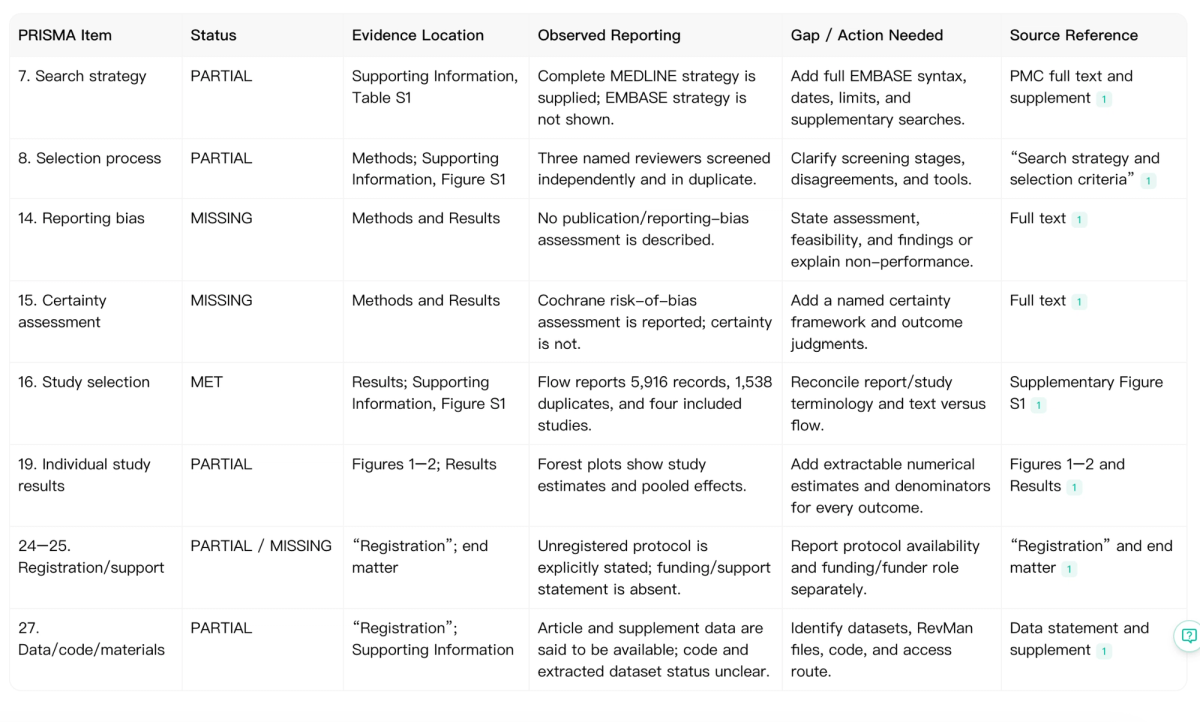
Two details prevent misleading conclusions. First, "no reporting-bias assessment described" is not the same as proving that no such evaluation occurred. Second, item 24 (registration and protocol) and item 25 (support) must be assessed independently, even when a compact display groups them in one screenshot. Here the article explicitly states that the review was not registered; the missing detail concerns protocol information, not an absent disclosure of registration status.
Step 2. Check the Abstract Separately
A manuscript-level audit is not a substitute for an abstract audit. The official PRISMA 2020 for Abstracts checklist contains 12 items covering the title, objectives, eligibility, information sources, risk of bias, synthesis methods and findings, included studies, limitations, interpretation, funding, and registration.
Ask Noah to judge the abstract using only the words in that abstract. Details supplied in the Methods section cannot silently turn an absent abstract item into "Present." Keep the complete list of items rather than treating an abstract as a shortened version of the 27-item manuscript checklist.
Audit only the published abstract against all 12 official PRISMA 2020 for Abstracts items. Do not borrow information from the main text. Return one table with Item, Status, Evidence in Abstract, and Missing Detail / Recommended Action. Mark funding or registration missing if not mentioned in the abstract. Preserve the exact reported figures and identify any inconsistency for author verification.
In this case, the corrected Noah abstract table marks limitations of evidence, funding, and registration as missing from the abstract. It also records that the abstract explicitly names MEDLINE and EMBASE, describes a Cochrane risk-of-bias tool, and reports pooled effect estimates. These observations are more useful than a generic claim that an abstract is "incomplete."
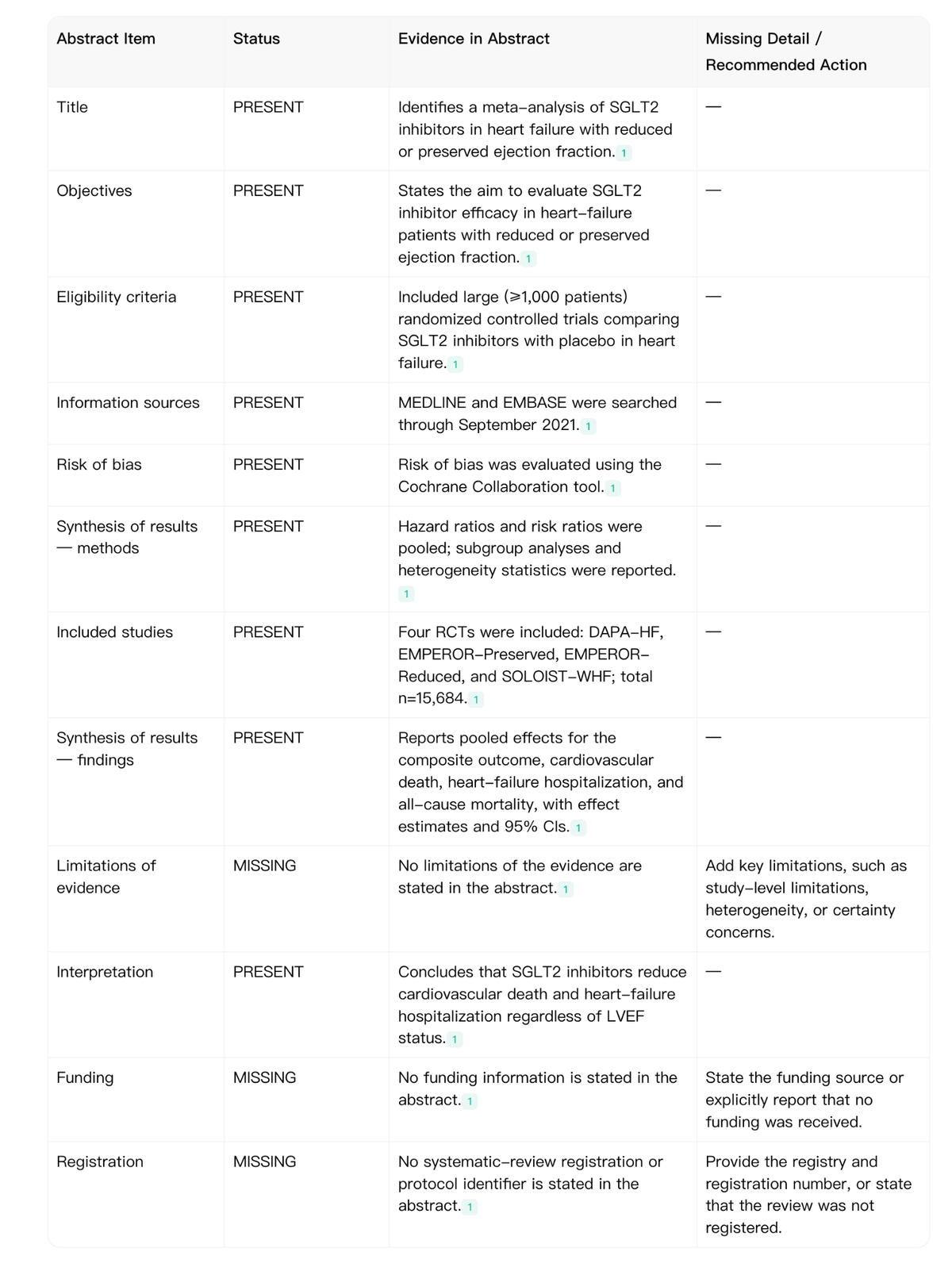
The abstract also reports four randomized trials and 15,684 participants. In the article's Results text, another passage reports 15,864. The audit preserves both numbers and flags them for verification against the original trial reports and analysis population. It does not choose a "correct" figure without evidence.
Research with Noah AI — Get 300 Free Credits
Try a source-grounded evidence audit, compare manuscript passages, and organize reporting questions. No credit card required.
Step 3. Turn Verified Gaps Into Usable Wording
After the table identifies specific gaps, use a third prompt to draft revisions. The crucial rule is simple: rewrite supported facts; use visible placeholders for anything the source does not establish. A model must not manufacture an EMBASE search string, claim that GRADE was performed, or invent a trial-selection meeting that cannot be documented.
For three items marked Partial or Missing, draft publication-ready wording based only on verified manuscript information. Give the item number, original evidence location, observed gap, suggested wording, and outstanding author confirmation. If a factual detail is unavailable, use [INSERT VERIFIED INFORMATION]. Do not reconstruct historical methods, search dates, funding, registration, or statistical analyses.
Example A: Search strategy transparency — Observed evidence: MEDLINE and EMBASE are named; a complete MEDLINE search strategy appears in Supporting Information Table S1, but the complete EMBASE strategy was not located in the inspected supplement. Drafting approach: "The MEDLINE search strategy is provided in Supplementary Table S1. [INSERT VERIFIED EMBASE STRATEGY, INTERFACE, SEARCH DATE, AND LIMITS.]" The bracketed text must be completed by someone with access to the original search history—not generated from likely keywords.
Example B: Risk of bias versus certainty of evidence — Observed evidence: The manuscript describes a Cochrane risk-of-bias assessment. The audit did not locate a separate certainty-of-evidence approach or its outcome-level judgments. Drafting approach: Ask the authors whether a certainty assessment was conducted, what framework was used, and where judgments can be reported. If it was not conducted, disclose that limitation rather than writing a fictional GRADE methods paragraph.
Example C: Participant-count consistency — Observed evidence: The abstract and one Results paragraph use different pooled participant totals. Action: reconcile the four source-trial populations and the exact analysis set, then update the relevant locations consistently. Do not treat an arithmetic guess as an audit finding.
In each example, the final sentence is still the author's responsibility. The benefit of the AI workflow is that the author receives a specific question and an evidence trail rather than a vague instruction to "improve reporting."
How This PRISMA Gaps Workflow Helps Researchers
A structured evidence audit can make revision work more focused, particularly when a manuscript has multiple tables, appendices, and sources. The approach is useful in three ways.
- It distinguishes omission from ambiguity. An unreported method, an inadequately described method, and an inaccessible supplement require different follow-up actions.
- It separates abstract reporting from manuscript reporting. Readers may only see the abstract; its completeness should be evaluated independently.
- It creates an auditable revision trail. The PRISMA item, source location, observed text, proposed clarification, and author verification can be recorded in one place.
There are limitations. A model can misread a heading, miss information in a supplementary file, conflate study-level and review-level risk of bias, or classify a legitimately unperformed procedure as simply missing. Reviewers should check every important finding against the underlying source and the official PRISMA explanation-and-elaboration guidance.
For formal systematic reviews, keep independent reviewer records, original search strategies, extraction logs, and analysis files in the research team's own controlled repository. An AI-generated audit table should sit alongside these materials, not replace them.
See the Noah Workflow in Action: A Heart-Failure Meta-Analysis
The worked example illustrates why a simple "27 out of 27" compliance score would be misleading. The article explicitly describes its unregistered status and supplies a study-selection flow diagram in supplementary material. Other details—including the complete EMBASE strategy, certainty-of-evidence reporting, and a separate funding statement—were not located in the audited sources. The abstract adds another layer: its published reporting omits explicit limitations, funding, and registration statements.
These observations support targeted editorial follow-up, not a judgment that the review's effect estimates are invalid. Nor do they establish that the missing analyses were never performed. The original data and the review authors' records are needed to resolve such questions.
For a comparable workflow, researchers can upload their own manuscript and accessible supplements, run a full checklist audit, check the abstract independently, and ask for evidence-bounded revision drafts. The same structure can be reused, while the statuses and reported gaps must be generated anew for each manuscript.
Frequently Asked Questions
Can AI check a systematic review against PRISMA 2020?
AI can compare a manuscript with checklist requirements, locate supporting passages, and surface possible reporting gaps. It still needs human review, especially where facts depend on inaccessible files or undocumented research decisions.
Does a PRISMA reporting gap mean the systematic review is poor quality?
No. PRISMA is a reporting guideline. Its purpose is transparency, not a direct measurement of methodological quality, risk of bias, or certainty of evidence.
Should information in supplementary figures count?
Yes, relevant information in accessible figures or supporting files should be checked and cited. Whether it fully satisfies a particular item depends on the actual reporting detail and the journal's requirements.
Is the abstract checklist the same as the full PRISMA checklist?
No. The main manuscript has 27 numbered items with sub-items. The PRISMA 2020 abstract checklist has 12 items and should be applied to the abstract independently.
Can Noah write missing PRISMA methods for me?
No tool should invent a search strategy, reviewer process, funding source, protocol, or unperformed analysis. Noah can organize verified text and create placeholders for information that the authors must supply or confirm.
Conclusion: Better Reporting Begins With Verifiable Evidence
A good PRISMA audit does more than count completed boxes. It identifies what is explicitly reported, what remains vague, which source holds the evidence, and what needs an author's decision. For this published heart-failure meta-analysis, that meant checking the supplementary search and flow files, independently reviewing the abstract, and preserving a participant-count discrepancy rather than silently resolving it.
Noah AI can help organize this work into cited tables and actionable revision questions. The final responsibility for accurate reporting—and for confirming what actually happened during the review—remains with the authors and human reviewers.
Source-grounded literature workflows — Start With 200 Free Credits
Review biomedical literature, organize evidence tables, and identify questions worth verifying before submission. No credit card required.