
How to Build a Literature Review Matrix with AI (2026)
Linda
Learn how to build a literature review matrix with AI. Organize research papers by methods, findings, limitations, and research gaps using Noah AI.
A practical, source-grounded guide to turning multiple papers into a comparable research matrix—with citation, methods, sample, findings, limitations, research gap, and relevance—using Noah AI.
After reading several research papers, it is easy to remember the broad conclusions but forget which authors used which methods, how many people were studied, or why a finding matters to your question. A literature review matrix solves this by putting every paper in a row and applying consistent fields across the evidence.
AI can help populate that structure, but a useful matrix is not simply an AI summary in spreadsheet form. It needs verifiable citations, carefully preserved study results, explicit limitations, and space for a researcher to judge what each paper contributes. In this guide, we used Noah AI to organize a real biomedical example: continuous glucose monitoring (CGM) in adults with type 2 diabetes.
Quick answer: Start with one focused research question. Select relevant papers, define seven consistent columns, ask AI to extract one verified row per source, and check the findings against the original publications. Then group the papers by themes, evaluate candidate gaps, and use the matrix to plan your literature review.
What Is a Literature Review Matrix?
A literature review matrix is a structured research table that helps researchers compare studies by themes, methods, findings, limitations, research gaps, and relevance to a review question.
Unlike a clinical evidence table, which emphasizes standardized fields such as population, intervention, comparator, endpoints, and numerical results, a literature review matrix focuses on thematic interpretation, methodological differences, and unanswered research questions.
Both formats support evidence comparison, but they serve different purposes: an evidence table documents what studies measured and reported, while a literature review matrix helps researchers understand how the studies relate to one another and what questions remain unresolved.
A typical matrix is useful for narrative literature reviews, thesis chapters, and research proposals. It can also serve as a working extraction aid in systematic or scoping review workflows, although it does not replace formal eligibility screening, risk-of-bias appraisal, or reproducible review methods.
Why Use a Matrix Instead of Separate Paper Summaries?
Summaries answer "What did this paper say?" A literature review matrix helps answer several harder questions at once: Which studies agree? Which use different measures? Whose findings are not directly comparable? Which limitations appear repeatedly?
For example, two glucose-monitoring trials can both study adults with type 2 diabetes but test different devices, follow patients for different lengths of time, and emphasize different endpoints. A table with shared columns exposes those differences before you try to synthesize results.
What Columns Should a Literature Review Matrix Include?
Start with the seven columns below. Additional fields—such as Research Aim, Theme, DOI/PMID, or Source Provenance—can be added when the question requires greater detail.
| Column | What to record |
|---|---|
| Citation | Author, year, title, journal and stable identifier (DOI or PMID). |
| Methods | Study design, intervention or exposure, comparator, and outcome timing. |
| Sample | Participants, setting, key eligibility characteristics, and relevant denominators. |
| Findings | The result relevant to the review question, including its numerical estimate and uncertainty where available. |
| Limitations | Reported weaknesses, missing data, possible bias, and limits on applicability. |
| Research Gap | A candidate unanswered question arising from the paper—not automatic proof that the wider literature has no answer. |
| Relevance | Why this study belongs in the review and which part of the question it informs. |
Reusable template header: Citation, Methods, Sample, Findings, Limitations, Research Gap, Relevance
How to Build a Literature Review Matrix with AI: Step by Step
Step 1 — Define One Review Question
The matrix has to be built around a question, not simply a broad topic. Our demonstration question was:
In adults with type 2 diabetes, does continuous glucose monitoring, compared with self-monitoring of blood glucose, improve glycemic control?
We focused on HbA1c and also tracked time in range (TIR), hypoglycemia, and patient-reported outcomes. That scope lets a paper with neutral HbA1c but useful hypoglycemia findings remain relevant without flattening the outcomes into a single "effective/not effective" label.
Step 2 — Select Papers and Check Their Sources
Choose a manageable set of papers that contribute to the same question. For this demonstration, the Noah report identified randomized studies and contextual reviews, including the Martens 2021 basal-insulin trial, the LIBERATES trial, and the GP-OSMOTIC primary-care study.
Before recording a row, verify the publication, year, population, methods and outcomes. Distinguish primary studies from reviews, follow-up reports or subgroup analyses. The LIBERATES article, for example, appears in the 2023 Diabetes Care publication record, even though its DOI and online-publication timeline include 2022.
Step 3 — Ask Noah AI for the Same Fields in Every Paper
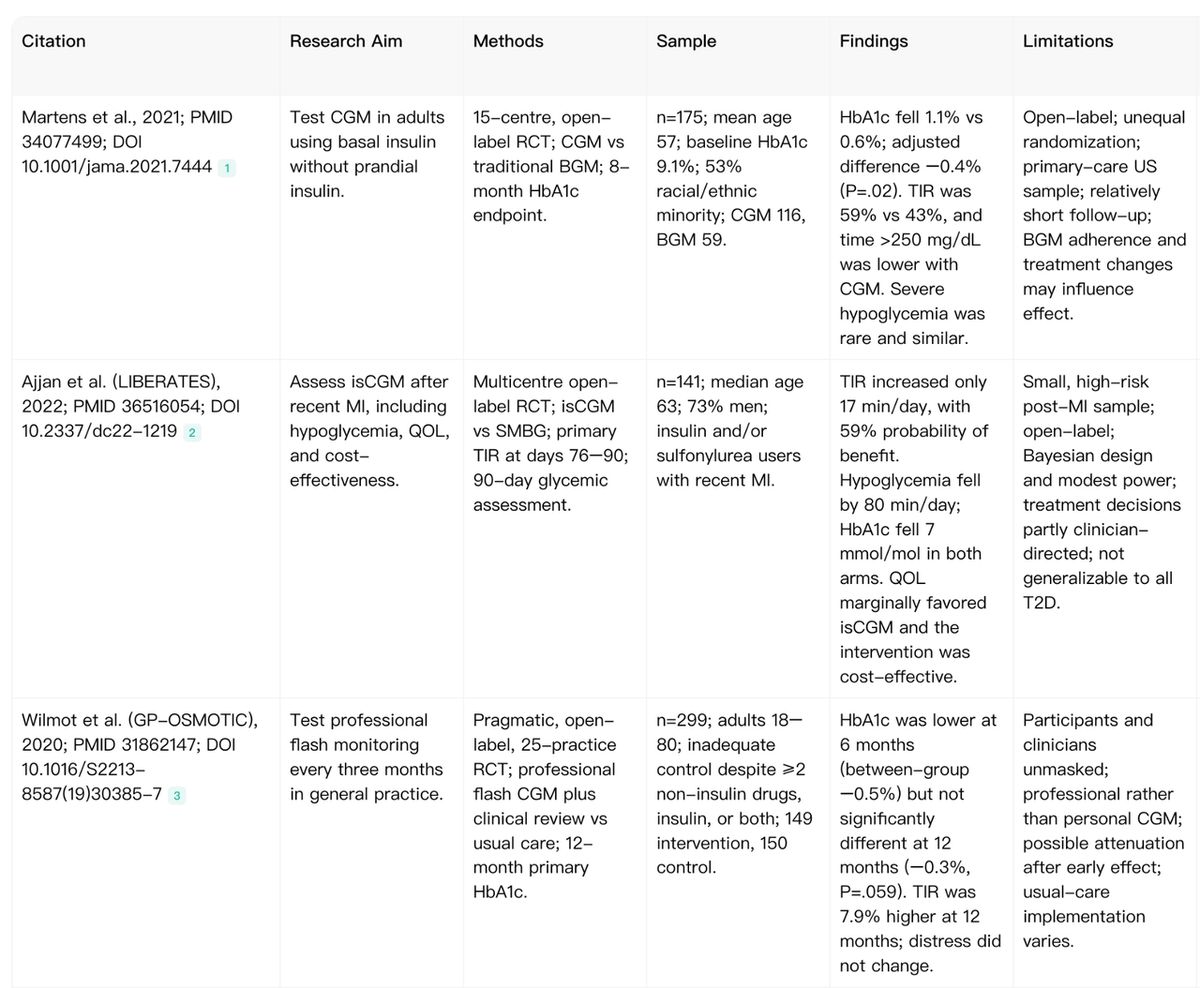
Rather than requesting "Summarize these studies," specify the column structure up front. One row should correspond to one publication, and every cell should keep its relationship to the source. In the actual Noah result below, the left-hand excerpt captures the citation, research aim, methods, sample, findings, and limitations for three studies.
Notice why uniform fields matter: the studies differ in size, delivery setting, glucose-monitoring approach, and follow-up. The matrix reveals those differences without requiring a full abstract for each study. For more detailed clinical endpoint standardization, see our evidence table tutorial.
Reusable Noah prompt:
Step 4 — Check Methods, Samples, and Findings Against the Papers
The first task after AI extraction is verification. Consider three concrete differences shown by the source studies:
- Martens et al., 2021: 175 adults randomized in a primary-care CGM-versus-meter study; adjusted HbA1c difference at eight months was −0.4 percentage points, favoring CGM. [1]
- LIBERATES: 141 participants with recent myocardial infarction; HbA1c reductions were similar across groups, while hypoglycemia exposure was lower with intermittently scanned CGM. [2]
- GP-OSMOTIC: HbA1c favored professional flash monitoring at six months but not significantly at the prespecified 12-month primary assessment; time in range was higher at 12 months. [3]
These results should not be combined as if they came from the same intervention, comparator, or endpoint. The job of the matrix is to preserve the distinctions, not to generate a cross-study treatment ranking.
Step 5 — Add Limitations, Research Gap, and Relevance
These three columns turn a source log into a working review matrix.
The following matrix applies the seven-column structure to three published studies. It connects each study's methods and findings with its limitations, relevance, and candidate research questions.
| Citation | Methods | Sample | Findings | Limitations | Research Gap (Candidate) | Relevance |
|---|---|---|---|---|---|---|
| Martens et al., 2021 | Randomized CGM vs blood glucose monitoring trial | 175 adults with T2D using basal insulin | Adjusted HbA1c difference of −0.4 percentage points at 8 months, favoring CGM | Results concern a defined basal-insulin population | Longer-term durability and applicability to other treatment groups require investigation | Supports CGM benefit in basal-insulin-treated T2D |
| Ajjan et al., 2023 (LIBERATES) | Randomized isCGM vs SMBG trial | 141 participants following myocardial infarction | Similar HbA1c reductions; lower hypoglycemia exposure with isCGM | Recent-MI population and device-specific findings limit generalization | Which patients benefit most from hypoglycemia reduction despite similar HbA1c? | Highlights outcomes beyond HbA1c |
| Wilmot et al., 2020 (GP-OSMOTIC) | Randomized primary-care flash monitoring study | Adults with T2D in primary care | HbA1c favored monitoring at 6 months but not significantly at 12 months; TIR improved | Findings vary by endpoint and follow-up | What explains differences between HbA1c and TIR outcomes over time? | Shows the importance of endpoint selection and follow-up |
Interpretation: These studies illustrate why a literature review matrix should go beyond recording treatment results. Their different populations, monitoring methods, and follow-up periods create distinct interpretive questions. The research gaps listed here are hypotheses for further investigation, not confirmed gaps in the entire literature. Researchers should verify them against more recent studies and systematic reviews before presenting them as established research gaps.
For instance, GP-OSMOTIC matters to this review precisely because its primary 12-month HbA1c result was not statistically significant while TIR improved. Recording this prevents the final review from exaggerating a universal HbA1c benefit. [3]
A limitation in one article is not automatically an unfilled research gap across the whole field. Check newer publications and existing syntheses before writing that something "has not been studied." For a dedicated workflow, see how to validate research gaps with AI.
Build a Literature Review Matrix with Noah AI
Get free credits to organize biomedical papers into a structured matrix, compare methods and findings, and identify questions that need verification. No credit card required.
Step 6 — Group Papers by Theme, Not by Author
The next step is to sort the verified studies into themes that can become sections of the literature review. In our Noah demonstration, the studies were organized into groups covering stronger benefits in some insulin-treated populations, mixed HbA1c effects, non-insulin and education-dependent use cases, and review-level context.
Grouping matters because the literature is not uniformly positive. The GLiMPSE trial, for instance, reported no additional HbA1c improvement with intermittently scanned CGM over structured blood glucose monitoring in a diabetes self-management education setting. [4] Other trials, such as Steno2tech, found improvements in an insulin-treated population. [5]
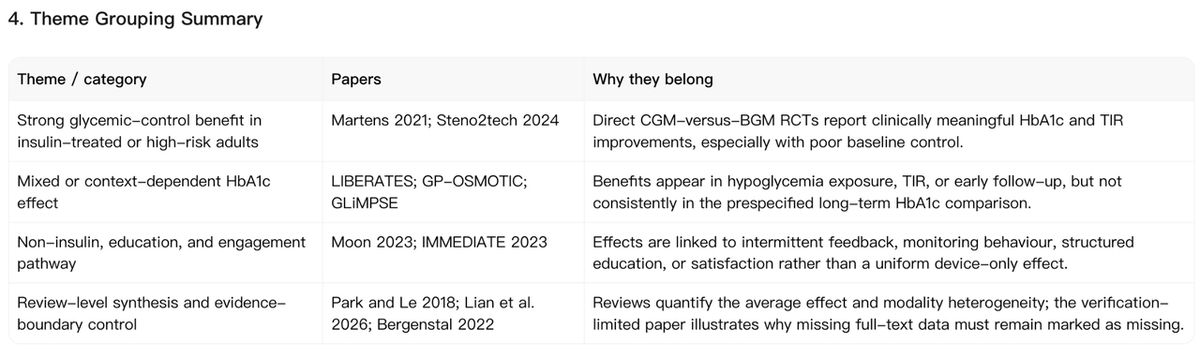
Instead of writing one paragraph per study, a thematic review can therefore discuss population, comparator intensity, device modality and endpoint differences. For a deeper methodological approach, see how to compare multiple research papers in a literature review.
Step 7 — Turn the Matrix Into a Literature Review Outline
With the matrix checked and themes assigned, draft an outline that reflects the evidence rather than the order in which you found papers:
- Scope and definitions: CGM versus SMBG/BGM in adults with type 2 diabetes, with clearly distinguished device types and outcomes.
- Insulin-treated populations: Where glycemic-control signals are stronger and which limitations apply.
- Non-insulin treatment and education: How structured education and monitoring behavior may shape incremental effects.
- Outcome and follow-up differences: Why HbA1c, TIR, hypoglycemia, and patient-reported results need distinct interpretations.
- Gaps and conclusion: What the selected studies can support, what remains uncertain, and which questions require a more comprehensive search.
This is the critical shift from paper-by-paper description to theme-based synthesis. A good paragraph makes a claim about the evidence, supports it with appropriately comparable sources, and explains limitations without overstating the result.
Which Format Should You Use?
Excel and Google Sheets are convenient for editable, sortable matrices; Notion or Word tables can work for smaller projects. Noah can help produce a structured working table, while a spreadsheet is useful for manual changes, theme tags, source links, and final checks. Do not assume direct synchronization with a reference manager or spreadsheet unless that functionality has been verified for your workflow.
A reusable seven-column CSV template is supplied with the downloadable article package. If you copy the header into a spreadsheet, keep DOI/PMID in the Citation cell or add a separate identifier column so readers can trace every row.
Common Mistakes When Creating a Literature Review Matrix
- Copying abstracts into cells. Short paraphrases are easier to compare, but must preserve the study's actual claim.
- Leaving Relevance blank. A paper can be on-topic without directly answering the review question.
- Treating all CGM devices as identical. rtCGM, isCGM, and professional monitoring may represent different interventions.
- Mixing outcomes and follow-up. A neutral 12-month HbA1c result should not be hidden by an earlier secondary result.
- Inventing missing values or gaps. Use "Not reported" or "Needs full-text verification" when necessary.
- Calling the matrix a systematic review. A completed table is not proof of an exhaustive search, reproducible selection, independent appraisal, or validated synthesis.
Frequently Asked Questions
What is the difference between a literature review matrix and an evidence table?
The terms often overlap. A literature review matrix is especially useful for working notes, themes, research gaps, and relevance to a writing question; an evidence table often emphasizes standardized outcome extraction and methodological traceability. The distinction is one of purpose, not a rigid technical boundary.
How many papers should I include?
There is no universal number. A small worked example with three to five well-chosen papers makes the columns easy to inspect. A thesis or systematic review may need many more, chosen according to scope and documented eligibility rules rather than a target count.
Can AI automatically identify research gaps from a matrix?
AI can flag recurring omissions, underrepresented populations, and conflicting findings. A gap is a candidate until the researcher checks whether newer or omitted studies already address it.
Can I use an AI-generated matrix as my final literature review?
No. The matrix is a working synthesis aid. The final review still requires source verification, appropriate methodological appraisal, sound interpretation and original writing.
Can I copy the matrix into Excel or Google Sheets?
Yes, if you have the table content in a supported format such as CSV. Keep the original references and verify values after transfer; the screenshots alone are visual evidence of the workflow, not an editable dataset.
Final Checklist
Before drafting from the matrix, confirm that each selected paper has a correct citation, stable identifier, appropriate methods and sample details, relevant findings, explicit limitations, and a defensible explanation of its relevance. Group papers by useful themes; investigate conflicting results; and validate proposed research gaps against newer evidence.
Evidence cutoff: 19 October 2026. This article documents an educational Noah AI workflow, not a completed systematic review. Some material in the source report was verified at abstract level only; one candidate paper was marked for full-text verification and should not be used to assert unverified quantitative outcomes. The screenshot theme labels are AI-assisted working categories, not independent evidence-quality judgments.
Turn Research Papers Into a Structured Review Matrix
Try Noah AI with free credits to organize citations, methods, samples, findings, limitations, and possible research gaps in one research workflow. No credit card required.
References and Further Reading
- Martens T, et al. (2021). Effect of Continuous Glucose Monitoring on Glycemic Control in Patients With Type 2 Diabetes Treated With Basal Insulin: A Randomized Clinical Trial. JAMA. PubMed / PMID 34077499.
- Ajjan RA, et al. (2023). LIBERATES trial: intermittently scanned CGM versus SMBG following acute myocardial infarction in type 2 diabetes. Diabetes Care. PubMed / PMID 36516054.
- Wilmot EG, et al. (2020). GP-OSMOTIC: professional-mode flash glucose monitoring in general practice. Lancet Diabetes Endocrinol. PubMed / PMID 31862147.
- Chandran SR, et al. (2024). GLiMPSE: intermittently scanned CGM compared with structured SMBG plus diabetes self-management education. Diabetes Res Clin Pract. PubMed / PMID 38642860.
- Lind N, et al. (2024). Steno2tech: continuous glucose monitoring versus blood glucose monitoring in insulin-treated type 2 diabetes. Diabetes Care. PubMed / PMID 38489032.