
How to Design an Experimental Protocol with AI: Step-by-Step Guide
Linda
Learn how to design an experimental protocol with AI, from research questions and control groups to assays, replication, quality checks, and a final protocol draft.
Learn how to use AI to plan experimental groups, identify essential controls, select measurable endpoints, organize laboratory workflows, and create a literature-grounded experimental protocol draft.
Designing an experimental protocol is more than describing a research idea or collecting methods from published papers.
A useful experimental protocol must connect a specific hypothesis with an appropriate experimental model, clearly defined treatment groups, controls, measurement methods, replication, quality control, and a statistical analysis plan.
These decisions are closely related. An experiment may use a relevant biological model but still produce misleading results if its controls are inadequate, its primary endpoint is poorly defined, or technical measurements are mistaken for independent biological replicates.
AI can support the planning process by organizing published experimental methods, identifying missing design elements, comparing potential controls, and transforming an initial research question into a structured protocol draft.
In this guide, we demonstrate an AI-assisted experimental protocol design workflow using Noah AI and a real biomedical research example: high-glucose-associated oxidative stress in human renal proximal tubular epithelial cells.
Research Question → Published Methods → Experimental Groups → Measurements → Replication → Quality Control → Protocol Blueprint
Testing note: We tested Noah AI directly using its Agent and Deep Research workflow. The output is a literature-grounded experimental design draft, not an experimentally validated laboratory SOP. Published methods, laboratory conditions, biosafety requirements, and proposed procedures must be checked by qualified researchers before execution.
Quick Answer: How Can AI Help Design an Experimental Protocol?
AI can help researchers develop an initial experimental protocol by organizing evidence from published studies and translating a testable hypothesis into a structured design.
A practical AI-assisted protocol workflow should answer six questions:
What precise research question will the experiment test?
Which experimental model and published methods are appropriate?
What treatment groups and controls are essential?
Which measurements can test the hypothesis reliably?
How will replication, bias, and quality control be handled?
What must be verified before the protocol can be implemented?
The expected output is a reviewable experimental protocol blueprint. AI-generated parameters should not be assumed to be optimized or ready for laboratory use.
What Is an Experimental Protocol?
An experimental protocol describes how a scientific question will be investigated using defined materials, experimental conditions, measurements, controls, and analytical procedures.
A well-designed protocol is intended to make an experiment interpretable and reproducible. It should identify what is being tested, how competing explanations will be controlled, and what evidence would support or challenge the working hypothesis.
| Protocol Component | Purpose |
|---|---|
| Research question and hypothesis | Define the scientific claim being tested. |
| Experimental model | Specify the biological system and its limitations. |
| Treatment and control groups | Separate the proposed experimental effect from alternative explanations. |
| Primary and secondary endpoints | Define how the experimental outcome will be measured. |
| Replication and randomization | Support reliable estimation and reduce avoidable bias. |
| Quality control | Identify technical failures, contamination, and assay interference. |
| Statistical analysis | Specify the comparisons and analytical assumptions before collecting data. |
Experimental Protocol vs. Research Proposal
A research proposal explains why a study is important, what question it will investigate, and how the overall research will be organized.
An experimental protocol goes further into the design decisions needed to perform and interpret a particular experiment.
| Research Proposal | Experimental Protocol |
|---|---|
| Why should the research be conducted? | How will the experiment test the hypothesis? |
| Defines research aims and significance. | Defines experimental groups, controls, and procedures. |
| Provides a study-level methodology. | Specifies measurements, replicates, and quality checks. |
| Produces a research plan. | Produces a protocol draft for technical review and validation. |
Real Example: Designing an HK-2 Cell Experiment with Noah AI
To demonstrate this workflow, we used a focused in vitro research question involving human renal proximal tubular epithelial cells, commonly known as HK-2 cells.
EXPERIMENTAL DESIGN CASE
High-Glucose-Associated Oxidative Stress in HK-2 Cells
Model: Human proximal-tubule-derived HK-2 cells
Independent variable: Glucose exposure condition
Key control: Matched osmotic condition
Research objective: Evaluate glucose-associated changes in oxidant-sensitive cellular measurements.
The research question was:
Research Question
How can we design a reproducible in vitro experiment to evaluate whether high-glucose exposure increases oxidative stress in HK-2 cells, while distinguishing glucose-associated effects from changes caused by osmotic stress?
This is a useful experimental design case because increasing glucose in culture medium can also change osmotic conditions. Without an appropriate osmotic control, a measured response could be incorrectly attributed entirely to glucose-associated biology.
Published HK-2 studies have used normal-glucose, high-glucose, and mannitol-containing control conditions to investigate these differences.
The objective of our Noah AI test was not to discover a new mechanism or generate laboratory results. It was to turn a clear question and existing methodological evidence into a structured experimental design that a researcher could review.
Step 1 — Define the Research Question and Working Hypothesis
Experimental protocol design begins with a question that can be answered by the chosen model and measurements.
An overly broad request such as "Design an experiment about diabetic kidney disease" leaves too many decisions undefined.
A more useful question identifies the cell model, experimental exposure, outcome of interest, and the main alternative explanation that the control design must address.
For this case, the working hypothesis was that high-glucose exposure may alter oxidant-sensitive cellular measurements in HK-2 cells relative to normal-glucose conditions, with an osmotic control helping assess whether the response is attributable partly or predominantly to added osmotic load.
The hypothesis should not assume that an effect will occur or predetermine its magnitude, direction, or statistical significance.
Step 2 — Enter the Experimental Design Task into Noah AI
We used Noah AI Agent with Deep Research and the 5.6 Terra · Balanced model.
Rather than asking the AI to produce a generic methods section, we specified the intended design outputs:
- A focused research question and hypothesis.
- Published experimental method precedents.
- Essential biological treatment groups and assay controls.
- Candidate conditions requiring verification.
- Primary and secondary measurements.
- Biological and technical replication considerations.
- Quality-control checkpoints.
- A final experimental protocol blueprint.
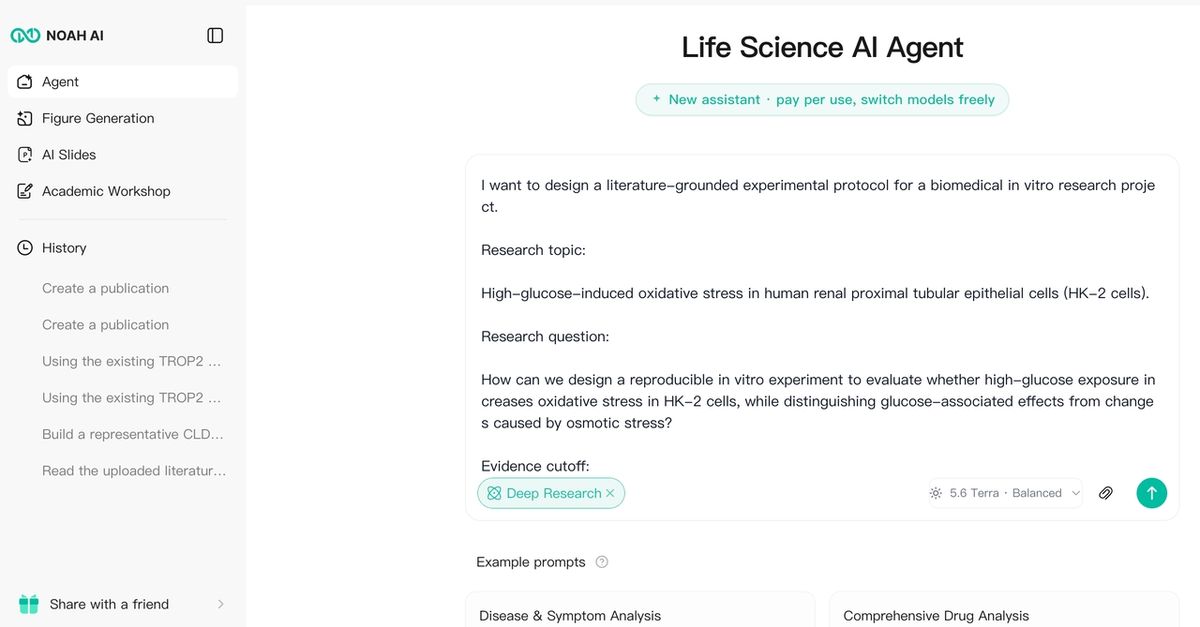
The prompt also instructed Noah to distinguish published methods from proposed adaptations and unverified parameters.
That distinction is important because an AI system can produce a detailed-looking protocol without independently establishing that all of its operational conditions are suitable for a specific laboratory.
Step 3 — Review Published Experimental Methods
Before selecting treatment conditions or assays, identify how related experiments have actually been conducted.
For the HK-2 case, the published literature includes high-glucose cell-culture studies using different basal glucose concentrations, exposure durations, assay platforms, and osmotic-control formulations.
One published metabolomics study compared 5.5 mM glucose, 25 mM glucose, and a control containing 5.5 mM glucose plus 19.5 mM mannitol.
That study provides a useful precedent for the biological comparison, but it does not automatically validate every assay, treatment duration, or culture condition in a new experiment.
| Method Element | Evidence-Informed Consideration |
|---|---|
| Cell model | HK-2 human proximal-tubule-derived epithelial cells. |
| Normal glucose | 5.5 mM glucose is a published comparison condition. |
| High glucose | 25 mM glucose is a published candidate condition. |
| Osmotic control | 5.5 mM glucose plus 19.5 mM mannitol is a published precedent for this comparison. |
| Primary assay | Must be chosen according to measurement specificity and local assay validation. |
| Exposure duration | Must be selected for the endpoint and verified using source methods and pilot data. |
The important lesson is to preserve the relationship between a published condition and the experiment in which it was used.
A concentration reported in one study does not establish an optimal treatment duration or assay configuration for every subsequent experiment.
Researchers can review the relevant three-group precedent in the published study A Non-Targeted Capillary Electrophoresis-Mass Spectrometry Strategy to Study Metabolic Differences in an In Vitro Model of High-Glucose-Induced Changes in HK-2 Cells.
Step 4 — Design Experimental Groups and Essential Controls
Experimental groups should be selected according to the specific comparison needed to test the hypothesis.
In this case, simply comparing high-glucose cells against normal-glucose cells would not be sufficient to distinguish glucose-associated effects from changes associated with additional osmotic load.
Noah AI generated a structured experimental group and control matrix identifying the role of each condition.
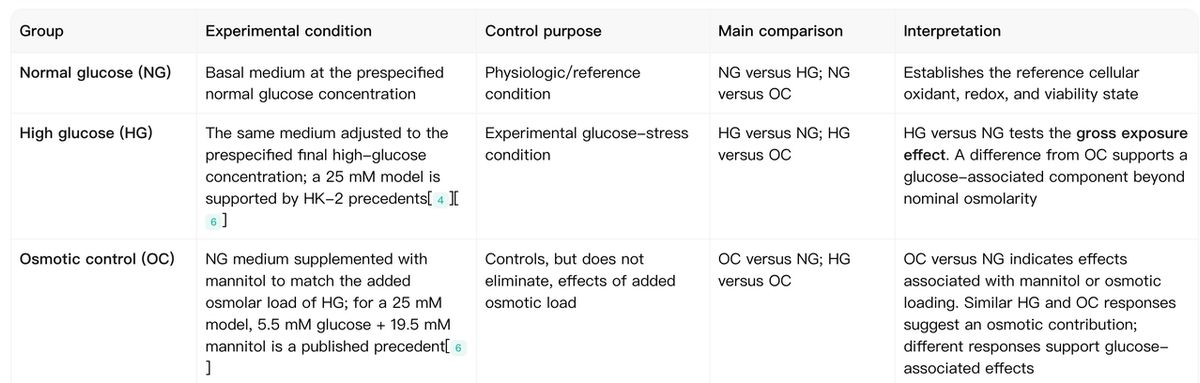
The proposed biological comparison includes three groups:
| Group | Experimental Purpose | Comparison |
|---|---|---|
| Normal Glucose (NG) | Establish the reference cellular state under the selected baseline condition. | NG vs. HG; NG vs. OC |
| High Glucose (HG) | Evaluate the overall response to high-glucose exposure. | HG vs. NG; HG vs. OC |
| Osmotic Control (OC) | Assess whether added osmotic load contributes to the response. | OC vs. NG; HG vs. OC |
The high-glucose versus normal-glucose comparison evaluates the overall response associated with changing glucose conditions.
The high-glucose versus osmotic-control comparison helps assess whether that response is distinguishable from the control condition containing added mannitol.
The osmotic-control versus normal-glucose comparison provides additional information about the effect of the added-solute condition itself.
Importantly, mannitol should not automatically be assumed to be biologically inert. Final osmolarity must also be assessed using the actual complete culture medium.
Why the control matters
If both high glucose and the matched osmotic control produce similar responses, part of the observed effect may be associated with osmotic or added-solute conditions rather than glucose-specific biology.
The report also listed assay-specific controls, including unstained cells, reagent-only controls, and cell-free media blanks. These support measurement quality but should not be confused with additional biological treatment groups.
Step 5 — Select Experimental Conditions Without Inventing Parameters
Once the experimental groups are defined, the next step is to identify the parameters that determine how the experiment will be conducted.
For a cell-culture experiment, these may include the basal medium, glucose concentration, osmotic-control formulation, cell density, passage range, exposure duration, sample collection timing, and assay conditions.
Noah distinguished literature-reported conditions from proposed adaptations and parameters requiring pilot optimization.
| Parameter | Status | Required Action |
|---|---|---|
| 25 mM high-glucose condition | Literature-reported precedent | Verify its suitability for the selected assay and culture setup. |
| Mannitol osmotic control | Literature-reported design | Check basal glucose and complete-medium osmolarity. |
| Exposure duration | Endpoint-dependent | Review relevant methods and perform pilot optimization. |
| Cell density and confluence | Requires verification | Use validated local culture procedures and record conditions. |
| Assay settings | Requires local validation | Verify instrument compatibility, controls, and signal range. |
This prevents a common AI-generated protocol problem: combining concentrations from one publication, incubation times from another, and an assay from a third without checking whether those choices are compatible.
A useful protocol draft should identify unresolved parameters clearly instead of presenting every number as scientifically optimized.
Step 6 — Define Primary and Secondary Experimental Endpoints
A well-designed experiment needs at least one clearly defined primary measurement aligned with the hypothesis.
In the HK-2 case, Noah proposed an oxidant-sensitive cellular fluorescence measurement as a candidate primary readout, paired with a viability measurement and an orthogonal redox assessment.
The final assay depends on available equipment, validated laboratory methods, and the precise biological question.
| Endpoint | Potential Measurement | Interpretation |
|---|---|---|
| Primary | Validated oxidant-sensitive DCF fluorescence | Relative oxidant-dependent signal, not a specific ROS concentration. |
| Secondary 1 | Viability or cell-death measurement | Helps distinguish signaling changes from cell loss or injury. |
| Secondary 2 | GSH/GSSG or another validated complementary redox assay | Provides a different view of cellular redox status. |
Assay specificity is important. DCFH-DA-based fluorescence responds to several oxidant-related chemical processes and should not be presented as a direct, specific measurement of hydrogen peroxide, superoxide, or all reactive oxygen species.
A second measurement can help test whether an observed signal reflects a broader biological response or an assay-dependent artifact.
The final protocol must also specify how raw measurements will be normalized and what controls are needed to evaluate background fluorescence, cell number, and assay performance.
Step 7 — Plan Biological Replicates, Technical Replicates, and Bias Control
A reproducible experiment requires a clear definition of the experimental unit.
This is particularly important in cell-culture research because several wells on a single plate may originate from the same cell preparation and treatment event.
Multiple wells are not automatically independent biological experiments.
| Replication Type | Meaning |
|---|---|
| Biological replicate | An independent culture or treatment event, as defined by the experimental design. |
| Technical replicate | Repeated wells or measurements used to evaluate within-experiment variability. |
| Repeated reading | Repeated acquisition from the same sample; does not create a new biological replicate. |
In Noah's proposed design, all three biological conditions would be represented within each independent experimental batch.
The protocol should also plan how treatment locations, processing order, passage number, culture batch, and data analysis will be managed.
Randomizing positions when appropriate, balancing treatment groups across batches, and using blinded data analysis where feasible can reduce avoidable experimental bias.
A statistically defensible sample size requires information about biological variability, assay precision, and a meaningful effect size. AI should not invent an adequate sample size without those inputs.
Step 8 — Organize the Step-by-Step Experimental Workflow
Once the study question, groups, endpoints, and replication strategy are defined, the design can be organized into an ordered workflow.
This helps researchers identify whether important preparation, measurement, quality-control, or data-handling stages have been omitted.
For the HK-2 case, the workflow moves through preparation, culture verification, group assignment, exposure, primary and secondary assays, and final analysis.
Each stage should specify its objective, the required action, the relevant quality-control check, and any parameters still needing confirmation.
The workflow is a design blueprint. It does not replace laboratory SOPs specifying approved reagent preparation, validated instrument settings, exposure conditions, or biosafety procedures.
Step 9 — Add Quality Control and a Statistical Analysis Plan
Quality control should be planned before collecting the final experimental data.
For this case, important checks include cell-line identity, contamination status, basal-medium glucose, osmolarity matching, passage history, cell density, viability, assay background, and batch effects.
The statistical plan should identify the main comparisons and preserve the distinction between biological and technical replication.
| Comparison | Main Question |
|---|---|
| HG vs. NG | Does the high-glucose condition change the selected endpoint relative to baseline? |
| HG vs. OC | Is the response distinguishable from the matched osmotic-control condition? |
| OC vs. NG | Does the osmotic-control condition itself alter the measurement? |
Technical measurements should be analyzed in a way that respects their relationship to the independent biological experiments.
Researchers should define data-normalization rules, exclusions, model assumptions, and planned comparisons before viewing the final results.
The statistical test or model should be chosen according to the data structure, not simply because a particular test is commonly used in similar papers.
Step 10 — Generate the Final Experimental Protocol Blueprint
The final step is to integrate the experimental design into a concise, reviewable protocol blueprint.
For this test, Noah AI organized the planned experiment into seven stages, with a main action and quality-control checkpoint for each stage.
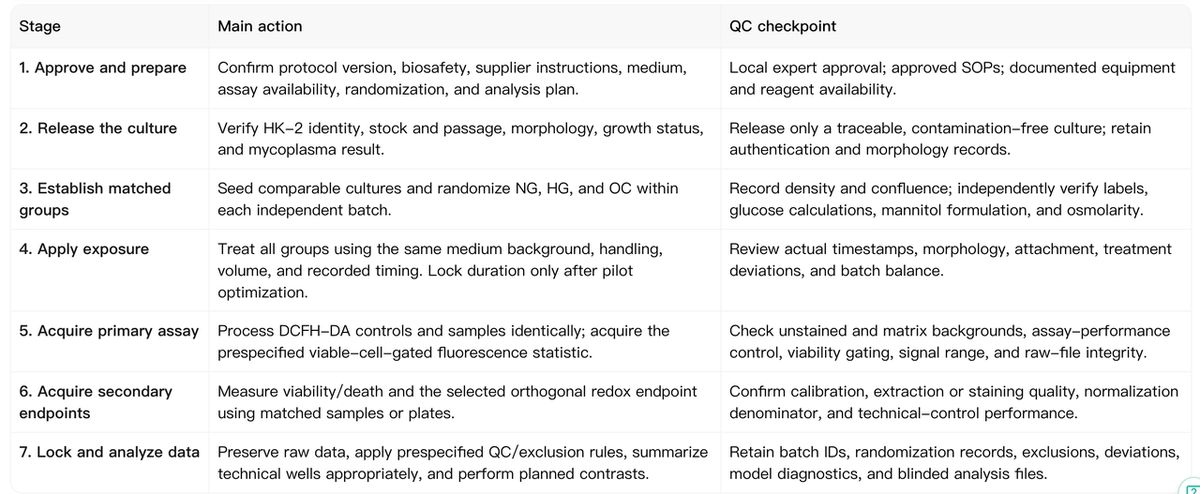
The seven stages are:
Approve and prepare: Review the protocol version, approved procedures, resources, and analysis plan.
Release the culture: Confirm cell-line identity, passage history, morphology, and contamination status.
Establish matched groups: Prepare comparable NG, HG, and OC conditions within independent batches.
Apply exposure: Follow verified conditions and record treatment timing and deviations.
Acquire the primary assay: Measure the prespecified oxidant-sensitive endpoint with appropriate controls.
Acquire secondary endpoints: Measure viability and the selected complementary redox endpoint.
Lock and analyze data: Preserve raw records, apply prespecified QC rules, and interpret the planned comparisons.
The accompanying QC column is essential. It ensures that the workflow is not merely a list of laboratory actions but a structured plan for producing interpretable data.
What Noah AI produced
A literature-grounded experimental design draft containing a research question, biological groups, control rationale, candidate readouts, replication considerations, QC checkpoints, and a seven-stage protocol workflow. This is a planning artifact requiring laboratory review—not a validated SOP or evidence that the experiment has been performed.
Design an Experimental Protocol with Noah AI
Use Noah AI to organize published experimental methods, compare control groups, define measurable endpoints, and draft a structured biomedical experimental plan for expert review.
Try Noah AI for free. Free credits are available, and no credit card is required.
Common Mistakes When Designing Experimental Protocols with AI
Asking AI for a Protocol Without a Specific Hypothesis — Broad requests may produce generic experimental suggestions without a clear primary comparison. Define the model, exposure, and outcome before requesting the protocol.
Copying Parameters from Unrelated Studies — Conditions used for metabolomics, oxidative-stress measurement, and cell-death analysis may not be interchangeable. Preserve the source and experimental context of each candidate parameter.
Omitting an Essential Control Group — A missing control can make theexperiment difficult to interpret. In this example, the osmotic-control group helps evaluate whether a response is associated with added osmotic load rather than glucose alone.
Confusing a Fluorescent Probe with a Specific Molecular Measurement — A general oxidant-sensitive fluorescent signal does not necessarily identify the reactive species responsible. Assay limitations and complementary validation should be defined in advance.
Treating Technical Wells as Independent Biological Replicates — Repeated measurements from a shared preparation may improve measurement precision without increasing the number of independent experimental units. Misclassifying these measurements can make results appear more precise than they are.
Selecting Statistical Tests After Viewing the Results — Primary comparisons, experimental units, QC exclusions, and analysis rules should be planned before interpreting outcome data.
Treating an AI Draft as an Approved Laboratory SOP — AI cannot establish that a new protocol has been validated in a laboratory. Operational instructions, safety requirements, assay performance, and unresolved parameters must be reviewed and verified locally.
Experimental Protocol Verification Checklist
Before any AI-generated experimental draft is converted into laboratory work, a trained researcher should check the following:
- The research question is clearly defined and experimentally testable.
- The biological model is suitable for the question.
- Published methods have been checked against original sources.
- Each treatment and control group has a clear purpose.
- Experimental conditions are internally consistent.
- All reagent and exposure parameters are verified.
- The primary measurement is scientifically interpretable.
- Assay-specific limitations and interference are addressed.
- Independent biological replicates are correctly defined.
- Quality-control procedures and exclusion rules are prespecified.
- The statistical analysis plan matches the experimental design.
- Required local biosafety, supplier, and laboratory SOP requirements are satisfied.
These checks help distinguish a convincing written plan from an experimentally reliable procedure.
Frequently Asked Questions
Can AI Design an Experimental Protocol?
AI can assist with experimental protocol drafting by organizing published methods, suggesting control structures, identifying measurement options, and outlining quality-control considerations. The draft still requires expert review and local validation before execution.
What Should an Experimental Protocol Include?
A protocol should include the research question, hypothesis, model, experimental groups, controls, procedures, measurable endpoints, replication strategy, quality control, data collection, and statistical analysis.
Can AI Help Select Experimental Controls?
Yes. AI can help explain why particular controls may be needed based on the experimental hypothesis and published methods. Researchers must verify that those controls are scientifically appropriate for the selected model and conditions.
Can AI Determine the Best Reagent Concentration or Exposure Time?
AI can identify concentrations and exposure durations reported in published studies. However, an optimal condition for a new experiment often requires method verification, equipment compatibility checks, and pilot optimization.
What Is the Difference Between Biological and Technical Replicates?
Biological replicates represent independently conducted experimental units according to the study design. Technical replicates evaluate measurement or handling variability within those units. Multiple technical measurements should not automatically be counted as independent biological samples.
Can Noah AI Generate a Step-by-Step Experimental Plan?
In our tested HK-2 example, Noah AI Agent organized the evidence into experimental groups, assay considerations, QC checkpoints, and a seven-stage protocol workflow. This demonstrated structured drafting capability, not automated laboratory validation or execution.
Can an AI-Generated Protocol Be Used Directly in the Laboratory?
It should not be treated as an approved SOP by default. Researchers must check original methods, verify operational parameters, follow institutional requirements, and validate the protocol under local conditions.
Related Reading
Explore related Noah AI guides for biomedical research planning and evidence review:
- How to Use Noah for Experimental Design
- Best AI Tools for Biomedical Research Proposal Development (2026)
- How to Assess Biomedical Research Question Feasibility with AI
- How to Use Noah for Medical Literature Review
Final Takeaway
Experimental protocol design is not simply about listing procedures or copying a methods section from a published study.
A defensible protocol must connect a specific research question to an appropriate model, essential controls, interpretable measurements, independent replication, quality control, and a prespecified analytical approach.
In our HK-2 example, Noah AI helped turn a high-glucose oxidative-stress question into a structured experimental design draft.
The most important output was not a collection of laboratory parameters. It was an explicit design showing why the normal-glucose, high-glucose, and osmotic-control groups were needed, how experimental measurements could be selected, and which quality-control checkpoints must accompany the workflow.
At the same time, the completed draft did not establish an optimal exposure duration, a validated assay configuration, a justified final sample size, or a laboratory-approved procedure.
AI can help researchers move from published evidence to a more organized first protocol draft. Scientific and operational validation remains essential before that draft becomes an executable experiment.
A Good Experimental Protocol Does Not Just Describe What to Do. It Explains What Each Comparison Tests and How the Results Can Be Trusted.
Start Planning Your Experiment with Noah AI
Explore biomedical literature, organize experimental evidence, compare controls, and develop reviewable research protocol drafts with Noah AI.
Noah AI offers free credits. No credit card is required to get started.