
How to Do a Literature Review with AI: Step-by-Step Guide (2026)
Linda
Learn how to do a literature review with AI in 7 steps, from defining a research question and searching papers to evidence synthesis and citations.
A practical seven-step workflow for finding research papers, screening evidence, taking useful notes, identifying themes, and writing a literature review with traceable citations.
Worked example: Digital CBT-I for chronic insomnia · Evidence cutoff: October 18, 2026
A strong literature review is not a stack of paper summaries. It explains what a field knows, what remains uncertain, and how the available studies relate to one another. AI can reduce the effort involved in locating sources and structuring evidence, but it cannot replace decisions about what to include, how strong a study is, or whether its conclusions are supported.
In this guide, we use a focused biomedical question and actual research outputs from Noah AI to illustrate a complete workflow. We also show where PubMed, reference managers, and researcher verification remain necessary.
Quick answer: To do a literature review with AI, (1) define a focused question, (2) search for relevant studies, (3) screen them against consistent criteria, (4) organize your sources, (5) extract and critically read the evidence, (6) synthesize patterns and disagreements, and (7) write a source-verified, thematic review.
What Is a Literature Review?
A literature review is a critical evaluation of existing research on a defined question. Instead of describing studies one at a time, it connects their designs, findings, limitations, and unresolved questions to develop an evidence-based account of a topic.
That makes a literature review different from an annotated bibliography. A bibliography documents individual sources; a literature review explains what those sources collectively show and where interpretation remains contested.
Types of Literature Reviews
| Review type | Purpose | What to remember |
|---|---|---|
| Narrative review | Explain the major themes and debates in a field. | Usually flexible in scope; selection and interpretation should still be transparent. |
| Systematic review | Answer a defined question using reproducible eligibility, search, and appraisal methods. | Requires a protocol, auditable decisions, and appropriate reporting (often PRISMA). |
| Scoping review | Map what evidence exists and where research gaps may lie. | Often broader in question and evidence type than a systematic effectiveness review. |
| Meta-analysis | Statistically combine sufficiently compatible quantitative estimates. | Requires a justified model and attention to heterogeneity and overlapping data. |
Our demonstration is an AI-assisted educational literature review workflow, not a completed systematic review or a new meta-analysis. Its selected papers and tables show how to work through the method, not a claim of exhaustive literature coverage.
Step 1: Define Your Research Question
Output: Focused question + scope
Start with a question that can be answered by actual studies. "Digital health for sleep" is too broad: it combines different conditions, interventions, outcomes, and study designs. A narrower question makes your subsequent inclusion and extraction decisions consistent.
For this example, we asked:
Example research question: In adults with chronic insomnia, how does digital cognitive behavioral therapy for insomnia (dCBT-I) affect insomnia severity compared with usual care, waitlist controls, or patient education?
Use PICO to make each part of that question explicit:
| PICO element | Definition in this review |
|---|---|
| Population | Adults with chronic insomnia, insomnia disorder, or clinically relevant symptoms. |
| Intervention | Internet-, web-, or app-delivered cognitive behavioral therapy for insomnia (dCBT-I). |
| Comparator | Usual care, waiting list, sleep education, or patient education. |
| Outcome | Primarily Insomnia Severity Index (ISI); secondarily sleep quality, adherence, and follow-up outcomes. |
This scope deliberately excludes children, pharmacotherapy-only trials, and generic sleep apps without recognizable CBT-I components. Defining boundaries now prevents the review from shifting whenever a new paper looks interesting.
How AI helps: Ask Noah to transform a broad topic into candidate research questions and a PICO table. Review the terms yourself and make sure the proposed outcomes are clinically meaningful and measurable.
Step 2: Search the Literature with AI
Output: Search strategy + candidate list
Search begins by translating the question into concepts and synonyms. For this case, useful variants include digital CBT-I, internet-delivered CBT-I, insomnia disorder, randomized trial, and Insomnia Severity Index. A draft PubMed query can combine those concepts with Boolean logic:
This is a starting query, not a validated exhaustive strategy. Run it in PubMed, inspect its search translation, test whether known relevant studies appear, and revise it. An overly restrictive outcomes filter can hide otherwise relevant trials. For a detailed walkthrough of PubMed query construction, see How to Search PubMed with AI.
Use keyword and citation-based discovery together
Keyword searching finds papers using the terms you anticipate. Backward reference checking finds older work cited by those papers; forward citation checking finds later work building on them. Tools such as ResearchRabbit can help explore citation relationships. That is a separate function from Noah's biomedical evidence organization and should not be confused with Noah providing an equivalent citation-network map.
In our Noah research run, the agent produced a candidate source table that included primary randomized trials, systematic reviews, and a study needing an overlap check. The screenshot below records the candidate type and available verification status, not an exhaustive set of search hits.
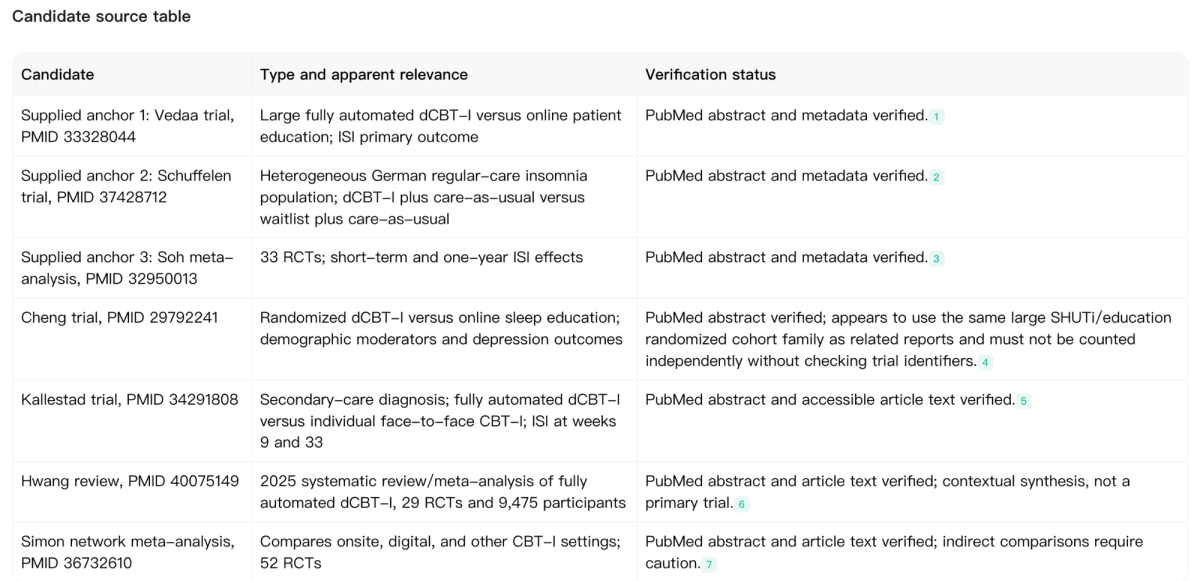
Document the database searched, the exact query, search date, filters, and actual number of results returned. Our October 18, 2026 research demonstration included a targeted discovery search, and did not perform backward or forward citation chasing; we therefore do not invent retrieval totals or claim systematic completeness.
Step 3: Evaluate and Screen Your Sources
Output: Eligibility decisions
Finding a relevant title does not make a paper eligible. Before reading in depth, decide whether the population, intervention, control, design, and outcome match your question. Apply those rules consistently, including when an influential paper falls outside the core criteria.
| Screening decision | Illustration from the example |
|---|---|
| Include as primary evidence | Randomized trials of dCBT-I against eligible education, waitlist, or usual-care comparators with insomnia outcomes. |
| Include for context, not as a new trial | Systematic reviews, meta-analyses, and trial-linked secondary analyses. |
| Separate comparator-context evidence | Digital versus face-to-face CBT-I comparisons, which do not estimate the same contrast as waitlist-controlled trials. |
| Hold for verification | Reports whose randomized population may overlap with another study, or whose full-text eligibility is unresolved. |
Screen in stages: first title and abstract, then the key methods and findings, then full text for central or uncertain papers. The Noah candidate set explicitly flagged possible population overlap for a related Cheng report and separated the Kallestad face-to-face comparison from the core minimal-control question.
Important: A proposed AI eligibility label is not independent human screening. Recheck randomization, diagnostic criteria, intervention content, relevant denominators, and trial identity before formally including a paper. A systematic review would require a complete audit trail and reporting of the screening process.
Step 4: Organize and Manage Your Sources
Output: Reference library + evidence schema
Use a citation manager to keep bibliographic records under control while collecting papers. For example, in Zotero, create a collection called "dCBT-I chronic insomnia" with folders for primary RCTs, reviews, secondary analyses, and excluded studies. Add verified PMID/DOI information, notes on trial identity, and whether the full text has been checked.
A reference manager and an evidence matrix do different jobs: the former tracks publications and formats citations; the latter makes findings comparable. In a Noah-assisted workflow, define an evidence schema before extracting results:
| Evidence field | Question to ask |
|---|---|
| Study design / population | Who was recruited, randomized, and analyzed? |
| Intervention / comparator | What treatment and control were actually delivered? |
| Endpoint / time point | Which outcome was measured and when? |
| Results / denominators | What numbers support the claimed finding? |
| Limitations / provenance | What should be interpreted cautiously, and what source supports each value? |
If a value is absent from an available abstract, label it "requires full-text verification" rather than letting AI fill the gap. For a narrower tutorial, see How to Create an Evidence Table for a Literature Review with AI.
No direct Zotero syncing was carried out in this demonstration; exporting or transferring references should be verified in the actual tools you use.
Step 5: Read Papers and Take Critical Notes
Output: Source-backed study notes
Effective reading means making a decision about each paper rather than trying to remember everything it says. Quickly scan peripheral papers, read methods and results carefully for directly relevant studies, and check supplements when trial denominators or outcome definitions are missing from the abstract.
Turn extracted findings into evaluative notes
Instead of writing only "this trial found an improvement," ask whether its design supports the comparison you want to make. A large trial may offer relatively precise evidence against sleep education but still have attrition and recruitment limitations. Another trial may occur in regular clinical care but not maintain a controlled comparison throughout long-term follow-up.
For instance, the Vedaa trial randomized 1,721 adults to fully automated dCBT-I or online education, with a reported adjusted difference in ISI change at nine weeks of −4.7 points (95% CI −5.4 to −4.1). The Schuffelen study randomized 238 adults in a regular-care setting and reported an adjusted post-treatment difference of −7.60 points. These are results from separate trials with different control settings, not a head-to-head comparison of treatments. (1) (2)
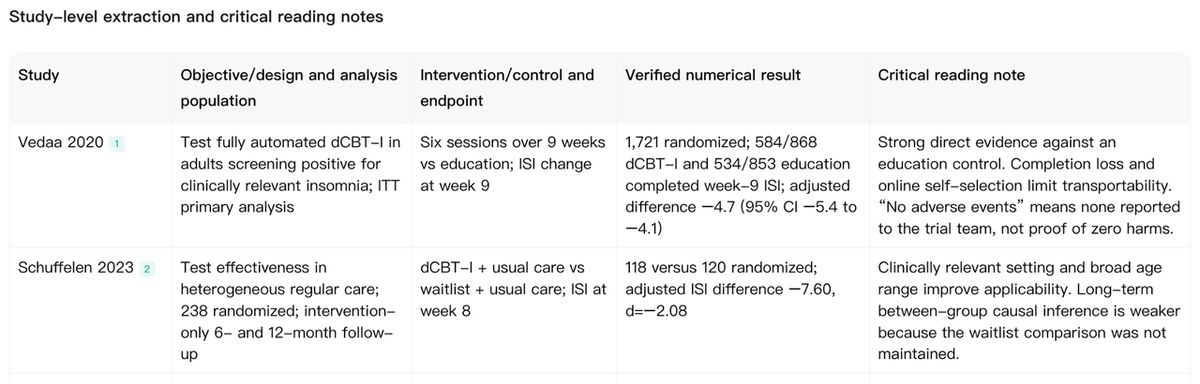
The screenshot shows why standardized reading notes are more useful than stand-alone abstracts: it pairs reported effects with the population, endpoint, comparator, and limitations that define how far those effects can be interpreted. Abstract-level extraction is a useful starting point, not a substitute for a final full-text risk-of-bias assessment.
Organize Biomedical Research Evidence with Noah AI
Try a focused literature search, structure study findings, and explore source-linked comparisons. Get free credits when you sign up; no credit card required.
Step 6: Synthesize Findings Across Papers
Output: Themes, differences, and gaps
Synthesis is the turning point in a literature review. The question is no longer "What did each paper say?" but "Which claims hold across papers, why do results vary, and what cannot yet be concluded?" Organize this reasoning by theme rather than by author name.
Compare agreement without flattening differences
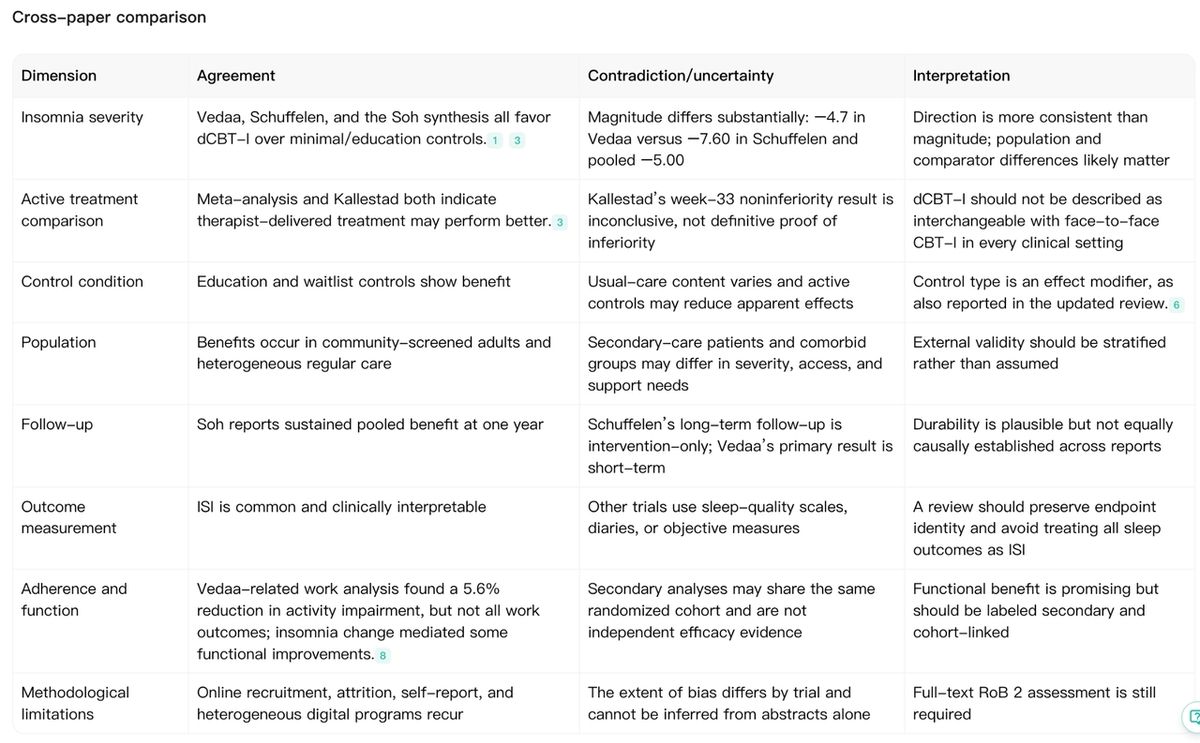
In the dCBT-I example, separate trials and a published meta-analysis generally support reduced self-reported insomnia severity relative to education or minimal controls. However, the magnitude of the reported effects differs. Comparator intensity, population characteristics, follow-up duration, and analysis choices are plausible contributors; the between-trial differences alone do not establish causality. (1) (2) (3)
We asked Noah to organize these issues under agreement, contradiction or uncertainty, and interpretation. The resulting cross-paper table separates the overall direction of evidence from the limits of applying one estimate to every clinical setting.
Build a theme-based interpretation
Theme 1 — Effects versus minimal or educational controls: The Vedaa and Schuffelen trials support improvement in insomnia severity over their respective controls, while the Soh meta-analysis provides broader context across trials. The pooled post-treatment ISI mean difference reported by Soh was −5.00, with substantial heterogeneity (I² = 79%). (3)
Theme 2 — Delivery formats are not interchangeable: In Kallestad's secondary-care trial comparing automated digital delivery with individual face-to-face CBT-I, the week-33 noninferiority finding was inconclusive and the digital intervention performed worse in the reported comparison. This is not the same comparison as digital treatment versus patient education. (4)
Theme 3 — Longer follow-up needs careful reading: A meta-analysis may provide longer-term pooled estimates, whereas an individual study's 6- or 12-month results may come from the intervention arm alone. These should not be described as equally strong controlled evidence. Also examine overlapping randomized cohorts before counting studies or combining estimates.
For a more specialized comparison method, see How to Compare Multiple Research Papers in a Literature Review with AI.
Step 7: Write and Verify the Literature Review
Output: Thematic draft + traceable references
With a validated matrix and thematic synthesis, writing becomes a structured task rather than an attempt to summarize papers from memory. A clear literature review usually contains an introduction that defines the scope, sections built around evidence-based claims, and a conclusion that identifies what the literature can and cannot establish.
An outline for the worked example
- Introduction: Why access to CBT-I matters and why digital delivery warrants examination.
- Evidence against education and minimal controls: Effects on insomnia severity with comparator-specific interpretation.
- Durability and secondary outcomes: What is known about follow-up and what remains uncertain.
- Delivery format and applicability: Automated versus therapist-delivered treatment, attrition, access, and research gaps.
- Conclusion: A balanced summary tied directly to the original research question.
Example of a synthesis paragraph (illustrative evidence-grounded draft)
Randomized evidence indicates that digital CBT-I can improve self-reported insomnia severity relative to education or waiting-list controls, but effect magnitude and clinical applicability depend on how studies recruit participants and define the comparison. A large online trial and a German regular-care trial reported favorable outcomes against different controls, while a 33-trial meta-analysis supported the broader direction of benefit with considerable heterogeneity. Evidence from an active-comparator study is more cautious about treating fully automated digital therapy as equivalent to individual face-to-face CBT-I. Taken together, these findings support digital delivery as an option worth evaluating, while leaving open questions about optimal guidance, adherence, long-term controlled effects, and patient selection. 1 2 3 4
Before using AI-assisted prose in a thesis or publication, open the cited primary studies, check that each statement is supported by the referenced section, verify numeric data and source identity, and rewrite the argument using your own informed interpretation. Do not cite a paper solely because an AI answer supplied a plausible-looking reference.
Also ensure the work complies with your institution's rules on AI assistance and attribution. Producing a draft is not the same as conducting the underlying review.
Common Literature Review Mistakes
- Searching too narrowly: Using only one term such as "digital CBT-I" can miss alternative wording and earlier work. Expand synonyms and test landmark papers.
- Treating every source as an independent trial: Review articles and secondary analyses may reuse the same participants. Track study identifiers and original cohorts.
- Confusing an abstract with full-text verification: Methods, adverse-event details, subgroup definitions, and risk of bias often require the original article and supplement.
- Comparing raw effects without comparators: A waitlist trial and a face-to-face active-treatment trial answer different questions.
- Writing paper-by-paper summaries: Draft around evidence themes, methodological differences, and uncertainties instead.
- Trusting AI-generated citations without checking: Verify titles, PMIDs/DOIs, authors, and the precise finding each citation is supposed to support.
Useful Tools for Literature Reviews in 2026
| Tool | Role in the workflow | Important limitation |
|---|---|---|
| Noah AI | Biomedical literature exploration, structured evidence extraction, source-aware comparison, and draft synthesis. | Its outputs require validation against primary sources; this example did not perform formal human screening. |
| PubMed | Discover and verify biomedical publications and indexing. | Search quality depends on terms, filters, and the completeness of the strategy. |
| ResearchRabbit | Explore related papers through reference and citation connections. | Network discovery complements rather than replaces a documented database search. |
| Zotero | Collect and organize references, notes, and formatted citations. | A reference library does not itself appraise study validity. |
We tested Noah AI directly for the research outputs pictured here. Other tools are described based on their publicly documented purposes and workflows; no comparative benchmark test was performed.
Frequently Asked Questions
Can AI do a literature review for me?
AI can assist with search planning, preliminary screening tables, evidence organization, comparisons, and outline drafting. Researchers remain responsible for verifying included studies, judging bias, interpreting conflicting findings, and approving the final writing.
How many papers do I need for a literature review?
There is no universal number. Appropriate coverage depends on the question, review type, field, and whether the important bodies of evidence and disagreements are represented. A focused worked example can start with a few key trials, but that is not equivalent to a comprehensive literature review.
What is the difference between a literature review and a systematic review?
A literature review synthesizes the state of research on a topic. A systematic review follows a prespecified, reproducible process for finding, selecting, appraising, and synthesizing evidence. Using an AI-generated table does not by itself make a review systematic.
How can I avoid incorrect AI citations?
Follow the citation back to a real indexed record, open the relevant article or supplement, verify the claim and numbers, and check whether multiple reports describe the same underlying study. Keep a record of which fields are verified and which still need review.
When should I stop searching?
For a narrative review, use relevance and coverage of major themes and landmark work. For a systematic review, apply the protocol's documented search and eligibility methods. Familiarity with the topic alone is not a defensible stopping rule for an exhaustive review.
Final Takeaway
A useful literature review moves from a clearly bounded question through transparent searching and screening to source-level reading, cross-paper reasoning, and a coherent argument. AI is most valuable when it makes that process easier to inspect—not when it hides missing information behind fluent prose.
The digital CBT-I example shows how Noah AI can help organize candidate publications, extract study-level information, and compare findings without collapsing distinct comparators or follow-up periods. The same general method can be adapted to other biomedical research questions, provided each source and conclusion receives independent verification.
Start Your Next Literature Review with Noah AI
Explore biomedical literature, build structured evidence notes, and compare research findings with citations. Get free credits to try Noah AI. No credit card required.
Primary Sources and Further Reading
- Vedaa Ø, et al. Effects of digital cognitive behavioural therapy for insomnia on insomnia severity: a large-scale randomised controlled trial. PMID: 33328044.
- Schuffelen J, et al. The clinical effects of digital cognitive behavioral therapy for insomnia in a heterogenous study sample: results from a randomized controlled trial. PMID: 37428712.
- Soh HL, et al. Efficacy of digital cognitive behavioural therapy for insomnia: a meta-analysis of randomised controlled trials. PMID: 32950013.
- Kallestad H, et al. Mode of delivery of Cognitive Behavioral Therapy for Insomnia: a randomized controlled non-inferiority trial of digital and face-to-face therapy. PMID: 34291808.
- Additional records and literature links used in the Noah demonstration: Cheng et al. (PMID: 29792241), Hwang et al. (PMID: 40075149), and Simon et al. (PMID: 36732610). Secondary-analysis overlap and some full-text fields require checking.
Evidence and limitations: Evidence cutoff October 18, 2026. The tables shown are genuine Noah AI research output from the supplied workflow, but not all studies were verified at full-text level; citation chasing, independent duplicate screening, and formal risk-of-bias assessment were not completed. This article demonstrates a review process and does not provide individualized medical advice.