
How to Evaluate Bispecific Antibody Safety with AI (2026)
Linda
Learn how to evaluate bispecific antibody safety with AI using CD19 × CD3 and blinatumomab. Explore CRS, neurotoxicity, clinical evidence, and safety risks.
An evidence-based CD19 × CD3 case study using blinatumomab, clinical trials, and a Noah AI research workflow.
Evidence cutoff: October 26, 2026 · Research context: CD19-directed CD3 T-cell engagement in B-cell precursor acute lymphoblastic leukemia (B-ALL).
Bispecific antibodies can bring two biological targets into one therapeutic mechanism. In oncology, that may enable potent T-cell redirection. It also changes the safety question: teams must evaluate not just each antigen separately but what happens when they are engaged together, in a particular tissue and patient population.
Blinatumomab (BLINCYTO) provides a clinically established example of CD19 × CD3 T-cell engagement, but it should not be treated as representative of every CD19 × CD3 bispecific antibody.
Blinatumomab is an Fc-free bispecific T-cell engager (BiTE) composed of two linked single-chain variable fragments. Its mean elimination half-life is approximately 2.2 hours, and it is administered by continuous intravenous infusion.
Other CD19 × CD3 constructs may differ in molecular architecture, binding affinity, valency, Fc engineering, elimination half-life, dosing schedule, and route of administration. These differences can influence systemic exposure, immune activation, and adverse-event profiles.
Blinatumomab's U.S. prescribing information carries boxed warnings for cytokine release syndrome (CRS) and neurological toxicities, including immune effector cell-associated neurotoxicity syndrome (ICANS). These are established risks of blinatumomab, not validated incidence estimates for all CD19 × CD3 bispecific antibodies.
Those warnings are documented human risks, not predictions from an AI model. 1
This step-by-step guide shows how to build a target-centric bispecific antibody safety assessment using Noah AI as a research and evidence-organization workflow. We used Noah AI directly to produce the CD19 × CD3 safety evidence matrix and the clinical-study comparison shown below, then checked selected findings against primary publications and the official US drug label. The objective is to organize evidence, identify limitations and frame development questions—not to predict an untested antibody's toxicity.
Step 1. Define Both Targets and the Intended Mechanism
Begin with the target pair, indication, molecular format and proposed mode of action. A bispecific antibody is not automatically safer, more effective or more predictable than its single-target comparators.
CD19 is expressed on malignant and many healthy B-lineage cells. Targeting CD19 can therefore affect normal B cells alongside leukemia cells. This is a biologically expected on-target, off-tumor effect—not a random off-target binding event. The downstream consequences may include changes in B-cell populations and humoral immunity, although prior therapy and the patient's disease can complicate attribution. 5
CD3 is part of the T-cell receptor signaling complex. When a CD3-binding domain appropriately engages a T cell in the presence of a CD19-positive target cell, T-cell activation can trigger cytotoxic granule release and cytokine production. The combined engagement—not CD19 expression alone—is central to the inflammatory mechanism of a CD19 × CD3 T-cell engager.
For the research brief, record four details before searching: which cells express each antigen, how the antibody bridges those cells, the intended cancer setting, and how administration and exposure may influence immune activation. These details determine whether evidence from an existing drug is relevant to a new candidate.
Step 2. Map Combined-Target Biology Before Searching for Adverse Events
Target-centric safety analysis should trace the steps from binding to a plausible biological consequence:
- A CD19-binding arm engages a malignant or normal B cell.
- A CD3-binding arm brings a T cell into proximity with that B cell.
- A productive immunological synapse triggers cytotoxic activity and cytokine release.
- Activated immune cells may amplify inflammatory signals.
- Target-cell depletion, inflammatory effects and patient-specific factors together shape the clinical safety profile.
This sequence helps distinguish normal B-cell depletion, which follows the antigen-expression pattern, from CRS, which depends on immune-cell activation and its downstream response. It also clarifies why antibody geometry, affinity, antigen density, dose schedule and disease burden matter when considering other bispecific formats.
Evidence should be labeled as one of three categories: directly demonstrated in an experiment, observed in treated patients, or mechanistically plausible but not clinically established. A plausible pathway alone does not establish an adverse-event incidence or its cause.
Step 3. Identify the Major CD19 × CD3 Safety Signals
Cytokine release syndrome (CRS)
CRS is an inflammatory syndrome that can involve fever, hypotension, hypoxia and organ dysfunction. The April 2026 US BLINCYTO label explicitly warns that it may be life-threatening or fatal. The label also gives specific premedication, observation, interruption and discontinuation instructions; these are management requirements for clinical practice, not a template for dosing an investigational molecule. 1
A published 2026 randomized pediatric trial reported grade 2 or higher CRS in 1.1% of patients assigned to blinatumomab. This rate applies to that pediatric trial and its definitions, not to all blinatumomab-treated patients or bispecific antibodies generally. 4
CRS, ICANS, Infection, and B-Cell Depletion: Evidence and Observation Windows
The following safety findings come from different sources and patient populations. Their reported frequencies and observation periods must not be treated as interchangeable.
| Safety Signal | Reported Evidence | Observation Window | Source |
|---|---|---|---|
| Cytokine release syndrome (CRS) | Blinatumomab can cause serious or fatal CRS. In a 2026 pediatric randomized trial, grade ≥2 CRS occurred in 1.1% of the blinatumomab group. | The U.S. label reports a median CRS onset of 2 days after infusion initiation and median resolution of 5 days among resolved cases. The pediatric percentage concerns trial-treatment safety reporting. | [U.S. BLINCYTO label, §5.1](https://dailymed.nlm.nih.gov/dailymed/drugInfo.cfm?setid=38b482a8-960b-4591-9857-5031ecb830aa); [Pediatric trial, 2026](https://pubmed.ncbi.nlm.nih.gov/42748428/) |
| Neurological toxicity and ICANS | The U.S. label reports signs and symptoms consistent with ICANS in 7.5% of patients in clinical trials. The 2026 pediatric trial reported broader neurotoxic events in 12.0% versus 3.2% with chemotherapy. These are different event definitions. | The label reports a median time to first neurological toxicity within the first 2 weeks of treatment. It does not provide a separate median onset time for ICANS in this section. | [U.S. BLINCYTO label, §5.2](https://dailymed.nlm.nih.gov/dailymed/drugInfo.cfm?setid=38b482a8-960b-4591-9857-5031ecb830aa); [Pediatric trial, 2026](https://pubmed.ncbi.nlm.nih.gov/42748428/) |
| Infections | The U.S. label reports serious infections in approximately 25% of patients with ALL receiving blinatumomab in clinical studies. In the 2026 pediatric chemotherapy-substitution trial, trial-treatment-related infections occurred in 23.9% versus 69.4%. | Infection risk was monitored during treatment. The pediatric trial evaluated replacement of two post-consolidation chemotherapy cycles; its abstract does not specify a separate infection-event ascertainment window. | [U.S. BLINCYTO label, §5.3](https://dailymed.nlm.nih.gov/dailymed/drugInfo.cfm?setid=38b482a8-960b-4591-9857-5031ecb830aa); [Pediatric trial, 2026](https://pubmed.ncbi.nlm.nih.gov/42748428/) |
| Normal B-cell depletion | In a pharmacodynamic study of 21 adults with MRD-positive B-ALL, peripheral B-cell counts fell below 1 cell/µL within approximately 2 days on average and remained essentially undetectable during treatment. | Serial measurements began at infusion initiation and continued during treatment cycles. These data do not establish an identical recovery time for other bispecific formats. | [Klinger et al., Blood, 2012 (PMID 22592608)](https://pubmed.ncbi.nlm.nih.gov/22592608/) |
Interpretation boundaries: CRS and ICANS are distinct clinical syndromes; not every neurological adverse event qualifies as ICANS. Infection risk cannot be attributed solely to B-cell depletion because chemotherapy, neutropenia, corticosteroids, underlying leukemia, and other treatments may contribute.
The pediatric trial's median follow-up of 2.9 years relates to its event-free survival analysis. It should not be presented as the observation window for every reported adverse event.
For a new CD19 × CD3 program, these data establish safety signals worth investigating, not candidate-specific rates. Additional studies must evaluate the actual molecular format, exposure, dosing strategy, patient population, and immune response.
Neurological toxicity and ICANS
Blinatumomab-associated neurological events include varied presentations such as confusion, tremor, speech disturbance, encephalopathy and seizures. Not every neurological adverse event is ICANS. Some events may relate to inflammatory mechanisms; others require assessment of alternative causes such as CNS leukemia, infection, medications or metabolic disturbances.
In the 2026 pediatric randomized study, neurotoxic events were reported in 12.0% with blinatumomab versus 3.2% with chemotherapy. The study compared replacement of specified chemotherapy cycles with blinatumomab; it was not a comparison against no treatment. 4
Normal B-cell effects and infection
Engagement of CD19-positive healthy B cells can contribute to B-cell depletion. Its potential implications for immunoglobulin levels and infection must be interpreted together with other sources of immunosuppression, including chemotherapy, corticosteroids, leukemia burden, neutropenia and transplantation.
In the same pediatric study, trial-treatment-related infection occurred in 23.9% with blinatumomab versus 69.4% with chemotherapy. The lower observed rate in that treatment-substitution trial does not prove that CD19 engagement prevents infection; nor does it mean infections occurring during blinatumomab treatment were all caused by B-cell depletion. 4
Step 4. Compare Safety Findings Across Real Clinical Studies
A useful AI-assisted analysis preserves study population, treatment setting, comparator, endpoint, denominator and adverse-event definition. Without them, adverse-event percentages can become misleading.
The following studies provide complementary, but non-interchangeable, safety evidence.
TOWER: relapsed or refractory adult B-ALL (2017)
TOWER randomized 405 adults: 271 to blinatumomab and 134 to standard chemotherapy. Grade 3 or higher adverse events occurred in 87% versus 92%, respectively. Severe toxicity was common in both groups; a lower overall percentage does not remove the need to assess CRS or neurological events separately. The comparison is also shaped by the toxicity of salvage chemotherapy. 2
E1910: adult consolidation after MRD-negative remission (2024)
E1910 randomized 224 adults with measurable residual disease (MRD)-negative remission, 112 per group, to consolidation with or without added blinatumomab. Published findings showed more treatment-related neurological or psychiatric adverse events of grade 3 or higher among patients starting blinatumomab (23% versus 5% in the corresponding treatment groups). This is a different clinical context from TOWER and should not be pooled with its rates. 3
Pediatric high-risk B-ALL: substitution for chemotherapy (2026)
In a 2026 randomized study of 709 children (358 assigned to blinatumomab and 351 to chemotherapy), the reported safety findings included trial-treatment-related infections of 23.9% versus 69.4%, neurotoxic events of 12.0% versus 3.2%, and grade 2 or higher CRS in 1.1% of the blinatumomab group. Life-threatening adverse events were less frequent in the blinatumomab group in this treatment-substitution design, but one fatal event was reported in that group. These observations must be read within the trial's pediatric setting and background regimen. 4
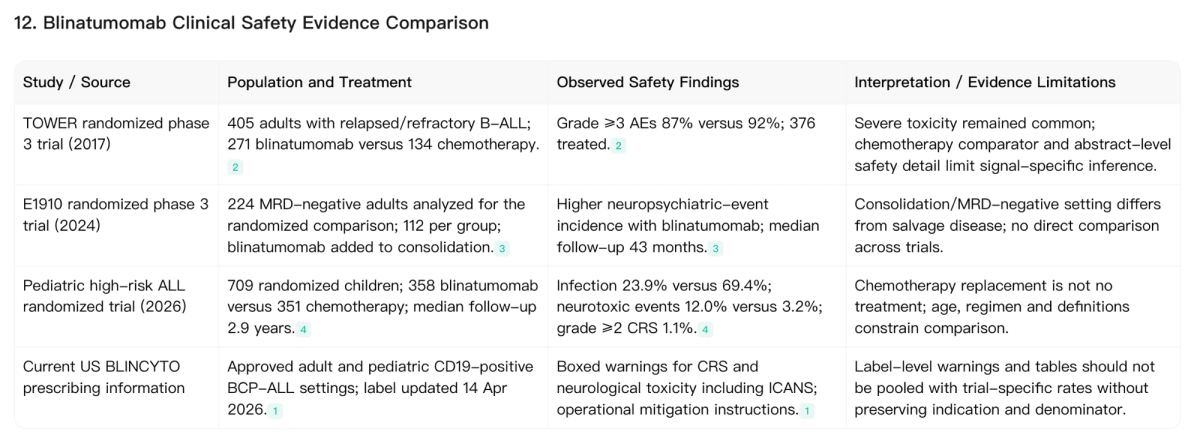
Reading the comparison correctly: Each row describes a distinct clinical question. Label-level boxed warnings should not be averaged with trial-specific rates, and pediatric findings should not be converted into predicted adult or new-product safety estimates.
Step 5. Separate On-Target Effects, Combined-Mechanism Effects and Uncertain Associations
The distinction between on-target and off-target is more nuanced for a T-cell-engaging bispecific than for a conventional inhibitor.
| Observed or Potential Finding | Evidence-Led Interpretation | Main Uncertainty |
|---|---|---|
| Normal B-cell depletion | Expected on-target effect of CD19 engagement on healthy B-lineage cells. | Recovery, immunoglobulin effects and contribution to infection vary by setting. |
| CRS | Documented clinical hazard linked to the combined T-cell-engaging mechanism. | Incidence and severity vary by population, schedule and grading system. |
| Neurological toxicity | Documented clinical hazard; label includes ICANS. | The same mechanism does not explain every event. |
| Infections | Observed in a population exposed to disease- and treatment-related immunosuppression. | Individual events cannot automatically be attributed to CD19-mediated depletion. |
| Safety of a novel bispecific format | Existing drugs identify hazards and questions worth testing. | Format-specific binding and exposure may fundamentally alter risk. |
A genuine off-target risk would require evidence of unintended molecular interactions or other candidate-specific mechanisms. An adverse event occurring after dosing is not automatically evidence of off-target binding. Conversely, a pharmacologically intended effect such as normal B-cell depletion is not necessarily tumor-selective.
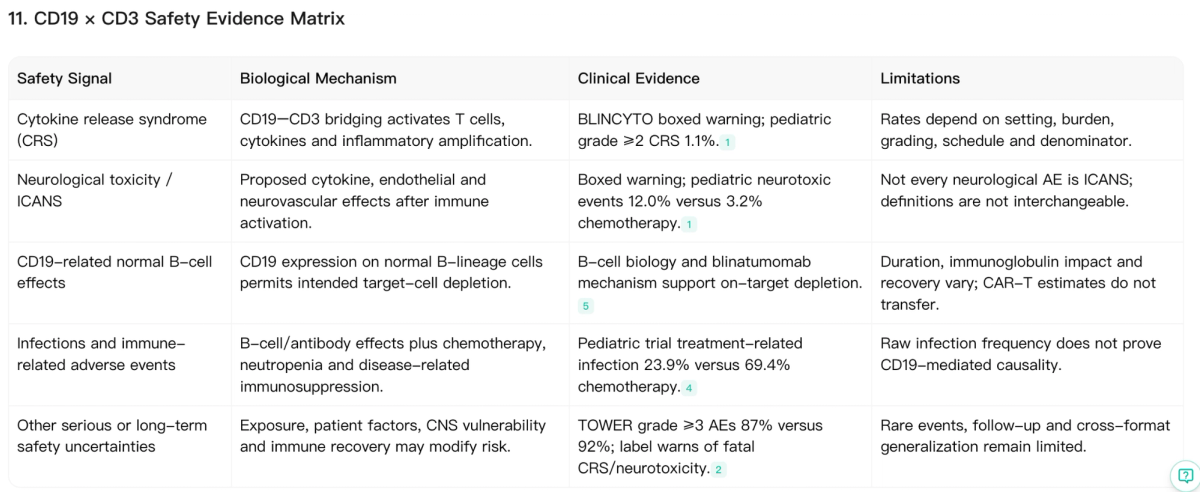
The Noah AI matrix organizes five types of safety concern into mechanism, human evidence and limitations. Its most useful feature is that it does not turn a proposed biological explanation into a confirmed clinical cause.
Step 6. Identify Translational Evidence Gaps for a New Bispecific
A known comparator can reveal what to investigate. It cannot provide an automatically transferable safety profile.
Target expression and tissue distribution. A new CD19 × CD3 construct may differ in epitope, affinity, valency or biodistribution. The relevant question is whether intended and healthy-cell engagement has been characterized in appropriate tissues.
Immune activation and cytokines. Human-cell or whole-blood assays can measure activation and cytokine release across concentrations, donor backgrounds and target densities. Such experiments characterize biological potential; they do not deliver a reliable human CRS percentage by themselves.
Neurological monitoring. The program should define methods for neurological assessment, event adjudication, alternative-cause investigations and follow-up. In clinical research, the distinction between broad neurotoxicity and specifically defined ICANS is essential.
Infection and humoral immunity. Serial B-cell counts, immunoglobulin measurements, infectious-event ascertainment and assessment of earlier treatments may help interpret risk. The long-term B-cell aplasia experience of CD19 CAR-T therapies should not simply be imported into a short-half-life antibody program.
Exposure and reversibility. Drug exposure, interruption, recovery of B-cell populations and changes in inflammatory biomarkers should be measured for the actual candidate, rather than assumed from blinatumomab.
The evidence-gap section should state both what is missing and what study could close that gap. Missing data do not establish that a risk is absent.
Step 7. Convert Safety Evidence Into a Development Decision Framework
A practical early-stage framework should focus on testable questions rather than an arbitrary numerical safety score.
| Development Question | Evidence Needed Before Advancement |
|---|---|
| Is combined-target engagement selective? | Antigen density, binding selectivity, normal-cell panels and target-negative controls. |
| Is inflammatory activation characterized? | Human-cell cytokine assays, exposure-response measurements and relevant model limitations. |
| Have neurological hazards been considered? | A neurological assessment plan, alternatives to immune-mediated causation and appropriate monitoring criteria. |
| Can normal B-cell effects be followed? | B-cell and immunoglobulin measurements plus longitudinal immune recovery. |
| Can first-in-human exposure be justified? | Candidate-specific pharmacology, species relevance, toxicology, modeled uncertainty and a regulatory-aligned starting-dose rationale. |
| Is the risk–benefit hypothesis indication-specific? | Clinical setting, tumor burden, standard treatment, intended benefit and a prospective assessment strategy. |
For development context, FDA's Bispecific Antibody Development Programs guidance (2021) is final guidance and addresses quality, nonclinical and clinical considerations. The agency's QSP-based MABEL dose-selection document (June 2026) is draft guidance, not a final or binding universal protocol.
No starting dose is recommended here. That decision requires candidate-specific nonclinical information, clinical judgment and applicable regulatory processes.
How We Used Noah AI for the CD19 × CD3 Assessment
We tested Noah AI directly by submitting a literature-based CD19 × CD3 safety research task using blinatumomab as the clinical case. The resulting report separated target biology, immune activation, CRS, neurological toxicity, healthy B-cell effects, clinical-study results and uncertainties. The two screenshots in this article show actual Noah outputs—not simulated competitor interfaces or AI-generated clinical trial charts.
The most effective workflow is to ask for original sources first, then require a table that retains the intervention, disease setting, numerator/denominator where available, endpoint definitions and limitations. A research assistant may help structure this information, but source-checking remains essential. We cross-checked selected values in the TOWER, E1910 and 2026 pediatric studies against their published records and checked label-level warnings against the April 2026 US prescribing information.
Try a source-grounded research workflow with Noah AI. New users can sign up for 300 free credits, with no credit card required.
Get 300 Free Credits with Noah AI →
What This Case Does—and Does Not—Demonstrate
The case demonstrates that a structured review can connect two-target biology with reported human risks, compare treatment contexts and make evidence gaps visible. It does not show that Noah AI has measured a drug's toxicity experimentally, accessed every pharmacovigilance record, or predicted the adverse-event rates of an untested molecular format.
The key limitation is generalizability. Blinatumomab is one established CD19 × CD3 T-cell engager. Another candidate could use a different molecular scaffold, binding affinity, CD3 activation threshold, half-life, Fc design, route or tumor indication. Those differences may alter tissue engagement and immune activation, making molecule-specific studies indispensable.
Frequently Asked Questions
What is the major safety concern for CD19 × CD3 bispecific antibodies?
CRS and neurological toxicity are established major risks for blinatumomab, and both appear in its US boxed warning. Normal B-cell depletion and infection-related considerations are also important. Exact risks depend on the construct and clinical setting.
Is every neurological adverse event ICANS?
No. ICANS is a defined syndrome, while neurological adverse events include a broader range of symptoms and potential causes. Rates should be reported using the definitions employed in the particular study.
Does CD19-targeted therapy necessarily cause serious infection?
No single mechanism explains all infections in patients with B-ALL. CD19-related B-cell effects may contribute, but chemotherapy, neutropenia, corticosteroids, transplantation and the underlying malignancy are important alternative or additional factors.
Can blinatumomab clinical safety data predict the risk of a new bispecific antibody?
They can identify relevant hazards and guide what should be measured. They cannot establish the incidence, severity or cause of toxicity for a new molecule without its own nonclinical and clinical data.
What does AI add to bispecific antibody safety assessment?
A research-oriented AI workflow can organize target biology, publications, clinical trial findings and missing evidence into a traceable comparison. It does not replace full-text verification, pharmacovigilance assessment, toxicology studies or regulatory review.
Conclusion: Use Target Biology to Ask Better Safety Questions
A target-centric approach to bispecific antibody safety begins with what each antigen does in normal tissue, then examines what co-engagement changes. For CD19 × CD3, healthy B-cell effects, T-cell activation, CRS and neurological toxicity are distinct but related considerations.
Blinatumomab provides robust clinical precedent, yet its published trial populations are not interchangeable. TOWER studied relapsed or refractory adult leukemia, E1910 evaluated consolidation in MRD-negative adults, and a 2026 pediatric study investigated replacing selected chemotherapy cycles. Their adverse-event percentages must remain tied to those settings.
The development lesson is to connect safety signal → biological mechanism → observed clinical evidence → uncertainty → next validation study. That chain can inform a more disciplined R&D decision without overstating what existing data—or AI analysis—can prove.
Ready to evaluate your next target combination? Use Noah AI to organize biomedical evidence and create a source-linked research assessment. Get 200 free credits on signup. No credit card required.