
How to Evaluate Clinical Outcome Assessments with AI: Alopecia Areata Case Study (2026)
Linda
Learn how to evaluate clinical outcome assessments with AI using alopecia areata trials. Compare SALT, PROs, ClinROs, BRAVE-AA and ALLEGRO evidence.
Evidence cutoff: October 27, 2026 · Case study: BRAVE-AA1, BRAVE-AA2 and ALLEGRO Phase 2b/3 · Research workflow demonstrated with Noah AI
A clinical trial can show that a treatment improves a visible disease sign without fully explaining how that treatment changes a patient's life. This distinction is particularly important in alopecia areata (AA), where the percentage of scalp hair loss is clinically relevant but cannot tell us whether patients feel less distressed, experience fewer activity limitations, or value improvements in eyebrow and eyelash hair.
Clinical outcome assessments (COAs) help capture different parts of that picture. Some are recorded by clinicians; others come directly from patients. Selecting and interpreting them requires attention to the concept being measured, the population, timepoint, instrument, and quality of the supporting evidence.
In this guide, we use Noah AI to organize and examine published COA evidence from three major alopecia areata trials: BRAVE-AA1, BRAVE-AA2 and ALLEGRO Phase 2b/3. We compare SALT, eyebrow and eyelash clinician ratings, AAPPO, Skindex-16 AA, and other patient-centered measures. The two screenshots are genuine tables from our Noah AI research report, not recreated interfaces or invented research results.
Quick Answer: What Should a COA Evaluation Include?
A useful COA review asks four questions: who reports the outcome, what concept is measured, how was it assessed, and what evidence supports the interpretation? For alopecia areata, clinicians assess scalp, eyebrow, and eyelash loss, while patients can report perceived hair loss, emotions, day-to-day restrictions, and overall change.
These instruments provide complementary information. A SALT score of 20 or less means that no more than 20% of scalp hair is missing; it does not mean that a patient has no emotional burden or has achieved meaningful improvement in every aspect of life. Likewise, an improvement in a patient-reported hair-loss item does not demonstrate that every psychosocial domain improved.
Step 1: Define the Patient-Relevant Concepts
Before selecting a measure, define the specific treatment benefit that matters. In alopecia areata, a trial may aim to demonstrate scalp regrowth, recovery of eyebrow and eyelash hair, or improvements in symptoms, emotional wellbeing, and social participation. These outcomes should not be collapsed into one unspecified concept of "improvement."
The Severity of Alopecia Tool (SALT) focuses on the extent of scalp hair loss. It does not describe the pattern of hair loss, eyebrow or eyelash involvement, concealment strategies, stigma, or the patient's response to the change in appearance. Two people with the same SALT score can experience different levels of distress and functional burden.
A source-grounded workflow begins by building a concept map. For this case, the key concepts were scalp hair loss; eyebrow and eyelash loss; patient-perceived regrowth; emotional symptoms; activity limitations; and health-related quality of life (HRQoL). The original BRAVE-AA studies and ALLEGRO provide overlapping but nonidentical evidence for these concepts. BRAVE-AA primary report · ALLEGRO primary report.
Step 2: Distinguish PROs, ClinROs, ObsROs and PerfOs
The FDA distinguishes four main COA categories. The categories refer to who provides the information and how it is obtained—not simply whether the number looks objective.
| COA type | Information source | Example or use |
|---|---|---|
| PRO (patient-reported outcome) | The patient, without clinician interpretation | AAPPO hair-loss items, emotional symptoms, activity limitations, and patient global impression of change |
| ClinRO (clinician-reported outcome) | A trained clinician | SALT scalp examination; eyebrow and eyelash clinician ratings |
| ObsRO (observer-reported outcome) | A caregiver or other nonclinician observer | Observable behavior or function when reliable patient self-report is not possible |
| PerfO (performance outcome) | A standardized patient task assessed by a trained observer or device | Performance on a defined functional task in a suitable disease setting |
Our three selected alopecia areata trials directly support analysis of ClinROs and PROs. Their cited publications do not establish use of an ObsRO or PerfO, so we do not attribute those measures to the trials.
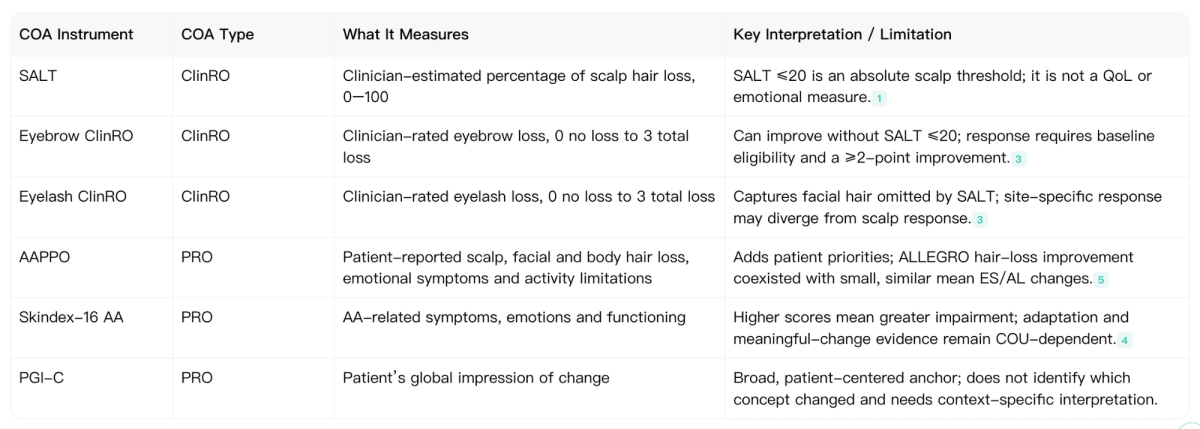
Noah AI Example: Alopecia Areata COA Instrument Matrix
We asked Noah to classify the measures by reporting source, measured concept, and interpretation. The output distinguishes SALT and eyebrow/eyelash clinician scores from AAPPO, Skindex-16 AA and PGI-C patient reports.
Step 3: Examine SALT as a Clinician-Reported Severity Measure
SALT measures the clinician-estimated percentage of scalp hair loss on a scale from 0 to 100: 0 means no scalp hair loss, and 100 means complete scalp hair loss. It is a physical disease-severity measure, not a direct assessment of quality of life.
Researchers must also distinguish an absolute threshold from relative change. SALT ≤20 means no more than 20% scalp loss at the specified visit. By contrast, SALT50, SALT75 and SALT90 refer to at least 50%, 75% or 90% improvement from each patient's baseline SALT score. Those are not interchangeable endpoints.
Two randomized phase 3 studies, BRAVE-AA1 and BRAVE-AA2, evaluated baricitinib in adults with severe alopecia areata. Their primary endpoint was the estimated proportion with SALT ≤20 at week 36. Although the studies share one primary publication, they remain separate trials with separate populations and estimates. King et al., NEJM 2022.
| Trial | Randomized participants | Baricitinib 4 mg | Baricitinib 2 mg | Placebo |
|---|---|---|---|---|
| BRAVE-AA1 (NCT03570749) | 654 | 38.80% | 22.80% | 6.20% |
| BRAVE-AA2 (NCT03899259) | 546 | 35.90% | 19.40% | 3.30% |
Outcome: estimated week-36 proportion achieving SALT ≤20. These are trial-reported estimates, not simple fractions inferred from rounded percentages.
These results show efficacy against the prespecified scalp endpoint. They do not establish the same magnitude of improvement in eyebrows, eyelashes, emotional symptoms, or everyday activities.
Step 4: Review Eyebrow and Eyelash Outcomes Separately
Scalp-only assessment misses hair loss in areas that may be important to a patient's appearance and daily experience. In BRAVE-AA analyses, clinicians used separate eyebrow (EB) and eyelash (EL) ratings, ranging from 0 (no hair loss) to 3 (complete hair loss). Specific response definitions required eligible baseline impairment and improvement to score 0 or 1 with a sufficient change from baseline.
A published follow-up analysis found that some patients experienced eyebrow or eyelash regrowth without reaching SALT ≤20. This is why an individual could have a meaningful improvement in facial hair even when classified as a nonresponder on the original primary scalp threshold. BRAVE-AA scalp-regrowth analysis.
The qualification is essential: those facial-hair patterns came from an integrated, later post hoc analysis, not a new randomized trial or a new prespecified primary endpoint. They should not be repackaged as proof that a scalp response caused eyebrow improvement, or that all treatment groups had equivalent follow-up opportunities.
Step 5: Extract Patient-Reported Outcomes in ALLEGRO
The ALLEGRO phase 2b/3 study (NCT03732807) investigated ritlecitinib in adolescents and adults with at least 50% scalp hair loss. Its main clinical efficacy analysis used a SALT-based response at week 24, while additional publications evaluated how participants described their own hair loss and its effects. ALLEGRO primary study.
The Alopecia Areata Patient Priority Outcomes (AAPPO) instrument covers patient-reported scalp, eyebrow, eyelash and body hair loss, as well as emotional symptoms and activity limitations. This is a different measurement perspective from a clinician estimating the amount of remaining scalp hair.
In the published ALLEGRO AAPPO analysis, 5%–36% of patients across the reported ritlecitinib dose groups described scalp-hair improvement at week 24, compared with 9% of placebo recipients. Patient-reported eyebrow, eyelash and body hair findings generally followed a similar direction. However, mean emotional-symptom and activity-limitation changes were relatively small and similar across groups during the reported periods. AAPPO secondary analysis.
These two findings are not contradictory. The instrument measures different concepts, and their sensitivity to change may differ. A patient can value visible regrowth without showing a large average change in a domain whose baseline impairment was modest. Equally, a small mean change does not prove that no individual experienced a meaningful emotional benefit.
Later analyses may ask different questions using different comparison groups or later observation windows. For example, a subsequent 48-week analysis compared maintenance-dose groups with a lower, subtherapeutic dose rather than the original week-24 placebo contrast; its findings must not be substituted for the earlier randomized placebo-period results. Additional ALLEGRO AAPPO analysis.
Organize Clinical Outcome Evidence with Noah AI
Compare trial endpoints, classify PRO and ClinRO instruments, and trace clinical findings back to the original publications.
New users get 300 free credits when they sign up. No credit card required.
Step 6: Compare Trial Findings Without Losing Their Limitations
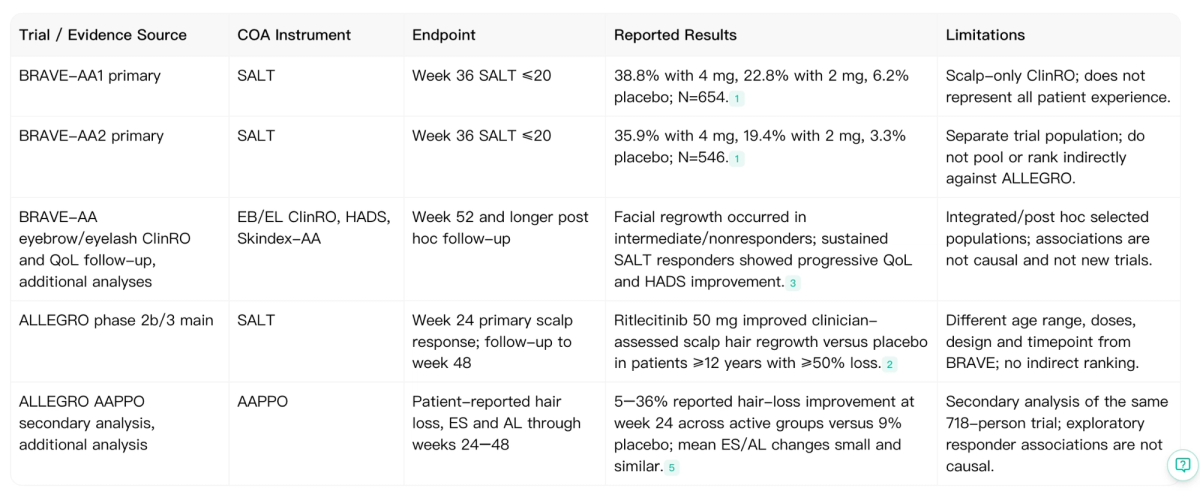
The next step is to place the instruments beside the actual evidence source, endpoint definition, observation period, result, and limitation. A comparison table is useful only if it preserves which claims are from the original randomized trials and which come from later, selected or post hoc analyses.
Our Noah AI output uses separate rows for the two BRAVE-AA primary trials, a follow-up analysis of eyebrow/eyelash and quality-of-life outcomes, the ALLEGRO primary trial, and the ALLEGRO AAPPO secondary analysis.
Why the Evidence Type Matters
A randomized primary analysis of SALT response answers a different question from a later post hoc association between scalp response and wellbeing. Post hoc analyses can be informative but often use selected responder groups, face missing-data challenges, and do not support the same causal interpretation as the randomized primary comparison.
The published BRAVE-AA quality-of-life follow-up, for example, observed improvements in Skindex-AA and HADS among patients who sustained a scalp response. But it evaluated a selected population over a longer period, and the results should not be read as a randomized demonstration that hair regrowth caused every emotional change. Sustained-response QoL analysis.
Similarly, the two baricitinib trials and the ritlecitinib trial differ in age eligibility, doses, follow-up, endpoint definitions, and analysis populations. The percentages are not a valid head-to-head drug ranking.
Step 7: Evaluate Whether a COA Is Fit for Purpose
Choosing an instrument is more than selecting one already used in a clinical trial. The FDA's October 2025 final guidance on selecting, developing, or modifying fit-for-purpose COAs emphasizes the intended concept of interest, context of use, relevant patient input, and evidence supporting the measure's performance in that setting.
For an alopecia areata program, researchers should review the instrument's content validity, reliability, ability to detect change, score interpretation, meaningful-change threshold, recall period, language and cultural relevance, patient comprehension, and missing-data handling. Evidence that SALT or AAPPO has been used in a trial does not establish that it is suitable for every new population or regulatory endpoint.
| Instrument | Useful evidence | Questions requiring further validation |
|---|---|---|
| SALT | Standardized clinician assessment and prespecified scalp-response thresholds | Inter-rater consistency in the intended setting, meaningful change for the population, and relevance of hair-loss location |
| Eyebrow / eyelash ClinRO | Clinician ratings and defined response rules in AA trials | Assessor training, grading reproducibility, and importance of facial-hair change to patients |
| AAPPO | Patient-centered concepts covering hair loss, emotions and activities | Suitability in the proposed age, language and disease context; meaningful-change interpretation |
| Skindex-16 AA | AA-adapted patient report on symptoms, emotions and functioning | Content and measurement support for a specific regulatory context and analysis strategy |
Important limit: Noah can retrieve, structure, and summarize the published measurement evidence. It cannot replace patient interviews, concept elicitation, cognitive debriefing, prospective psychometric validation, or an FDA qualification process. Nor does appearance in an approved medicine's labeling automatically mean an instrument has been formally FDA-qualified.
How We Tested Noah AI for This Case
We tested Noah AI directly by asking it to review published BRAVE-AA1, BRAVE-AA2, and ALLEGRO evidence through an October 27, 2026 cutoff. The requested output separated original randomized trials from subsequent publications, identified each instrument's reporting source, retained assessment timepoints, and assembled the two comparison tables shown above.
The workflow was designed to organize published evidence, not to administer questionnaires to patients, conduct qualitative research, calculate new psychometric statistics, access proprietary patient-level records, or create a regulatory-grade instrument validation dossier.
Example Research Prompt
Compare clinical outcome assessments used in BRAVE-AA1, BRAVE-AA2 and ALLEGRO phase 2b/3 for alopecia areata. Distinguish clinician-reported SALT and eyebrow/eyelash measures from patient-reported AAPPO, Skindex-16 AA, HADS and PGI-C where supported. Extract trial identifier, instrument, concept, endpoint definition, dose, timepoint, reported findings and limitations. Keep original randomized findings separate from secondary and post hoc analyses. Preserve small or null emotional/activity findings and cite primary publications. Produce (1) a COA instrument matrix and (2) a trial-to-COA evidence comparison. Do not invent instrument-validation statistics or claim FDA qualification.
This abbreviated prompt is a reproducible example. It is not presented as a screenshot of the complete original research instruction.
Frequently Asked Questions
What is the difference between a PRO and a ClinRO?
A PRO is reported directly by the patient without interpretation by a clinician. A ClinRO is recorded by a trained clinician based on examination or clinical judgment. In alopecia areata, SALT is a ClinRO, while AAPPO is a PRO.
Is SALT a quality-of-life questionnaire?
No. SALT measures the extent of scalp hair loss. It does not assess emotional symptoms, social functioning, anxiety, treatment satisfaction, or other patient experiences.
What does SALT ≤20 mean?
SALT ≤20 means no more than 20% scalp hair loss at a defined timepoint. This absolute threshold differs from SALT50 or SALT75, which describe relative change from an individual's baseline severity.
Why might a PRO and ClinRO show different patterns?
They measure different constructs and may use different assessment windows. Clinical signs can improve without a comparable group-average change in emotion or activities; individual baseline burden and expectations also vary.
Can AI validate an alopecia areata clinical outcome assessment?
AI can help review the existing evidence and identify missing measurement-property information. It cannot substitute for direct patient research, appropriate psychometric studies, or regulatory review of an instrument in its proposed context of use.
Did BRAVE-AA and ALLEGRO measure exactly the same outcomes?
No. Their primary trial designs, ages, interventions, and outcome schedules differed. Analyses of the same instruments may also be primary, secondary, exploratory, or post hoc. Direct drug rankings from these separate studies are not justified.
Conclusion: Put the Patient Voice Beside the Clinical Sign
Clinical outcome assessment is most informative when researchers distinguish what clinicians observe from what patients experience. BRAVE-AA1 and BRAVE-AA2 established scalp hair regrowth using SALT thresholds, while later analyses revealed additional information about facial hair and quality of life. ALLEGRO showed the value of a patient-priority measure capable of separating perceived hair improvement from emotional symptoms and activity limitations.
For any evidence review, retain the original study, its patient population, endpoint definition, timepoint, and uncertainty. The aim is not to force every measure into agreement, but to understand which dimensions of treatment benefit have actually been demonstrated.
Start Your Next COA Evidence Review with Noah AI
Bring clinical trial publications, patient-reported outcomes, and instrument limitations into one source-linked research workflow.
Sign up to receive 200 free credits — no credit card required.