
How to Screen Research Papers with AI: Inclusion and Exclusion Criteria (2026)
Linda
Learn how to screen research papers with AI using PICO and inclusion-exclusion criteria. Explore real medical studies, screening decisions, and human review.
A practical, source-grounded approach to applying PICO, documenting exclusion reasons, and reviewing real medical papers—with Noah AI supporting the evidence trail while researchers retain final decisions.Evidence cutoff: October 29, 2026 · Case study: SGLT2 inhibitor trials in heart failure
Key Takeaways
- Freeze your rules first. Define the population, intervention, comparator, outcome, study design, and report identity before examining results.
- Separate relevance from eligibility. A well-conducted randomized trial can still fail a prespecified population, drug-class, or endpoint requirement.
- Keep reasons traceable. Each preliminary screening suggestion should show the decisive criterion and a source-linked passage or labeled paraphrase.
- Make humans responsible. AI-suggested “Likely Include” or “Likely Exclude” labels are not final systematic-review decisions.
Introduction: Why Inclusion–Exclusion Screening Matters
Searching PubMed can reveal studies that seem to answer the same question, even when they recruited different populations, used different primary outcomes, or published secondary analyses of an already-reported trial. Screening decides which records warrant closer inspection and, eventually, which underlying studies meet a review’s pre-established eligibility rules. Without consistent criteria, reviewers risk mixing evidence that answers different questions.A useful screening template converts the research question into observable requirements. PICO—Population, Intervention, Comparator, and Outcome—offers a starting structure. Study design, publication type, data availability, and duplicate-report handling are additional decisions. The template should also define what to do when a source is ambiguous: retain it for full-text review rather than manufacture certainty.Below, we use nine prespecified publications about heart failure and SGLT2 inhibitors to show a workflow in Noah AI. The nine records were deliberately chosen to illustrate different screening decisions. They are not a comprehensive search result, and no PRISMA study count or AI accuracy estimate can be inferred from them.
Key Challenges in Literature Review Screening
Many false matches are subtle. A paper might involve the right drug and outcome but a different ejection-fraction range; another might study the exact patients of interest but treat a symptom questionnaire as its primary endpoint rather than a clinical event composite. Additional reports of one clinical trial can also appear to be independent studies if researchers screen publications without checking trial identities.
- Population mismatch: Heart-failure trials with LVEF ≤40% do not meet an explicitly prespecified LVEF >40% eligibility rule.
- Outcome mismatch: KCCQ symptom scores and six-minute walk distance measure valuable patient outcomes, but they are not interchangeable with a clinical-event composite.
- Intervention mismatch: Finerenone and SGLT2 inhibitors can be studied in overlapping patient populations, but they belong to different drug classes.
- Publication versus study: A systematic review, subgroup analysis, or follow-up paper is not an additional independently randomized trial.
- Incomplete information: An abstract may provide enough evidence for a provisional suggestion but not for a final full-text eligibility decision.
Do not use statistical significance as a generic inclusion threshold. Selecting only positive findings can bias the resulting evidence base. Also, a requirement that a particular outcome be the primary endpoint is unusually restrictive and should be justified prospectively. We use that rule here solely because it defines this specific worked example—not as a universal recommendation for systematic reviews. See the Cochrane Handbook for guidance on specifying eligibility criteria.
How to Use Noah AI for Literature Review Screening
Start by providing Noah with a research question, a frozen eligibility template, and an identified set of paper records or sources. Ask it to extract the exact attributes relevant to PICO—rather than making free-form relevance judgments. It can organize those findings into a consistent table, show where a paper appears to fail a rule, and identify what still needs verification. The output is an evidence-organizing aid, not an independent adjudicator.A practical prompt is: “For each supplied PMID, compare the paper against the prespecified PICO and study-design criteria. Return only Likely Include, Likely Exclude, or Uncertain—Full-Text Review. Give the exact failed criterion, the source evidence or a labeled paraphrase, and the specific item a human reviewer must verify. Never report a final inclusion decision.”Do not describe a Noah-produced candidate list as a complete database search, or claim that all full-text PDFs were reviewed when only indexed abstracts were accessible. The screening record should preserve the difference between abstract evidence and verified full-text evidence.
Step-by-Step Workflow: Screening Studies with AI and Human Review
Step 1. Define PICO and prespecify your inclusion/exclusion template
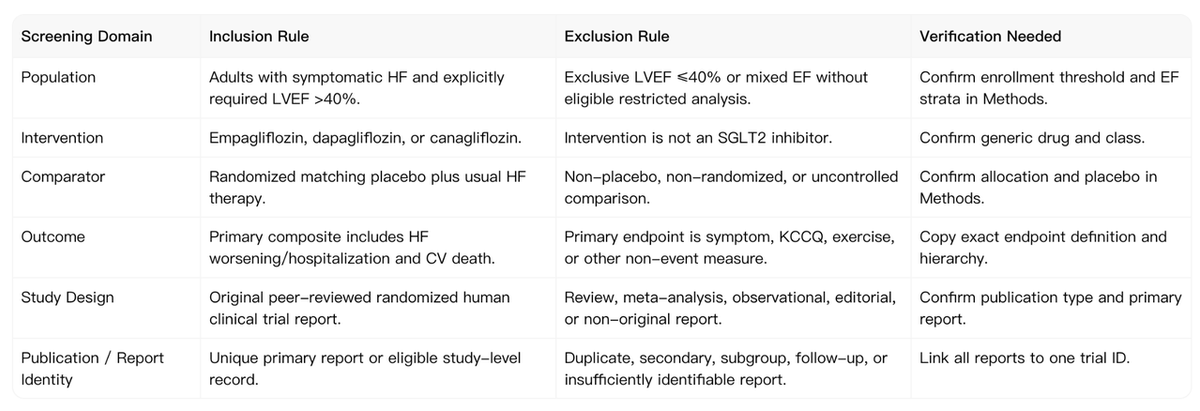
Our example asks whether SGLT2 inhibitors, compared with placebo plus usual therapy, reduce a prespecified composite of heart-failure worsening or hospitalization and cardiovascular death in adults with symptomatic heart failure and LVEF >40%. Eligible records must be original, peer-reviewed randomized placebo-controlled trial reports. The illustrative rules are intentionally narrow; a different review question could legitimately include symptom-score trials or mixed-EF studies.
| PICO element | Criterion used in this example |
|---|---|
| Population | Adults with symptomatic heart failure; trial eligibility explicitly requires LVEF >40%. |
| Intervention | Empagliflozin, dapagliflozin, or canagliflozin. |
| Comparator | Randomized matching placebo with background heart-failure therapy. |
| Outcome | Prespecified primary composite with HF worsening/hospitalization and cardiovascular death. |
| Study/report | Primary original RCT report, not a meta-analysis, secondary publication, or duplicate record. |
The first actual Noah output is the screening template below. Notice that the fourth column is not a verdict; it specifies what evidence a reviewer still needs to inspect.
Step 2. Screen titles and abstracts against the same rules
At the first screening level, extract the trial name, patient EF threshold, intervention, control group, primary endpoint, and publication type. Use three provisional labels: Likely Include, Likely Exclude, and Uncertain—Full-Text Review. The last category is important when the abstract does not provide enough detail to establish a criterion.For example, EMPEROR-Preserved (empagliflozin) and DELIVER (dapagliflozin) appear to satisfy the selected population, treatment, placebo and primary-event requirements. By contrast, DAPA-HF and EMPEROR-Reduced enroll reduced-EF populations and therefore receive provisional E1 population-mismatch flags under this particular protocol. The similarity of their heart-failure outcomes does not override the EF threshold.
Step 3. Check full texts before final eligibility decisions
Abstracts are compressed descriptions. The original methods and trial protocol may be needed to confirm eligibility thresholds, randomization, endpoint hierarchy, and how urgent heart-failure visits were defined. In the research demonstration, full text was inspected for PRESERVED-HF, CHIEF-HF and the identified meta-analysis; six other records were classified from accessible abstracts, with full-text confirmation still outstanding.PRESERVED-HF illustrates why the exact primary endpoint matters: it compared dapagliflozin with placebo in a relevant population, but its primary endpoint was a change in Kansas City Cardiomyopathy Questionnaire Clinical Summary Score at 12 weeks. That makes it a likely E4 exclusion under the narrowly specified event-outcome rule, not a poor or uninformative trial. Similarly, EMPERIAL-Preserved used six-minute walk distance as its primary endpoint. Human reviewers should confirm these distinctions in the source text.
Step 4. Resolve disagreements and connect multiple reports
The final call belongs to human reviewers working independently with a documented reconciliation process. A shared log should keep each reviewer’s decision, evidence location, exclusion code, and date. If reviewers disagree about whether a mixed-EF population meets the criteria, return to the prespecified protocol and the paper’s Methods—not an AI confidence score.Also screen at the correct unit of analysis. The EMPERIAL publication reports two parallel trials, while the SGLT2 meta-analysis reuses patients from several previously conducted trials. A single paper may describe more than one study; multiple papers may describe the same underlying trial. Neither situation justifies counting duplicate patient populations.
Step 5. Document the evidence and retain an audit trail
Save the original PICO, search methods if applicable, the candidate list, PMIDs and DOIs, AI suggestions, human reviewer decisions, conflict resolutions, full-text accessibility, and the reason for each final exclusion. PRISMA 2020 provides a reporting framework for describing this process, including records identified, screened, and excluded. It does not determine eligibility and does not justify inventing a flow diagram for a teaching sample.
Build a source-linked evidence table with Noah AI
Organize biomedical research papers, compare study criteria and trace claims back to their original sources.Get 300 Free CreditsFree signup · No credit card required
Best Practices & Common Pitfalls
Before scaling up to hundreds of records, pilot your screening form on a small, varied sample. Clarify how to treat mixed populations, multiple publications, endpoints reported only as secondary outcomes, and unknown details. Record any protocol change transparently, with the reason and timing. Do not quietly change rules after seeing favorable or unfavorable study results.Be especially careful with incomplete evidence. “Full text not accessed” does not equal “ineligible.” Make the unknown visible, retrieve the report where possible, and keep the record for appropriate human assessment. For eligible studies, assess risk of bias later as a separate process; screening eligibility and study quality are not interchangeable.For systematic reviews, the Cochrane Handbook’s study selection guidance emphasizes independent human selection and auditable reasons. AI can assist with information organization, but the research team must ensure that difficult borderline studies do not disappear because a model produced an overconfident exclusion label.
Citing Sources and Avoiding Misleading Evidence
Screening needs more than a paper title and a generic relevance score. For each record, use a stable identifier such as a PMID or DOI, identify the exact fact that determines eligibility, and indicate whether the evidence came from an abstract, a verified full text, a protocol, or a secondary source. A concise, attributed paraphrase is preferable to a fabricated verbatim quotation. Noah’s sample table explicitly labels supporting evidence as paraphrases where appropriate.Keep original clinical trial reports separate from reviews and pooled analyses. A meta-analysis is useful for finding studies or checking bibliography coverage, but it cannot become an additional randomized population in an original-RCT-only screening exercise. Likewise, including the same trial’s extended follow-up as another independent RCT would distort a later synthesis.
Example Use Case: Screening Nine Real Heart-Failure Papers
To make the workflow concrete, we supplied nine named publications rather than an unverified bulk database harvest. They include two plausible matches, two reduced-EF trials, two trials with patient-centered or exercise primary outcomes, one mixed-EF symptom trial, one different drug class and one meta-analysis.9Prespecified example records2Likely Include suggestions7Likely Exclude suggestionsEMPEROR-Preserved and DELIVER are provisional include candidates. DAPA-HF and EMPEROR-Reduced fail the LVEF rule (E1). PRESERVED-HF and EMPERIAL-Preserved fail the prespecified primary-outcome rule (E4). CHIEF-HF does not prospectively restrict the population to LVEF >40% and uses a symptom score (E1/E4). FINEARTS-HF involves the mineralocorticoid receptor antagonist finerenone rather than an SGLT2 inhibitor (E2). The meta-analysis is a secondary synthesis, not a fresh patient-randomized trial (E5).These are suggestions based on published source descriptions, not final exclusions. The reasons are narrower and more useful than “not relevant”: they show exactly why a study fails a criterion even when it remains clinically important.
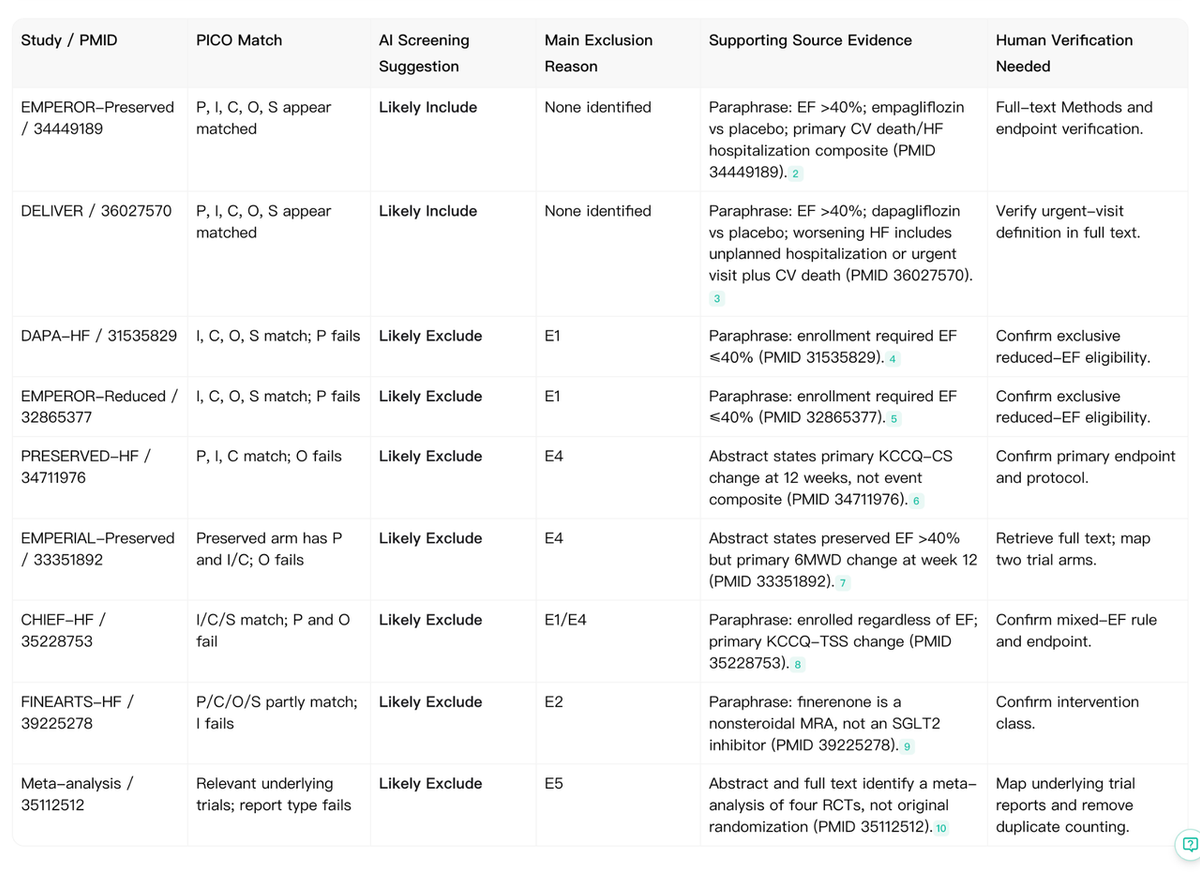
The output is useful because the interpretation remains auditable. A reviewer can move from “E4—outcome mismatch” to the paper’s Methods, confirm whether the endpoint was primary, and either uphold or overturn that suggestion. The table does not prove that Noah can perform complete or error-free systematic-review screening.Evidence access note: The Noah report marked six records as abstract-verified only, with full-text verification still required. Three records had accessible full-text material checked. The nine-record set is illustrative, not a completed systematic review, and no PRISMA identification or search totals are claimed.
Final Checklist for Inclusion–Exclusion Screening
- Define the research question and PICO before screening.
- Write explicit, justified inclusion and exclusion rules, including treatment of missing information.
- Freeze the initial protocol and document amendments.
- Assign stable identifiers and check multiple reports of the same trial.
- Label abstract-only evidence separately from verified full-text evidence.
- Record the specific failed criterion, source passage and reason for every proposed exclusion.
- Use independent human reviewers for final full-text decisions and a prespecified disagreement process.
- Keep AI suggestions in a separate field from human reviewer decisions.
- Report the actual search and selection process transparently; do not invent PRISMA counts.
- Assess risk of bias and synthesize effects only after eligibility and study identities have been resolved.
Conclusion: Faster Organization, Human-Controlled Decisions
Good screening is not about rejecting the most papers in the shortest time. It is about applying justified rules consistently and making each decision easy to reconstruct. In this SGLT2 heart-failure example, an apparently similar group of publications separated into different provisional categories because of differences in EF eligibility, primary outcomes, intervention class and report type.Noah AI can help standardize the working table and surface passages that matter for eligibility. But researchers must still review relevant full texts, resolve ambiguous study identities, document exclusions and make final decisions independently. That distinction is what makes an AI-assisted literature-review workflow useful without overstating automation.
Start your next evidence review with Noah AI
Turn a prespecified research question into traceable study comparisons and supporting evidence, then verify final screening decisions with your research team.Get 300 Free CreditsNo credit card required · Start with a free account
Frequently Asked Questions
Can AI automatically include or exclude studies in a systematic review?
AI can generate provisional eligibility suggestions and locate potential reasons, but it should not be described as completing this review. Final full-text eligibility decisions, disagreement resolution and documentation are researcher responsibilities.
What is the difference between PICO screening and a relevance score?
PICO screening compares each paper against explicit study requirements. A relevance score may reflect topical similarity without showing which inclusion rule was satisfied or failed.
What should happen when a paper lacks enough information in its abstract?
Mark the uncertainty and seek the full report. Missing information is not evidence that the criterion fails. Where a protocol or registry can clarify design details, check it and record the source.
Should a systematic review exclude studies without statistically significant results?
No. Doing so can introduce selection bias. Include or exclude according to prospectively justified eligibility criteria, not whether the result supports a preferred conclusion.
Does a PRISMA flow diagram prove screening was done correctly?
No. PRISMA is a reporting framework. A flow diagram describes the actual identification and selection pathway; it does not validate an AI model, replace independent reviewers or certify eligibility judgments.