
KIT Target Evaluation: Mutations, Resistance, Clinical Competition, and R&D Strategy
Linda
Explore KIT target biology in GIST, exon 9/11 mutations, exon 13/14 and 17/18 resistance, KIT inhibitors, clinical evidence, and R&D strategy.
A mutation-resolved assessment of KIT biology, acquired resistance, clinical competition, and later-line gastrointestinal stromal tumor (GIST) development.
Evidence cutoff: October 13, 2026 | Research report | Noah AI-assisted analysis
This KIT target evaluation uses a Noah AI-assisted research workflow to organize public evidence around KIT biology, clinically relevant mutations, established kinase inhibitors, acquired resistance, and the development opportunities that remain in gastrointestinal stromal tumors (GIST). The goal is not to count every drug associated with KIT but to identify which mutation-defined questions can inform target validation, asset scouting, and indication prioritization.
The workflow begins with a defined research question, then separates primary KIT driver mutations from secondary resistance mechanisms and distinguishes randomized clinical evidence from exploratory biomarker analyses. Scientific and portfolio decisions require human review of the cited studies, current labels, and trial records.
KIT Target Overview
| Target parameter | Evaluation |
|---|---|
| KIT / CD117 | Stem cell factor receptor tyrosine kinase; UniProt P10721 |
| Primary clinical focus | KIT-driven GIST, particularly imatinib-sensitive disease and acquired resistance after treatment |
| Primary activating mutations | KIT exon 11 and exon 9; treatment sensitivity and dosing considerations are not identical |
| Key acquired resistance domains | ATP-binding pocket (exons 13/14) and activation loop (exons 17/18) |
| Established therapy benchmarks | Imatinib, sunitinib, regorafenib, and ripretinib in their relevant GIST treatment settings |
| Development question | Can a new inhibitor or combination provide better mutation coverage, durability, or tolerability? |
The broad drug-record, disease-link, and trial-count totals in the PatSnap reference are not reproduced because they depend on that platform's proprietary query scope. A registry match is not necessarily a direct KIT-target validation study.
Executive Takeaway
KIT is biologically and clinically validated, but it is not an open therapeutic field. The remaining opportunity lies in resolving treatment-relevant mutations, anticipating polyclonal resistance, and demonstrating a differentiated therapeutic profile in a defined treatment line. A program that merely inhibits KIT without showing why it is better than current inhibitors has a high development and competitive burden.
Biology Signal: KIT signaling regulates cell growth and survival through pathways including PI3K–AKT and RAS–RAF–MAPK. Activating KIT mutations are major oncogenic drivers in GIST.
Clinical Evidence: Multiple kinase inhibitors have established benefit in GIST; resistance arises from distinct secondary mutation classes that are not uniformly covered by every drug.
R&D Priority: Mutation-resolved profiling, evidence-based later-line sequencing, and complementary ATP-pocket/activation-loop coverage should precede broad new-asset investment.
Biology and Disease Rationale
KIT, also known as CD117, is the receptor for stem cell factor (KITLG). Signaling through KIT contributes to hematopoiesis, melanocyte biology, mast cell development, and cellular survival. In GIST, gain-of-function mutations can activate the kinase independently of normal ligand control, making KIT a tractable driver rather than merely a tumor-associated marker.
Primary KIT exon 11 mutations affect the juxtamembrane region and are commonly sensitive to imatinib. Primary exon 9 mutations define a biologically and clinically distinct subgroup and have historically shown lower response rates to standard-dose imatinib in some study populations. Exon 9 should not automatically be described as a resistance mutation: it can be the tumor's original driver.
Following initial KIT inhibition, distinct resistant subclones may arise. Mutations in exons 13/14 affect the ATP-binding pocket; mutations in exons 17/18 affect the activation loop. These categories matter because kinase inhibitors differ in their activity against them. A single biopsy may miss coexisting clones, while circulating tumor DNA (ctDNA) can provide additional information when detectable. However, ctDNA non-detection does not establish absence of a mutation.
For R&D, KIT's extensive biology is not sufficient by itself to justify a new program. The asset must be evaluated against the mutation context, previous treatment exposure, clinical benchmark, off-target effects, and the likelihood of multiple concurrent resistance alleles. KIT-mutant GIST should also be distinguished from PDGFRA-mutant GIST; for example, PDGFRA D842V is not a KIT mutation.
Validation and Competitive Landscape
Established treatment sequence. Imatinib is a key first-line comparator in KIT-mutant advanced GIST. Sunitinib is an established post-imatinib treatment; regorafenib and ripretinib provide additional later-line options. FDA approval of ripretinib after at least three prior kinase inhibitors was based on the randomized INVICTUS study, which reported median progression-free survival (PFS) of 6.3 months versus 1.0 month with placebo. These historical trials validate KIT-directed therapy, but treatment-line differences make cross-trial ranking inappropriate.
Mutation-specific clinical signal. Exploratory ctDNA analyses from the randomized INTRIGUE study suggest that sunitinib may be more active than ripretinib in selected patients with primary KIT exon 11 and secondary exon 13/14 mutations, while ripretinib showed a stronger signal in an exon 11 + 17/18 subset. Those analyses were not a universal treatment algorithm or the original trial's successful superiority result. INSIGHT was designed to prospectively test the latter mutation-defined hypothesis.
Emerging competitive pressure. The PEAK Phase III study reported median PFS of 16.5 months for bezuclastinib plus sunitinib versus 9.2 months for sunitinib alone, with an objective response rate of 46% versus 26% in the analyzed study population. These results were presented in a 2026 conference abstract, and the clinical/regulatory position of the combination should be checked separately from trial efficacy. The findings support complementary mutation coverage as a development thesis, not proven benefit for every individual KIT allele.
KIT Mutation × Drug × Resistance × Clinical Evidence
The evidence table below was generated within the Noah research workflow. It separates primary mutation groups, secondary resistance domains, treatment evidence, and the implication for new-drug development.
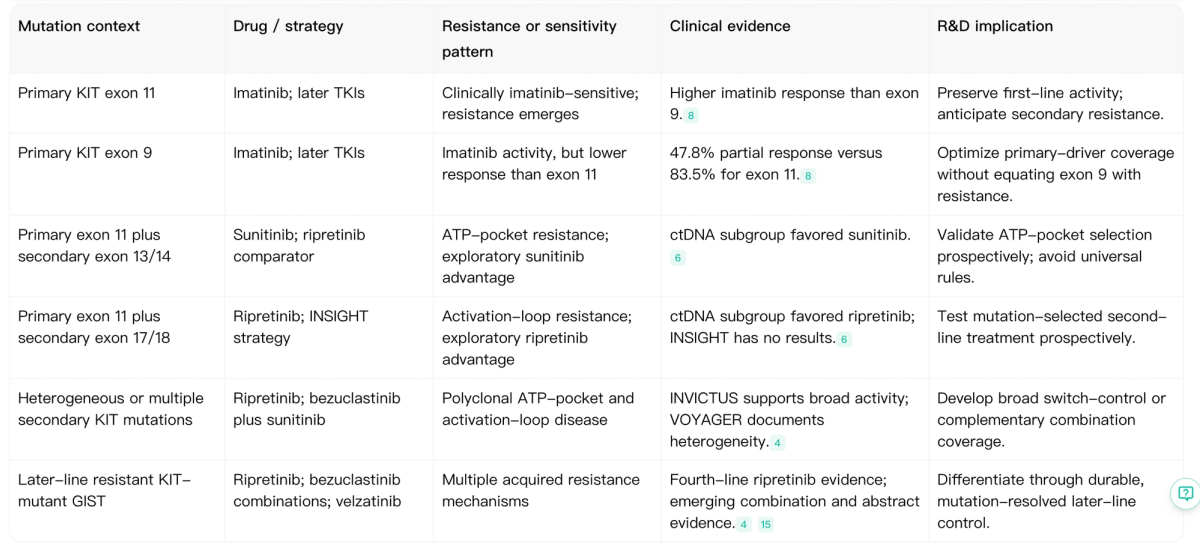
The table reinforces an important distinction: mutation-specific sensitivity is contextual. For example, an exon 11 driver plus a secondary exon 17/18 mutation is not interchangeable with a primary exon 9 tumor, even though both fall under KIT-mutant GIST. Study line, prior inhibitor exposure, assay method, and concurrent resistance alleles all affect the comparison.
For development programs, the key competitive questions are whether a candidate covers an important unaddressed resistant clone, combines complementary binding profiles, retains sufficient exposure in relevant lesions, and achieves durable control with manageable toxicity. Safety should be compared using actual human adverse-event data rather than a mechanistic claim of greater selectivity.
IP and Partnering Implications
A differentiated KIT asset is likely to depend on a specific chemistry and mutation-coverage claim rather than generic KIT inhibition. Relevant diligence areas include compound and binding-mode patents; activity across ATP-pocket and activation-loop variants; combinations that address mixed resistant clones; dose or formulation innovations; and biomarker-defined treatment populations. None of these categories alone establishes enforceable patent rights or freedom to operate.
Partnering screens should require mutation-resolved in-vitro profiles, clinically achievable exposure, any human pharmacokinetic and tolerability data, trial eligibility criteria, and evidence of superiority or complementarity against appropriate drugs. Patent family scope, ownership, territorial rights, and expiry require a separate specialist review before commercial decisions are made.
Recommended Next Steps
- Define the KIT mutation context. Distinguish primary exon 9/11 mutations from acquired exon 13/14 and 17/18 mutations; document how tissue sequencing and ctDNA are used.
- Benchmark relevant inhibitors. Compare imatinib, sunitinib, regorafenib, ripretinib, and relevant investigational combinations by line of therapy, cohort, endpoint, and mutation coverage.
- Stress-test the resistance thesis. Include polyclonal secondary mutations and test activity at clinically achievable exposures, not only single-allele model potency.
- Prioritize a clear differentiated asset strategy. Advance discovery or licensing only if mutation coverage, durability, safety, delivery, or a justified combination offers a credible clinical advantage.
Bottom Line
KIT is a highly validated but deeply competitive drug-development target. Its strongest remaining opportunities are mutation-resolved: targeting acquired resistance, developing clinically useful combinations, and improving durable later-line disease control. A credible R&D program should therefore connect KIT mutation → drug sensitivity → resistance evidence → clinical development hypothesis rather than relying on broad target-level drug and trial counts.
Evidence note: This research brief uses an October 13, 2026 cutoff and draws on named studies including INVICTUS, INTRIGUE, INSIGHT, and the PEAK Phase III conference abstract. The mutation table represents a structured synthesis, not prospective proof of a universal mutation-guided treatment rule. Clinical decisions require appropriate professional review.
Try Noah AI for Free
Evaluate KIT mutations, resistance mechanisms, and competing drug assets with Noah AI.
Free credits are available, and no credit card is required to get started.
Learn more about the Noah AI human-in-the-loop research workflow.