
MAPK1/ERK2 Target Evaluation: Biology, Clinical Evidence, Resistance & R&D Opportunities (2026)
Linda
Explore MAPK1/ERK2 as an oncology drug target through an AI-assisted evaluation of pathway biology, target validation, ERK inhibitor clinical evidence, resistance mechanisms, biomarkers, and R&D opportunities. The analysis includes ulixertinib and other ERK1/2 inhibitor programs, highlighting clinical limitations and potential strategies for differentiated drug development.
ERK sits at the end of a heavily targeted signaling pathway. But strong biology is not the same as a validated drug-development opportunity. This evidence-led assessment reviews what is known, what clinical trials have not established, and where a differentiated program might still be tested.
Evidence cutoff: 21 October 2026 · Target: MAPK1 (ERK2) · Research workflow: Noah AI · Source type: peer-reviewed studies + trial registries
01 / Executive Readout
The opportunity is resistance-defined—not MAPK1 mutation-defined.
MAPK1 encodes ERK2, a serine/threonine kinase activated downstream of RAS, RAF and MEK. ERK signaling supports proliferation, cell-state programs and feedback control; it is also essential to normal tissue function. Direct ERK blockade therefore has a credible mechanistic rationale when tumors restore MAPK output after upstream inhibition, but clinical selectivity and tolerability are major constraints. [1][2][8]
Importantly, most clinically tested ERK inhibitors inhibit both ERK1 and ERK2. MAPK3 encodes ERK1, whose activity can partly compensate for ERK2 loss. Genetic evidence in KRAS-driven tumor models supports combined ERK1/2 dependency more directly than a universally actionable, ERK2-only target hypothesis. [3][4]
Target biology — Compelling pathway role: established terminal kinase biology; isoform-specific dependence remains context-sensitive.
Ulixertinib phase I — 11 / 81 (14%) partial responses in evaluable expansion patients; historical, uncontrolled early signal. [5]
Clinical validation — Unresolved: negative disease-specific results and dose-limiting tolerability complicate broad claims. [6][13]
Decision boundary. The analyzed evidence supports exploratory, biomarker-rich R&D. It does not demonstrate that an ERK2-selective agent is clinically effective, that ERK inhibitors reverse resistance across tumor types, or that any combination has a confirmed favorable therapeutic index.
02 / Target Biology
Where MAPK1/ERK2 sits in the signaling cascade
ERK1/2 integrates oncogenic signals from receptor tyrosine kinases and RAS. Activated RAF phosphorylates MEK, and MEK activates ERK, which in turn affects substrates including RSK, ELK1, transcriptional regulators and feedback components such as DUSP6. These outputs connect MAPK signaling to growth, survival and adaptation. [1][2]
RTK → RAS → RAF → MEK → ERK1 / ERK2 → Cellular output
MAPK1-specific evidence — ERK2 identity and alleles. UniProt P28482 establishes MAPK1 as ERK2. Functional profiling of MAPK1 missense variants suggests that individual alleles can alter activity and drug response, although such findings do not amount to validated patient-selection biomarkers. [1][11]
Dual-isoform evidence — ERK1/2 pathway dependence. Most pharmacology and the relevant KRAS-driven deletion experiments involve total ERK1/2 output. Losing one isoform can leave enough signaling through the other to preserve tumor initiation in model systems. [3][4]
Why direct ERK inhibition could differ from RAF or MEK blockade. Tumors can reactivate signaling through RAF amplification, RAS feedback or MEK alterations after upstream pathway inhibition. An inhibitor acting at ERK may suppress downstream output despite some of those upstream events. Yet feedback relief can activate parallel signaling, and normal tissues also rely on ERK activity. Thus, a biologically downstream position is an opportunity for testing—not proof of a better therapeutic window. [8][9][12]
03 / Validation
What target validation actually supports
| Evidence level | What the evidence shows | What it does not establish |
|---|---|---|
| Genetic | KRAS-driven tumor models support overlapping ERK1/2 function; concurrent deletion impairs tumor development. [4] | Universal MAPK1-only oncogene addiction. |
| Preclinical pharmacology | Ulixertinib and temuterkib suppressed ERK output in selected RAS/RAF-driven models. [7][12] | Human survival or response advantage. |
| Early human studies | ERK inhibitor exposure, pharmacodynamic activity and some objective responses were reported. [5] | Randomized comparative efficacy. |
| Negative clinical counterevidence | Uveal-melanoma and pancreatic-combination studies did not show meaningful activity in the examined settings. [6][13] | That every tumor with MAPK pathway activation is sensitive to ERK inhibition. |
A target can be mechanistically important while remaining difficult to drug safely. The distinction between biochemical target engagement, tumor response and comparative patient benefit is central to interpreting this evidence.
04 / Clinical Evidence
ERK inhibitors: early signals and meaningful negatives
Ulixertinib (BVD-523) provides the clearest early human anchor. The multicenter phase I study enrolled 135 patients; 11 of 81 evaluable expansion patients achieved partial responses (14%), while 32% of the expansion cohort required dose reductions. Diarrhea, fatigue, nausea and acneiform dermatitis were frequent. These findings demonstrate activity in selected patients, not broad efficacy. [5]
| Program / context | Human evidence | Interpretation for R&D |
|---|---|---|
| Ulixertinib (ERK1/2 · Phase I · [NCT01781429](https://clinicaltrials.gov/study/NCT01781429)) | 135 enrolled; 11/81 (14%) partial responses among evaluable expansion patients; 32% needed dose reduction. [5] | Clinical feasibility and an indication-selective signal; no randomized validation. |
| Ulixertinib, uveal melanoma (Phase II · [NCT03417739](https://clinicaltrials.gov/study/NCT03417739)) | In the first 13 patients, no objective responses; median time to progression 2.0 months. Trial stopped after stage one. [6] | Pathway activation alone is not a reliable predictive biomarker. |
| Temuterkib (LY3214996) (ERK1/2 program) | Preclinical pRSK suppression was documented. A metastatic pancreatic phase II study reported DCR 5% with combination versus 5.3% with monotherapy. [7][13] | Strong biochemical logic did not translate into activity in that setting. |
| Rineterkib (LTT462) + naporafenib (Phase Ib · [NCT02974725](https://clinicaltrials.gov/study/NCT02974725)) | Three partial responses among 62 response-evaluable NSCLC patients; target-pathway pharmacodynamic changes were observed. [14] | Limited signal and overlapping toxicity warrant careful exposure and biomarker strategies. |
Registry context. Trial status descriptions in the underlying Noah report reflect its 21 October 2026 evidence cutoff. Recruitment, completion and termination labels can change, and registry status alone does not establish efficacy.
05 / Resistance Mechanisms
Downstream inhibition is not immune to pathway escape
01 · RAS/RAF/MEK reactivation — Upstream amplification, RAF dimerization or MEK changes can restore MAPK signaling after targeted therapy. Direct ERK inhibition may intercept some routes when adequate downstream coverage is retained. Evidence: preclinical and selected resistance contexts. [8][9]
02 · Feedback rebound — ERK inhibition may reduce negative feedback and increase ERK phosphorylation despite suppressed catalytic output. A pERK rise alone should not be read as treatment failure or success. PD readouts: pRSK, DUSP6, substrate activity. [12][17]
03 · ERK-inhibitor resistance — MAPK1 and MAPK3 resistance alleles have been identified experimentally. Tumor lineage, allele context and drug-binding mode affect interpretation. Priority: serial sequencing and functional validation. [19]
04 · Parallel survival circuits — RTK/HER, PI3K/AKT, SHP2 and autophagy-related programs can preserve viability despite ERK-pathway perturbation. Combining pathways creates a new toxicity problem. Priority: prove both target engagement and tolerability. [18][20][21]
Consequently, ERK-dependent resistance and ERK-independent bypass must not be collapsed into a single "RAF/MEK resistant" category. Biomarker design should test both the target pathway and plausible survival alternatives.
06 / Real Noah Research Output
One research task, four decision-oriented dimensions
The following is a screenshot of the actual Noah research output supplied for this analysis. It brings biology, clinical data, resistance and possible R&D directions into a common view. The four-column format is a decision aid; the citation identifiers and full original papers still need to be checked for consequential decisions.
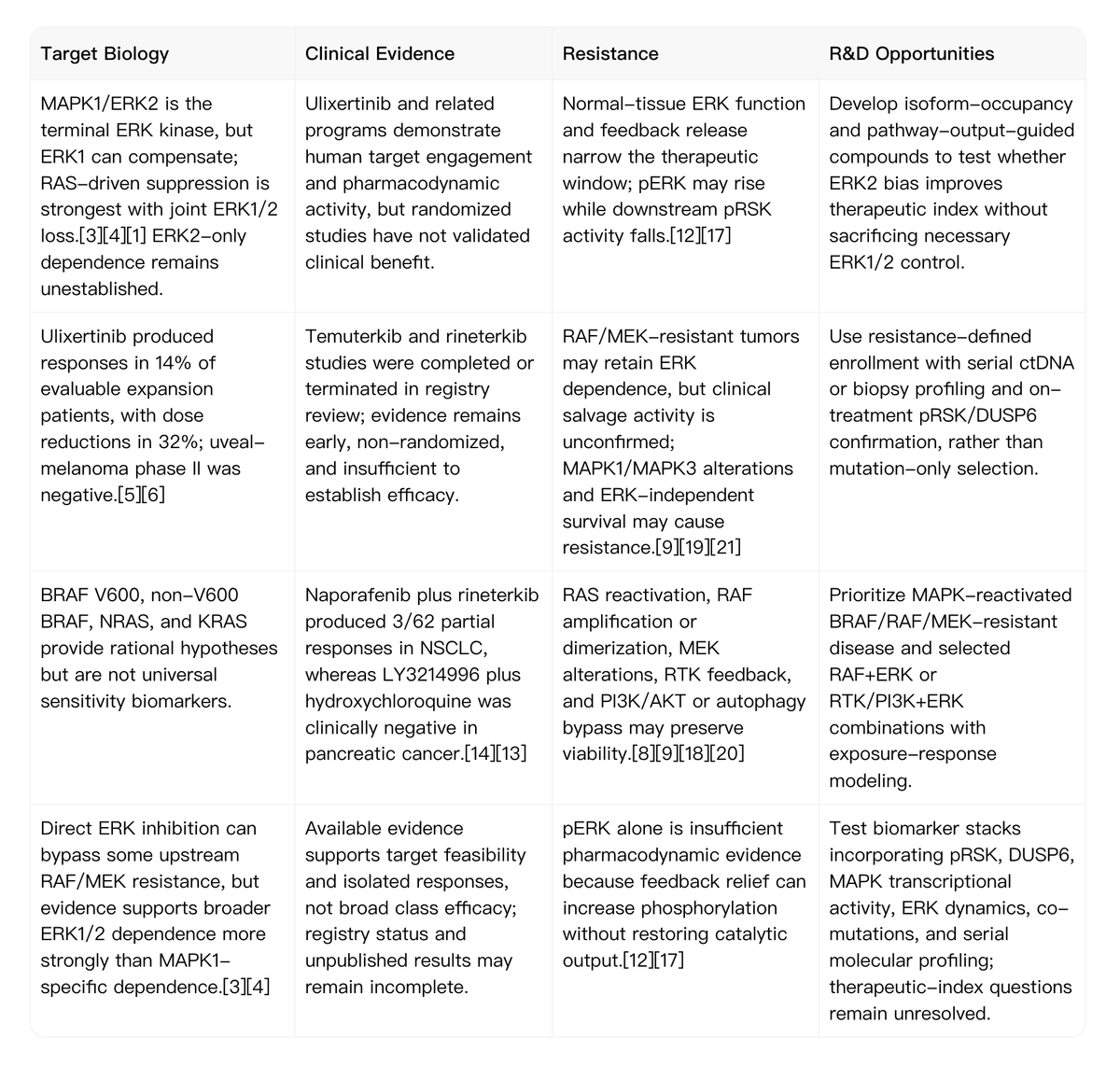
The second supplied image was selected because its full table is more legible. The first image is included as an alternate asset in the ZIP but not repeated here. Source-number labels in the screenshot correspond to the bibliography below.
07 / R&D Strategy
Where a differentiated research program might still fit
| Opportunity | Evidence-led next experiment | Principal uncertainty |
|---|---|---|
| Resistance-defined salvage | Enroll tumors with documented MAPK reactivation after RAF/MEK exposure; combine tissue or ctDNA profiling with on-treatment pRSK/DUSP6 measurements. [9][12] | Some tumors may escape through ERK-independent survival. |
| Biomarker stack, not genotype alone | Integrate BRAF/NRAS/KRAS context with pathway transcription, pharmacodynamic activity and co-mutations in a prospective trial. [7][14] | No validated threshold reliably predicts response. |
| Therapeutic-index engineering | Compare isoform-biased and dual ERK1/2 inhibition across tumor and normal-tissue models, with intermittent dosing and occupancy measurements. [3][15] | ERK2 selectivity could weaken efficacy without improving safety. |
| Rational vertical inhibition | Study RAF+ERK exposure, downstream signaling suppression and overlapping adverse effects before efficacy expansion. [10][14] | Biochemical synergy may be offset by dose limitations. |
| Mechanism-aware combinations | Test feedback-driven RTK/PI3K activation and separately evaluate autophagy approaches using mechanism-appropriate markers. [13][18] | Existing pancreatic clinical results are negative; mechanism alone is insufficient. |
Prepared as an educational biomedical research case study using Noah AI output. Evidence cutoff: 21 October 2026. Visit Noah AI or browse research insights.
No clinical, patent, regulatory or investment advice is provided.