
MASP2 Target Evaluation Report 2026: Biology & R&D Strategy
Linda
Explore MASP2 biology, lectin complement pathway inhibition, narsoplimab's TA-TMA approval, IgA nephropathy trial outcomes, and R&D opportunities in 2026.
October 15, 2026 · Evidence cutoff: October 15, 2026 · MASP2 / UniProt O00187
MASP2 is a proximal regulator of the lectin complement pathway. Its value as a therapeutic target is now supported by a US regulatory precedent in transplant-associated thrombotic microangiopathy (TA-TMA), but that success does not translate automatically into benefit across renal or other complement-mediated diseases.
This Noah AI-assisted target evaluation organizes public evidence on MASP2 biology, clinical validation, competing complement approaches, intellectual-property considerations, and indication-specific R&D decisions. The central question is why MASP-2 inhibition achieved regulatory validation in TA-TMA while its phase III development in IgA nephropathy (IgAN) did not demonstrate a significant benefit over placebo.
Executive View
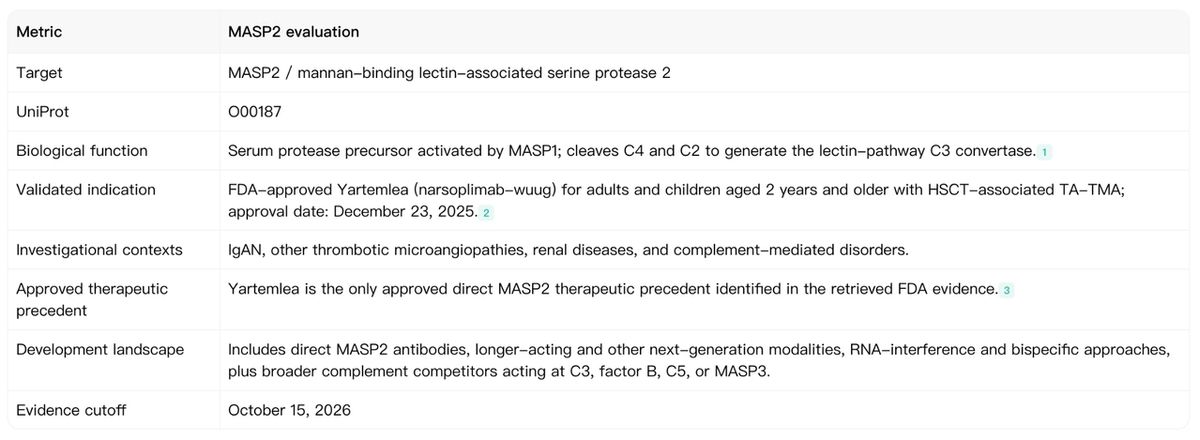
Biology Signal — MASP2 encodes MASP-2, a serine protease that cleaves complement proteins C4 and C2 after lectin-pathway recognition, helping form the C4b2a C3 convertase. Selective inhibition acts upstream of C3 and C5 while aiming to preserve classical- and alternative-pathway activity. That narrower mechanism could be useful when lectin-pathway activation is central to disease, but pathway selectivity does not establish clinical superiority or eliminate safety risks.
Validation Evidence — The FDA approved Yartemlea (narsoplimab-wuug) on December 23, 2025 for adults and children aged two years and older with hematopoietic stem-cell transplant-associated TA-TMA. In the pivotal open-label study of 28 adults, 61% met the TMA response definition. This is meaningful regulatory validation, but not randomized proof of superiority against existing care or other complement agents.
European interpretation differs. The EMA issued a negative opinion in June 2026, highlighting uncertainty arising from noncomparative evidence and related study limitations. Re-examination was requested; the reviewed public record did not establish a changed final recommendation at the evidence cutoff.
Competition and IP Pressure — The competitive landscape includes direct MASP-2 programs as well as mechanistically distinct complement approaches targeting C3, C5, factor B, or MASP-3. Those pathways differ in biological coverage and cannot be used as direct evidence of MASP2 efficacy. For potential entrants, antibody binding and engineering, delivery format, indication-specific claims, and patient-selection methods require targeted IP review.
Clinical Validation and Competitive Landscape
The key contrast is between a positive regulatory decision in TA-TMA and a negative phase III readout in IgAN. The ARTEMIS-IGAN interim analysis did not show a statistically significant reduction in proteinuria versus placebo, and the sponsor discontinued the trial. SHR-2010 demonstrated lectin-pathway pharmacodynamic inhibition in healthy volunteers, but its terminated phase II IgAN study has no publicly established reason for termination or reported IgAN efficacy outcome.
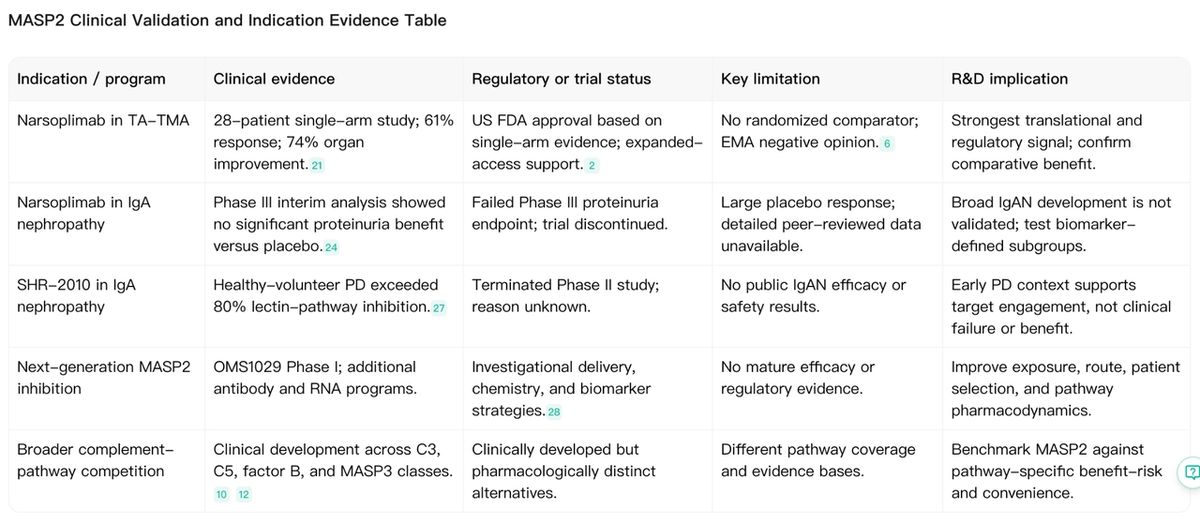
Interpretation: TA-TMA currently provides the clearest direct MASP2 clinical and regulatory precedent. IgAN illustrates why pathway involvement alone is insufficient to predict drug benefit; future renal programs need stronger disease segmentation and prospective biomarker validation.
IP and R&D Strategy Recommendation
Relevant IP review should address anti-MASP2 antibody composition and epitopes, antibody engineering, formulation and administration routes, TA-TMA methods of use, and renal indication or biomarker claims. Public patent disclosures are useful screening inputs, but they cannot establish freedom to operate, infringement, validity, or the remaining term of specific rights without legal analysis.
Advance. Prioritize TA-TMA and related endothelial-injury settings where lectin-pathway activity can be measured and clinical endpoints are prospectively testable. Favor development programs with credible improvements in dosing, exposure, or administration convenience.
Hold. Treat IgAN and other renal indications as biomarker-dependent hypotheses until randomized benefit is demonstrated. Consider selected populations and predefined lectin-pathway or endothelial-injury measures rather than broad, unselected enrollment.
Deprioritize. Avoid undifferentiated anti-MASP2 entrants and broad indication expansion based only on complement association. Separate MASP2 evidence from MASP3, C3, C5, and factor B evidence when evaluating competitive claims.
The most defensible MASP2 strategy is indication-led rather than target-led: build from clinically substantiated disease biology, establish meaningful differentiation, and test treatment benefit prospectively.
Evaluate MASP2 Indication-Specific Evidence with Noah AI
Use Noah AI to compare MASP2 clinical evidence across TA-TMA, IgA nephropathy, and other indications. Organize trial outcomes, assess evidence limitations, and identify biomarker and R&D gaps for indication-specific validation.
Evaluate MASP2 Evidence with Noah AI →
Free credits are available, and no credit card is required to get started. Learn more about Noah AI research workflows.