
How to Build a Multi-Database Literature Search Strategy with AI (2026)
Linda
Learn how to build a multi-database literature search strategy with AI. Compare PubMed, Scopus, and Web of Science, create search strings, and track searches.
A seven-step guide to choosing research databases, translating one question into valid search strategies, finding overlooked sources, and documenting what you actually searched.
Evidence cutoff: October 18, 2026 · Worked example: Home blood pressure telemonitoring
Finding sources for a literature review is not the same as collecting the first papers returned by Google Scholar or an AI assistant. A defensible search starts with a clear question, expands that question into searchable concepts, adapts the syntax to each database, and leaves a record another researcher could inspect.
In this tutorial, we used Noah AI, a life-science-focused research agent, to help draft and organize a multi-database search strategy. The example examines home blood pressure telemonitoring for adults with hypertension. We show the actual term matrix, database-query drafts, and search audit produced in the workflow. Importantly, the reported outputs are search plans, not proof that subscription databases were searched.
Start with Your Research Question, Not a Search Bar
Rather than asking AI to "find good hypertension papers," define what counts as relevant. We used the question below throughout this example:
Worked research question: In adults with hypertension, does home blood pressure telemonitoring, compared with usual care, improve blood pressure control?
| PICO element | Scope for this search |
|---|---|
| Population | Adults with diagnosed hypertension. |
| Intervention | Home blood pressure measurement with electronic transmission to a clinician, pharmacist, nurse, or monitoring service. |
| Comparator | Usual care or clinic-based management. |
| Outcome | Systolic blood pressure as the primary measure; diastolic pressure, control rate, and adherence as secondary measures. |
The distinction between self-monitoring and telemonitoring matters here. A device that saves readings locally is not necessarily transmitting them to a care team. Those two designs may appear under similar keywords but answer different questions. A structured question helps you identify those differences during screening.
Which Databases Should You Use for a Literature Review?
No database indexes every relevant source. Choose databases based on disciplinary coverage and the type of evidence you need—not only because an interface is familiar.
| Database | Why use it for this example? | Search consideration |
|---|---|---|
| PubMed / MEDLINE | Clinical studies, hypertension, primary care and biomedical evidence. | Combine MeSH, title/abstract terms and publication types; recent records may lack complete indexing. |
| Embase | Additional biomedical, pharmaceutical, device and conference coverage. | Uses Emtree; syntax and access depend on the platform. |
| Scopus | Multidisciplinary digital-health literature and citation discovery. | Uses field codes such as TITLE-ABS-KEY(); typically subscription-based. |
| Web of Science | Multidisciplinary coverage and cited-reference searches. | Topic searching uses TS=; collection selection changes coverage. |
| Google Scholar | Supplementary discovery, cross-disciplinary papers and public versions of articles. | Results and ranking are less reproducible; avoid relying on displayed totals. |
| Cochrane Library | Existing systematic reviews and controlled-trial discovery through CENTRAL. | Check which Cochrane collection is searched and document access limits. |
A practical starting combination for this question is PubMed plus another biomedical database where access permits, followed by Scopus or Web of Science for complementary coverage and citation searching. The exact combination should reflect the review type and access available to the researcher.
Step 1: Build Your Search Term and Synonym List
Start with concept groups, not one long sentence. For hypertension telemonitoring, the crucial concepts are hypertension, home blood pressure measurement, and remote transmission. Terms such as "RPM," "HBPM," "digital health," and "telehealth" can broaden discovery, but they are not perfect substitutes for one another.
We asked Noah AI to organize primary terms, synonyms, abbreviations, candidate controlled vocabulary, and verification status into a common matrix. The excerpt below shows what this produces:
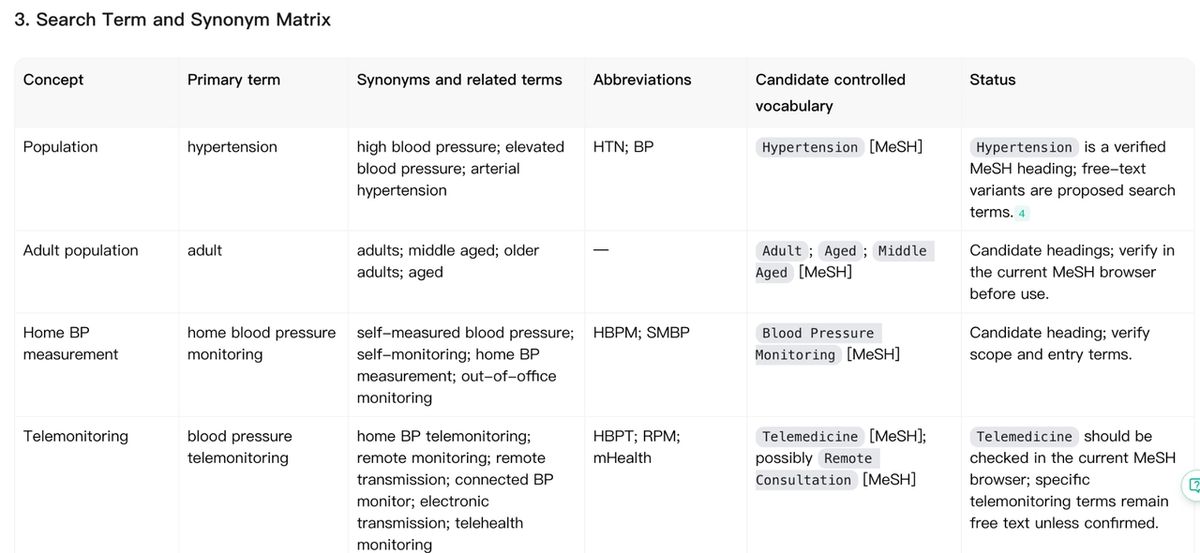
Two useful decisions follow from this table. First, hypertension and "high blood pressure" belong in the same concept block joined by OR. Second, an initial sensitive search should not automatically require an outcome or comparator term: some relevant abstracts do not explicitly mention them, even when the full study reports them.
Human check: A plausible term is not automatically a valid MeSH heading. Check the current MeSH Browser and inspect PubMed Search Details before adopting candidate indexed terms.
Step 2: Build and Test a PubMed Search
For biomedical literature, PubMed is a logical starting point. The search should combine synonyms with OR inside each concept and connect distinct concepts with AND. The sample below is a draft for testing, not a claim of an executed search.
Run the draft in PubMed Advanced Search, inspect its translation, and check whether it retrieves relevant studies already known to the researcher. If not, investigate indexing and terminology before adding more restrictive filters.
Use known papers as a search-quality check
Three verified source anchors were identified for this demonstration:
- TASMINH4 (PMID 29499873) — randomized trial including home BP self-monitoring with and without telemonitoring versus usual care.
- Automatic-transmission systematic review (PMID 36710899) — a review relevant to transmitted home BP data.
- Pharmacist-led telemonitoring review (PMID 37499595) — evidence about a particular care-delivery model.
Finding these records directly by PMID verifies their identity; it does not prove that the draft Boolean search retrieves all three. That must be tested in PubMed and documented. Also note that TASMINH4 included both self-monitoring alone and telemonitoring arms: those interventions should not be collapsed into one category.
Step 3: Adapt the Search for Scopus and Web of Science
The conceptual blocks can travel between databases; their syntax cannot simply be pasted unchanged. PubMed uses MeSH and field tags, whereas Scopus and Web of Science use different bibliographic search fields.
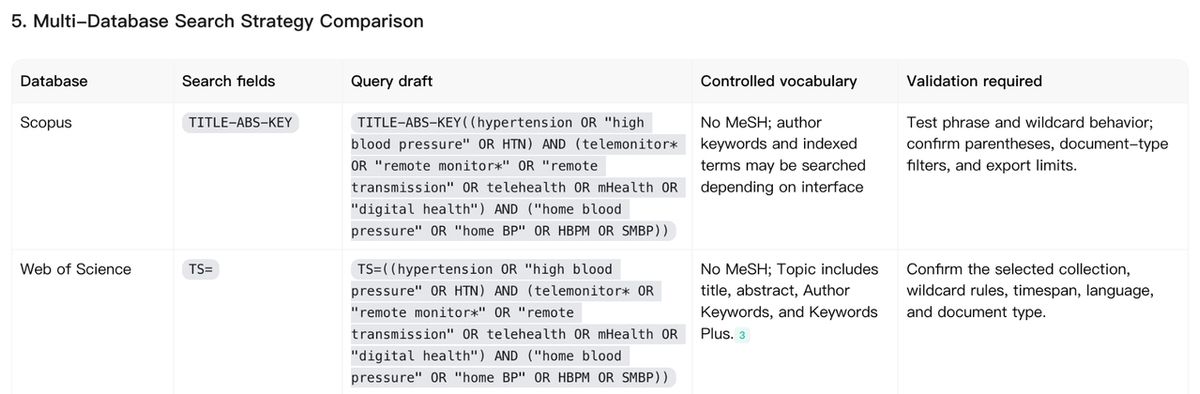
| Platform | Field syntax | What to verify |
|---|---|---|
| PubMed | [tiab], [Mesh], [pt] | MeSH validity, phrase handling, search translation and indexing status. |
| Scopus | TITLE-ABS-KEY(...) | Boolean nesting, wildcard behavior, search fields, filters and export coverage. |
| Web of Science | TS=(...) | Selected Core Collection, Topic coverage, timespan and wildcard behavior. |
| Embase | Platform-specific text fields and Emtree | Exact Emtree headings, search platform and field syntax before execution. |
For the complete database-specific query text, preserve the original Noah-generated search strategy as an editable working document. If a subscription platform is not available, label that search as not executed rather than presenting the draft as a completed search.
Step 4: Use Google Scholar to Look Beyond Indexed Database Results
Google Scholar is useful for broad orientation, exploring cited-by links and locating public versions of papers. It complements a structured database search but is less suitable as the sole reproducible search method.
For our example, a supplementary query might be:
Try separate searches with intervention variants such as remote patient monitoring and pharmacist-led telemonitoring. Record the exact phrases and date, screen the returned references, and verify each source in its original publication or registry. Do not treat Google Scholar's estimated result total as a reliable deduplicated record count.
How to Build a Better Literature Search String
The quality of a search usually improves when you distinguish several techniques that serve different purposes.
Boolean operators: AND, OR and NOT
- OR joins synonyms within a concept: hypertension OR "high blood pressure".
- AND joins concept groups: hypertension AND telemonitoring.
- NOT excludes terms but can remove useful papers. Apply it cautiously, only when exclusions are justified.
Truncation, phrase searching and field tags
In PubMed, an asterisk () can capture multiple term endings, as in telemonitor. Quotation marks can request phrases, but phrase searching and wildcards can change automatic term mapping. A PubMed field tag such as [tiab] restricts the search to titles and abstracts. Wildcard characters and phrase handling vary by database; do not assume ? works in PubMed as a universal one-character wildcard.
Controlled vocabulary: MeSH versus Emtree
MeSH terms help locate MEDLINE records even when authors use different words. Embase uses Emtree, which is a different vocabulary. In this example, Hypertension is a confirmed MeSH heading, while several suggested terms for telemonitoring or home monitoring still need a scope and indexing check. Controlled vocabulary and free-text terms are complementary, especially for newer records.
For a dedicated PubMed walk-through, see How to Search PubMed for a Literature Review with AI.
Build a Search Strategy with Noah AI
Use Noah AI to organize biomedical research questions, explore relevant literature, and develop source-linked research workflows. Start with free credits; no credit card required.
Step 5: Use Citation Networks When Keyword Searches Plateau
Once you have a small set of relevant seed papers, examine papers they reference (backward citation searching) and later papers that cite them (forward citation searching). This can uncover older foundational studies, terminology variants, and follow-up work that a phrase search misses.
For the hypertension example, the TASMINH4 trial is a useful seed. A researcher can inspect its reference list, look for subsequent papers citing it, and check whether alternative intervention names occur in those sources. Then feed genuinely relevant vocabulary back into the term matrix and rerun the search.
Tools such as ResearchRabbit specialize in visually exploring citation relationships. PubMed Similar Articles and citation databases can also support discovery. Noah AI can help reason about the source list and document proposed next searches, but this report did not establish that Noah performed a complete citation-network crawl or generated an equivalent graph.
Step 6: Look for Grey Literature and Unpublished Evidence
Journal articles are not the only relevant sources. The appropriate supplementary sources depend on the research question and type of review, particularly if unpublished or ongoing work could affect the picture.
| Source | Use in this example | Evidence caveat |
|---|---|---|
| ClinicalTrials.gov | Find registered, completed, ongoing, or unpublished telemonitoring trials. | Registry entries are not substitutes for independently verified publications. |
| Government / public-health reports | Find implementation guidance, policy context or technology standards. | Record issuing agency, date and research methods. |
| Institutional repositories | Find theses and accessible versions of reports or accepted manuscripts. | Check version, authorship and relationship to published papers. |
| Preprints | Discover recent results not yet peer reviewed. | Explicitly label as preliminary and inspect later journal versions. |
| Conference abstracts | Identify emerging studies and research programs. | Usually lack enough detail for strong trial-level conclusions. |
A good search log distinguishes where a source was discovered from what evidentiary status it holds. A registered study, an abstract and a peer-reviewed completed trial may relate to one project; they are not automatically three independent pieces of clinical evidence.
Step 7: Document Every Database Search and Its Verification Status
A search log should preserve the platform, exact query or query-version reference, date, filters, retrieval count when actually observed, and the next verification action. This is where the difference between drafted and executed research matters most.
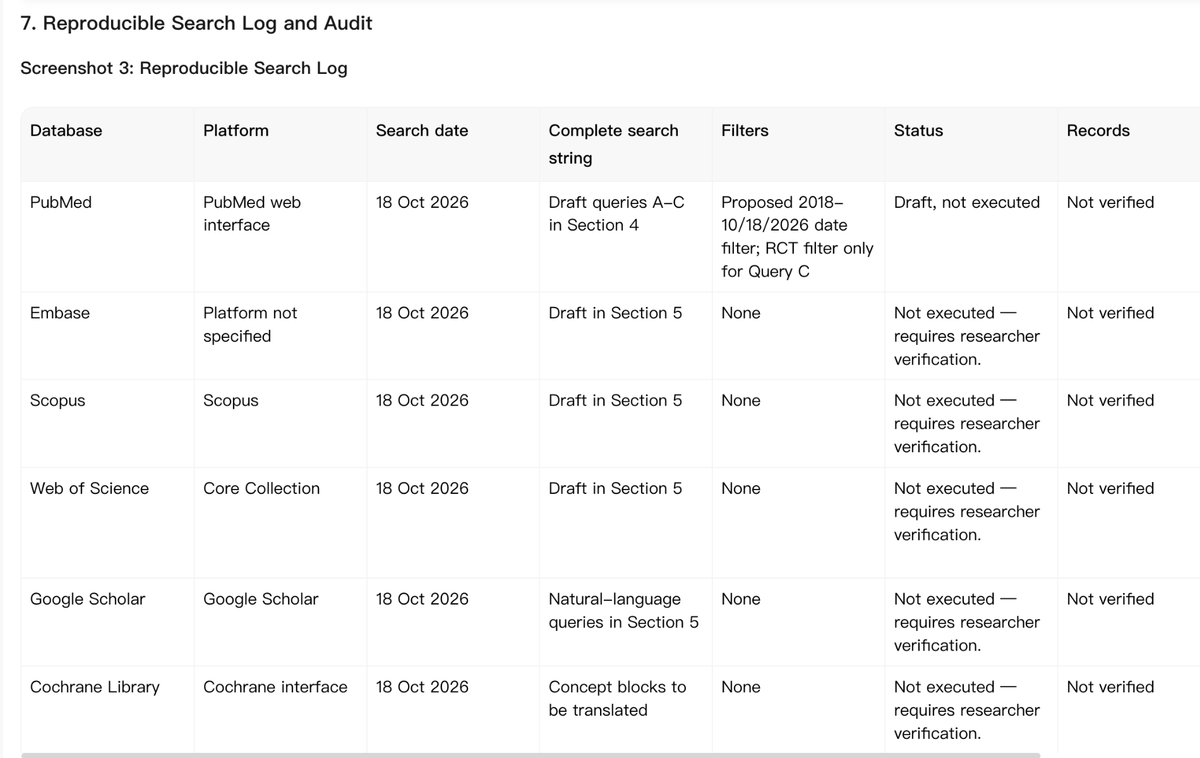
| Database | Search / record date | Query source | Status | Records | Next action |
|---|---|---|---|---|---|
| PubMed | 18 Oct 2026 | Draft A–C, source report §4 | Draft; not executed | Not verified | Execute and inspect Search Details; verify retrieval of known papers. |
| Embase | 18 Oct 2026 | Draft, source report §5 | Not executed | Not verified | Confirm platform, Emtree headings and field syntax before use. |
| Scopus | 18 Oct 2026 | Draft, source report §5 | Not executed | Not verified | Run Advanced Search and export records if access is available. |
| Web of Science | 18 Oct 2026 | Draft, source report §5 | Not executed | Not verified | Confirm collection, timespan and cited-reference search. |
| Google Scholar | 18 Oct 2026 | Natural-language draft, §5 | Not executed | Not verified | Record exact search and screened pages; verify individual records. |
| Cochrane Library | 18 Oct 2026 | Concept blocks pending translation | Not executed | Not verified | Search CENTRAL and reviews separately; preserve search history. |
How to turn this plan into a reproducible search: execute each query in the named platform; save the complete query text (not only "draft in section 5"), log the actual date and count, export records, deduplicate by identifiers and manual review, and update status from "not executed" only after the action occurred. The dates above are when the drafts were documented, not dates of confirmed searches.
Evidence boundary: We tested Noah AI's preparation of term matrices, database-specific query drafts and an audit plan. These results do not demonstrate completed searches in PubMed, Embase, Scopus, Web of Science, Google Scholar or CENTRAL, nor do they establish exhaustive coverage or systematic-review eligibility.
Common Literature Search Mistakes
- Searching one phrase in one database. Alternative terminology and index coverage can cause missed papers.
- Copying PubMed syntax to other databases. MeSH tags, field codes and controlled vocabularies are not portable.
- Adding restrictive outcome or age terms too soon. Relevant studies may be omitted when an abstract does not mention them.
- Treating candidate MeSH headings as validated terms. Check the official thesaurus and live query translation.
- Using AI-generated counts as completed results. A draft cannot supply an authentic retrieval count.
- Stopping after keyword results. Check references, later citations and appropriate grey literature.
- Failing to save search versions. A modified query should have a new dated log entry, not silently overwrite an earlier one.
Frequently Asked Questions
How many databases should I search for a literature review?
There is no universal minimum. Select databases based on the discipline, review type, and likely index coverage. A structured evidence synthesis typically requires more deliberate coverage than a short narrative assignment.
Is Google Scholar enough?
It is useful for exploratory and supplementary searches, but it does not replace more reproducible subject-specific database searches when completeness matters.
What is the difference between MeSH and keywords?
MeSH is standardized indexing used for MEDLINE records within PubMed. Keywords search actual words appearing in selected fields, including titles and abstracts. Combining them improves the chance of finding records with different terminology or indexing status.
Can Noah AI search Scopus or Web of Science for me?
In the workflow demonstrated here, Noah produced database-specific query drafts. We did not verify direct execution or access to those subscription databases. The queries should be run and checked in the relevant platforms by a researcher with appropriate access.
When should I use citation searching?
Once you have credible seed papers, follow references backward and citing papers forward to supplement keyword searching. Document exactly which connections were explored, rather than presenting a proposed network search as completed.
What makes a literature search reproducible?
Save the database and platform, search date, full query string, filters, actual retrieval count when available, exported records, and changes to the search strategy. Mark missing or unperformed parts clearly.
Final Takeaway: AI Helps Plan the Search; Researchers Verify It
A practical multi-database workflow moves from a focused question to synonyms, a subject-specific query, translated database strategies, broader discovery, citation searching, grey-literature review, and an auditable search log. In our hypertension telemonitoring example, Noah AI provided useful structure at each planning stage. It did not replace execution in the source databases or the researcher's judgment about completeness and inclusion.
For a related workflow focused on evaluating retrieved sources rather than designing searches, see How to Find Sources for a Research Paper with AI.
Try a Source-Grounded Research Workflow
Explore biomedical literature, clarify your research question, and organize evidence with Noah AI. Free credits are available when you start; no credit card required.