
Noah AI vs Anara for Cited Biomedical Literature Reviews (2026)
Linda
Compare Noah AI and Anara for cited biomedical literature reviews in 2026, with real Noah evidence screenshots, source verification, and clinical trial examples.
Both tools can support citation-based research writing, but they approach evidence from different starting points. Here we examine a real Noah AI Deep Research output on intravenous iron in heart failure, and compare it with Anara's documented library-to-review workflow—without presenting untested features as hands-on results.
Evidence cutoff: October 21, 2026 · Focused review: four randomized trials · Methods: Noah hands-on; Anara official documentation
Quick takeaway. Choose Noah AI when your task begins with a biomedical question and you want a structured, cited evidence brief across clinical trials. Consider Anara when you already have a curated library of papers and want a literature-review draft with references to passages in those documents. Neither workflow removes the need to check whether a cited study actually supports a claim.
The difference is more than having citations
In biomedical literature reviews, an inline reference is a starting point—not proof of scientific validity. Researchers must determine whether the citation identifies the correct publication, whether the reported endpoint is primary or secondary, and whether the paper actually supports the strength of the claim. A correctly linked trial can still be misinterpreted when its statistical threshold or population restrictions are overlooked.
Question-first — Noah AI
The tested Noah Agent session accepted a defined clinical question, retrieved source material, prepared a four-trial evidence table, and drafted claim-by-claim interpretation with PMIDs and limitations. These are observations from the example shown below.
Library-first — Anara
According to its official literature-review documentation, Anara drafts thematic, multi-section reviews from papers in a folder, with citations intended to link to specific source passages. This article does not include an independent Anara report run.
What a Cited Biomedical Literature Review Should Preserve
For a review to be useful to medical researchers, the quality of the evidence trail matters more than prose length. We used the following questions to assess the displayed Noah example and to frame the Anara workflow comparison.
01 · Study identity — Can the reader trace a claim to the original trial, PMID, DOI, or source passage?
02 · Endpoint integrity — Are primary outcomes, component outcomes, and sensitivity analyses clearly separated?
03 · Interpretive restraint — Does the draft preserve uncertainty, eligibility criteria, and prespecified statistical rules?
A focused narrative review of four selected randomized trials is not the same as a systematic review. Unless a reproducible search, screening, bias assessment, and appropriate synthesis have been performed, it should not be described as PRISMA-compliant or comprehensive.
Noah AI vs Anara: Side-by-Side Comparison
| Comparison area | Noah AI | Anara |
|---|---|---|
| Typical starting point | Biomedical research question or defined evidence task | Existing papers organized in a research library or folder |
| Literature review output | In this test: trial table, evidence synthesis, claim-by-claim source audit | Officially documented: multi-section draft arranged by theme from library papers |
| Source traceability | PMIDs and linked references visible in tested output | Official documentation describes clickable, source-passage citations for papers in the library |
| Best suited task | Focused biomedical evidence synthesis from a question | Writing and revising against a curated paper collection |
| Scientific verification | Manually check each cited trial and the interpretation of outcomes | Manually inspect the cited PDF passage and contextual meaning |
| Evidence in this article | Directly demonstrated by three actual screenshots | Officially documented; no independent Anara execution |
This table compares workflow orientation and documented capabilities. It does not claim measured differences in accuracy, recall, speed, or citation error rates.
Is Anara Free in 2026?
Anara's official pricing page lists a $0 Free plan with limited AI usage and uploads and no credit card requirement. Its August 2026 usage update describes an included AI usage meter that refreshes daily for Free users. Higher plans expand usage and document limits; the official plan comparison places dedicated PubMed and ClinicalTrials.gov connectors in paid tiers. Plan availability and limits may change.
For a user who already has research PDFs, Anara's free entry point may be useful for exploring a library-based workflow. But availability of a free plan does not demonstrate that a particular four-paper review can be completed within its remaining usage allowance.
Noah AI in Practice: Four Intravenous-Iron Trials in Heart Failure
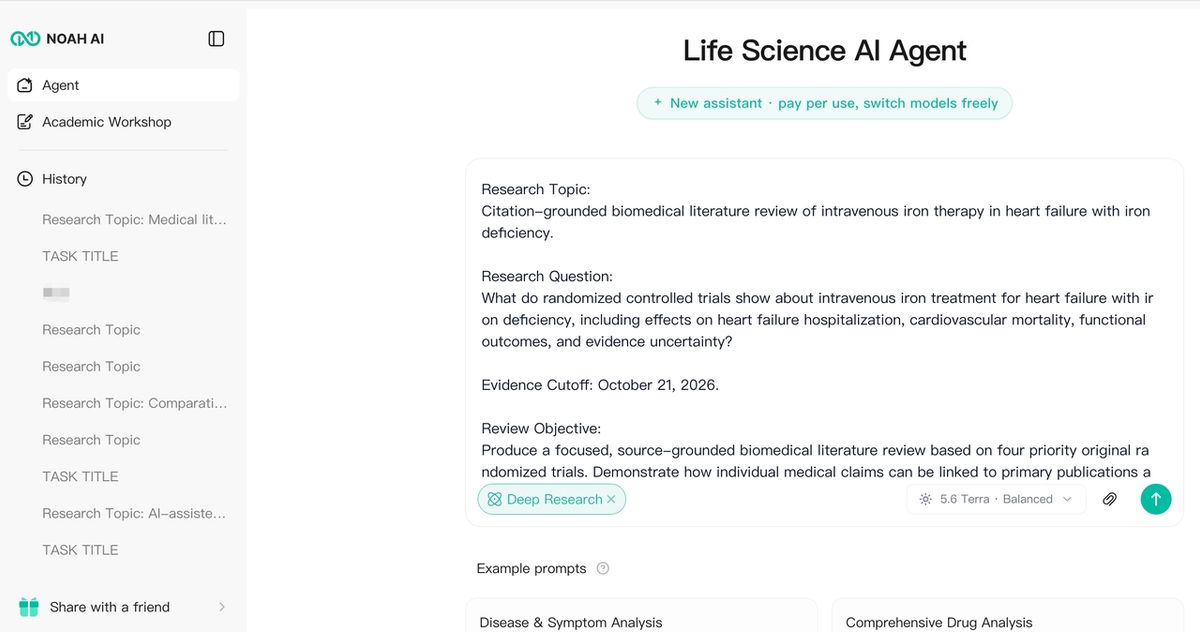
We used a focused clinical question: What do randomized controlled trials show about intravenous iron in patients with heart failure and iron deficiency, including hospitalization, cardiovascular mortality, and functional outcomes? The specified sources were AFFIRM-AHF, IRONMAN, HEART-FID, and FAIR-HF2. The evidence cutoff was October 21, 2026.
4 priority randomized trials · 3 screenshots from one Noah run · 0 unsupported Anara test claims
Step 1 — Start with a source-aware medical question
The input asked Noah to distinguish trial populations, interventions, primary outcomes, and significance thresholds while retaining source identifiers. The actual interface shows Deep Research selected.
Step 2 — Summarize trials without collapsing their differences
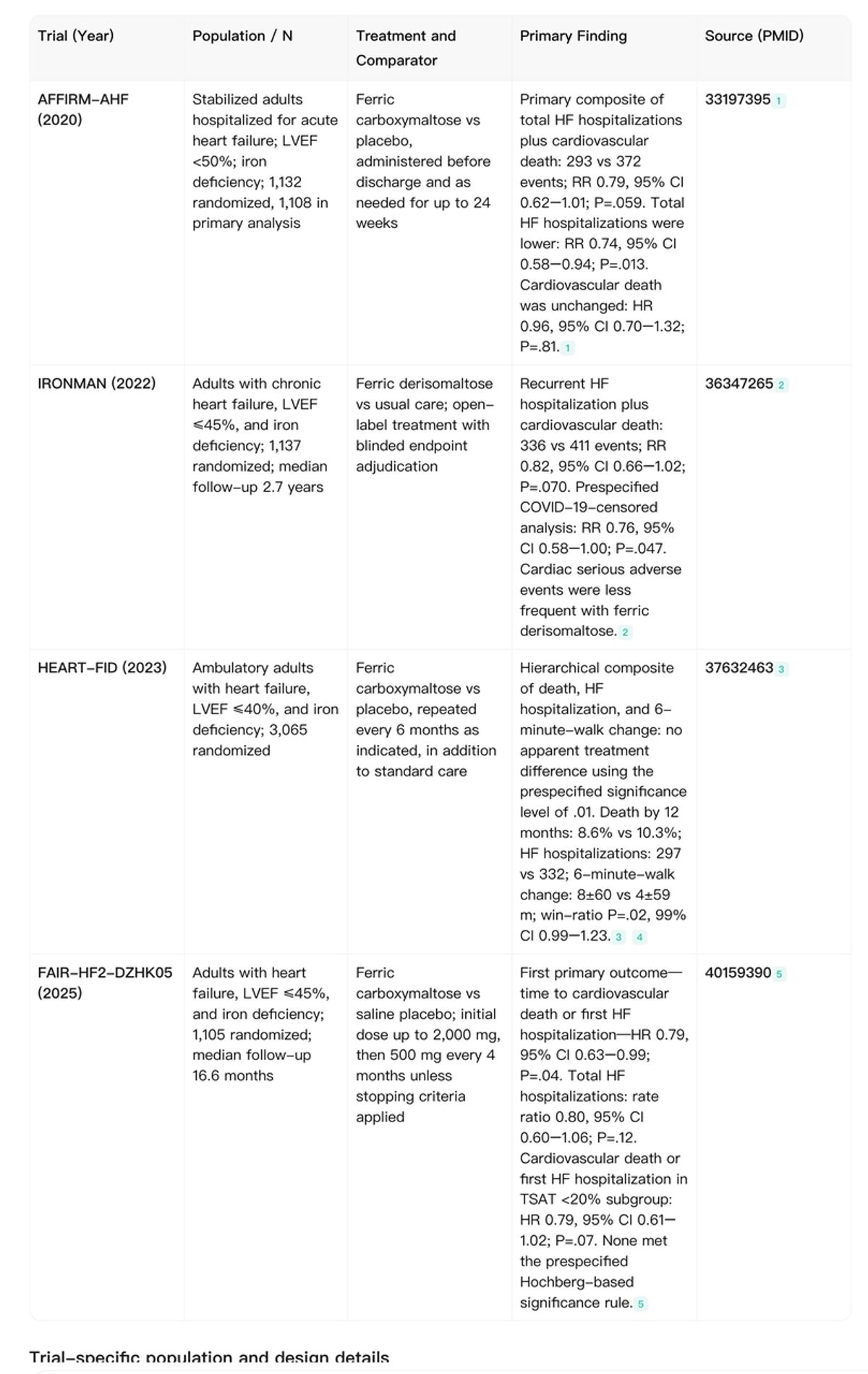
The resulting Four-Trial Cited Evidence Comparison organized the selected RCTs by population, treatment, primary finding, and PMID. These are not interchangeable experiments: AFFIRM-AHF enrolled patients stabilized after acute heart-failure hospitalization; IRONMAN used ferric derisomaltose and usual care; HEART-FID used a hierarchical composite; and FAIR-HF2 applied a multiplicity-adjusted decision rule.
What the cited trials actually reported
AFFIRM-AHF (2020) — Among patients stabilized after an acute heart-failure episode, ferric carboxymaltose produced fewer total heart-failure hospitalizations than placebo (217 vs 294; rate ratio 0.74, 95% CI 0.58–0.94; P=.013). However, the primary composite of total HF hospitalizations and cardiovascular death did not meet conventional statistical significance (RR 0.79; P=.059). The distinction matters when summarizing the study. Original trial · PMID 33197395 ↗
IRONMAN (2022) — The primary recurrent-HF-hospitalization-plus-cardiovascular-death outcome favored ferric derisomaltose numerically but did not reach conventional significance (RR 0.82, 95% CI 0.66–1.02; P=.070). A prespecified analysis censoring follow-up during the COVID-19 period produced RR 0.76 (P=.047), but a sensitivity analysis is not interchangeable with the main result. Original trial · PMID 36347265 ↗
HEART-FID (2023) — The hierarchical outcome combined death, HF hospitalization, and six-minute-walk distance. Its reported P value was .02, but the trial had set a prespecified significance threshold of .01. The appropriate summary is therefore that the primary hierarchical endpoint did not meet its formal statistical criterion—not that the trial proved efficacy. Original trial · PMID 37632463 ↗
FAIR-HF2 (2025) — The cardiovascular-death-or-first-HF-hospitalization comparison had a nominal P=.04, but the trial evaluated three primary comparisons using a predefined Hochberg-type multiple-testing rule. The reported P values (.04, .12, and .07) did not satisfy that prespecified success rule. An AI-generated summary that reports only the P=.04 result would be misleading. Original trial · PMID 40159390 ↗
The figures above are source-reported trial findings, not pooled estimates. Relative-effect estimates, study populations, endpoints, follow-up, and iron formulations differ and should not be used to create an indirect treatment ranking.
Step 3 — Check the claim, the source, and the statistical rule
For the cited-review question, the most useful part of this run is the Citation-Grounded Interpretation section. Rather than treating a citation as enough, the output puts the medical claim next to its PMID, verification basis, and limitation. The example below distinguishes HEART-FID's P=.02 from its required P≤.01, and FAIR-HF2's nominal P=.04 from its multiplicity rule.
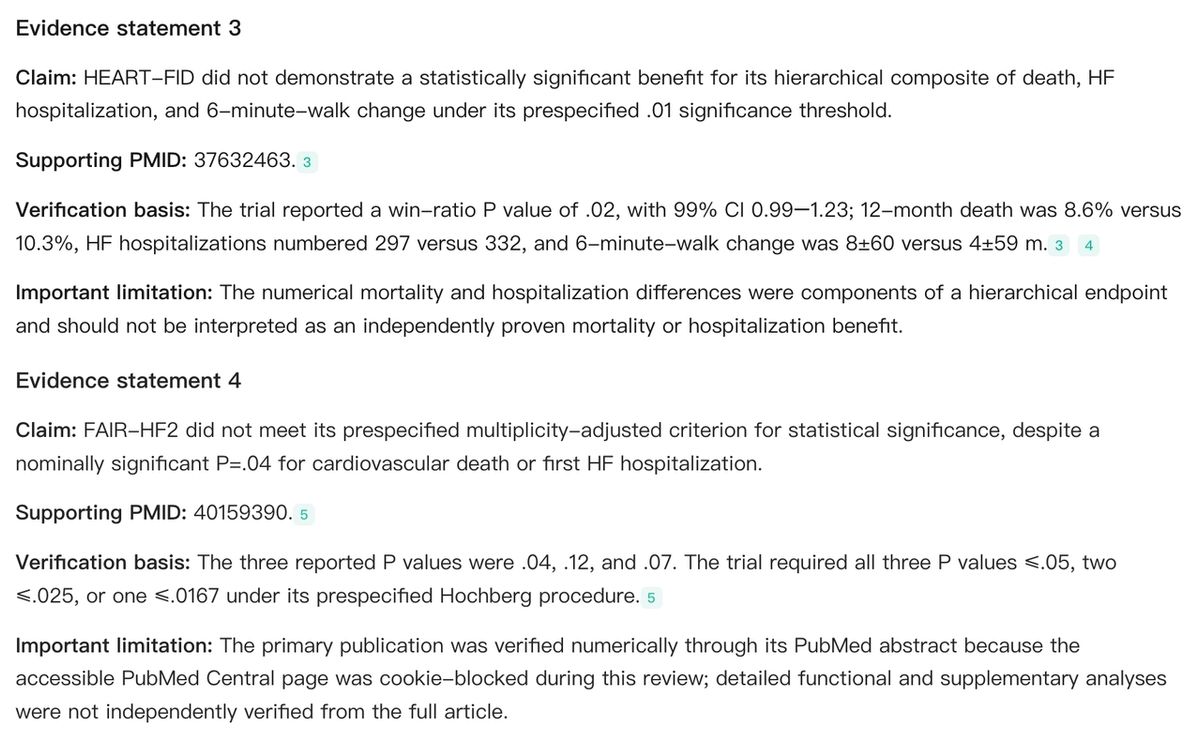
What this example establishes: Noah produced a structured, cited clinical evidence review in this specific run. It does not establish a universal citation accuracy rate, full-text verification of every claim, or superiority over Anara. The reviewed source trail should still be checked by a researcher.
Turn a biomedical question into a cited evidence brief
Use Noah AI to organize trial findings, source identifiers, interpretation limits, and a reviewable first draft—then verify the original publications before using the findings.
Start a research report with Noah AI →
Anara: Drafting from a Curated Research Library
Anara describes a different workflow in its official guide. The researcher organizes papers into a folder, instructs the assistant to use the library, and requests a thematic literature-review draft with inline references to passages in those documents. The documentation also recommends flagging claims that are unsupported by the selected collection.
That is a meaningful capability for researchers who want to draft and revise against a known set of PDFs. It differs from asking an agent to investigate a biomedical question and produce a trial-centered evidence brief.
Testing disclosure: We did not run the four heart-failure papers through Anara for this article. Its workflow description is based on Anara's official documentation, and no Anara result screenshot is represented as a tested output. Therefore, this is not a matched-output accuracy benchmark.
Where Anara May Fit Better / Where Noah May Fit Better
Where Anara may fit better:
- Working from an established set of papers that the author has already screened.
- Building a narrative or dissertation-style literature-review draft organized by theme.
- Opening a cited source passage to examine surrounding context, provided the relevant PDF content is available in the library.
- Iteratively restructuring a written review without moving away from the selected paper collection.
Where Noah may fit better:
- Beginning with a focused biomedicine or clinical evidence question rather than an existing document folder.
- Requesting a compact study-by-study table with original source identifiers.
- Organizing primary results, sensitivity analyses, and statistical interpretation limits for a research brief.
- Producing an evidence-first starting point for subsequent medical or pharmaceutical research work.
How to Verify a Cited Medical AI Review
Whether the draft comes from Noah, Anara, or another research tool, a reliable review needs a reproducible manual check. The four-trial case illustrates why seemingly small distinctions change the conclusion.
| Check | Question to ask | Example from this case |
|---|---|---|
| Paper identity | Is the citation linked to the right original trial? | Verify trial name and PMID for each claim. |
| Primary endpoint | Was the reported benefit the prespecified primary test? | AFFIRM-AHF's hospitalization component differed from the overall composite. |
| Significance criteria | Did the result meet the trial's prespecified threshold and multiplicity procedure? | HEART-FID: P=.02 vs threshold .01; FAIR-HF2: nominal P=.04 vs adjusted decision rule. |
| Analysis status | Is the result a primary analysis or sensitivity analysis? | IRONMAN's COVID-19-censored result must be separately labeled. |
| Study comparability | Are population, intervention, control, and follow-up comparable? | Different IV iron formulations, recruitment settings and endpoint hierarchies. |
| Source accessibility | Did the AI or reviewer inspect the full text or only the abstract? | Abstract-based claims should be explicitly identified as such. |
The purpose of this workflow is not to discourage AI-assisted review writing; it is to keep the final language proportional to the cited evidence.
Can You Use Noah AI and Anara Together?
Potentially. A researcher can use Noah to form an initial evidence brief and identify pivotal trials, then collect eligible papers in a library for a more detailed Anara drafting workflow. The draft still requires independent source and interpretation review. This combination is a plausible manual workflow, not an automatic integration or tested transfer between the two products.
Final Takeaway
If the difficult part is moving from a biomedical question to a structured, source-aware clinical evidence synthesis, the Noah workflow shown here is directly relevant. If the difficult part is drafting and revising a narrative review against a collection of papers you already possess, Anara's documented library-first workflow is relevant.
Neither a polished report nor an inline reference is enough by itself. The most important step remains verifying how a publication supports the exact words of the conclusion—especially when trials use different endpoints or statistical decision rules.
Build Your Next Evidence-First Literature Review
Start with a focused biomedical question, preserve the primary sources and make the boundaries of the evidence explicit.
FAQ
Is Anara an alternative to Noah AI for biomedical literature reviews?
Yes, their research writing use cases overlap. Anara emphasizes drafting from organized paper collections, while the Noah example here demonstrates question-led clinical evidence synthesis with a trial table and a citation audit. The suitability depends on the task and the sources available.
Does Anara provide clickable citations?
Its official literature-review documentation describes citations linking to specific passages in source PDFs held in the user's library. That should not be interpreted as a guarantee that every imported record has readable full text or a verifiable passage.
Can Noah AI generate a cited medical research report?
In the example shown here, Noah generated a four-study comparison and claim-level evidence statements with PMIDs and source references. The citations and conclusions still require review against the original studies.
Which tool is more accurate?
We did not run a controlled head-to-head benchmark. A valid accuracy comparison would require matching source sets, tasks, evaluation criteria and blinded review of factual and citation errors. This article does not make an accuracy ranking.
Is Anara free?
Anara advertises a free plan with limited AI usage and uploads. Advanced capacity and dedicated database connectors appear in paid plans. Check the current official pricing page before choosing a tier.
Can either tool replace a systematic review?
No. A generated narrative review alone does not establish comprehensive search coverage, duplicate screening, risk-of-bias assessment, or PRISMA compliance. Those procedures require a separately documented research protocol and researcher oversight.
Original Evidence and Product Documentation
- AFFIRM-AHF (2020) — PMID 33197395. Ferric carboxymaltose after acute heart-failure hospitalization.
- IRONMAN (2022) — PMID 36347265. Ferric derisomaltose and recurrent HF outcomes.
- HEART-FID (2023) — PMID 37632463. Hierarchical clinical and functional endpoint.
- FAIR-HF2 (2025) — PMID 40159390. Co-primary outcomes and multiplicity-adjusted statistical rules.
- Anara — Write a literature review (official workflow documentation).
- Anara — Pricing and plan features and 2026 usage update.
Research and publication disclaimer. This article is for research workflow education, not medical advice. A focused comparison of four trials is not an exhaustive review of intravenous iron in heart failure, a clinical guideline, or a head-to-head product performance test. AI-generated evidence summaries require verification of original sources, trial endpoint hierarchies, and interpretation limits before use in clinical or scientific decisions.
Related: How to Use Noah for Medical Literature Review · AI Tools for Cited Literature Review Reports