
Noah AI vs AnswerThis for Literature Review Generation (2026)
Linda
Compare Noah AI vs AnswerThis for literature review generation in 2026, including biomedical evidence synthesis, citations, and real workflow screenshots.
A useful AI-generated literature review needs more than fluent paragraphs. It needs a defensible selection of studies, traceable citations, a synthesis of agreement and disagreement, and clear limits on what the studies establish.
Noah AI and AnswerThis approach academic research through different interfaces and capabilities. Noah AI offers a biomedical-focused Agent workflow, while AnswerThis documents literature review generation, research search, citation management, and writing tools. This guide compares their documented workflows and shows screenshots from a single biomedical topic rather than claiming a controlled performance benchmark.
Evidence and product information checked: October 20, 2026 · Research example: adjuvant CDK4/6 inhibitors in early breast cancer · Reading focus: workflow, citations, clinical interpretation
Quick Takeaway: Noah AI or AnswerThis?
Consider Noah AI when you want a biomedical question developed into a structured, source-aware research synthesis that explicitly explains trial populations, contrasting results, endpoint maturity, and limits to cross-trial conclusions. The Noah screenshots below show that workflow applied to four oncology trials.
Consider AnswerThis when you need an academic research environment oriented around literature search, review drafting, citation styles, paper libraries, and writing. Those capabilities are described in AnswerThis's official literature review guide. The AnswerThis test screenshot supplied for this article documents its Research Agent query and source pane, not a finished cited literature review.
How this comparison was made. Noah AI was used in Agent / Deep Research with a focused oncology prompt and returned a trial overview plus literature-style synthesis. The AnswerThis screenshot came from its logged-in Research Agent using the same general question; it shows the query and source discovery, but no complete review body in the captured frame. These are not equivalent product modes or a blinded accuracy test. Observations are kept separate from vendor-documented functionality.
What Is AnswerThis, and Is It Free in 2026?
AnswerThis describes itself as an academic AI research assistant with tools for searching scholarly work, generating literature review text, exploring citations, managing a library, and editing academic drafts. Its literature review product page promotes citation-backed generation, while the AI Writer page describes writing and citation workflows.
According to the official pricing page, AnswerThis has a $0 entry plan with no credit card required and paid plans for broader usage and advanced review features. Because its current pricing page displays more than one feature and tier matrix, check the live plan terms for the exact limit relevant to your account rather than assuming a fixed number of full reviews.
There is also a separate public Literature Review Generator preview. It generates an outline and one cited opening paragraph from accessible scholarly abstracts; it explicitly does not generate a complete review. The screenshot used in this article is from the logged-in Research Agent, not that public preview page.
Noah AI vs AnswerThis: Side-by-Side Comparison
| Workflow Area | Noah AI | AnswerThis |
|---|---|---|
| Primary fit | Biomedical research question → evidence synthesis | Academic literature search, review drafting, and citations |
| Documented starting point | Research question submitted to Agent / Deep Research | Literature Review / Research Agent question or paper-library workflow |
| Visible test output | Trial comparison and review-style synthesis with source markers | Submitted question and source-discovery pane; final review text not visible in the screenshot |
| Review writing | Demonstrated in the supplied oncology report | Documented by its literature review and AI Writer product pages; not verified in the supplied screenshot |
| Clinical source checking | Requires verification of trial endpoints, follow-up and interpretation | Requires checking cited studies and matching citations to claims |
| Best reason to choose | A structured medical evidence brief and cross-study interpretation | A paper-and-writing-centered academic workspace |
This table compares observed workflows and officially documented features. It does not measure search recall, factual accuracy, generation speed, or citation precision across matched configurations.
What Makes Biomedical Literature Review Generation Difficult?
A generated review can look polished while misrepresenting the evidence. Clinical studies may differ in eligibility criteria, therapies, treatment duration, outcome definitions, assessment dates, and analysis maturity. Even papers about the same drug class may not answer the same research question.
For this example, we selected four phase III programs of adjuvant CDK4/6 inhibition in hormone receptor-positive (HR-positive), HER2-negative early breast cancer: monarchE, NATALEE, PALLAS, and PENELOPE-B. The studies are especially useful for reviewing both supportive and nonsupportive evidence without assuming that different agents, populations, and trial designs are interchangeable.
For an evidence-grounded review, the essential steps are to identify the underlying trials, distinguish later updates from independent studies, synthesize both positive and negative findings, and separate invasive disease-free survival (iDFS) from overall survival (OS) claims.
Noah AI Output: From a Research Question to a Literature Review
Step 1 — Define the question and evidence scope
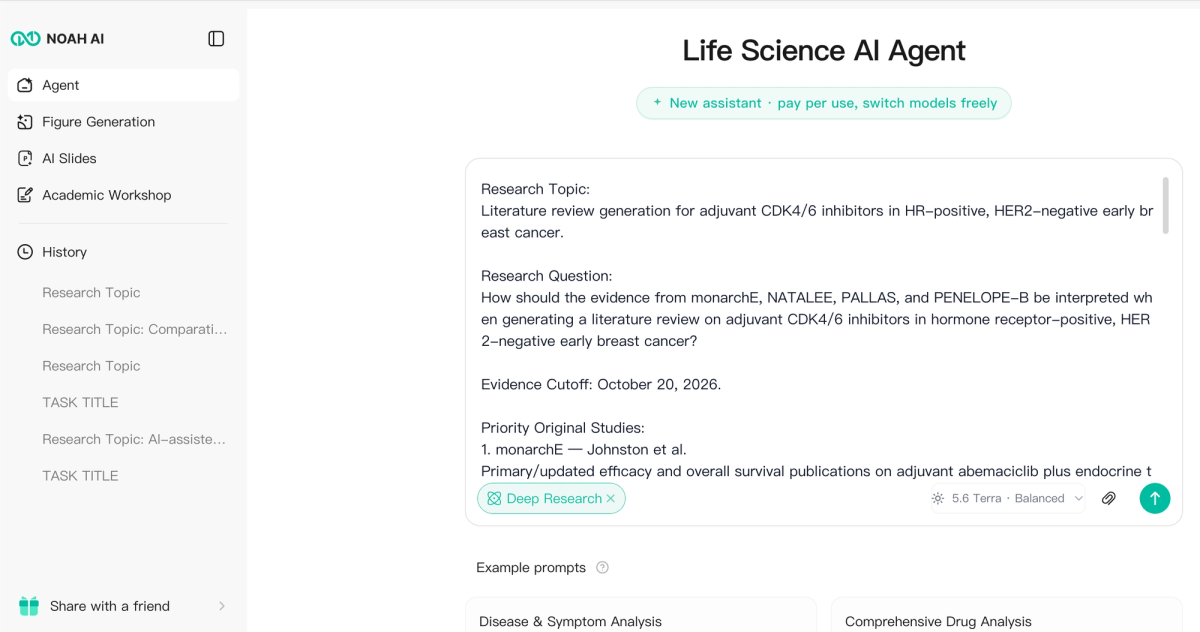
We entered a question about how the results of the four CDK4/6 studies should be interpreted in a literature review. The prompt requested trial comparison, cross-study interpretation, research gaps, and a cautious review-style synthesis. The visible input also included an evidence cutoff of October 20, 2026.
Step 2 — Organize the four trial programs
The Noah report generated a Trial Overview Table with separate rows for monarchE, NATALEE, PALLAS, and PENELOPE-B. It differentiated study eligibility, endocrine-therapy backbone, CDK4/6 agent, treatment duration, and efficacy follow-up. Those distinctions matter more than an unsupported simple ranking of drugs.
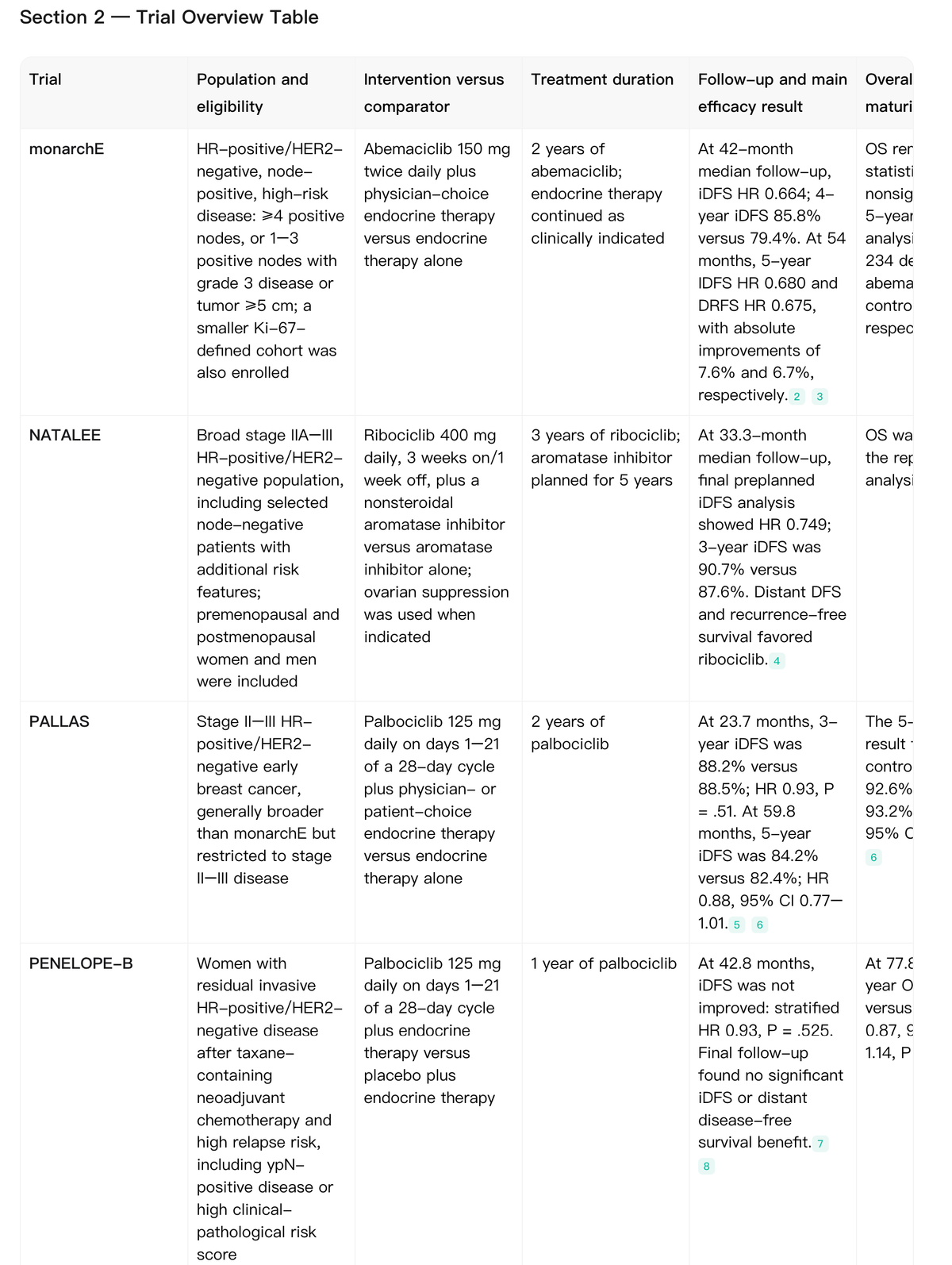
Trial-specific outcomes should be kept in their proper context. The table below is an editorial verification against later primary reports, not a claim that every value was visible in the screenshot.
| Trial | Intervention and population | Relevant published finding by the cutoff | Primary source |
|---|---|---|---|
| monarchE | Abemaciclib + endocrine therapy in node-positive, high-risk early disease | Updated OS analysis: HR 0.842 (95% CI 0.722–0.981); 7-year OS 86.8% vs 85.0% | [PMID 41110697](https://pubmed.ncbi.nlm.nih.gov/41110697/) |
| NATALEE | Ribociclib + nonsteroidal aromatase inhibitor in a broader stage II–III population | 5-year update: iDFS HR 0.716 (95% CI 0.618–0.829); OS still maturing | [PMID 41320342](https://pubmed.ncbi.nlm.nih.gov/41320342/) |
| PALLAS | Palbociclib + endocrine therapy in stage II–III disease | 5-year iDFS 84.2% vs 82.4%; HR 0.88 (95% CI 0.77–1.01), not statistically significant | [PMID 41110701](https://pubmed.ncbi.nlm.nih.gov/41110701/) |
| PENELOPE-B | Palbociclib + endocrine therapy in residual high-risk disease following neoadjuvant chemotherapy | Final survival update: 6-year OS 82.4% vs 80.3%; HR 0.87 (95% CI 0.67–1.14), not statistically significant | [PMID 40139460](https://pubmed.ncbi.nlm.nih.gov/40139460/) |
Editorial evidence check: these are within-trial estimates at different follow-up horizons, not comparable head-to-head efficacy scores. Updated reports of a trial are not counted as separate randomized trials.
Step 3 — Generate a cross-study literature synthesis
The most relevant Noah output for this article is the Literature Review Style Synthesis section. Rather than listing isolated abstracts, it discussed why the positive results of monarchE and NATALEE should be interpreted alongside the nonsupportive findings from PALLAS and PENELOPE-B. It also noted distinctions in population risk, drug choice, dose, treatment duration, and clinical applicability.
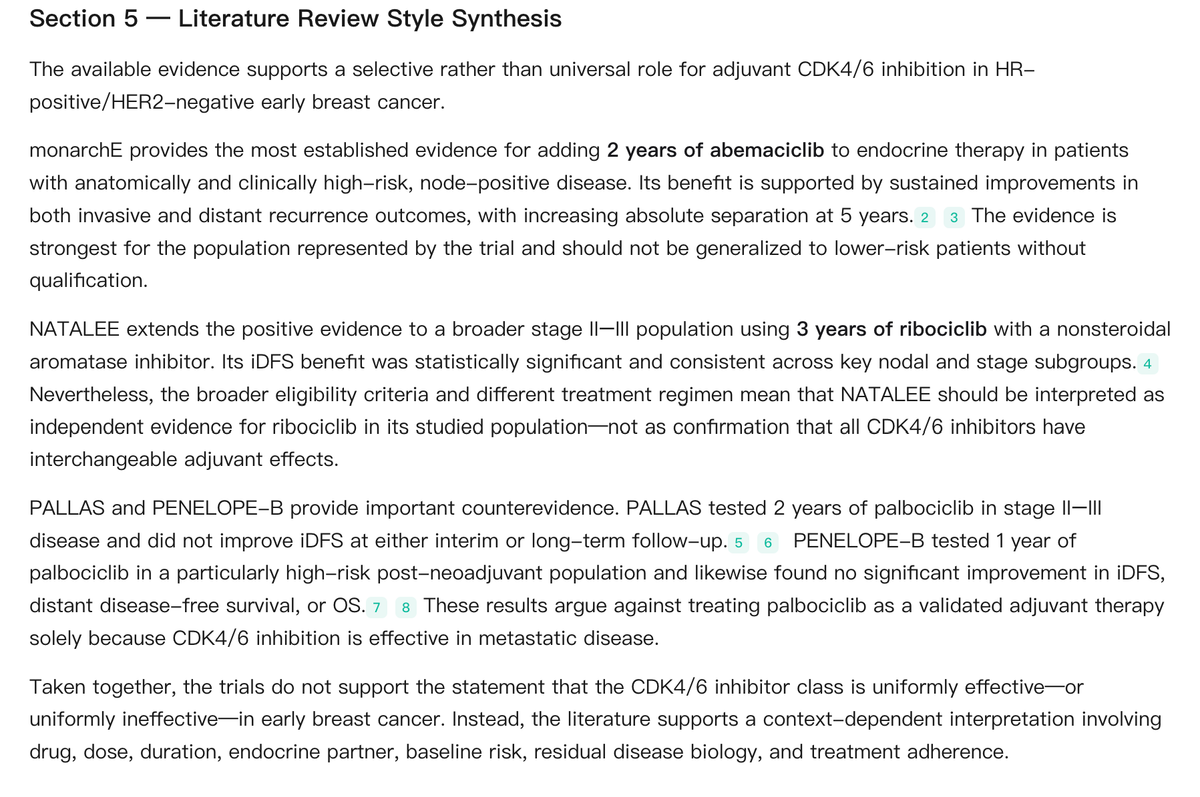
This distinction is important: a polished paragraph is only a draft until its underlying studies, endpoint estimates and clinical boundaries have been checked. The report's earlier survival-maturity language should not be reused without consulting the later monarchE and NATALEE analyses cited above.
Build a Source-Aware Biomedical Literature Review with Noah AI
Start with a focused oncology or medical research question, then review the study comparison, source citations, and cross-paper synthesis before drafting your own conclusions.
Free Credits Available · No Credit Card Required · Research outputs require human verification
AnswerThis Output: What the Supplied Research Agent Screenshot Shows
The same CDK4/6 research topic was submitted in AnswerThis. The supplied image is from the logged-in Research Agent and includes the request in the conversation pane, a research activity area, and a source pane identifying a PENELOPE-B publication.
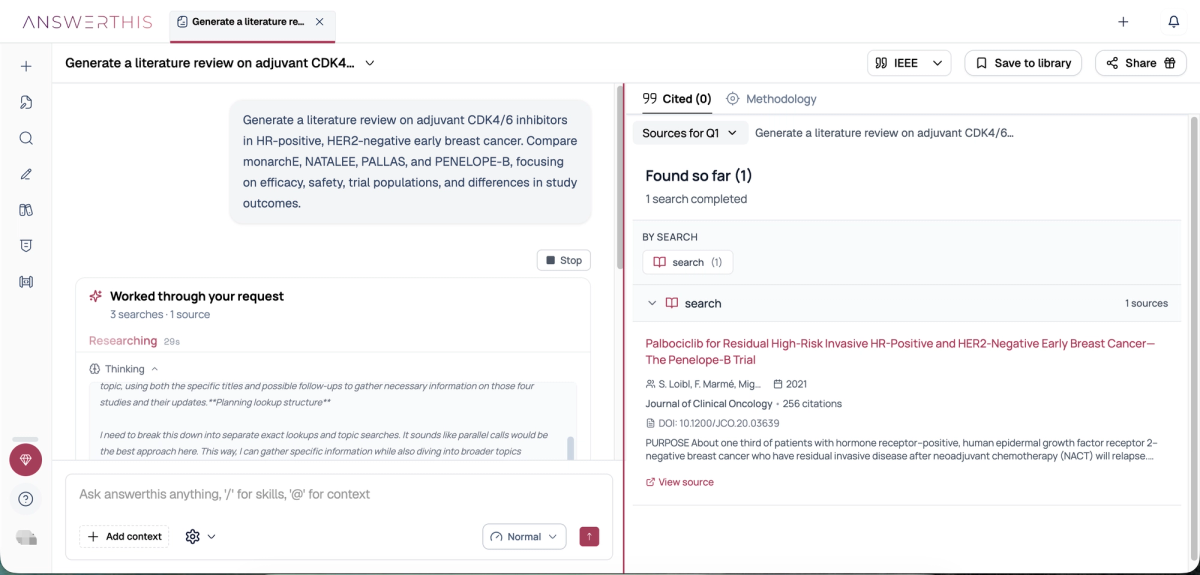
In the frame provided, the source panel shows a single visible paper record and the on-screen counter reads "Cited (0)". The workflow also displays research activity. The tester reported that the session had ended; however, a finished citation-backed review is not visible in this screenshot. It would therefore be inaccurate to describe this image as a successful full-review output or to use it to measure AnswerThis's general generation quality.
That limitation is about the evidence available for this comparison, not proof that AnswerThis lacks review generation. AnswerThis's official guide documents citation-linked literature-review summaries, while the product page describes full review drafting. To compare completed outputs fairly, both platforms would need finished reviews from comparable modes, followed by independent checks of source selection and citation support.
What Can We Actually Learn from the Two Workflows?
| Evidence Question | What the Screenshots Support | What Remains Unverified |
|---|---|---|
| Can the tools accept a complex oncology question? | Yes—both submitted interfaces display the CDK4/6 question. | Whether either platform always handles every detailed research instruction correctly. |
| Was a structured review produced? | Visible in the Noah report as a trial table and narrative synthesis. | Not visible for AnswerThis in the supplied capture. |
| Were academic sources surfaced? | Noah output includes source markers; AnswerThis source pane displays a scholarly paper. | Completeness, citation accuracy and paper-level recall for either platform. |
| Can we conclude one tool is more accurate? | No. The screenshots show different interfaces and output states. | A matched-mode, independent source and claim audit. |
In particular, neither screenshot set establishes a systematic review, PRISMA-compliant selection process, comprehensive database recall, or the ability to substitute for clinical literature appraisal.
When Should You Use Noah AI?
- Your main task is a biomedical evidence question, not simply drafting general academic prose.
- You need a review organized around original trial programs, study eligibility and endpoints.
- You want the output to distinguish contradictory findings and state interpretation limits.
- You are prepared to verify current publications and correct any outdated trial follow-up statements.
When Should You Use AnswerThis?
- You prefer an academic workspace centered on literature search, reference handling and writing.
- You want citation styles, source inspection and literature-review drafting features documented by the platform.
- You are preparing a dissertation, thesis, or paper and want a writing-oriented interface alongside research discovery.
- You can inspect the actual generated review and validate the cited sources before reuse.
AnswerThis should not be dismissed as a mere search engine: its official materials describe literature review generation and academic writing features. The available single screenshot simply does not demonstrate the final text for this particular run.
Can You Use Noah AI and AnswerThis Together?
Yes, as a manual workflow. A researcher could use Noah to frame a biomedical evidence question and construct an initial source-aware trial synthesis, then use AnswerThis's paper search, citation and writing tools for an academic draft. The final draft should be checked against the full articles, especially where updated follow-up results have changed what can be concluded.
This is a suggested way to use the tools, not a claim that the platforms are directly integrated or that one automatically transfers data into the other.
Final Takeaway
Noah AI and AnswerThis both target parts of the literature review workflow, but the practical choice depends on what you need to produce. The screenshots supplied here show Noah developing a four-trial oncology question into a structured trial overview and literature-style synthesis. They show AnswerThis receiving the related research question and displaying a retrieved scholarly source, without a complete review text in the captured frame.
That is a useful workflow observation, not evidence that one product is universally superior. For biomedical work, the decisive standard should be whether the generated review preserves original trial evidence, distinguishes changing endpoints and follow-up, and allows every important claim to be audited.
Turn Your Next Medical Research Question into a Reviewable Evidence Brief
Explore Noah AI for structured biomedical literature research, trial comparisons and source-aware synthesis. Review the sources and conclusions before publication or clinical use.
Start Researching with Noah AI →
Free Credits Available · No Credit Card Required
FAQ
Is AnswerThis an AI literature review generator?
Yes. AnswerThis officially documents literature review generation, research search and citation-backed writing. Its public generator preview is limited to an outline and one cited opening paragraph, while the logged-in platform describes broader review workflows.
What is the main difference between Noah AI and AnswerThis?
The strongest practical distinction in this example is the demonstrated output: Noah AI's supplied Deep Research report included trial comparison and literature-style synthesis; the supplied AnswerThis Research Agent screenshot did not display a finished review. AnswerThis's broader academic writing and citation features remain officially documented.
Did you test both products with the same question?
The same underlying CDK4/6 early-breast-cancer topic was used, but the prompts and product modes were not fully matched. This is a workflow illustration, not a head-to-head accuracy benchmark.
Does AnswerThis have a free plan?
Its pricing page advertises a $0 entry tier with no card required. Feature access and allowances vary, so check the current pricing table before assuming a full review-generation workflow is included in the free tier.
Can an AI-generated literature review be used directly in a publication?
No generated review should be used without verifying source relevance, quotations, endpoints, effect estimates, study populations and whether newer publications supersede older findings. Review and revise the draft before submitting a manuscript.
Why should trial updates not be treated as separate studies?
Several reports can originate from the same randomized trial cohort. Counting each follow-up paper as a new independent trial inflates the apparent evidence base and may distort a synthesis.
Research and medical disclaimer. This article compares AI-assisted research workflows and is not medical advice. Trial data and clinical interpretations are sourced to the original PubMed-indexed publications linked above. Follow-up estimates come from different time points, populations and outcomes and are not comparable treatment rankings.
Screenshot and testing disclosure. Three Noah images document the actual submitted prompt and report output; the AnswerThis screenshot documents a Research Agent query and source panel, not a visible full literature-review response. The Noah trial-table screenshot has a clipped rightmost area. No screenshot was recreated, extended or presented as independent scientific verification.