
Noah AI vs Bohrium for AI Literature Review Writing (2026)
Linda
Compare Noah AI vs Bohrium for literature review writing in 2026. Explore biomedical evidence synthesis, citations, and real AI research workflows.
Both Noah AI and Bohrium can support AI-assisted literature review workflows. The difficult question is not whether a tool produces fluent paragraphs, but whether those paragraphs distinguish original clinical trials from updated analyses, preserve endpoint definitions, and support important claims with verifiable sources.
We used the same biomedical research topic—neoadjuvant and perioperative immunotherapy in resectable non-small-cell lung cancer (NSCLC)—to examine visible workflow outputs from Noah AI and Bohrium.
Research case: Resectable NSCLC · Evidence cutoff: October 23, 2026 · Real product screenshots
Quick Takeaway
Noah AI is relevant when the task starts with a biomedical question and requires structured, source-aware interpretation. In our actual NSCLC task, the output contained a continuous literature-review draft discussing trial design, pathological response, and updated overall survival evidence.
Bohrium offers literature review writing workflows and research-agent capabilities. In our actual task, its visible output documented citation and verification limitations and pointed to a saved Markdown review file. The screenshot does not expose the complete draft, so it cannot support a section-by-section writing-quality ranking against Noah.
Best demonstrated Noah use case: Writing linked biomedical evidence narratives and explaining why results from different clinical trials cannot be ranked directly.
Best demonstrated Bohrium use case: Recording a literature review task's source-verification notes, limitations, and references to an exported report.
Methodology note: This is a qualitative workflow illustration based on screenshots and primary-study checks, not a controlled benchmark of accuracy, speed, cost, or citation precision. We did not independently audit Bohrium's entire exported 21-reference document.
What Is Bohrium?
Bohrium is a scientific-research platform with literature search, research agents, academic writing and review-drafting workflows. Its published guides describe going from a research topic through literature discovery, synthesis, citations and draft export. It would be inaccurate to characterize Bohrium as merely a chatbot or paper search engine.
Noah AI approaches the same broad task through a life-science-oriented Agent/Deep Research workflow, with biomedical questions, primary sources, and structured research outputs.
Both products require a human researcher to verify their references, the dates of updated studies, numerical results and the meaning of clinical endpoints.
How We Compared the Two Literature Review Workflows
We selected four major randomized trials of neoadjuvant or perioperative immunotherapy for resectable NSCLC: CheckMate 816, KEYNOTE-671, AEGEAN and CheckMate 77T. The review also needed to recognize subsequent follow-up publications without double-counting them as independent trials.
The common writing goal was a biomedical review that explained event-free survival (EFS), pathological complete response (pCR), major pathological response (MPR), and overall survival (OS) while preserving the trials' different designs and evidence maturity.
| Review criterion | What we checked |
|---|---|
| Research scope | Four original RCTs, resectable NSCLC, specified evidence cutoff. |
| Writing output | Whether visible results contain coherent synthesis rather than isolated abstracts. |
| Updated evidence | Whether 2025–2026 survival analyses are distinguished from the original trial reports. |
| Citations | Whether major claims point to identifiable, verifiable publications. |
| Interpretation boundaries | Whether different designs, endpoints and biomarkers are kept distinct. |
| Evidence limitation | Whether abstract-only and preliminary reports are labeled accordingly. |
The Noah task used a detailed Deep Research prompt. The Bohrium task used a research-writing request on the same clinical topic in its Task workspace; identical model settings and complete outputs were not established.
Noah AI vs Bohrium: Side-by-Side Comparison
| Area | Noah AI: observed | Bohrium: observed |
|---|---|---|
| Interface used | Life Science AI Agent with Deep Research selected. | Bohrium Task workspace, with an exported-review file shown. |
| Research topic | Neoadjuvant and perioperative immunotherapy in resectable NSCLC. | Corresponding citation-grounded biomedical literature review task. |
| Writing evidence in screenshots | Continuous narrative sections addressing treatment evolution and 2026 OS updates. | Verification and limitations section; complete review body not shown. |
| Reference handling | Inline citation markers visible in narrative paragraphs. | Inline source markers in verification notes and a linked Markdown report referenced in the task output. |
| Updated trials | CheckMate 816 mature OS and KEYNOTE-671 five-year data included in captured narrative. | Verification notes identify later analyses and distinguish them from independent trials. |
| Claims this test cannot establish | No proof of universal accuracy or superiority over other tools. | No full-document content audit or validated head-to-head accuracy score. |
The most useful conclusion from these screenshots is about workflow visibility, not a universal winner: the Noah screenshots show substantive review prose; the Bohrium screenshot shows citation auditing and an output-file handoff. To compare final draft quality directly, both full exported reviews would need to be checked using the same source-verification rubric.
What Noah AI Produced in Our Biomedical Review
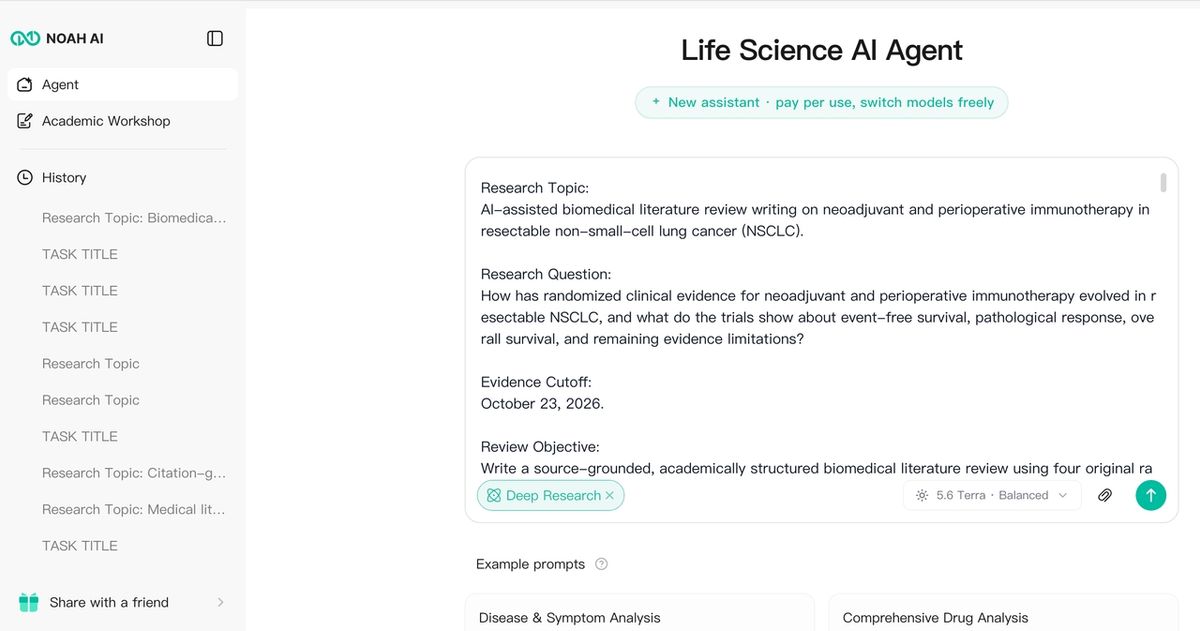
1. Starting with a focused clinical question
The input asked how randomized evidence for neoadjuvant and perioperative immunotherapy developed and what the trials show about EFS, pathological response, OS, and interpretation limits. The evidence cutoff was explicitly specified as October 23, 2026.
2. Writing a coherent history of the evidence
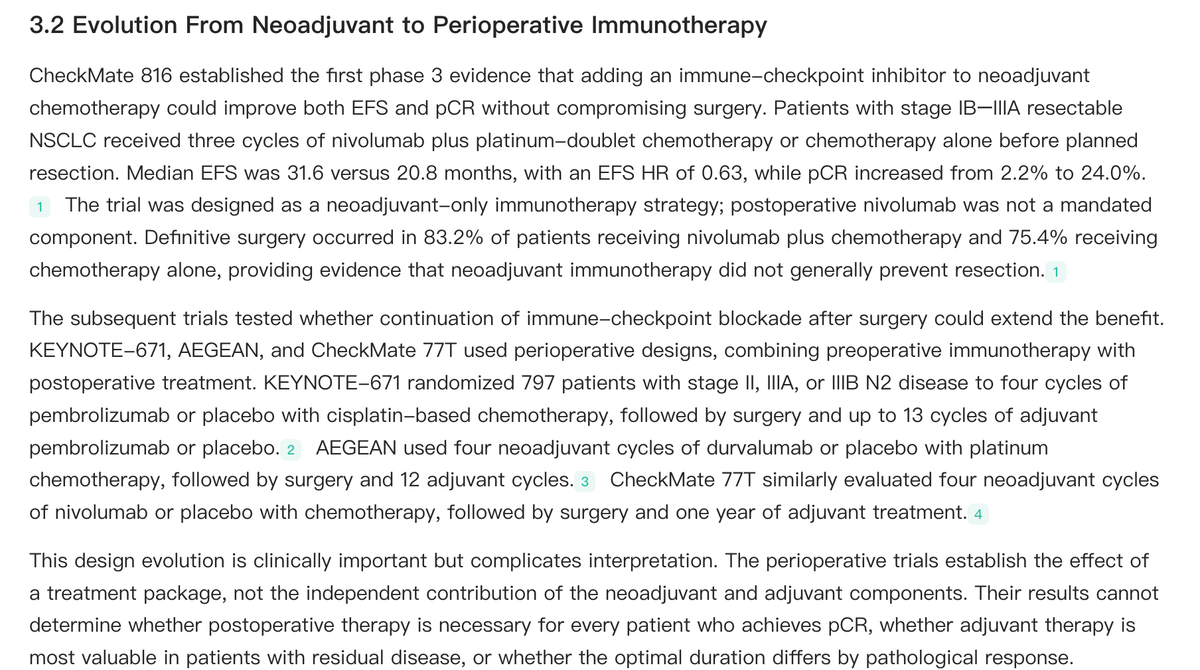
The generated literature review explained the progression from neoadjuvant-only immunotherapy in CheckMate 816 to perioperative treatment packages in KEYNOTE-671, AEGEAN and CheckMate 77T. It preserved a crucial design distinction: a perioperative trial compares the complete presurgery-plus-postsurgery strategy, not the isolated contribution of adjuvant immunotherapy.
For example, the narrative preserved CheckMate 816's original EFS and pCR results and placed those findings alongside the different adjuvant-treatment schedules tested in the later trials. The prose connected studies rather than presenting four disconnected study summaries.
3. Incorporating updated overall survival evidence
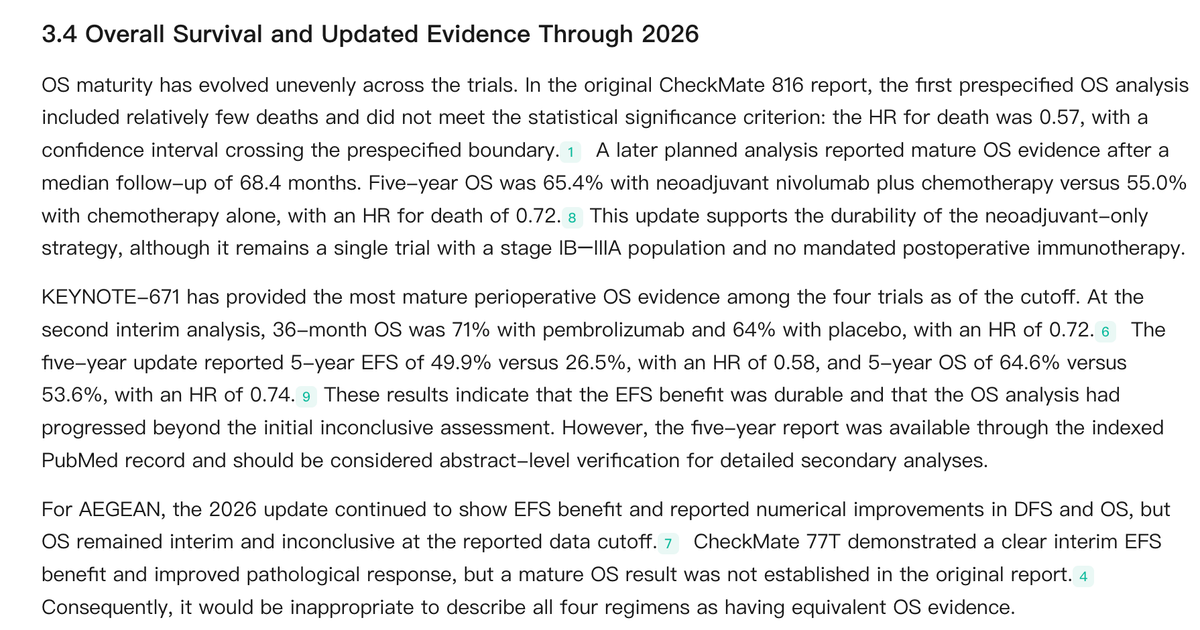
The OS section illustrates why review writing must distinguish an original publication from later analyses of the same RCT. CheckMate 816's planned OS analysis reported five-year OS of 65.4% vs 55.0% (HR 0.72), while the KEYNOTE-671 five-year report found OS of 64.6% vs 53.6% (HR 0.74). These are within-trial results; the percentages must not be compared as a direct treatment ranking.
The same review explained that AEGEAN's 2026 report retained an EFS advantage but did not establish a statistically significant OS benefit at that interim analysis (OS HR 0.89, 95% CI 0.70–1.14). This prevents a misleading claim that every regimen has equally mature survival evidence.
Try the same biomedical literature review workflow
Use Noah AI to turn a focused clinical question into structured research and a source-aware narrative draft. New accounts can start with free credits, and no credit card is required to register. Always review the cited original studies before publishing.
What Bohrium Showed in Our Research Task
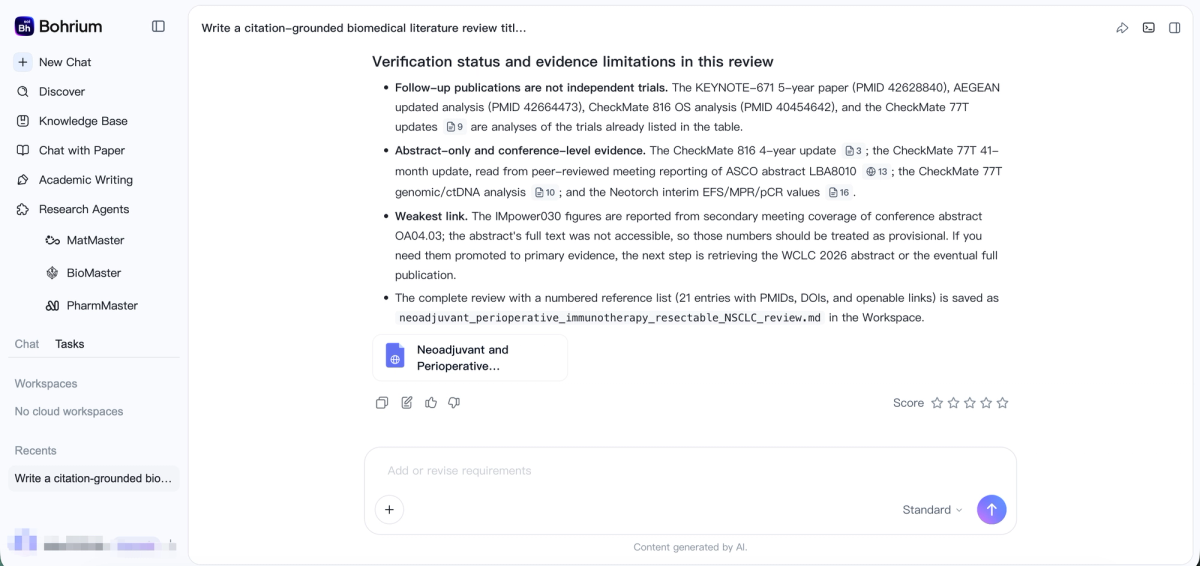
Bohrium was given a citation-grounded review-writing task about the same NSCLC immunotherapy research question. The captured completion screen contains a section titled "Verification status and evidence limitations in this review." It identifies follow-up publications as updates to existing trials, flags abstract-only or conference-level evidence, and cautions about a weaker secondary source.
The visible task response also refers to a saved Markdown report with a numbered reference list. That is evidence of an output handoff in the interface, but it is not independent verification of every source or the quality of the unseen full draft.
What this shows—and what it does not
- Visible: Bohrium recorded distinctions between original trials and follow-up reports, acknowledged evidence-access limits, and provided a report-file reference.
- Not established by this screenshot: whether every inline citation in the complete Markdown report supports its claim, whether the prose is as detailed as Noah's, or which tool would produce a more accurate final review under equal conditions.
Bohrium's official guidance also describes literature review drafting and exports. The official product description and the observed single-session output are different forms of evidence and should not be conflated.
Clinical Evidence Used for the Literature Review
The literature review centered on four original phase 3 randomized trials. The table below summarizes verified trial-level distinctions from the cited publications; it is an editorial reference table, not a screenshot of a tool's generated table.
| Study | Treatment approach | Selected reported evidence | Primary source |
|---|---|---|---|
| CheckMate 816 2022 | Neoadjuvant nivolumab plus chemotherapy before surgery; no mandated postoperative nivolumab. | Median EFS 31.6 vs 20.8 months; pCR 24.0% vs 2.2%. | [PMID 35403841](https://pubmed.ncbi.nlm.nih.gov/35403841/) |
| KEYNOTE-671 2023 | Neoadjuvant pembrolizumab plus chemotherapy, surgery and adjuvant pembrolizumab. | Original 24-month EFS 62.4% vs 40.6%; HR 0.58. | [PMID 37272513](https://pubmed.ncbi.nlm.nih.gov/37272513/) |
| AEGEAN 2023 | Neoadjuvant durvalumab plus chemotherapy, surgery and adjuvant durvalumab. | Original EFS HR 0.68; pCR 17.2% vs 4.3%. | [PMID 37870974](https://pubmed.ncbi.nlm.nih.gov/37870974/) |
| CheckMate 77T 2024 | Neoadjuvant nivolumab plus chemotherapy, surgery and adjuvant nivolumab. | 18-month EFS 70.2% vs 50.0%; HR 0.58. | [PMID 38749033](https://pubmed.ncbi.nlm.nih.gov/38749033/) |
Why updated survival publications matter
As of the October 23, 2026 evidence cutoff, several important later reports altered the interpretation of initial OS maturity. CheckMate 816's planned final analysis showed a five-year OS benefit; KEYNOTE-671's five-year update supported durable EFS and OS improvement; AEGEAN's newer OS analysis remained interim.
- CheckMate 816: mature OS follow-up (2025), PMID 40454642
- KEYNOTE-671: five-year outcomes (2026), PMID 42628840
- AEGEAN: updated outcomes (2026), PMID 42664473
Follow-up reports should update the same trial's evidence record, not increase the count of independent randomized studies. EFS, pCR and OS should also be interpreted separately; pathological response improvement does not automatically establish an OS benefit for every regimen.
When Should You Use Noah AI or Bohrium?
Choose Noah AI when… You want a biomedical question-led Agent workflow and structured discussion of original studies, trial endpoints, survival updates and interpretation boundaries. The visible NSCLC example demonstrates narrative sections with source markers.
Consider Bohrium when… You want a broader scientific writing environment with Task-based report generation and a saved document workflow. The captured session demonstrates a verification section and an exported-report link, but the complete report should be inspected before relying on it.
Practical source-checking checklist
- Confirm that every PMID or DOI resolves to the paper named in the review.
- Verify the reported population, sample, treatment schedule and comparator.
- Check each numerical outcome against the correct report and follow-up date.
- Distinguish a statistically significant within-trial result from an unsupported comparison between trials.
- Identify which claims rely on abstracts, conference reports or inaccessible supplements.
- Keep the final manuscript under researcher review before dissemination.
Start a source-aware medical research review
Try Noah AI Agent for a focused literature question, then verify the generated study tables, citations and review paragraphs against original publications. Free signup credits are available without a credit card.
References and Source Notes
- Forde et al. Neoadjuvant Nivolumab plus Chemotherapy in Resectable Lung Cancer. PMID 35403841.
- Wakelee et al. Perioperative Pembrolizumab for Early-Stage Non-Small-Cell Lung Cancer. PMID 37272513.
- Heymach et al. Perioperative Durvalumab for Resectable Non-Small-Cell Lung Cancer. PMID 37870974.
- Cascone et al. Perioperative Nivolumab in Resectable Lung Cancer. PMID 38749033.
- Forde et al. Overall Survival with Neoadjuvant Nivolumab plus Chemotherapy in Lung Cancer. PMID 40454642.
- Wakelee et al. Five-Year Outcomes of KEYNOTE-671. PMID 42628840.
- Heymach et al. AEGEAN Updated Outcomes. PMID 42664473.
- Bohrium: AI tools and workflows for literature review writing.
- Noah AI: Search and Agent workflow documentation.
Research disclaimer: This is an educational comparison of research workflows, not clinical guidance or a formal systematic review. The Noah and Bohrium screenshots are genuine examples of different visible stages, not a fully standardized benchmark. Evidence cutoff: October 23, 2026. Statements about tools other than observed screenshot behavior use the vendors' published information. Medical claims should be verified against the primary studies before reuse.