
Noah AI vs Consensus for Literature Review and Evidence Synthesis (2026)
Linda
Compare Noah AI vs Consensus for medical literature reviews in 2026. Explore clinical evidence tables, benefit-risk synthesis, and Noah AI's free credits.
Compare two AI research tools using real clinical evidence. See how Noah AI organizes randomized trials, synthesizes benefits and risks, and makes scientific uncertainty visible.
Noah AI · Free Credits Available · No Credit Card Required
Finding relevant medical papers is only the beginning of a literature review.
Researchers also need to compare study populations, extract clinical outcomes, understand differences between trial designs, and determine what the combined evidence supports.
This becomes especially important when studies report both potential benefits and clinically important harms.
Noah AI and Consensus both support AI-assisted literature research, but their interfaces and research workflows emphasize different ways of working with evidence.
Consensus offers academic literature discovery, AI-generated research analysis, cited summaries, and deeper review capabilities.
Noah AI is a life-science-focused research Agent that can be prompted to organize clinical studies into structured comparison tables and generate outcome-based biomedical evidence synthesis.
To examine these workflows, we used the same clinical research topic in both products:
Our Research Question: In adults without established cardiovascular disease, how do the cardiovascular benefits and major bleeding risks of low-dose aspirin for primary prevention differ across older adults, people with diabetes, and adults at moderate cardiovascular risk?
The comparison draws on three major randomized clinical trials: ASPREE, ASCEND, and ARRIVE.
These trials studied different primary-prevention populations, making them useful for evaluating whether AI-generated reviews preserve clinical context rather than combining all findings into a single generalized claim.
Testing disclosure: We tested both Noah AI and Consensus using the same low-dose aspirin primary-prevention research topic, covering cardiovascular benefits and major bleeding risks across different patient populations. Noah AI was given a structured evidence-synthesis task, while Consensus was tested in Pro mode with 10 research steps, not Deep Review. The prompts and research modes were not standardized for a controlled head-to-head comparison. This article describes the observed outputs rather than comparing overall accuracy or maximum capabilities.
Quick Answer: Noah AI vs Consensus
Both products can help researchers work with academic literature.
Noah AI is worth considering when the desired output is a structured biomedical evidence review that compares clinical outcomes, risks, and uncertainties across studies.
Consensus is useful for exploring published research, finding relevant papers, investigating scientific questions, and generating cited literature analyses.
| Comparison | Noah AI | Consensus |
|---|---|---|
| Primary orientation | Medical, pharmaceutical, and life-science research. | Academic literature search and evidence analysis across disciplines. |
| Research starting point | Biomedical question with instructions for Agent research and evidence outputs. | Natural-language question followed by research synthesis and supporting papers. |
| Clinical trial extraction | Generated a three-trial evidence comparison in our test. | Supports evidence extraction and structured analysis; the captured Pro view focused on a narrative summary and papers. |
| Cross-study synthesis | Generated a population-level benefit-risk synthesis. | Supports cited multi-paper synthesis, including more detailed Deep Review workflows. |
| Source visibility | Study-specific evidence and citation markers in the generated tables. | Supporting papers, research citations, and source-level exploration. |
| Uncertainty | Dedicated limitation and uncertainty fields in the observed outputs. | Can explain evidence differences and qualifications within its research analysis. |
| Getting started | Free signup credits; no credit card required. | Free and paid plans with usage limits depending on research mode. |
This comparison is not a claim that only Noah can create tables or that Consensus cannot conduct deep literature reviews. Both platforms support substantial evidence-analysis tasks.
The meaningful difference in this example is how the actual generated outputs help a medical researcher inspect the evidence.
What Matters in a Medical Literature Review?
A medical evidence review must do more than identify papers with similar keywords.
Researchers should be able to answer several questions:
- Which population did each study investigate?
- Which outcomes were prespecified and measured?
- What were the absolute and relative treatment effects?
- Were beneficial and harmful outcomes both considered?
- Can the findings be generalized across different patient groups?
- Which conclusions remain statistically or clinically uncertain?
- Can important claims be traced back to the original studies?
These questions are particularly relevant for low-dose aspirin in cardiovascular primary prevention.
Aspirin may reduce certain cardiovascular events in some populations, but it can also increase bleeding. The balance changes with baseline risk, age, and other patient characteristics.
That makes the topic a useful demonstration of evidence synthesis rather than simple paper summarization.
Our Test Case: Aspirin for Primary Cardiovascular Prevention
We selected three landmark randomized trials:
| Trial | Population | Main Evidence Question |
|---|---|---|
| ASPREE | Generally healthy older adults. | Did aspirin reduce cardiovascular events without unacceptable bleeding harm? |
| ASCEND | Adults with diabetes but no established cardiovascular disease. | Did prevention of serious vascular events outweigh major bleeding risk? |
| ARRIVE | Adults selected for estimated moderate cardiovascular risk. | Could aspirin prevent an initial vascular event in the enrolled population? |
All three trials investigated low-dose aspirin in primary prevention, but they differed substantially in baseline population characteristics, outcome definitions, and observed event rates.
This makes it inappropriate to treat their estimates as interchangeable or to assume one conclusion applies equally to all adults without cardiovascular disease.
Noah AI: From Clinical Papers to Structured Evidence
We used Noah AI Agent to conduct a source-grounded medical literature review centered on these three randomized trials.
The research task requested a common comparison of patient populations, cardiovascular findings, bleeding outcomes, and limitations.
It also required a second synthesis showing how the balance of benefit and harm differed across the three populations.
Two outputs were especially useful.
1. Compare Multiple Clinical Trials in a Single Evidence Table
The first Noah output organized ASPREE, ASCEND, and ARRIVE using the same clinical comparison fields.
Instead of returning three disconnected study summaries, it placed population characteristics, cardiovascular outcomes, bleeding outcomes, and methodological limitations side by side.
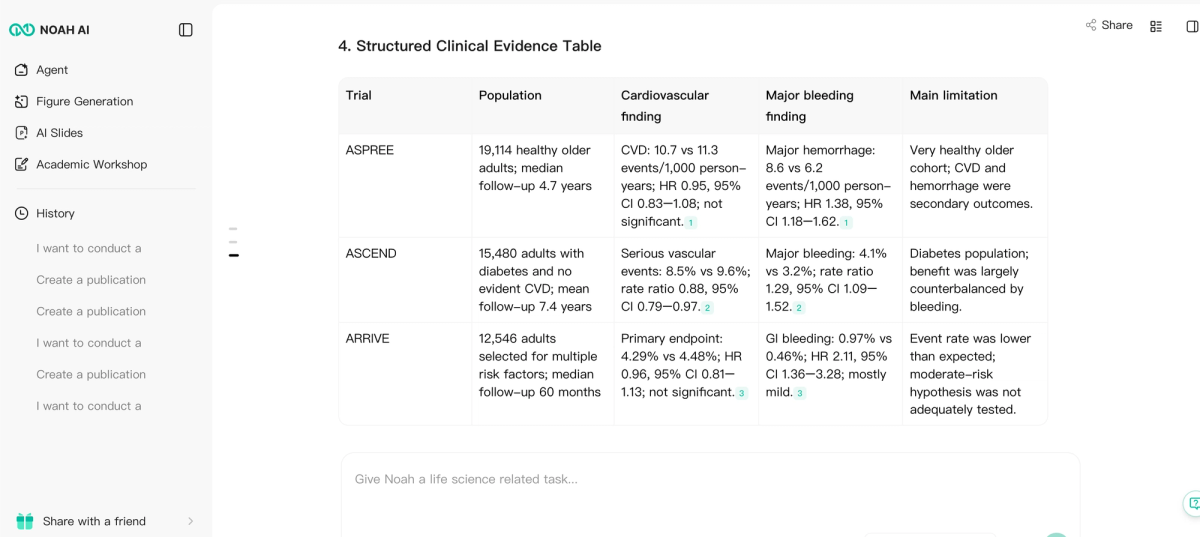
The table preserves several important distinctions.
ASPREE enrolled 19,114 older adults without established cardiovascular disease, dementia, or disability.
Its cardiovascular event rate was 10.7 versus 11.3 per 1,000 person-years with aspirin and placebo, respectively. The hazard ratio was 0.95 (95% CI 0.83–1.08), indicating that a statistically significant reduction was not established.
Major hemorrhage, however, increased from 6.2 to 8.6 events per 1,000 person-years (HR 1.38; 95% CI 1.18–1.62).
An important methodological qualification is that cardiovascular disease and major hemorrhage were prespecified secondary outcomes in the broader ASPREE program. Disability-free survival was its overall primary endpoint.
Verify the ASPREE cardiovascular and bleeding results.
ASCEND studied 15,480 adults with diabetes but no evident cardiovascular disease.
Serious vascular events occurred in 8.5% of participants assigned aspirin and 9.6% assigned placebo, while major bleeding increased from 3.2% to 4.1%.
The important conclusion is not simply that aspirin reduced vascular events. The absolute cardiovascular benefit was largely counterbalanced by the increased bleeding risk.
Verify the ASCEND primary efficacy and safety findings.
ARRIVE randomized 12,546 adults selected for estimated moderate cardiovascular risk.
The trial did not establish a statistically significant reduction in its primary cardiovascular endpoint: 4.29% versus 4.48%, with a hazard ratio of 0.96 (95% CI 0.81–1.13).
Gastrointestinal bleeding increased from 0.46% to 0.97%, although most reported events were mild.
The observed cardiovascular event rate was lower than expected, limiting the ability to answer the originally intended moderate-risk question.
Verify the ARRIVE trial results31924-X).
What Noah demonstrated: a structured table that keeps key trial results and limitations visible at the same time.
This is useful because a medical literature review should not present every randomized trial as though it evaluated the same population or outcome.
2. Go Beyond Trial Summaries with Benefit–Risk Evidence Synthesis
The second Noah output addressed a different task.
Rather than combining cardiovascular benefits and bleeding harms into a single numerical score, it organized these outcomes separately across three patient populations, preserving absolute effects, overall interpretations, and remaining uncertainties.
The table included:
- Cardiovascular evidence
- Bleeding evidence
- Overall interpretation
- Main uncertainty
This output makes an important distinction that can be lost in broad summaries: the benefit-risk balance is not uniform across patients.
In the ASPREE population, bleeding risk increased without an established cardiovascular benefit.
In ASCEND, aspirin significantly reduced serious vascular events, but the absolute gain was substantially offset by increased major bleeding.
In ARRIVE, the primary cardiovascular benefit was not established in the observed lower-than-expected-risk population, while gastrointestinal bleeding increased.
The final table also retained what the evidence did not resolve.
For instance, ASCEND does not establish one universal benefit-risk balance for every person with diabetes. Individual baseline cardiovascular and bleeding risks remain relevant.
The Key Value Demonstrated by Noah
Noah AI moved from individual trial results to a structured, population-specific evidence synthesis while keeping uncertainty visible. The result is a working evidence summary that researchers can inspect, verify, and refine.
This does not mean Noah independently determines the correct treatment for a patient.
The generated synthesis is research assistance and should be checked against original publications before use in academic or clinical work.
Turn Medical Literature into Structured Evidence with Noah AI
Compare clinical trials, synthesize biomedical evidence, and identify important research uncertainties using Noah AI.
Free Credits Available · No Credit Card Required
Free credits are usage-limited. Credit availability and research task costs depend on the current plan.
Consensus: Research Summaries with Supporting Academic Sources
Consensus approaches literature research through a natural-language academic search and evidence-analysis interface.
Researchers can ask scientific questions and examine AI-generated responses together with the publications supporting those responses.
Depending on the mode used, Consensus can search, compare, and synthesize studies, generate structured reports, and surface cited evidence.
We ran the same low-dose aspirin topic in Consensus and captured the resulting research thread.
The screenshot shows a Pro research response with 10 steps, a written synthesis, and a References panel displaying relevant original publications.
The visible results included the three main studies:
- ASPREE: The summary of the original study highlighted increased major hemorrhage without a statistically significant cardiovascular reduction in older adults.
- ASCEND: The study takeaway acknowledged fewer serious vascular events alongside increased major bleeding in adults with diabetes.
- ARRIVE: The retrieved study addressed the estimated moderate-risk primary-prevention population.
These are relevant sources for the research question, and the right-hand References panel offers a useful way to investigate the publications behind the summary.
The visible Consensus output also summarized the overall pattern: any cardiovascular benefit in primary prevention must be weighed against bleeding harm, and the balance differs across patient populations.
These are useful literature-review capabilities.
However, the single captured Pro screenshot does not display the same five-column trial comparison and population-specific benefit-risk matrix shown in the two Noah screenshots.
That is a difference between the specific outputs we captured. It does not mean Consensus is incapable of generating tables or detailed evidence reviews.
Consensus also offers a more extensive Deep Review mode that can investigate a topic through multiple searches and produce a longer structured synthesis.
Key Differences Observed in the Two Workflows
- Starting from a Medical Research Question — Both Noah AI and Consensus can begin with a natural-language research question. In Noah, we explicitly requested clinical trial extraction, separate benefit and harm comparisons, and an outcome-level synthesis. In Consensus, the captured Pro thread presented an integrated narrative response with supporting study references. The output format is therefore influenced by the task instructions and research mode, not just the product name.
- Structured Clinical Trial Comparison — One clear value demonstrated in the Noah test was the structured comparison of three randomized trials. By displaying all three populations and their key cardiovascular and bleeding results together, the table made differences in study findings easier to inspect. Consensus also supports comparing papers and producing structured outputs, but the visible Pro response was organized primarily as narrative synthesis and source results.
- Benefit–Risk Evidence Synthesis — Clinical evidence synthesis requires an interpretation across studies, not merely a count of favorable or unfavorable results. The Noah output used separate columns for cardiovascular evidence, bleeding evidence, overall interpretation, and remaining uncertainty. This made the benefit-risk question central to the structure of the review. The Consensus summary also recognized differences between patient populations and identified bleeding as an important counterbalance to cardiovascular benefit. The two observed outputs therefore supported overlapping scientific conclusions, but displayed the evidence in different formats.
- Sources and Citation Traceability — Both platforms connect their research outputs to source material. Noah's generated tables included study-specific citation markers that researchers could use when verifying the trial findings. Consensus displayed source papers and associated study takeaways alongside the main research response. Source visibility is useful in both cases, but researchers must still confirm that each numerical claim accurately reflects the cited paper.
- Biomedical Context and Applicability — Noah's demonstrated synthesis separated older adults, adults with diabetes, and people selected for moderate cardiovascular risk. This matters because an effect observed in one population should not automatically be generalized to a different population. A useful research review should preserve these limitations even when a short overall conclusion would be easier to read.
What Did This Comparison Actually Show?
The clearest difference was in the research outputs visible in this example.
| Observed Output | Noah AI | Consensus Pro |
|---|---|---|
| Three pivotal trials identified | Yes, in the generated evidence table. | Yes, in the visible source results. |
| Trial-level evidence table | Yes, five structured columns. | Not shown in the captured Pro screenshot. |
| Population-specific benefit-risk matrix | Yes, including overall interpretation and uncertainty. | Not shown in the captured Pro screenshot. |
| Research narrative | Included in the wider generated report. | Visible in the Pro research response. |
| Supporting sources | Citation-linked claims in report tables. | Paper titles, study takeaways, and source cards. |
The results illustrate the value of requesting specific evidence structures when working with an AI research tool.
They do not prove that one platform is categorically more accurate, comprehensive, or capable than the other.
The two captured runs also used different research configurations: Noah was given a detailed Deep Research task, while the visible Consensus result was from Pro mode.
A controlled comparison of maximal synthesis capability would require equivalent output instructions, matched evidence access, and review of full results from both platforms.
When Should You Choose Noah AI?
Consider Noah AI when the main goal is to produce a structured biomedical research output.
This can include:
- Comparing clinical trials using consistent extraction fields.
- Separating efficacy outcomes from safety outcomes.
- Identifying differences in study populations and endpoints.
- Organizing cross-study evidence by clinical question.
- Preserving limitations and scientific uncertainty.
- Preparing a source-grounded synthesis draft for expert review.
The aspirin case shows how Noah can help move from several randomized trials to a structured comparison and then to a population-specific benefit-risk synthesis.
This is a useful starting point for medical research reports, literature-review drafting, evidence mapping, and research planning.
When Should You Choose Consensus?
Consensus is useful when the research workflow begins with exploring what the academic literature says about a question.
Its interface makes it possible to inspect an AI-generated analysis together with relevant research publications.
Researchers can use it to:
- Find relevant scientific papers using natural-language questions.
- Explore cited evidence supporting a research summary.
- Investigate agreement and disagreement across studies.
- Ask follow-up questions about a research topic.
- Conduct more extensive reviews using available Deep Review workflows.
Consensus may be particularly convenient when researchers want an accessible question-to-literature workflow across different academic disciplines.
Can Researchers Use Noah AI and Consensus Together?
Yes. The tools can support complementary research activities.
A researcher might use Consensus to explore the relevant literature and inspect key publications, then use Noah to generate a structured clinical comparison and evidence synthesis.
For example:
- Define a focused biomedical research question.
- Identify relevant original studies and evidence reviews.
- Verify important publications and study designs.
- Use a structured comparison to extract clinical outcomes.
- Synthesize benefits, harms, and scientific uncertainty.
- Check all important numerical claims against the original papers.
The objective is not to use as many tools as possible. It is to make the review process more transparent and scientifically reliable.
What Should Researchers Verify in AI-Generated Evidence Reviews?
Both Noah AI and Consensus should be used with human verification.
For medical literature reviews, key checks include:
- Source identity: Confirm the trial title, authors, DOI, and publication date.
- Population: Verify trial eligibility criteria and baseline characteristics.
- Study endpoints: Distinguish overall primary endpoints, secondary endpoints, and safety outcomes.
- Numerical estimates: Check percentages, event rates, hazard ratios, confidence intervals, and denominators.
- Outcome comparability: Do not assume different cardiovascular composites measure exactly the same thing.
- Absolute risk: Preserve absolute effects when discussing the clinical balance between benefits and harms.
- Statistical interpretation: Do not treat nonsignificant findings as proof of zero effect.
- Applicability: Avoid extending trial findings to populations that were excluded or insufficiently studied.
- Citation alignment: Confirm that each source actually supports the statement attached to it.
These safeguards are particularly important when findings may influence medical research, clinical guidelines, scientific writing, or healthcare decisions.
AI assistance can organize research more efficiently, but a polished evidence table or cited paragraph is not, by itself, proof of scientific correctness.
Can You Try Noah AI for Free?
Yes. Noah AI offers a free Basic plan with signup credits.
No payment or credit card is required to get started.
Free credits allow new users to explore the product before deciding whether additional paid usage is appropriate.
The available credit balance and cost of individual research tasks depend on the current plan and usage rules.
Free signup credits should not be confused with unlimited Deep Research access.
Researchers can review the current details on the Noah AI pricing page.
Frequently Asked Questions
Is Noah AI Better Than Consensus for Medical Literature Reviews?
It depends on the task. In our demonstrated clinical example, Noah generated a structured evidence table and a population-specific benefit-risk synthesis. Consensus produced a cited research summary with supporting papers. This observation does not establish an overall product ranking.
Can Noah AI Compare Multiple Randomized Clinical Trials?
Yes. Our tested Noah workflow compared ASPREE, ASCEND, and ARRIVE across patient populations, cardiovascular results, bleeding outcomes, and limitations. Researchers should verify the underlying data before using the comparison.
Can Consensus Generate Literature Reviews?
Yes. Consensus supports research summaries and a more detailed Deep Review mode for multi-paper evidence synthesis. Its features include academic search, citations, research analysis, and structured outputs.
Does Consensus Support Evidence Tables?
Yes. Consensus can produce structured research outputs, including evidence tables, depending on the prompt and research mode. The screenshot used in this comparison shows a Pro narrative response and References view rather than a completed custom evidence table.
What Is the Difference Between Literature Review and Evidence Synthesis?
A literature review identifies and discusses relevant research on a topic. Evidence synthesis places findings from several studies into a comparative framework, explains methodological differences, and develops a qualified interpretation of the collective evidence.
Can AI Evaluate Cardiovascular Benefits and Bleeding Risks?
AI can help organize published efficacy and safety data and explain their differences. It cannot replace independent verification, clinical judgment, or patient-specific risk assessment.
Can I Use Noah AI for Free?
Noah AI offers free signup credits without requiring a credit card. The amount of research activity available depends on the credit balance and current task costs.
Does an AI-Generated Literature Review Replace a Systematic Review?
No. A formal systematic review requires a documented protocol, reproducible literature searches, explicit selection criteria, risk-of-bias assessment, and appropriate synthesis methods. An AI-generated narrative review is not automatically a completed systematic review.
Related Reading
Explore related Noah AI articles covering medical evidence reviews, paper comparison, and biomedical literature synthesis.
- How to Conduct a Medical Literature Review with AI: Step-by-Step Guide (2026)
- Best AI Tools for Medical Literature Review and Evidence Synthesis (2026)
- How to Compare Multiple Research Papers in a Literature Review with AI
- Best AI Tools for PubMed Literature Review (2026)
Final Takeaway: Which Tool Fits Your Research Workflow?
Noah AI and Consensus both offer useful capabilities for AI-assisted literature research.
Consensus provides an accessible way to investigate academic questions and examine supporting publications. Its deeper review tools can support more extensive research synthesis.
Noah AI is especially relevant when researchers want a focused biomedical question to lead to structured clinical evidence and an outcome-based synthesis.
In our low-dose aspirin example, Noah generated a three-trial comparison and a population-specific benefit-risk synthesis.
The result preserved several essential distinctions: cardiovascular outcomes differed across populations, bleeding risk remained clinically important, and uncertainty could not be reduced to a single universal treatment conclusion.
Consensus's captured Pro response also identified relevant randomized studies and presented cited research findings, demonstrating useful evidence exploration and source discovery.
The strongest conclusion from this comparison is not that one AI platform universally outperforms the other. It is that a structured biomedical evidence workflow can make differences between clinical studies easier to inspect and verify.
Researchers should choose the workflow that matches their task and independently verify important findings against the original literature.
For those interested in trying a biomedical research Agent without an upfront payment, Noah AI offers free signup credits and requires no credit card.
Start Your Medical Literature Review with Noah AI
Compare clinical research, synthesize biomedical findings, and build structured, source-grounded evidence reviews with Noah AI.
Build a Benefit–Risk Evidence Review with Noah AI
Evaluate treatment benefits, adverse outcomes, and population-specific uncertainties. Use Noah AI to organize clinical trial evidence into structured, reviewable benefit–risk syntheses.
Free Credits Available · No Credit Card Required