
Noah AI vs EvidenceHunt for Medical Evidence Reviews (2026)
Linda
Compare Noah AI vs EvidenceHunt for medical evidence reviews in 2026, with real aspirin trial screenshots, verified citations, and benefit–risk analysis.
Can an AI research assistant turn a clinical question into a traceable, balanced medical evidence review? We examined a low-dose aspirin primary-prevention question using Noah AI Agent Deep Research and EvidenceHunt Chat. The comparison focuses on visible workflows, clinical trial evidence, source traceability, and the limits of what screenshots can prove.
Evidence cutoff: October 27, 2026 · Clinical case: Low-dose aspirin primary prevention
Noah AI vs EvidenceHunt: What Are They Designed to Do?
EvidenceHunt is a medical evidence platform offering a conversational research interface and, according to its official website, separate products for systematic review workflows, document processing, data extraction and enterprise evidence management. Its Chat workflow allows researchers to ask medical questions and inspect linked sources. The separate systematic-review product should not be treated as identical to an ordinary Chat session.
Noah AI was used here through the Life Science AI Agent with Deep Research selected. The actual test output was a sectioned review: a PICO scope, a three-trial evidence matrix, trial-specific analysis, a six-row benefit–harm table, guideline context, citation checking and references.
| Dimension | Noah AI — observed in this test | EvidenceHunt — observed in this test |
|---|---|---|
| Test interface | Agent / Deep Research | Chat, with source and answer-format controls visible in the initial interface |
| Question format | Detailed research brief specifying PICO, original trials, endpoints and verification | Natural-language medical evidence question |
| Structured output | Three-trial evidence matrix and separate absolute benefit–harm table | A clinical-trial evidence table visible in the supplied response screenshot |
| Source presentation | Trial-level PMIDs in the exported report and links in references | Numbered citation markers and a right-hand References panel |
| Full citation audit | Key figures could be cross-checked against original PubMed records | Not fully assessed from the single partial result screenshot |
| Independent speed / accuracy ranking | Not established: no matched timing data, exhaustive source audit, or repeated blinded tests were provided | — |
Scope note: This is a documented workflow comparison, not a controlled product benchmark. Official product capabilities and actual screenshots are identified separately.
How We Tested Medical Evidence Review Generation
We used the same clinical topic in both workflows: Does daily low-dose aspirin prevent first cardiovascular events in adults without established cardiovascular disease, and how do possible benefits compare with major bleeding harms? The reference set centered on three large 2018 randomized trial programs, each involving a meaningfully different population.
| PICO element | Test specification |
|---|---|
| Population | Adults without established cardiovascular disease; healthy older adults, adults selected for moderate risk, and adults with diabetes |
| Intervention | Trial-defined daily low-dose aspirin (100 mg in the three selected programs) |
| Comparator | Randomized placebo |
| Outcomes | First cardiovascular events, serious vascular events, major bleeding or trial-defined gastrointestinal bleeding |
| Evidence cutoff | October 27, 2026 |
| Review design | Focused evidence comparison; not a systematic review or meta-analysis |
The common reference set was ASPREE (PMID 30221597), ARRIVE (PMID 30158069) and ASCEND (PMID 30146931). Trial results were checked against their PubMed abstracts; ASPREE's original primary endpoint was also checked in the corresponding disability-free-survival paper (PMID 30221596).
Both tests sought a balanced answer, including numerical findings and caveats. The Noah prompt requested more explicit output structure, while EvidenceHunt was tested through its normal medical question-and-answer interface. This difference is itself part of the workflow comparison.
EvidenceHunt: What Was Visible in the Real Test?
In the resulting EvidenceHunt view, a table titled Clinical Evidence from Randomized Controlled Trials was visible. The screenshot shows the ASPREE section and part of ASCEND, alongside numbered citation badges and a dedicated References panel. At least one original ASPREE cardiovascular-events publication appears in the visible reference list; other visible entries include review or commentary material.
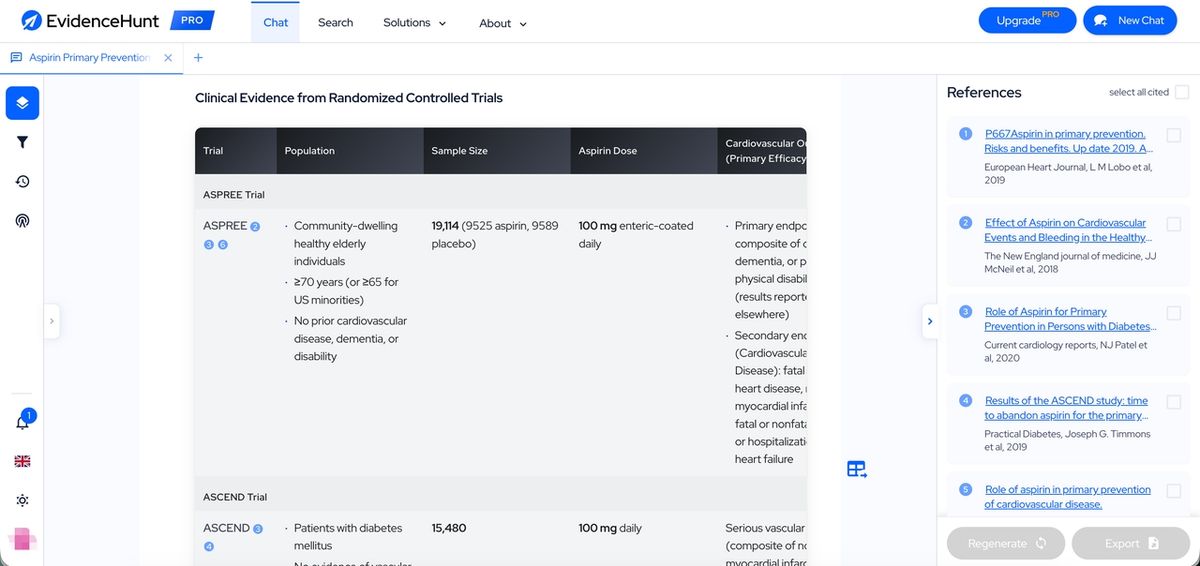
This provides direct evidence that EvidenceHunt can present a medical trial table with linked references in this workflow. However, the supplied capture does not establish whether the complete response covered ARRIVE, displayed all bleeding outcomes, or attached a primary-trial source to every significant claim. We therefore do not score it for complete trial coverage, citation accuracy or lack of nuance based on this image alone.
Important evidence boundary. A source list can contain original randomized trials, reviews and commentaries. For a medical evidence review, the relevant check is whether each quantitative claim is supported by the appropriate original publication, not merely whether some citation appears beside it.
Noah AI: Clinical Evidence Matrix and Benefit–Harm Verification
The tested Noah workflow used a detailed Deep Research prompt asking for the three original trials, population-specific interpretation, absolute event information, source provenance, ASPREE endpoint distinctions and separate guidance context.
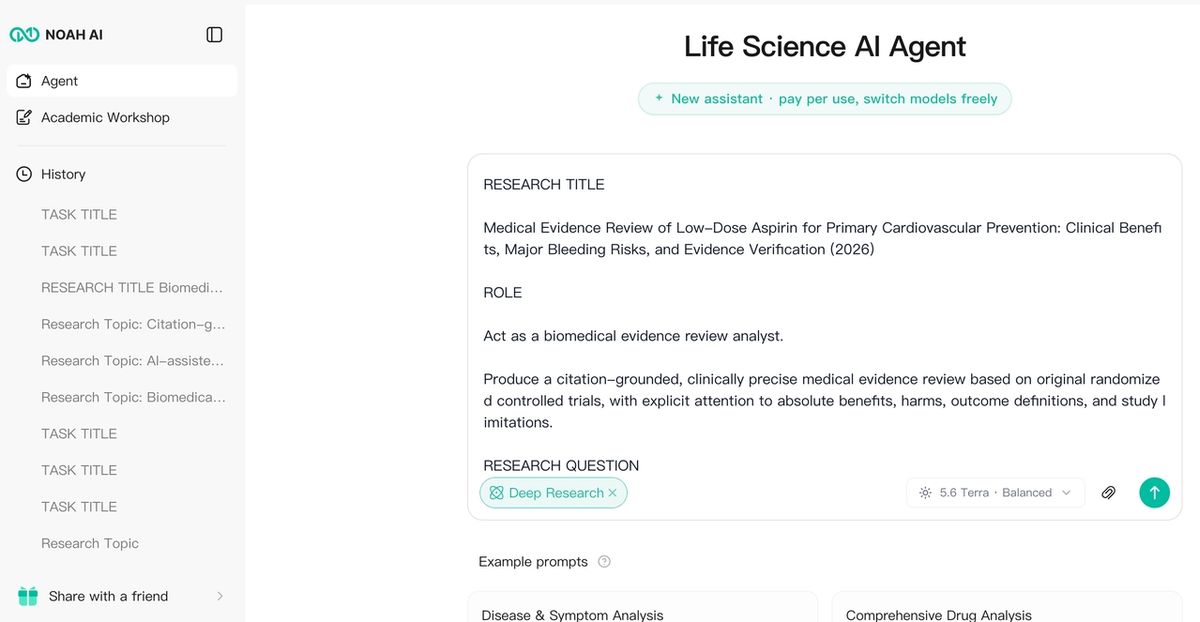
One matrix, three different trial populations
The Noah output displayed an evidence matrix summarizing ASPREE, ARRIVE and ASCEND, including population sizes, aspirin regimens, cardiovascular findings and bleeding outcomes. In particular, it preserved the distinction that cardiovascular events were a secondary outcome in ASPREE: its original primary endpoint was disability-free survival.
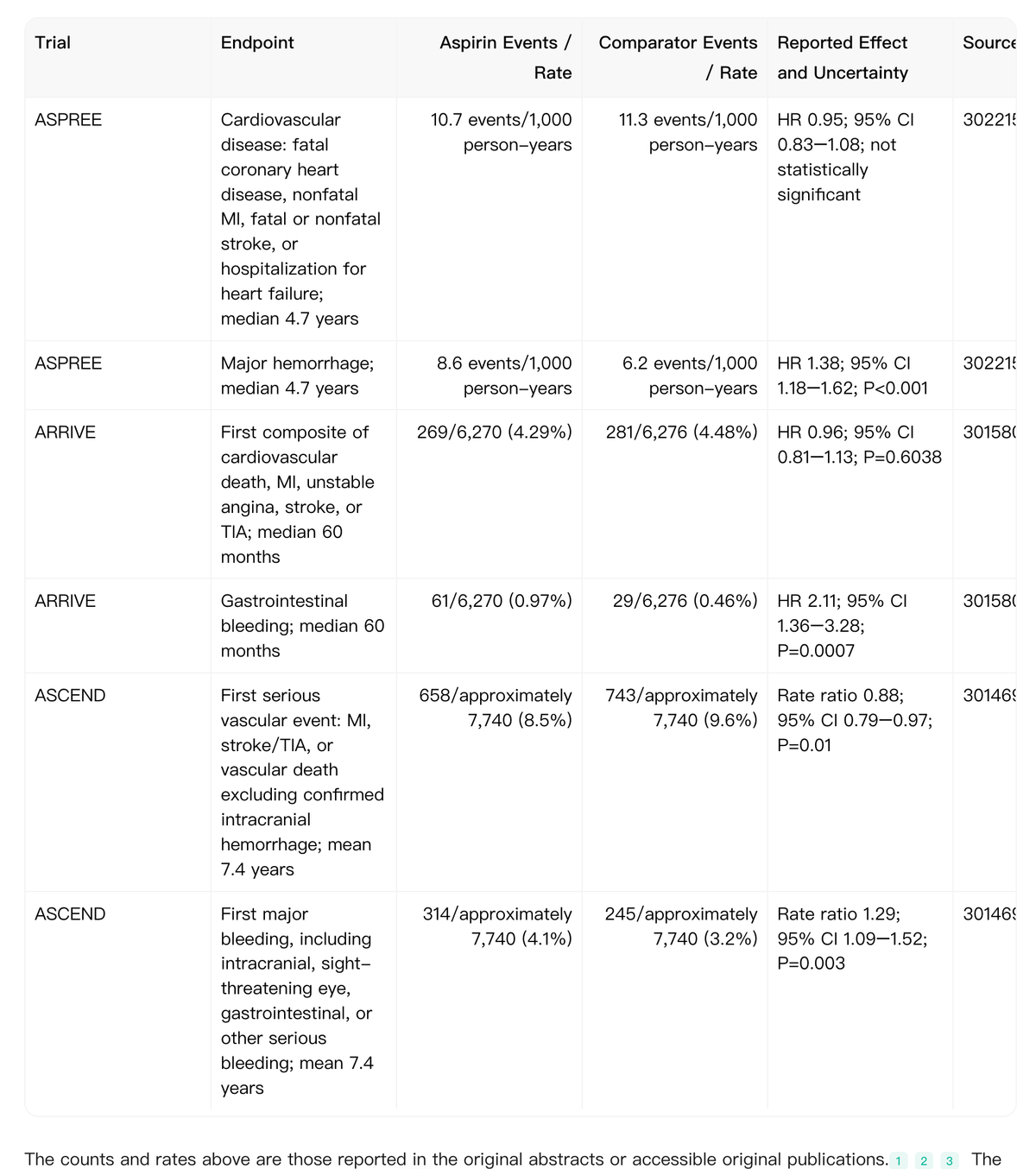
Absolute benefit and harm cannot be reduced to a single score
The report then separated clinical benefits and bleeding harms into six trial-endpoint rows. This is useful because an apparently favorable cardiovascular signal and a material bleeding signal can coexist, especially when absolute baseline risk differs across populations.
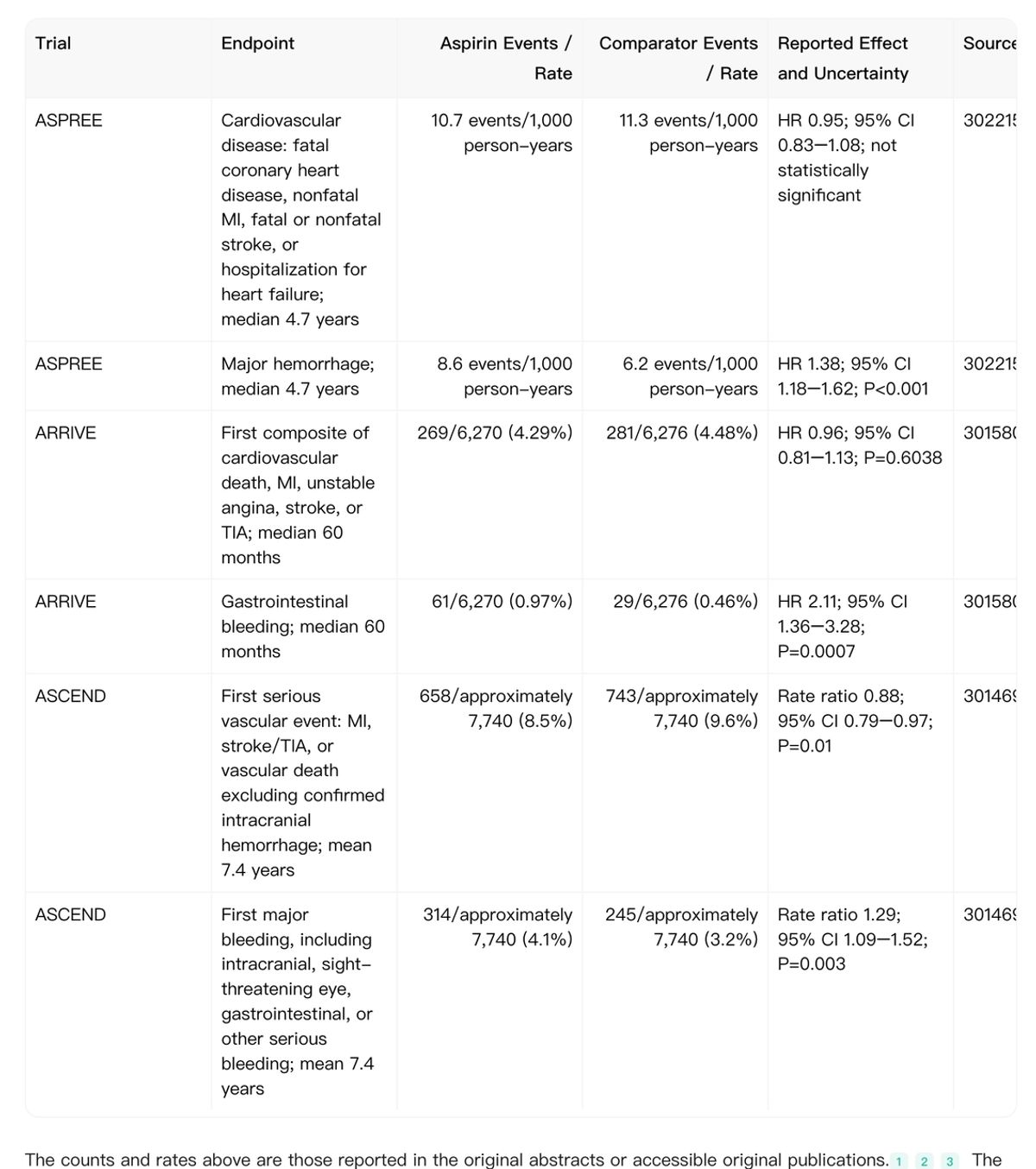
Noah's exported report supplied the full source identifiers for these rows. The comparison below reflects those text records and the original published studies, not an assumption that every numeric detail can be read from the cropped figure alone.
Explore a structured medical evidence workflow
Use Noah AI Agent to frame a biomedical question, request traceable source references and organize trial-level findings for review.
What the Original Aspirin Trials Actually Reported
The underlying clinical evidence is more important than the formatting of either AI response. Below are selected results verified against primary trial reports. Rates, denominators and time horizons differ; the rows must not be combined into a numerical ranking of trials or drugs.
| Original RCT | Population / follow-up | Cardiovascular outcome | Bleeding outcome | Original source |
|---|---|---|---|---|
| ASPREE (2018) | 19,114 relatively healthy older adults; median 4.7 years | Cardiovascular disease: 10.7 vs 11.3 per 1,000 person-years (aspirin vs placebo), HR 0.95 (95% CI 0.83–1.08); not a significant difference | Major hemorrhage: 8.6 vs 6.2 per 1,000 person-years, HR 1.38 (95% CI 1.18–1.62) | [PMID 30221597](https://pubmed.ncbi.nlm.nih.gov/30221597/) |
| ARRIVE (2018) | 12,546 adults selected for intended moderate risk; median 60 months | Primary composite: 269/6,270 (4.29%) vs 281/6,276 (4.48%), HR 0.96 (95% CI 0.81–1.13) | Gastrointestinal bleeding: 61 (0.97%) vs 29 (0.46%), HR 2.11 (95% CI 1.36–3.28) | [PMID 30158069](https://pubmed.ncbi.nlm.nih.gov/30158069/) |
| ASCEND (2018) | 15,480 adults with diabetes but no evident CVD; mean 7.4 years | Serious vascular events: 658 (8.5%) vs 743 (9.6%), rate ratio 0.88 (95% CI 0.79–0.97) | Major bleeding: 314 (4.1%) vs 245 (3.2%), rate ratio 1.29 (95% CI 1.09–1.52) | [PMID 30146931](https://pubmed.ncbi.nlm.nih.gov/30146931/) |
Why the interpretation matters
ASPREE: In healthy older adults, aspirin did not significantly reduce the reported cardiovascular disease endpoint but did increase major hemorrhage. Importantly, its original primary outcome was death, dementia or persistent disability—not cardiovascular events (ASPREE primary-outcome paper).
ARRIVE: Aspirin did not significantly reduce the composite primary endpoint. The observed cardiovascular event rate was lower than expected, limiting conclusions about the originally intended moderate-risk population. Most reported gastrointestinal bleeding events were characterized as mild, so the ARRIVE bleeding category should not be casually equated with the major-bleeding endpoints of ASPREE or ASCEND.
ASCEND: In adults with diabetes but no evident cardiovascular disease, serious vascular events were significantly reduced, yet major bleeding was significantly increased. The absolute differences—approximately 1.1 percentage points for serious vascular events and 0.9 percentage points for major bleeding over the trial follow-up—illustrate why a benefit-only answer would be misleading.
These results come from different populations and composite endpoint definitions. They are not randomized head-to-head comparisons between AI tools and cannot establish that any particular individual should begin or stop aspirin.
What Counts as a Citation-Grounded Medical Evidence Review?
When evaluating Noah AI, EvidenceHunt or another medical research assistant, the central question is not how many citations appear on the page. It is whether the evidence supports each specific claim.
| Review check | Why it matters in the aspirin case |
|---|---|
| Original study provenance | An ASPREE statistic should lead to the original ASPREE paper, not just a secondary commentary. |
| Primary vs secondary endpoints | ASPREE's original primary endpoint was disability-free survival; its cardiovascular report addressed a secondary outcome. |
| Population and sample | ASPREE, ARRIVE and ASCEND enrolled meaningfully different patients and cannot be treated as one interchangeable cohort. |
| Absolute event information | Effect estimates without event rates or denominators can obscure the magnitude of benefit or harm. |
| Matched outcome definitions | Gastrointestinal bleeding, major hemorrhage and major bleeding are not identical definitions. |
| Statistical uncertainty | Nonsignificant differences are not proof of zero effect; confidence intervals are required for interpretation. |
| Clinical guidance context | Guidelines synthesize evidence and values; they are not additional randomized trials. |
What About Current Prevention Guidance?
Guideline sources and access date: November 4, 2026.
The U.S. Preventive Services Task Force (USPSTF), in its final recommendation statement Aspirin Use to Prevent Cardiovascular Disease: Preventive Medication (April 26, 2022), recommends individualized decision-making for adults aged 40–59 years with an estimated 10-year cardiovascular disease risk of at least 10% and no increased bleeding risk (Grade C). The USPSTF recommends against initiating low-dose aspirin for primary prevention in adults aged 60 years or older (Grade D).
Source: USPSTF, 2022 Final Recommendation Statement. Accessed November 4, 2026.
The American College of Cardiology and American Heart Association (ACC/AHA), in the 2019 ACC/AHA Guideline on the Primary Prevention of Cardiovascular Disease, state that low-dose aspirin (75–100 mg daily) might be considered for selected adults aged 40–70 years at higher cardiovascular risk who are not at increased bleeding risk. Routine use is discouraged in adults older than 70 years, and aspirin should not be used for primary prevention in individuals at increased bleeding risk.
Source: 2019 ACC/AHA Primary Prevention Guideline. Accessed November 4, 2026.
The ACC also published a 2026 Scientific Statement on Antiplatelet Therapy, reinforcing that routine aspirin use for primary prevention is not supported in unselected populations. This is a scientific statement, not a replacement ACC/AHA clinical practice guideline.
Source: ACC Scientific Statement, June 30, 2026. Accessed November 4, 2026.
These recommendations apply to primary prevention and should not be automatically extended to patients with established cardiovascular disease. They are population-level guidance, not individualized instructions to start or discontinue medication.
These are population-level recommendations, not personal medical advice. A person taking aspirin should not change medication based on an AI output or this article.
Which Tool Should You Use for Medical Evidence Reviews?
Consider Noah AI if your assignment needs a long, defined research deliverable
In the documented example, Noah produced a sectioned research report with an explicit PICO scope, a three-trial table, six benefit–harm rows, limitations and a source list. That makes the observed workflow suitable for tasks where the researcher wants to specify deliverables up front and inspect a structured draft. The output still needs independent source validation before formal use.
Consider EvidenceHunt if you want a conversational medical evidence interface
EvidenceHunt Chat offers question-based evidence retrieval and linked references; the captured response included a randomized-trial table with a references sidebar. Its broader platform also advertises distinct data-extraction and systematic-review products. Those capabilities should be evaluated separately from the Chat run shown here, rather than credited to this test without direct evidence.
The defensible conclusion
Noah demonstrated a more fully documented multi-section output in the material supplied for this comparison. EvidenceHunt also visibly generated structured evidence with references. Because only a partial EvidenceHunt result screenshot was captured, this comparison does not establish that Noah has superior citation accuracy, wider retrieval coverage, better medical correctness or faster performance.
Build your next biomedical evidence review with Noah AI
Start with a PICO question, specify endpoints and denominators, and verify every important claim against the original medical literature.
Frequently Asked Questions
Is EvidenceHunt the same as a full systematic review platform?
No. EvidenceHunt markets both a conversational Chat product and separate systematic-review workflow capabilities. The Chat screenshot in this article should not be interpreted as a completed systematic review.
Can Noah AI generate a structured medical evidence review?
In the documented aspirin case, Noah's Deep Research output included a trial comparison, benefit–harm analysis, source-verification entries and original-study references. This describes one actual run, not a guarantee for every prompt.
Which tool has more accurate medical citations?
This test does not establish a winner. Only selected Noah claims were checked against primary PubMed papers, while the available EvidenceHunt response screenshot was incomplete. A consistent source-by-source audit of both full outputs would be necessary.
Can AI medical evidence reviews replace a systematic literature review?
No. Formal systematic reviews need predefined eligibility rules, reproducible searches, screening procedures, risk-of-bias assessment and appropriately documented synthesis.
What does the aspirin example demonstrate?
The central interpretation is benefit–harm balance: ASCEND found fewer serious vascular events and more major bleeding; ASPREE found increased bleeding without a significant cardiovascular reduction; ARRIVE did not significantly reduce its primary cardiovascular endpoint.
Is daily aspirin recommended for everyone to prevent a first heart attack?
No. Primary-prevention decisions vary with age, baseline vascular risk and bleeding susceptibility. People should seek individualized medical guidance rather than starting or stopping aspirin based on an AI review.