
Noah AI vs Logically (formerly Afforai) for AI Literature Reviews (2026)
Linda
Compare Noah AI vs Logically (formerly Afforai) for AI literature reviews in 2026, including medical research workflows, citations, and a real ATTR-CM case.
AI research tools comparison · Medical literature reviews · Evidence cutoff: October 28, 2026
An AI-generated literature review is useful only if its citations, trial outcomes, and clinical interpretations remain traceable. This comparison examines Noah AI and Logically (formerly Afforai) using one medical research question: how tafamidis, patisiran, and vutrisiran have been studied in transthyretin amyloid cardiomyopathy (ATTR-CM).
We have a real Noah Deep Research report and a real screenshot of Logically's AI Research Assistant response. The Logically screenshot shows the opening of a three-study comparison; it does not show the entire finished review. We therefore distinguish what was actually visible in the test from features described in official product documentation.
Quick Comparison: Noah AI vs Logically
| Research need | Noah AI | Logically (Afforai) |
|---|---|---|
| Primary workflow | Question-led biomedical research and evidence synthesis | General academic research assistant and research-writing workspace |
| Starting material | Medical question, specific publications, or research scope | Research prompt; can also work from document libraries and academic search |
| Literature review output | Observed in this case: structured clinical evidence table and cited review sections | Observed in the provided screenshot: opening narrative and a three-trial comparison table |
| Source checking | Actual Noah report distinguished primary trials, abstract-level verification, and secondary analyses | Product documentation describes cited research answers; complete citation checking was not visible in this screenshot |
| Medical-specific interpretation | Focused report separated mortality, recurrent events, six-minute walk distance, and health status | The excerpt recognizes the three ATTR-CM studies, but the full clinical synthesis is not available to assess here |
| What this comparison cannot establish | No controlled measurement of retrieval recall, citation error rate, overall clinical accuracy, or speed was performed. | — |
What Is Logically (Formerly Afforai)?
Logically, formerly Afforai, is a research and writing workspace that includes an AI Research Assistant, reference management, document annotation, and writing tools. Its official user guide describes research using uploaded documents and academic-search modes, including Semantic Scholar.
That makes Logically relevant for literature discovery, working with collections of papers, and producing academic drafts. Whether a particular response is based on uploaded documents, a search database, or broader web sources matters when judging its citations. The visible test screenshot confirms use of the AI Research Assistant, but it does not independently establish every source or search mode the answer used.
What Is Noah AI?
Noah AI is positioned for biomedical and life-science research. Its question-led workflow can be used to organize original trial findings, produce structured comparisons, and draft evidence-linked medical research reports.
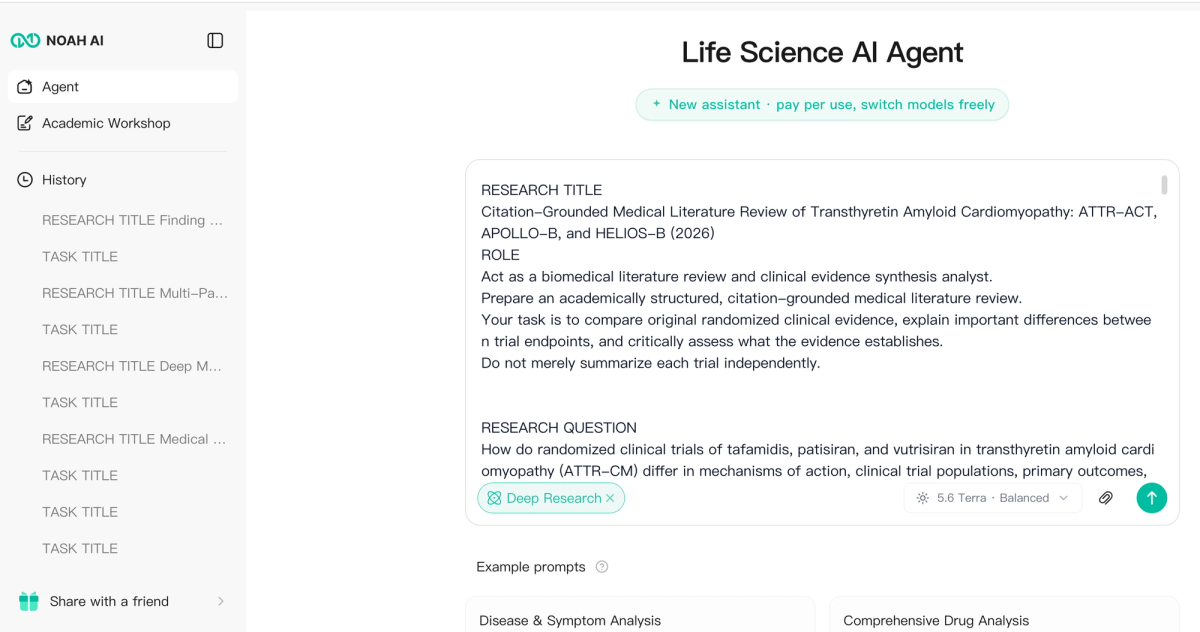
In the ATTR-CM case, the Noah Agent Deep Research prompt requested a clinical literature review using three named randomized trials. The subsequent report covered mechanisms of action, clinical populations, primary endpoints, quantitative outcomes, secondary analyses, and evidence limits. The screenshots below come from that actual workflow, not a simulated interface.
How the Medical Literature Review Was Set Up
The common clinical question was: How do the ATTR-ACT, APOLLO-B, and HELIOS-B randomized trials differ in mechanisms, patient populations, primary endpoints, mortality evidence, cardiovascular events, and interpretation limits? The evidence cutoff was October 28, 2026.
The analysis focused on three original trial publications: ATTR-ACT (PMID 30145929), APOLLO-B (PMID 37888916), and HELIOS-B (PMID 39213194). All three are randomized, placebo-controlled studies, but the treatments and endpoints are not interchangeable.
Logically: What the Real Result Screenshot Shows
The supplied Logically screenshot shows its AI Research Assistant beginning an ATTR-CM review. The response opens with a three-study table listing ATTR-ACT, APOLLO-B, and HELIOS-B and organizing fields such as sample size, intervention, comparator, and follow-up. This demonstrates that the visible response attempted a multi-study structure rather than a one-paper summary.
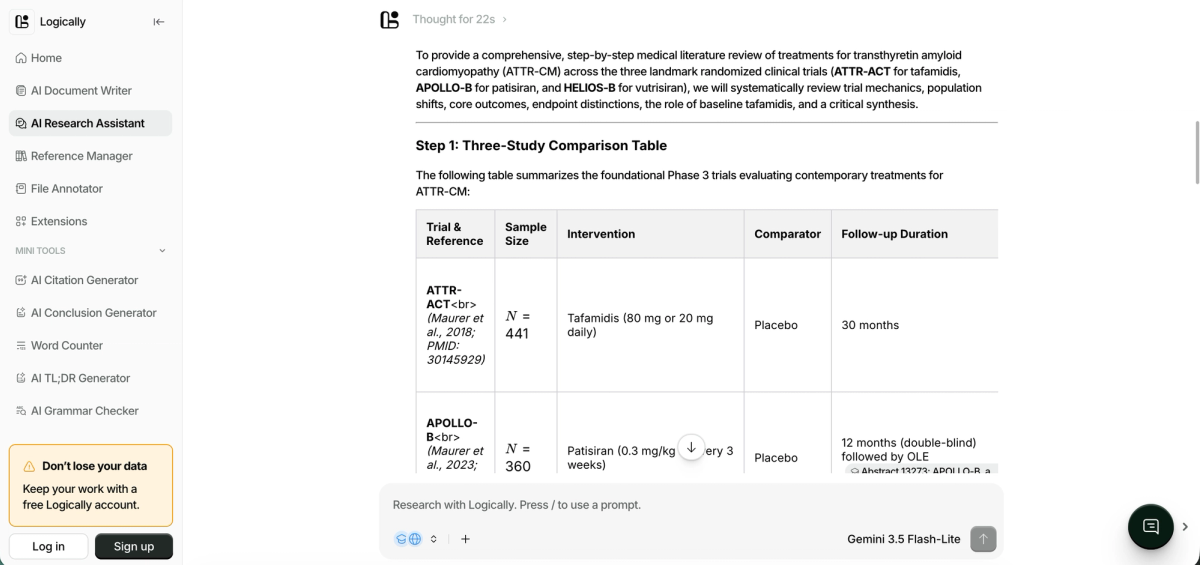
One limitation is visible: the captured table contains raw line-break markup in part of a citation cell, and the remainder of the response falls outside the frame. These are observations about this screenshot, not evidence of systematic problems across Logically. The image also does not provide enough context to independently verify all downstream citations, endpoint handling, or the completed review narrative.
Noah AI: Clinical Evidence Matrix from the Same Research Case
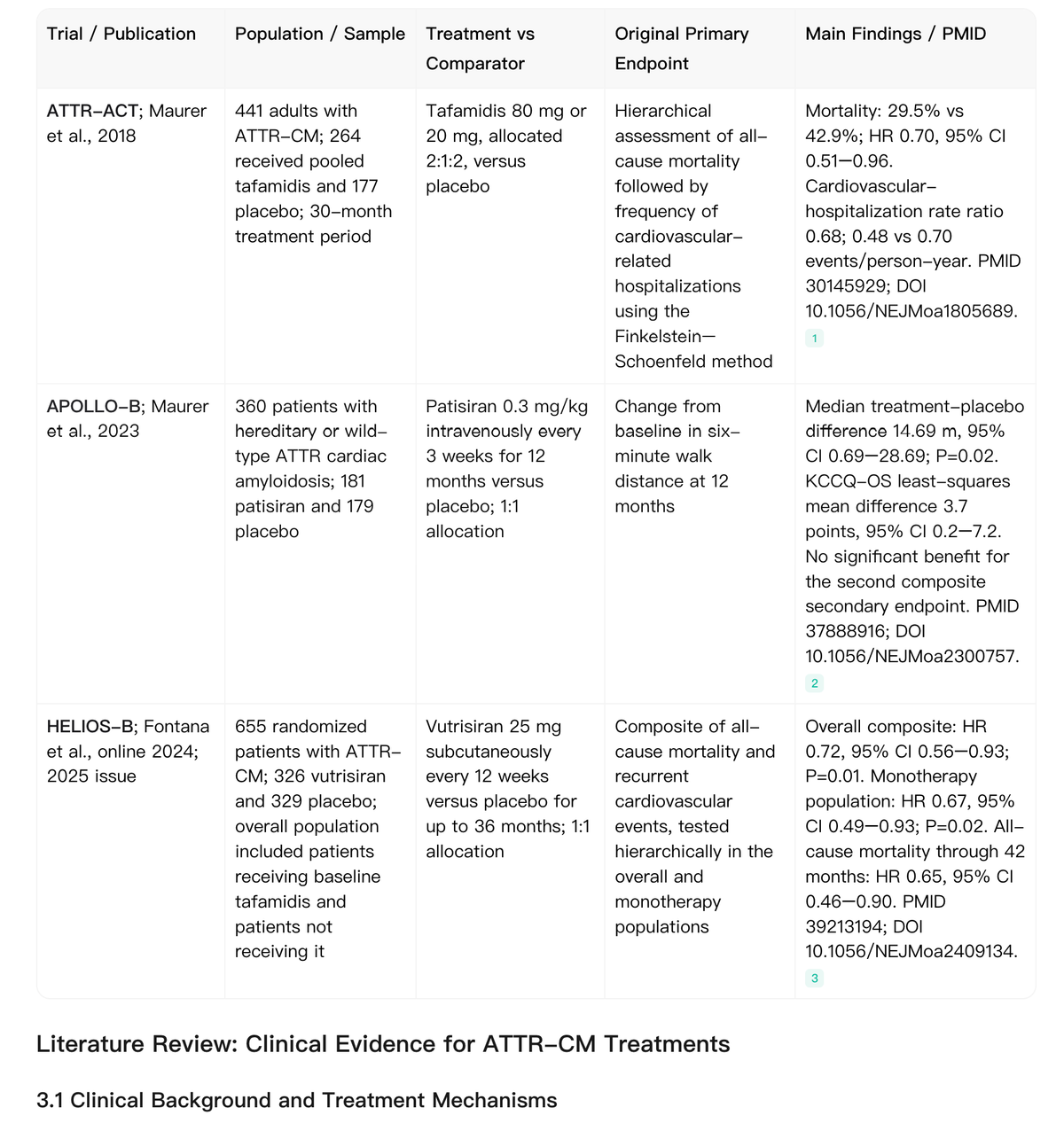
The supplied Noah report produced a five-column table comparing the three original trials by population, treatment, primary endpoint, and major findings. It linked the trials to PubMed identifiers and treated follow-up publications as secondary evidence rather than additional independent trials.
What the original randomized trials actually reported
| Original trial | Drug and primary endpoint | Selected original finding | Original source |
|---|---|---|---|
| ATTR-ACT (2018) — 441 randomized | Tafamidis; hierarchical mortality and cardiovascular-related hospitalization assessment over 30 months | All-cause mortality 29.5% vs 42.9%; HR 0.70 (95% CI 0.51–0.96). CV hospitalization rate ratio 0.68. | [PMID 30145929](https://pubmed.ncbi.nlm.nih.gov/30145929/) |
| APOLLO-B (2023) — 360 randomized | Patisiran; change in six-minute walk distance at 12 months | Median treatment–placebo difference 14.69 m (95% CI 0.69–28.69; P=0.02). This was not a primary mortality endpoint. | [PMID 37888916](https://pubmed.ncbi.nlm.nih.gov/37888916/) |
| HELIOS-B (2025 issue; online 2024) — 655 randomized | Vutrisiran; all-cause death and recurrent cardiovascular-event composite | Overall primary composite HR 0.72 (95% CI 0.56–0.93). All-cause mortality through 42 months was a secondary outcome. | [PMID 39213194](https://pubmed.ncbi.nlm.nih.gov/39213194/) |
These results cannot be used as an unadjusted ranking of tafamidis, patisiran, and vutrisiran. ATTR-ACT used a hierarchical mortality/hospitalization analysis, APOLLO-B tested functional capacity, and HELIOS-B tested mortality combined with recurrent cardiovascular events. Population composition, follow-up periods, statistical methods, and background treatment were also different.
Working on a biomedical literature review? Use a clearly defined research question and verify important clinical claims against the original publications.
Try Noah AI for biomedical research
Noah AI: Cited Literature Review and Clinical Interpretation
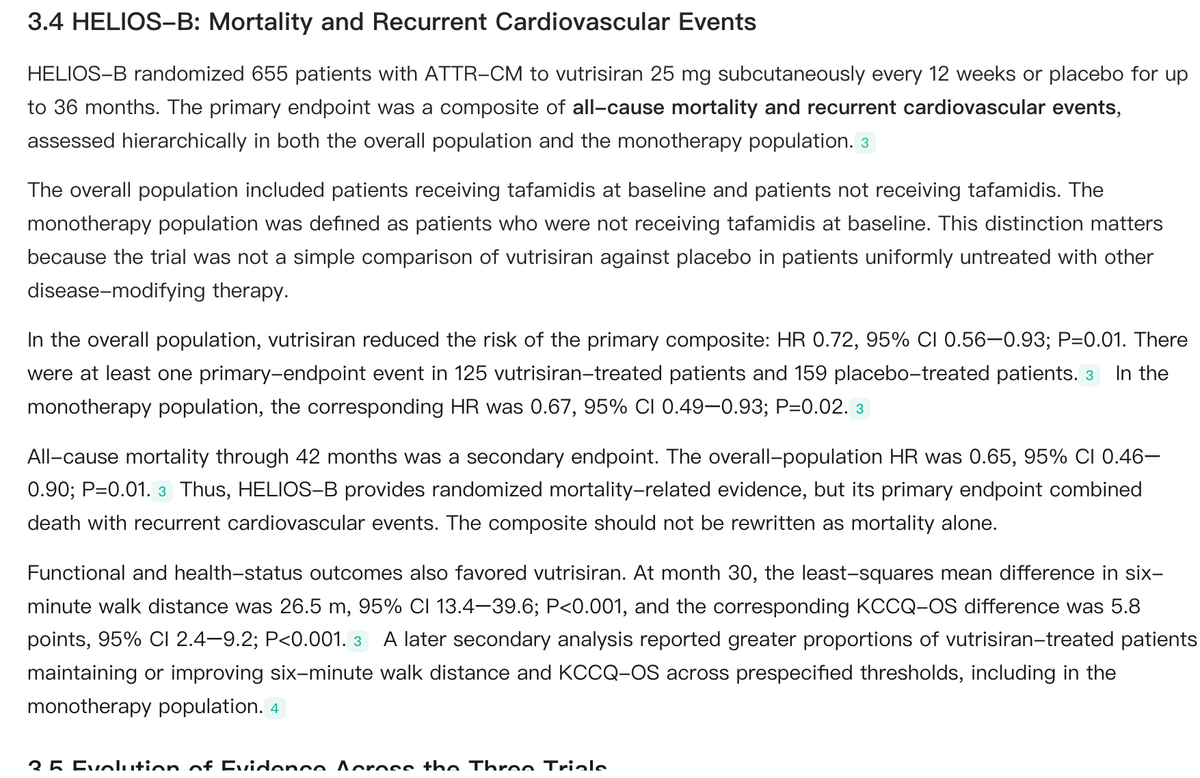
The Noah report also contained narrative sections, rather than only tables. Its HELIOS-B section distinguished the overall population from the monotherapy population, which excluded patients already receiving tafamidis at baseline. This distinction is important: the placebo-controlled trial did not directly randomize patients between different treatment combinations.
Three distinctions an accurate AI review must preserve
- Functional outcomes are not survival outcomes. APOLLO-B's primary measure was change in six-minute walk distance after 12 months. Its statistically significant functional result does not prove a mortality benefit. The report also noted that its second composite secondary endpoint did not show a significant benefit.
- A composite endpoint is not the same as any single component. HELIOS-B's primary composite combined all-cause mortality with recurrent cardiovascular events. Its reported all-cause mortality finding through 42 months was a secondary analysis, not a redefinition of the primary endpoint.
- Baseline treatment matters. HELIOS-B included patients taking tafamidis at baseline and patients not taking it. Its monotherapy subgroup was defined by baseline tafamidis use. That design does not provide a randomized head-to-head comparison proving combination therapy is better than either treatment alone.
Citation Quality: What Was and Was Not Verified
The Noah report explicitly described its main numerical verification as based on PubMed records and indexed abstracts. This is a useful source-provenance distinction: abstract-level checks can substantiate reported outcomes, but cannot automatically establish that every relevant supplementary analysis, protocol detail, or adverse-event table was reviewed.
Logically's screenshot visibly presents a structured multi-study answer, but the frame is not sufficient to audit its complete reference list or fully judge whether every subsequent claim is linked to a correct passage. A fair comparison should avoid filling those gaps with assumptions.
| Claim to audit | What the original studies support | Verification warning |
|---|---|---|
| Tafamidis reduced mortality in ATTR-ACT. | Mortality 29.5% vs 42.9% within the hierarchical analysis. | Keep the trial's original mortality/hospitalization hierarchy. |
| Patisiran improved the APOLLO-B primary outcome. | Six-minute walk difference 14.69 m at month 12. | Do not turn functional improvement into a survival claim. |
| Vutrisiran reduced HELIOS-B events. | Overall primary composite HR 0.72; secondary all-cause mortality HR 0.65 through 42 months. | Do not label the primary composite as mortality alone. |
| The three drugs can be ranked by their trial hazard ratios. | No direct randomized three-drug comparison was provided by these trials. | Different endpoints and populations invalidate naïve cross-trial ranking. |
Noah AI vs Logically: Which Should You Choose?
Consider Noah AI when the work begins with a biomedical question and the desired result is a structured clinical research report: trial selection, source-linked findings, endpoint interpretation, and a narrative synthesis with explicit limitations.
Consider Logically when you want a more general academic workspace combining research assistance, reference management, annotation, and writing. Its documented document-retrieval and academic-search modes may be particularly relevant when organizing a broader literature workflow.
These are workflow distinctions, not a measured accuracy ranking. The available screenshots confirm one Noah report and one partial Logically response, not a controlled benchmark across representative research tasks.
Frequently Asked Questions
Is Logically the same product as Afforai?
Yes. Logically's own documentation describes its rebranding from Afforai. You may encounter both names in older guides and discussions.
Can Logically help generate literature reviews?
Its official materials describe AI research assistance, academic search, uploaded-document research, and reference workflows. The real screenshot in this comparison shows an initial three-study answer, but not a full independently audited final review.
Can Noah AI analyze multiple clinical studies?
The supplied ATTR-CM report demonstrates a three-study evidence matrix and connected narrative synthesis. That single example does not establish performance across all medical specialties or study designs.
Which tool is better for citation verification?
No tool should be assumed more accurate without consistent, controlled testing. Confirm original titles, PMID/DOI, endpoint definitions, numerical effects, and whether the source actually supports the claim.
Why does APOLLO-B need special care in a literature review?
Its prespecified primary endpoint was six-minute walk distance at 12 months, not mortality. A review that calls it a mortality trial would overstate the evidence.
Can AI rank ATTR-CM treatments from separate trials?
Not reliably from separate placebo-controlled hazard ratios alone. Patient populations, outcome definitions, background therapies, and timepoints differ; direct comparative designs are required for strong head-to-head conclusions.
Final Takeaway
Noah AI and Logically can both be relevant to AI-assisted literature review work, but their published workflows and the available test evidence should not be conflated. Here, the Noah report visibly provided a biomedical trial matrix and cited clinical synthesis. The captured Logically response visibly organized the same three trials in an opening comparison table; the complete output was not available for audit.
For medical literature reviews, the priority is not the number of generated paragraphs. It is whether the answer preserves original endpoints, reports uncertainty, and links claims to verifiable research.
Explore a question-led medical research workflow.