
Noah AI vs Paper Digest for Cited Literature Review Generation (2026)
Linda
Compare Noah AI and Paper Digest for cited literature review generation in 2026, with real biomedical research screenshots, primary-study evidence and citation checks.
Which workflow better matches a biomedical researcher's needs: a question-driven AI research agent or a topic-driven literature review generator? This comparison looks at Noah AI and Paper Digest through the same research area—anti-amyloid monoclonal antibodies in early Alzheimer's disease—with special attention to source citations, evidence interpretation, and what we could actually see in the tools.
Topic: Early Alzheimer's disease · Four priority original publications · Assessment prepared: October 25, 2026
Quick takeaway
Noah AI: demonstrated here — Its Deep Research output included a five-row original-trial evidence matrix and coherent, cited prose distinguishing amyloid plaque reduction from measured clinical benefit.
Paper Digest: demonstrated here — The visible Quick Review result presented a topical Related Work bibliography linking to relevant systematic reviews and meta-analyses. A comparable generated narrative was not captured.
These are observed workflow differences, not a controlled head-to-head accuracy benchmark. Noah received a detailed prompt specifying original trials, clinical endpoints and source checks; Paper Digest received a shorter topic query in its Quick Review interface. The tools offer different input controls and the available screenshots show different stages or portions of their output.
What is Paper Digest?
Paper Digest Literature Review is a topic-driven academic research tool. According to its official product description, users can enter keywords, define a subject area and time range, find influential research items, and generate a literature review linked to indexed source records. Paper Digest offers a shorter default review and a longer account-based Extensive Review. It also describes a non-LLM generation option.
This makes Paper Digest relevant to researchers who want rapid discovery and an overview of an unfamiliar field. However, a source appearing in a list does not by itself establish whether every statement in a generated review is supported by that source. Claim-level verification is still necessary.
Fair comparison: Paper Digest is not merely a paper-summary tool. Its official materials explicitly describe literature review generation. The screenshot available for this article, however, shows its Related Work section, not the complete generated prose.
Noah AI vs Paper Digest: workflow comparison
| Aspect | Noah AI | Paper Digest |
|---|---|---|
| Entry point | Agent → Deep Research | Literature Review → Quick Review |
| Input style | Detailed research question, specified source set and validation rules | Topic keywords and configurable search dimensions |
| What the screenshots show | Question input, structured primary-study table, cited narrative synthesis | Selected topic, Quick mode and a Related Work bibliography |
| Original clinical data | Visible primary-trial results and scale-specific findings | Not assessable from the captured bibliography alone |
| Writing quality | A continuous analytical section is visible | Full narrative prose not captured; no like-for-like assessment |
| Sources and citations | Numbered source markers in tables and prose; verification is still required | Linked research titles in Related Work; claim-level links not assessed |
| Best apparent fit | Evidence-first clinical review drafting and explicit interpretation limits | Rapid topical literature exploration; broader writing capabilities are officially documented |
The distinctions above are descriptive. They are not measured rankings of research accuracy, speed, completeness, or overall writing quality.
Test case: anti-amyloid therapies in early Alzheimer's disease
We examined the same biomedical topic in both environments: lecanemab, donanemab and gantenerumab for biomarker-confirmed early Alzheimer's disease, focusing on cognitive or functional outcomes, amyloid-PET reduction and amyloid-related imaging abnormalities (ARIA).
The Noah prompt identified the original publications for TRAILBLAZER-ALZ, CLARITY AD, TRAILBLAZER-ALZ 2 and GRADUATE I/II. The last publication covers two distinct randomized trials, so the evidence matrix correctly used five trial rows while still representing four primary publications.
| Publication | Original evidence | Why it matters |
|---|---|---|
| TRAILBLAZER-ALZ (2021) | Donanemab phase 2; [PMID 33720637](https://pubmed.ncbi.nlm.nih.gov/33720637/) | Early iADRS signal, with mixed secondary outcomes |
| CLARITY AD (2023 issue) | Lecanemab phase 3; [PMID 36449413](https://pubmed.ncbi.nlm.nih.gov/36449413/) | CDR-SB outcome and amyloid-PET changes |
| TRAILBLAZER-ALZ 2 (2023) | Donanemab phase 3; [PMID 37459141](https://pubmed.ncbi.nlm.nih.gov/37459141/) | iADRS and CDR-SB results in prespecified populations |
| GRADUATE I / II (2023) | Two gantenerumab trials in one publication; [PMID 37966285](https://pubmed.ncbi.nlm.nih.gov/37966285/) | Amyloid reduction without significant primary CDR-SB improvement |
Evidence-cutoff correction: The Noah input screenshot visibly states October 26, 2026, although the comparison was prepared on October 25, 2026. That future date is a prompt-entry discrepancy, not proof that later research was checked. This article uses established pre-cutoff original publications and does not claim a validated literature search through October 26.
Noah AI: From a Clinical Research Question to Cited Synthesis
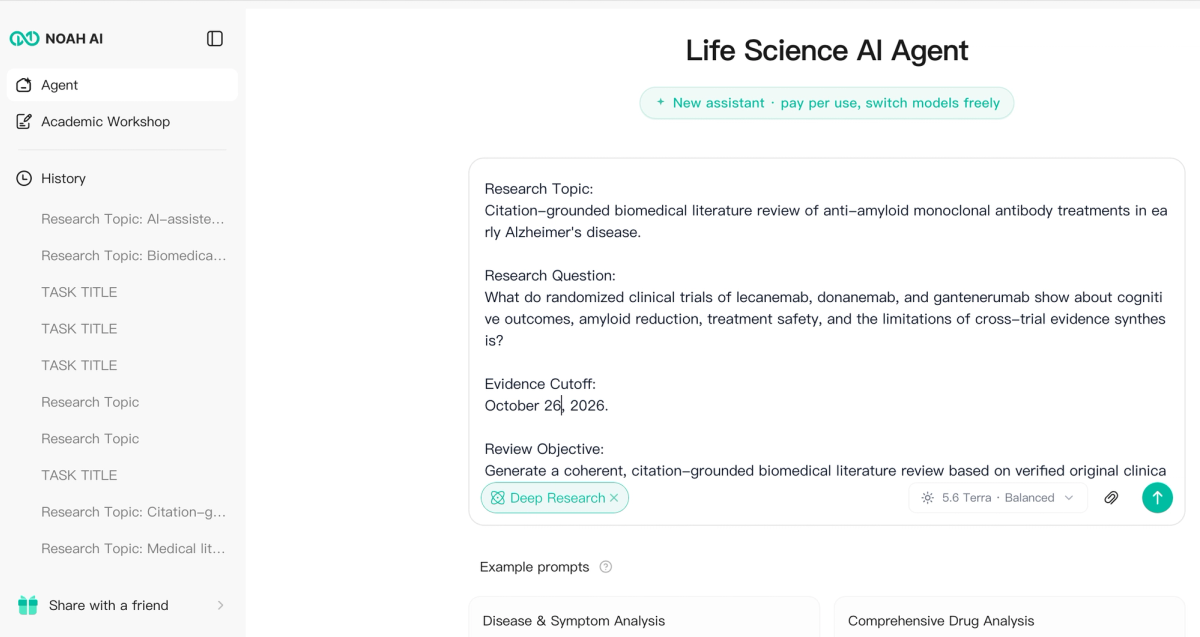
The Noah AI Agent was tasked with a source-grounded review. The prompt asked for verified original publications, outcome-specific interpretation, structured study evidence, and a distinction between biomarker efficacy and clinical benefit.
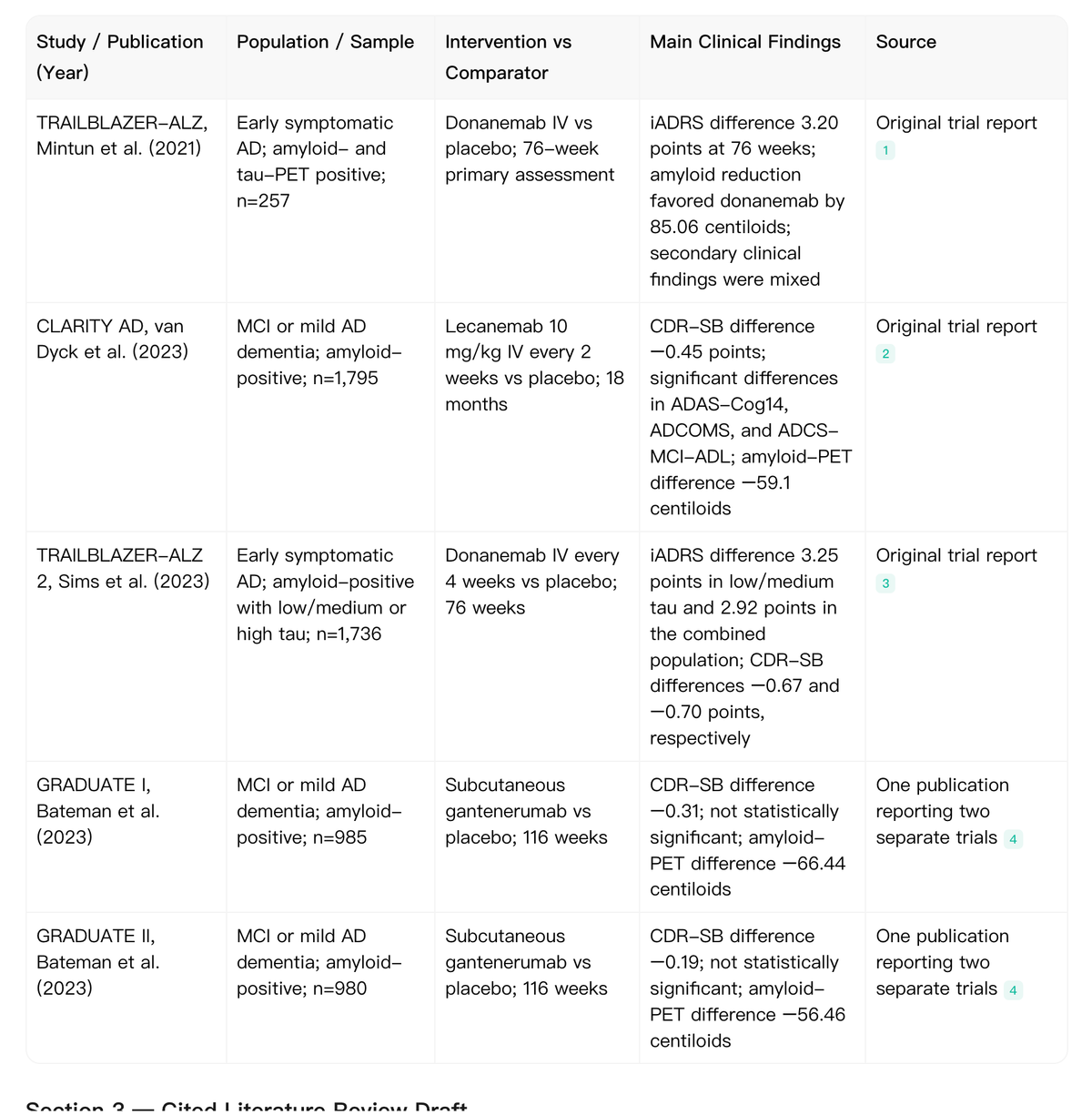
Step 1: Organizing four publications into five trial rows
The generated evidence matrix preserved intervention, sample and endpoint information. For CLARITY AD, it reported a between-group CDR-SB difference of −0.45 points at 18 months. For TRAILBLAZER-ALZ 2, it separated low/medium-tau and combined-population iADRS effects. GRADUATE I and II were retained as separate trials with nonsignificant primary clinical results.
Step 2: Writing beyond a list of findings
In the cited prose section, Noah explained why amyloid-PET reduction must not automatically be interpreted as a guaranteed cognitive benefit. The output contrasted CLARITY AD and TRAILBLAZER-ALZ findings with the GRADUATE I/II results, then described differences in trial design, clinical endpoints and biomarker measurement as limits on indirect comparison.
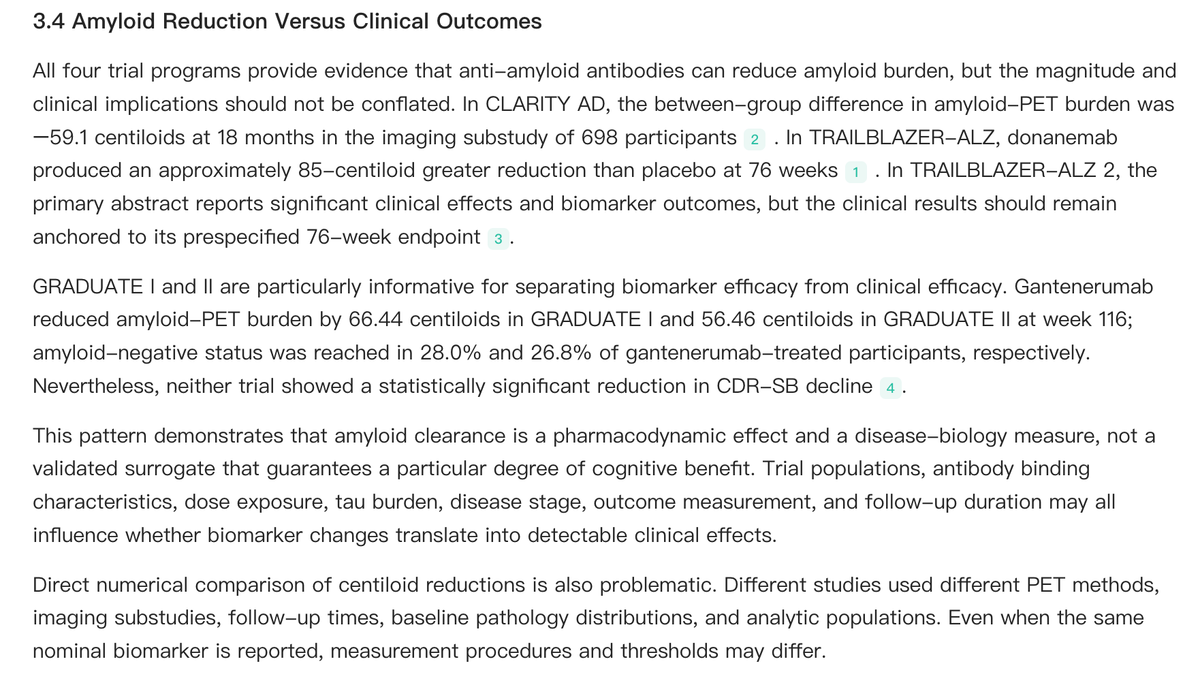
That distinction is important for biomedical review writing: summarizing that a therapy reduces a biomarker is different from demonstrating that it slows clinical deterioration. Likewise, showing a statistically significant effect on one scale does not allow a direct numerical ranking against an effect measured using another scale.
Build a cited biomedical literature review with Noah AI
Start with a research question, identify original studies and organize the supporting evidence into a readable review. Review all medical claims against their primary sources before publication.
Registration availability and any introductory free credits are subject to the current signup offer.
Paper Digest: Topic-Based Related Work Discovery
The Paper Digest screenshot shows the Literature Review interface with a topic on anti-amyloid monoclonal antibodies, Review mode, Papers, Any Time and Quick selected.
The visible result begins with Related Work, presenting linked scholarly titles. Several listed items are systematic reviews or meta-analyses rather than the four original randomized-trial publications used to structure the Noah analysis. That is a difference in the displayed source set and section, not evidence that Paper Digest cannot cite original trials or generate prose elsewhere in its workflow.
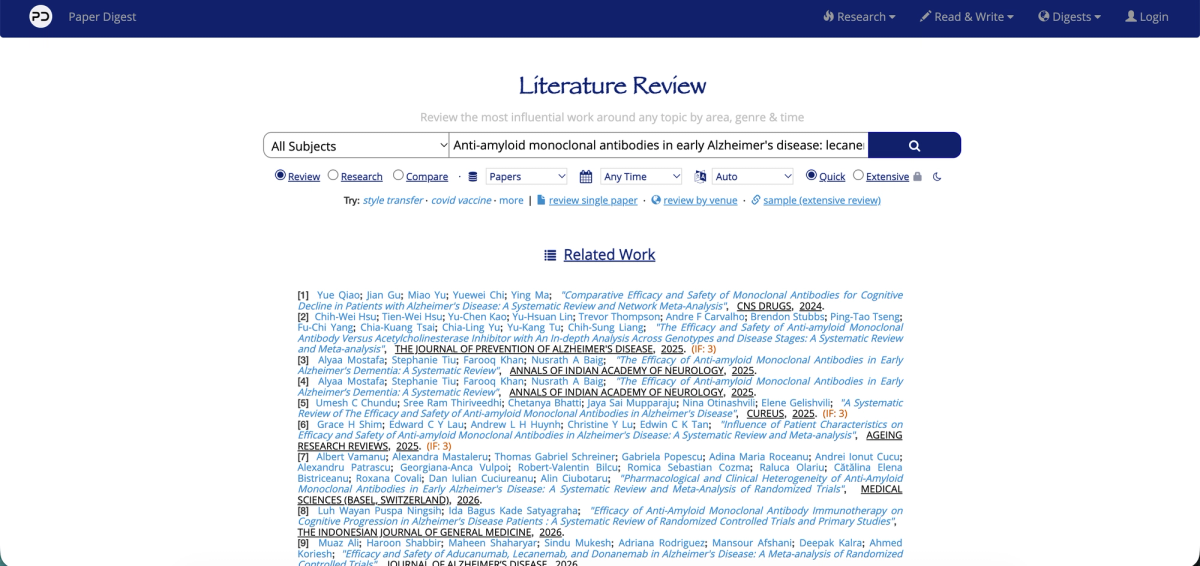
What this screenshot can and cannot prove
- Visible and confirmable: Paper Digest accepted the topic query, displayed its review settings and returned a list of related scholarly references.
- Not confirmable from this screenshot: How Paper Digest expressed a full clinical synthesis, whether it discussed negative trials accurately, or whether individual statements linked to correctly supporting primary studies.
Paper Digest's official documentation describes fluent, source-linked review prose and a longer Extensive Review option. Those published capabilities should not be dismissed merely because the provided Quick Review screenshot focuses on its bibliography.
Why Citation Checking Matters in an AI-Written Biomedical Review
Every listed publication can be genuine while an AI-generated statement about that publication is still exaggerated or incorrect. The question is not only "Is the citation real?" but also "Does the cited study actually support this sentence, endpoint, population and timeframe?"
| Example statement | Primary-source check | Interpretation boundary |
|---|---|---|
| Lecanemab slowed worsening on CDR-SB at 18 months | CLARITY AD: adjusted difference −0.45 points (95% CI −0.67 to −0.23) | Both groups declined; the finding is less worsening, not reversal of Alzheimer's disease |
| Donanemab improved the primary integrated score | TRAILBLAZER-ALZ 2: iADRS difference 3.25 points in the low/medium-tau population at 76 weeks | Do not treat the iADRS scale as numerically identical to CDR-SB |
| Gantenerumab substantially reduced amyloid burden | GRADUATE I/II: amyloid-PET decreased, while primary CDR-SB differences were not statistically significant | Biomarker reduction does not automatically establish clinical efficacy |
| Anti-amyloid therapy carries ARIA risk | Adverse-event results are reported in trial publications | Definitions, MRI schedules and denominators differ across trials; percentages are not a fair cross-drug ranking |
For the Noah screenshot, source markers can be seen within the evidence table and prose, while original PMIDs are linked in this article. For Paper Digest, linked bibliography items are visible, but the provided screenshot does not establish claim-to-source alignment within a generated narrative. Neither observation eliminates the need for independent scientific verification.
When Should You Use Noah AI or Paper Digest?
Consider Noah AI when… You need a biomedical question-driven research process with an explicit list of original studies, endpoint-specific evidence tables, a narrative discussion of conflicting results and cautions about statistical or clinical interpretation. The observed Noah task demonstrates these outputs for this case.
Consider Paper Digest when… You want to begin with a concise topic and explore related scholarly work quickly. Its official product materials also describe full literature review generation, review filters and export options. The captured Quick Review result substantiates the discovery and bibliography portion of that workflow.
Can the tools be used together? Potentially. A researcher could use topical discovery to locate relevant review articles and then verify the underlying randomized trials in a separate primary-evidence review. However, the workflow used in this article did not test an automated integration between the two services.
Practical conclusion: For this particular evidence-first drafting task, Noah's supplied output demonstrates more of the complete clinical narrative and numerical interpretation. We cannot infer that its literature-review writing quality is universally better than Paper Digest from these four screenshots alone.
Try a Source-Grounded Medical Research Workflow
Explore clinical evidence, organize original studies and draft a cited interpretation in Noah AI. Validate sources and statistical statements before reusing them in scholarly writing.
Check the current signup page for available free credits and payment requirements.
Frequently Asked Questions
Does Paper Digest generate literature reviews or only paper lists?
Paper Digest officially offers topic-based literature review generation, including source-linked review text. The screenshot used here shows its Related Work section, which alone does not represent its entire writing functionality.
Does Noah AI support cited biomedical literature review drafting?
In the example shown here, Noah AI generated a structured clinical evidence matrix and a connected literature-review discussion with numbered citations. The references and medical claims still require human checking.
Is a real paper citation proof that an AI claim is correct?
No. It is necessary to check whether a specific publication supports the stated patient population, endpoint, numerical result, timepoint and conclusion.
Why use lecanemab, donanemab and gantenerumab for the comparison?
These programs illustrate why a review must separate biomarker responses from cognitive or functional outcomes and preserve differences between CDR-SB and iADRS measurements.
Can I compare Alzheimer's drug efficacy by subtracting the trial percentages?
No. The trials differ in design, populations, endpoints, dosing, follow-up and outcome ascertainment. Unadjusted cross-trial percentages are not a validated head-to-head comparison.
Can the review replace a formal systematic review or medical judgment?
No. This is a focused demonstration of AI-supported review drafting. It is not a PRISMA-compliant systematic review, meta-analysis, clinical guideline or individualized treatment recommendation.