
Noah AI vs Paperguide for AI Literature Review Workflows (2026)
Linda
Compare Noah AI and Paperguide for AI literature review workflows in 2026, with real screenshots of biomedical study comparison, synthesis, and reports.
AI Literature Review Tools · Workflow Comparison · 2026
An AI literature review should do more than locate papers. Researchers need to distinguish study designs, compare populations and interventions, preserve important differences between outcomes, and trace conclusions back to reliable sources. Noah AI and Paperguide both support AI-assisted research, but they organize this work in different ways.
To make the comparison concrete, we used the same biomedical research question in both platforms: How do supervised exercise interventions affect fatigue and physical functioning during breast cancer chemotherapy? Below, we show real screenshots of a Noah AI Deep Research output and a Paperguide Research Agent literature report, then explain what the evidence does—and does not—establish.
Quick Takeaway: Noah AI or Paperguide?
Choose Noah AI when your starting point is a specific biomedical research question and you need a structured, source-traceable synthesis that keeps population, comparator, endpoint, and interpretation differences visible.
Choose Paperguide when your research involves collecting, organizing, extracting, and working with academic papers in a dedicated literature-review environment. Its separate Literature Review Agent also has documented screening and selection workflows.
Neither output should be treated as independently verified evidence. The meaningful distinction is workflow fit—not an unsupported claim that either platform always finds more papers or produces more accurate conclusions.
How We Compared the Two Tools
Research question: In adults receiving adjuvant chemotherapy for breast cancer, how do supervised aerobic and/or resistance exercise interventions affect cancer-related fatigue and physical functioning compared with usual care, relaxation controls, or alternative exercise regimens?
Evidence cutoff: October 19, 2026. We prioritized randomized controlled trials and asked the tools to preserve important differences in trial design and results.
Testing disclosure. We directly ran Noah AI in its Agent interface with Deep Research enabled and the visible 5.6 Terra · Balanced model configuration. In Paperguide, our screenshot shows a Research Agent session and its Literature Report panel. That is not evidence that we separately tested Paperguide's dedicated Literature Review Agent or its formal Systematic Review product.
We assessed the visible workflow and outputs, not search recall, citation accuracy, medical validity, time-to-completion, or statistical performance under controlled benchmark conditions. For the biomedical claims below, the original studies are linked directly to PubMed.
Is Paperguide Free in 2026?
Yes. According to Paperguide's published pricing, its Free plan includes 2,000 AI credits per month, access to a Research Agent, and listed literature-review and deep-research report features. The free Extract Data table is limited to up to five columns and ten papers per table. Agent tasks consume credits, so the presence of a feature in the Free plan does not guarantee that every lengthy review will fit the available allowance.
Noah AI also offers free starting credits for new users. The important comparison is not simply whether a platform has a free entry point, but whether its available credits and tools cover your specific research task. Always check current limits before planning a large review.
Noah AI vs Paperguide: Side-by-Side Comparison
| Comparison Area | Noah AI | Paperguide |
|---|---|---|
| Core workflow | Biomedical question to structured evidence synthesis | Research question and paper-centered literature workflow |
| Directly tested here | Agent with Deep Research | Research Agent with a Literature Report |
| Visible output | Core trial-comparison table and cross-study synthesis | Literature report with a study-level table |
| Research focus | Medical and life-science evidence interpretation | Broader academic research and literature management |
| Paper screening | Not evaluated as a formal screening workflow in this test | Documented for its separate Literature Review Agent |
| Source verification | Check citations and trial-level claims against original publications | Check included studies, identifiers, extracted fields, and citations against source records |
| Best fit | Focused biomedical evidence synthesis | Paper discovery, organization, extraction, and review drafting |
Paperguide's separate agent workflow is described in its official Literature Review Agent documentation. The feature exists, but that should not be confused with the specific Research Agent session shown below.
Why This Biomedical Literature Review Is Difficult
The research question sounds straightforward: does exercise help women receiving chemotherapy for breast cancer? But the underlying trials do not all test the same comparison or measure the same primary endpoint.
- Different comparators: usual care, supervised relaxation, and lower-versus-higher exercise doses answer different questions.
- Different outcomes: fatigue, physical functioning, aerobic fitness, and muscular strength cannot be treated as interchangeable.
- Primary versus secondary findings: an improvement in a secondary or subgroup measure is not the same as success on a trial's primary endpoint.
- Evidence traceability: claims should lead back to an identifiable original publication, not only to an AI-generated sentence.
This is a useful test because a credible literature review must preserve these distinctions rather than collapsing all trials into a single positive or negative conclusion.
Noah AI Output: From Biomedical Question to Evidence Synthesis
Step 1: Start with a Focused Research Question
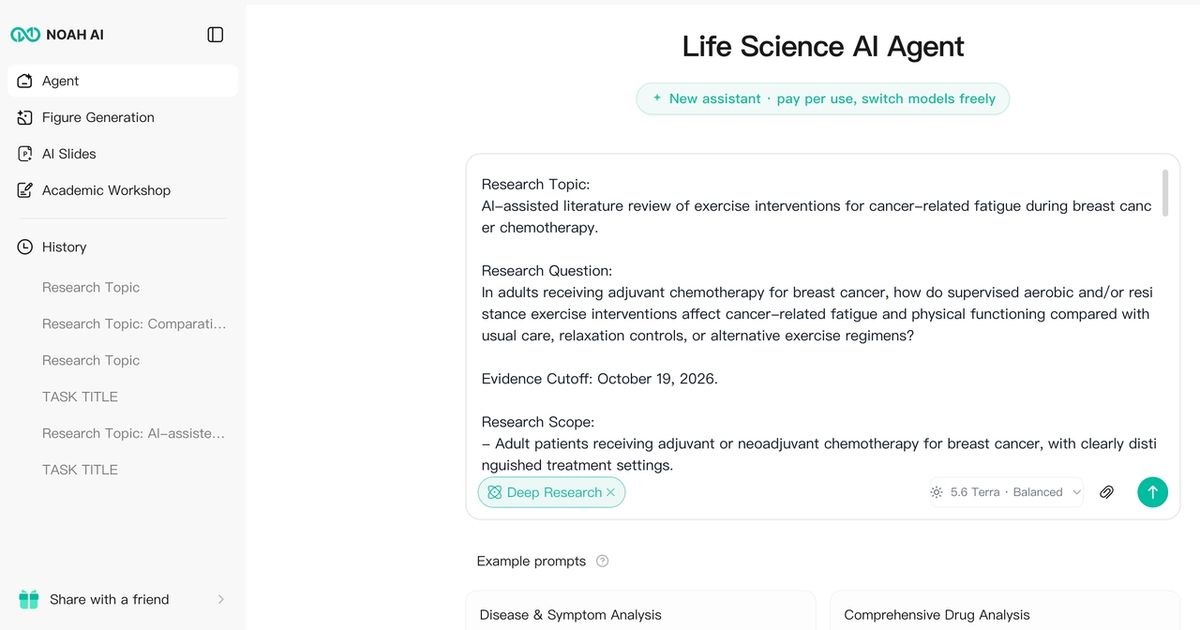
In Noah AI, we entered the breast cancer chemotherapy exercise question, specified the evidence cutoff, prioritized randomized trials, and requested study-level comparisons followed by a cross-study synthesis. The screenshot shows the real Agent input, the selected Deep Research mode, and 5.6 Terra · Balanced.
Step 2: Compare the Original Randomized Trials
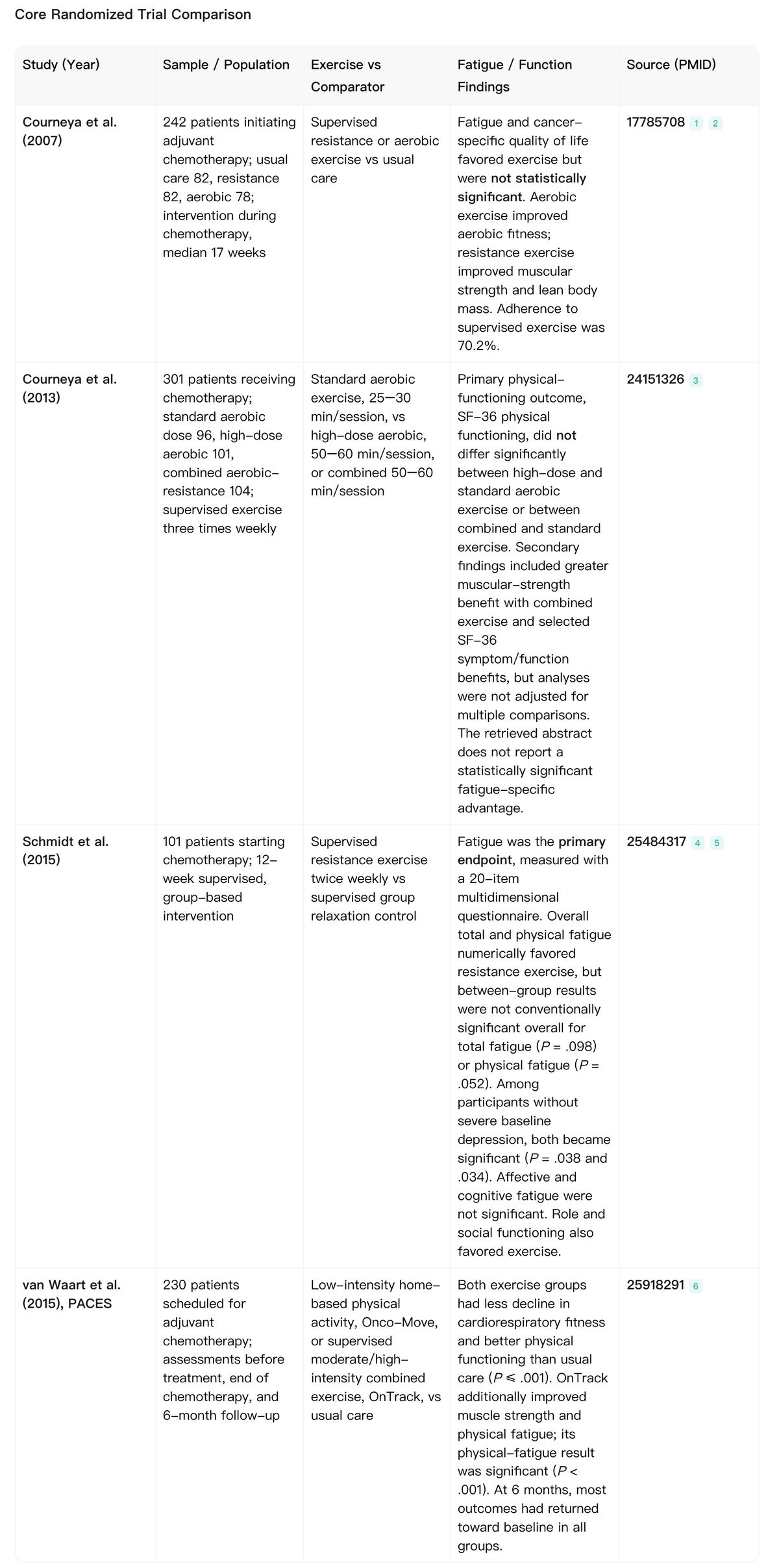
Noah produced a Core Randomized Trial Comparison table organized around study population, exercise intervention and comparator, fatigue or functional findings, and source identifiers. Rather than presenting four papers as interchangeable, the report retained the different comparison groups and endpoint qualifications.
The four prioritized source studies can also be checked independently:
| Original Study | Population / Comparison | Interpretation Relevant to This Review |
|---|---|---|
| Courneya et al., 2007 (PMID: 17785708) | 242 patients; aerobic or resistance exercise versus usual care | Fitness and strength benefits were reported, while fatigue differences favored exercise without reaching statistical significance. |
| Courneya et al., 2013 (PMID: 24151326) | 301 patients; standard aerobic versus higher-dose aerobic or combined exercise | Neither higher-dose nor combined exercise significantly improved the primary SF-36 physical-functioning comparison over standard aerobic exercise. |
| Schmidt et al., 2015 (PMID: 25484317) | 101 patients; resistance exercise versus group relaxation | Overall total- and physical-fatigue comparisons were not conventionally significant; benefits were significant in a reported subgroup. |
| van Waart et al., 2015 PACES (PMID: 25918291) | 230 patients; low-intensity or supervised combined exercise versus usual care | Exercise groups had better physical-function outcomes than usual care, with additional physical-fatigue benefits reported for supervised combined exercise. |
These summaries are not a pooled effect estimate. They indicate how the trials differed and why a literature review needs more than a headline conclusion.
Step 3: Synthesize What the Studies Agree—and Disagree—On
Noah's next output was the Cross-Study Evidence Synthesis. It examined fatigue, physical functioning, exercise modality, comparator choice, and overall uncertainty. Importantly, the synthesis did not declare a single exercise regimen the definitive winner.
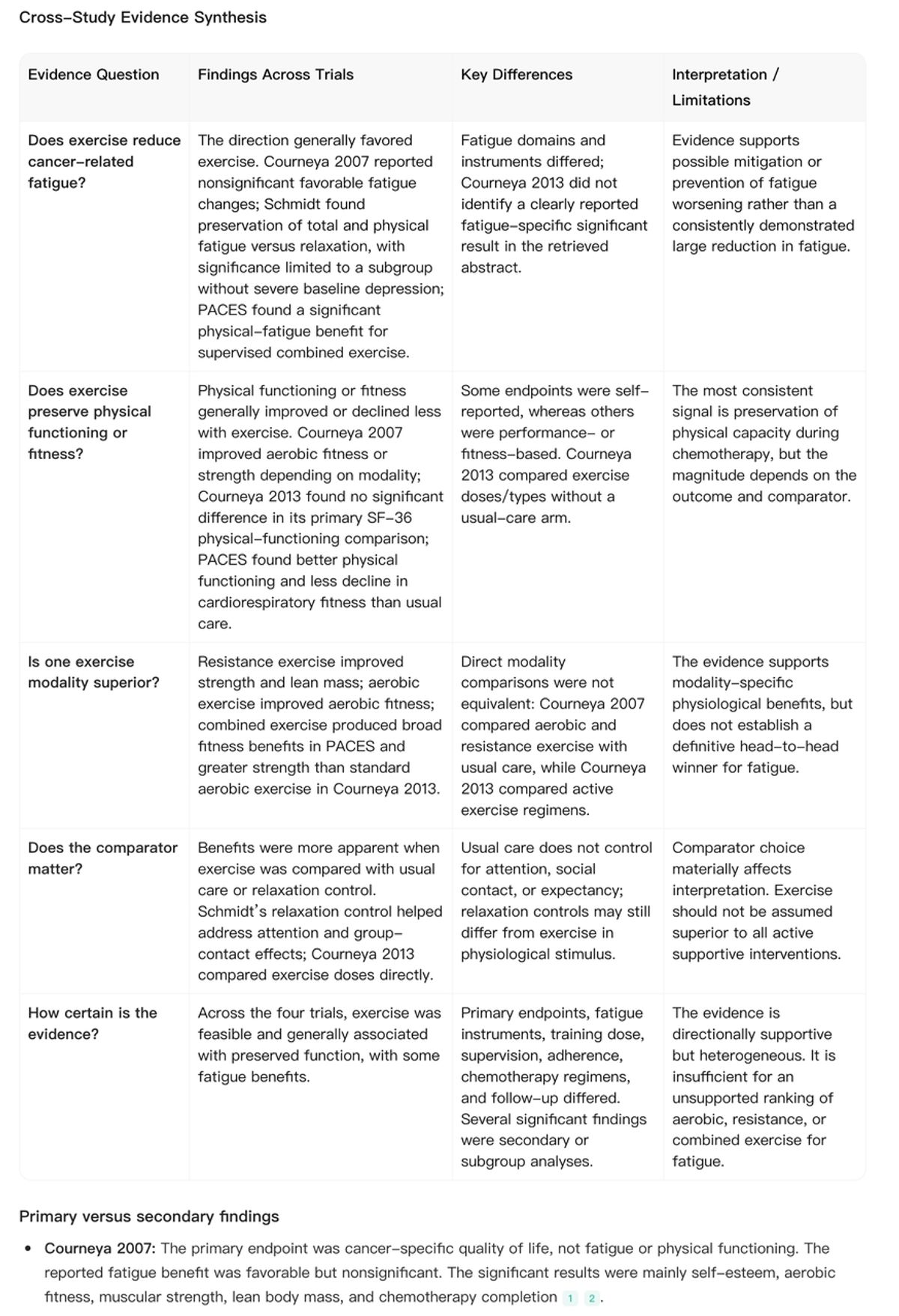
What the result shows: The overall evidence is more consistent for preserving physical capacity during chemotherapy than for a uniform, statistically significant reduction in fatigue across all four trials. Different interventions, control conditions, and outcome instruments constrain direct comparison. The report also identified gaps involving exercise dose, adherence, outcome standardization, and post-treatment follow-up.
What it does not prove: These screenshots do not establish that Noah systematically identified every eligible study, performed a formal risk-of-bias assessment, or produced a PRISMA-compliant review. The visible output is best described as a focused narrative evidence review.
Turn a Biomedical Question into a Reviewable Evidence Summary
Use Noah AI to explore original medical studies, compare trial designs and outcomes, and draft a structured synthesis with sources that researchers can verify.
Free Credits Available · No Credit Card Required
Paperguide Output: A Research Agent Literature Report
We entered a closely matched question in Paperguide, including the breast cancer chemotherapy population, exercise interventions, priority randomized trials, evidence cutoff, and request for cited cross-paper comparison. The captured screen shows a Research Agent conversation on the left and a generated Literature Report on the right.
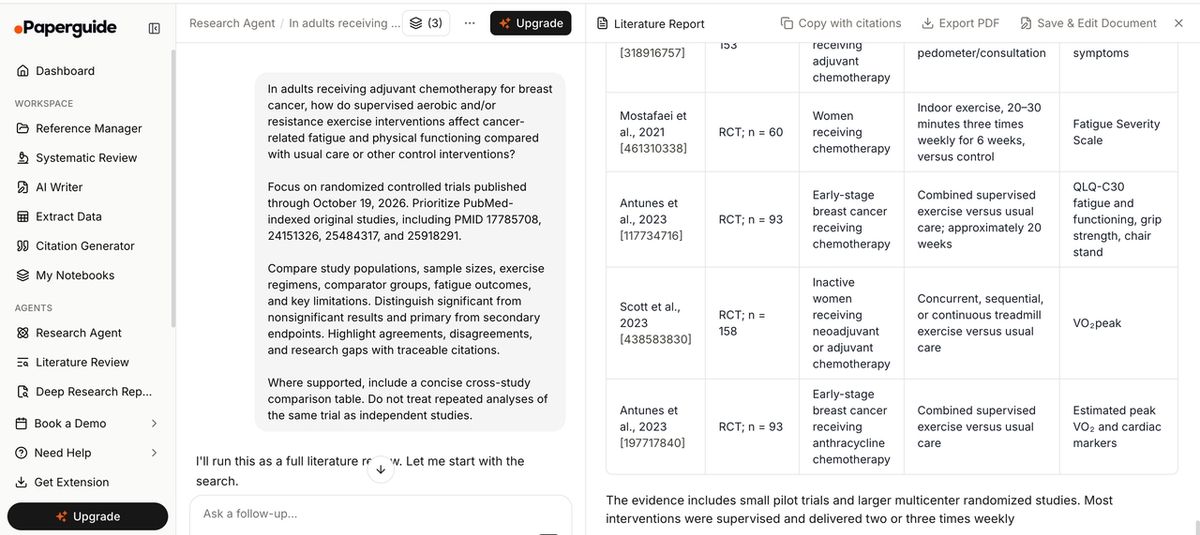
The interface demonstrates a paper-oriented reporting experience. The visible report organizes studies by author or year, study design and sample, population, intervention, and measured outcome. That structure can be useful when researchers want to inspect a set of retrieved papers while drafting a review.
However, a single partial report screenshot cannot verify every cited paper, identifier, extraction, or conclusion. We have not treated the additional study rows visible in this screenshot as independently verified biomedical findings. For publication-quality work, researchers should open the underlying papers and confirm their bibliographic identifiers and outcome data.
What About Paperguide's Dedicated Literature Review Agent?
Paperguide's official documentation describes a separate Literature Review Agent that can plan a review, search sources including PubMed, screen candidates, extract study data, and produce a cited review report. Paperguide also offers other research and systematic-review workspaces. These are documented product capabilities, not features independently tested in the screenshot above.
What Did the Two Workflows Reveal?
| Observed Aspect | Noah AI Screenshot | Paperguide Screenshot |
|---|---|---|
| Entry point | Biomedical task entered into an Agent using Deep Research | Question entered into Research Agent |
| Research organization | Two distinct tables: individual trials and cross-study synthesis | Literature Report with a study-level table |
| Evidence emphasis | Outcome interpretation, trial comparators, and limitations | Study metadata and structured report presentation |
| What remains unverified | Exhaustive search coverage and formal systematic-review methods | Completeness of literature retrieval and verification of all displayed study references |
Both tools generated relevant research-oriented outputs. In this specific example, Noah's captured results make the distinction between trial-level evidence and cross-trial interpretation especially visible. Paperguide's captured result emphasizes a report workspace and structured study display. This is an observation about the supplied screenshots, not a general performance ranking.
When Should You Use Noah AI?
- You are starting with a medical, clinical, drug-development, or life-science research question.
- You need a cited evidence brief rather than only a list of potentially relevant papers.
- You want study populations, interventions, endpoints, and comparators explicitly separated.
- You need help describing evidence gaps and interpretation limits across clinical studies.
If you want to explore the workflow further, see How to Conduct a Medical Literature Review with AI or open the Noah AI research Agent.
When Should You Use Paperguide?
- You need an academic environment for collecting, organizing, and reviewing papers.
- You plan to inspect study-level data and develop a literature-review draft in a dedicated workspace.
- You want to explore its separately documented screening, extraction, reference-management, or systematic-review functions.
- Your research spans disciplines beyond biomedical evidence synthesis.
The best Paperguide entry point depends on whether you want a Research Agent answer, the dedicated Literature Review Agent, or a formal Systematic Review workflow. These are not interchangeable modes.
Can You Use Noah AI and Paperguide Together?
Yes, as a researcher-managed workflow. For example, you could use Paperguide to find and organize candidate papers, verify the selected original studies, and then use Noah AI to formulate a focused biomedical comparison and evidence synthesis. Alternatively, use Noah to clarify key research questions before assembling a broader paper collection.
This is a manual workflow suggestion. It does not imply a verified direct integration or automatic transfer of references and reports between the two platforms.
Final Takeaway
Noah AI and Paperguide overlap in AI literature research, but they are not identical tools. The Noah AI test showed a biomedical Deep Research workflow that separated individual randomized trials from a cross-study synthesis, preserving key endpoint and comparator differences. The Paperguide test showed a Research Agent producing a Literature Report with a structured study table; its broader dedicated literature-review capabilities are described in official documentation.
For researchers whose immediate task is a structured, cited medical evidence synthesis, Noah AI is a reasonable tool to try. For those focused on paper organization, review management, extraction, and academic writing workflows, Paperguide offers relevant tools. In either case, original-paper verification remains essential.
Start Your Next Medical Literature Review with Noah AI
Ask a focused biomedical question, inspect the underlying evidence, and build a reviewable synthesis with clearly stated limitations.
Start Researching with Noah AI →
Free Credits Available · No Credit Card Required
FAQ: Noah AI vs Paperguide
Is Noah AI a Paperguide alternative for literature reviews?
Yes, for overlapping tasks such as finding evidence, comparing studies, and producing a cited synthesis. Noah AI is positioned around biomedical research, while Paperguide provides a broader paper-oriented academic research environment.
What is the main difference between Noah AI and Paperguide?
In this test, Noah AI's captured output emphasized trial-by-trial comparison and cross-study evidence interpretation. Paperguide's captured Research Agent report emphasized structured presentation of papers. Both may support additional workflows beyond what was visible in this test.
Can Paperguide generate an AI literature review report?
Yes. Its official pricing and documentation list literature-review reporting features. Our screenshot specifically shows a Research Agent session with a Literature Report; we did not separately benchmark the dedicated Literature Review Agent.
Is Paperguide free?
Paperguide publishes a Free plan with 2,000 monthly AI credits and defined feature limits. Usage and plan details can change, so check the official pricing page before relying on a particular allowance.
Can Noah AI compare multiple clinical research papers?
The real test shown in this article produced a structured comparison of four randomized trials and a cross-study synthesis. The result still requires researchers to verify citations, source interpretations, and any missing full-text evidence.
Can either tool replace a formal systematic review?
No AI-generated report alone establishes that a formal systematic review has been completed. A defensible review requires appropriate protocol, reproducible search methods, eligibility decisions, risk-of-bias assessment, documentation, and human verification for the specific review type.
Which tool is better for biomedical evidence synthesis?
For a focused clinical evidence brief like the exercise-and-fatigue example, Noah's visible structured synthesis is useful. Researchers needing formal screening or detailed paper-library workflows should also evaluate Paperguide's documented tools. The screenshots do not justify a universal accuracy ranking.