
Noah AI vs Petal for Multi-Paper Literature Analysis (2026)
Linda
Compare Noah AI vs Petal for multi-paper literature analysis in 2026, using CREDENCE, DAPA-CKD and EMPA-KIDNEY evidence and three real Noah screenshots.
Comparing several clinical papers requires more than collecting summaries. A useful research workflow must preserve differences in study populations, original endpoints, event rates, and citations. This guide compares Noah AI and Petal for multi-paper literature analysis, using three landmark chronic kidney disease (CKD) trials as a concrete example.Short answer: Noah AI is relevant when researchers begin with a biomedical question and need a structured, source-linked evidence brief. Petal is designed around managing, reading, and querying an existing document library. The better fit depends on the starting materials and research task—not an unverified claim that one tool is universally more accurate.
Quick Comparison: Noah AI vs Petal
| Dimension | Noah AI | Petal |
|---|---|---|
| Primary workflow | Question-led biomedical research and evidence reporting | Document-library organization and analysis |
| Starting materials | Clinical question, specified studies, and accessible external sources | Uploaded or imported documents organized in collections |
| Multi-paper output | Structured clinical comparisons and source-linked synthesis, as shown in the example below | Multi-doc Chat and AI Table, as documented by Petal |
| Reference handling | Biomedical source links and source verification within research reports | Document metadata, collections, annotations, and citations |
| Practical consideration | Clinical claims, access to sources, and comparisons still need verification | Full-text access, upload workflow, and advanced-feature eligibility matter |
| Verification in this article | Three real Noah screenshots from a CKD analysis | Official product documentation; no completed multi-doc output test |
Feature statements describe documented workflows and the example shown below. This is not a controlled performance benchmark.
What Is Petal?
Petal combines academic reference management with AI assistance. Its reference manager supports document collections, metadata, organization, and PDF-oriented research workflows. Petal also describes an AI Table for extracting and comparing information across documents, along with Multi-doc Chat for asking questions about a selected document collection.This makes Petal a natural candidate for researchers who already have a set of articles, such as three trial PDFs, and want a consistent way to query those files. Document availability is central: importing a PMID or DOI record supplies bibliographic metadata, but does not necessarily mean that the underlying full text has been imported and analyzed.Is Petal free? Petal's published plan comparison lists a Free plan with a limited trial of Multi-doc Chat and AI Table. It lists Multi-doc Chat as included in Advanced and Premium, but not Plus. Access and pricing can change, so researchers should check their current account and plan before making a purchasing decision.
What Is Noah AI?
Noah AI is a research assistant focused on life sciences, biomedical evidence, and structured research outputs. In the documented workflow here, a clinical question about SGLT2 inhibitors was submitted to Noah Agent using Deep Research. The resulting research report contained a three-study evidence comparison and a second table separating each trial's kidney endpoint definition from its treatment effect.The relevant distinction is a research-question-first workflow. The investigator starts with a clinical question, specifies the key original studies, and asks the assistant to verify study details, compare evidence, and explain limitations. Its source-linked results should still be checked against the publications before they are used in a formal review or decision.Working with clinical papers and biomedical research questions?Explore Noah AI and start a research workflow
Case Study: Three SGLT2 Inhibitor Trials in Chronic Kidney Disease
To illustrate multi-paper clinical analysis, we use three original placebo-controlled randomized trials: CREDENCE (2019), DAPA-CKD (2020), and EMPA-KIDNEY (2023). All investigated SGLT2 inhibition in CKD, yet they enrolled different populations and used different composite outcomes. That difference matters as much as the headline hazard ratios.Our focused review used a research cutoff of October 28, 2026. The three trial publications were selected in advance; the task was comparison and interpretation, not autonomous discovery or a formal systematic review.
Step 1: Define the multi-paper research question
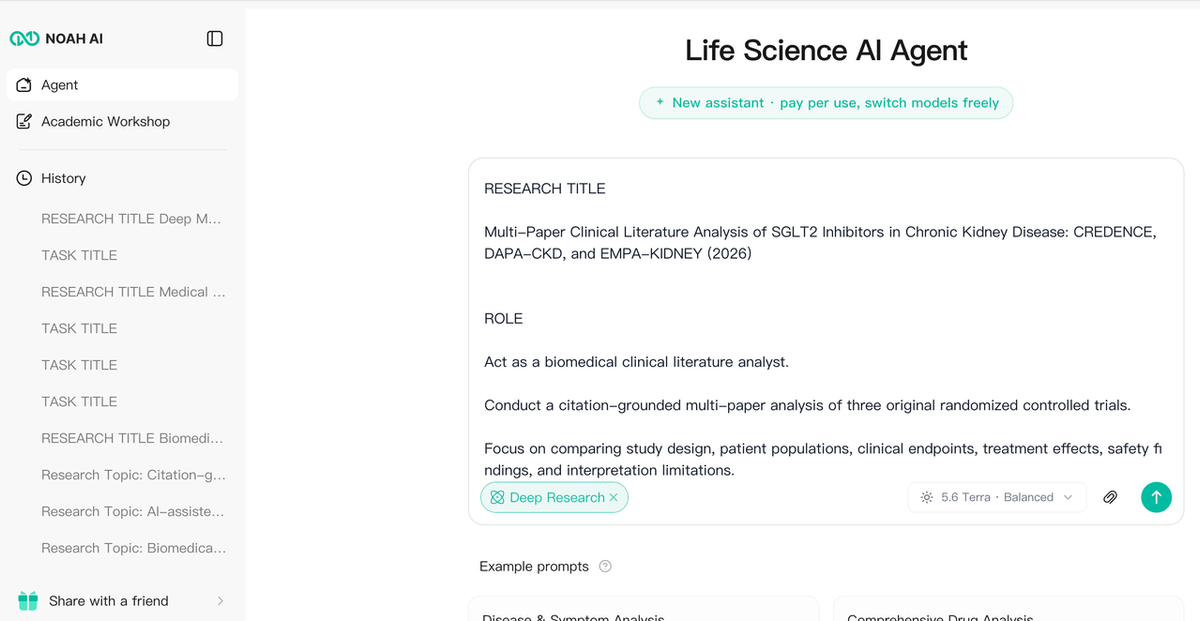
The Noah Deep Research prompt asked how the three studies differed in CKD population, diabetes status, eGFR and albuminuria requirements, primary renal and cardiovascular endpoints, safety, and statistical interpretation. It required original-source citations and specifically prohibited ranking three drugs by unadjusted results from separate placebo-controlled trials.
Step 2: Compare the original studies side by side
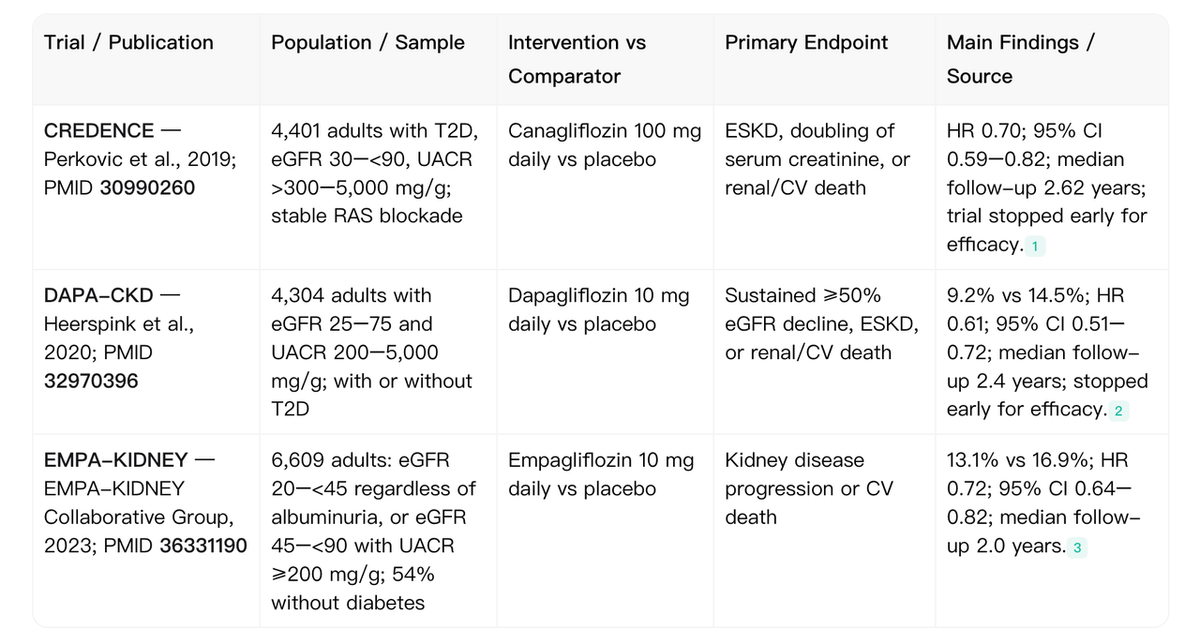
The generated Noah evidence matrix aligned three reports by population, intervention, primary endpoint, and main findings. In the screenshot, the source PMIDs are visible alongside the study names; individual citation markers appear in the results column.
| Trial | Population | Kidney-related primary outcome | Reported relative effect |
|---|---|---|---|
| "CREDENCE (2019) n = 4,401" | Type 2 diabetes and albuminuric CKD; eGFR 30 to below 90 | ESKD, doubling of serum creatinine, or death from renal or CV causes | HR 0.70 (95% CI 0.59–0.82) |
| "DAPA-CKD (2020) n = 4,304" | CKD with or without diabetes; eGFR 25–75 and UACR 200–5,000 mg/g | Sustained eGFR decline of at least 50%, ESKD, or renal/CV death | HR 0.61 (95% CI 0.51–0.72) |
| "EMPA-KIDNEY (2023) n = 6,609" | Broader CKD population, including people without diabetes and patients with lower albuminuria at lower eGFR | Kidney disease progression, including sustained eGFR decline of at least 40%, or CV death | HR 0.72 (95% CI 0.64–0.82) |
The numbers above are trial-reported within-study results, not estimates from a comparative trial of the three drugs. Original reports: CREDENCE, DAPA-CKD, and EMPA-KIDNEY.
Step 3: Separate endpoint definitions from treatment effects
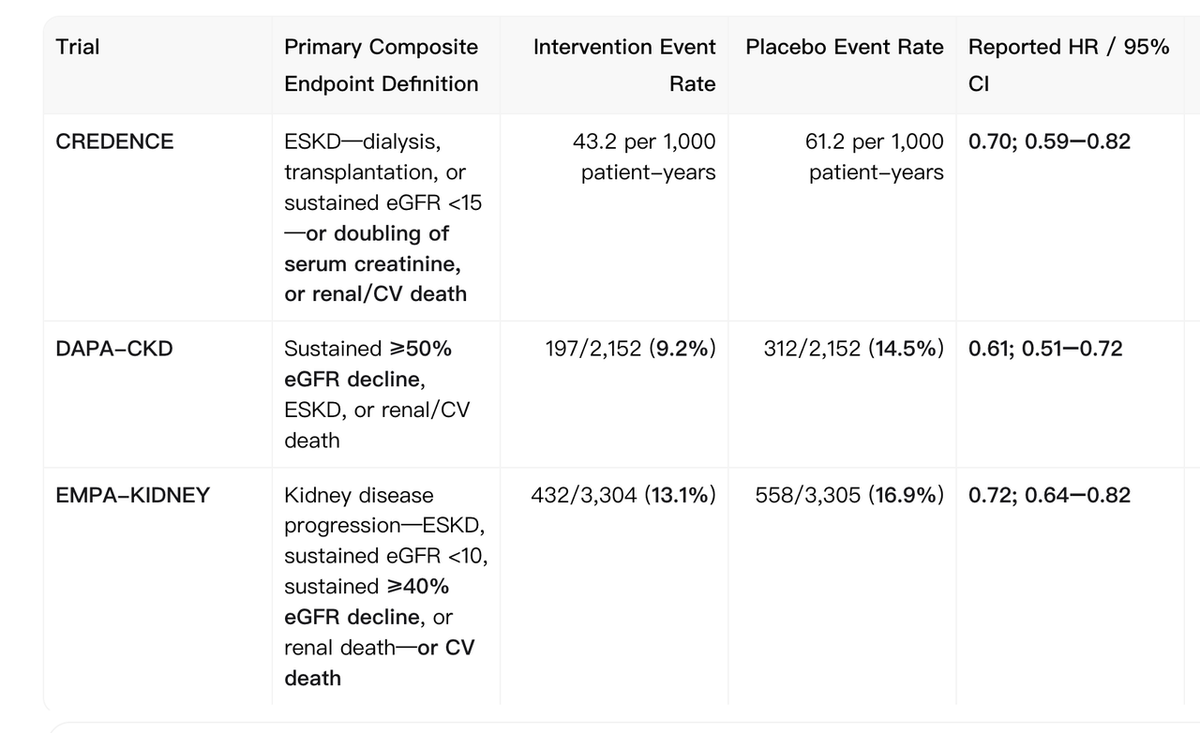
A second Noah table retained the original endpoint definitions, intervention event rates, placebo event rates, hazard ratios, and confidence intervals. This is particularly useful in nephrology, where a composite involving creatinine doubling is not numerically identical to one using a sustained 50% or 40% decrease in eGFR.
What the Original Clinical Evidence Actually Shows
CREDENCE: Canagliflozin in diabetic kidney disease
CREDENCE randomized 4,401 patients with type 2 diabetes, albuminuric CKD, and background renin–angiotensin system blockade. Its primary composite included end-stage kidney disease, doubling of serum creatinine, or renal or cardiovascular death. The canagliflozin group had 43.2 primary-outcome events per 1,000 patient-years, compared with 61.2 with placebo (HR 0.70; 95% CI 0.59–0.82). The trial was stopped early for efficacy.
DAPA-CKD: Dapagliflozin with and without diabetes
DAPA-CKD randomized 4,304 participants with eGFR 25–75 and UACR 200–5,000 mg/g, including patients with and without type 2 diabetes. Its primary outcome included sustained eGFR decline of at least 50%, ESKD, or renal/CV death. A primary event occurred in 9.2% of dapagliflozin recipients and 14.5% of placebo recipients (HR 0.61; 95% CI 0.51–0.72), over a median of 2.4 years. The trial was also stopped early after efficacy findings.
EMPA-KIDNEY: Empagliflozin in a broader CKD population
EMPA-KIDNEY randomized 6,609 participants, including patients without diabetes and those with lower levels of albuminuria when eGFR was below 45. The primary outcome combined kidney disease progression—defined through several events including sustained eGFR decline of at least 40%—with cardiovascular death. Events occurred in 13.1% of empagliflozin recipients and 16.9% of placebo recipients (HR 0.72; 95% CI 0.64–0.82), over a median of 2.0 years.
Why the Three Hazard Ratios Are Not a Drug Ranking
It would be tempting to order the results as 0.61, 0.70, and 0.72, then conclude that dapagliflozin outperformed the others. That conclusion is not supported by these studies. Each number is a within-trial effect against its own control group, under different eligibility criteria, endpoint definitions, background risk, and follow-up time.
- Different kidney populations. CREDENCE required diabetes and substantial albuminuria. DAPA-CKD included non-diabetic CKD but retained a proteinuria threshold. EMPA-KIDNEY enrolled a broader population with lower eGFR and a wider albuminuria distribution.
- Different outcomes. Creatinine doubling in CREDENCE differs from sustained eGFR declines of 50% in DAPA-CKD and 40% in EMPA-KIDNEY. All three included other components within the respective composite outcomes.
- Different reporting formats. CREDENCE's prominent rates were reported per 1,000 patient-years. DAPA-CKD and EMPA-KIDNEY also reported cumulative percentages over their follow-up periods.
- Different cardiovascular findings. Secondary cardiovascular outcomes, event counts, and statistical precision varied. A nonsignificant finding in one study does not establish inferiority to another drug.
The credible conclusion is that all three trials support kidney-protective effects of SGLT2 inhibitors in the populations studied—not that the smallest hazard ratio identifies the universally strongest drug.
How the Workflows Differ in Practice
When Petal makes sense
Petal is appealing for researchers who already have a well-defined paper library. Its document collections, metadata tools, Multi-doc Chat, and AI Table can support repeated extraction and comparison within that library. This approach is useful in a journal club, an internal evidence library, or a project requiring consistent questions across known PDFs.However, the availability of actual full text, document-import permissions, and subscription access must be checked. For this article, no completed Petal multi-document output was obtained. Therefore, the screenshots above are all from Noah and the discussion of Petal refers to documented product capabilities, not a measured output-quality test.
When Noah makes sense
Noah's demonstrated workflow begins from a multi-paper medical question and produces a structured evidence report. In the example shown, its output connected the clinical trial population, intervention, endpoint and effect to the named original studies, then explained why the separate trial results should not be ranked. That makes it relevant for research briefs and citation-aware comparison of clinical evidence.One research report cannot establish a universal accuracy advantage. Researchers should still open the original publications, verify crucial numbers, and check whether the assistant reviewed full text or only abstracts. The Noah report used here explicitly noted that DAPA-CKD verification relied on an accessible PubMed abstract, while some original article content was available for the other two studies.
Important Limitations
This article includes a real Noah Agent input screenshot and two real Noah output tables. It is not a head-to-head performance benchmark because Petal's multi-doc analysis was not completed. No comparison of speed, citation accuracy rates, missing-paper rates, or overall model quality is claimed.The evidence tables are research aids, not substitutes for original clinical publications. Clinical endpoint harmonization, subgroup interpretation, and rare adverse-event analysis may require full texts, protocols, and statistical analysis plans. This clinical research example is not individualized medical advice.
Frequently Asked Questions
Can Petal analyze multiple research papers?
Petal documents Multi-doc Chat and AI Table for work across document collections. Whether those features are usable depends on the account plan and the availability of the underlying documents.
Does importing a PMID mean Petal has read the full paper?
No. Bibliographic metadata import and full-text document analysis are distinct steps. Verify which source materials were actually available to the tool before treating an answer as a full-paper review.
Can Noah AI compare results from different clinical trials?
In the demonstrated CKD case, Noah produced comparisons of trial characteristics, kidney endpoints, and reported treatment effects. Medical interpretation still requires checking the cited original studies.
Why are primary endpoints important in multi-paper analysis?
Composite endpoints determine which events contribute to an effect estimate. Different eGFR decline thresholds or death components can change event rates and limit comparability across studies.
Can we directly compare CREDENCE, DAPA-CKD, and EMPA-KIDNEY hazard ratios?
Not as a drug ranking. They were separate placebo-controlled trials with different populations and endpoint definitions. A lower within-trial hazard ratio does not establish superior treatment efficacy against another drug.
Which is better for a researcher who already has a large PDF library?
Petal may be a better workflow fit for managing and querying an existing collection, provided its multi-document features and uploaded full texts are accessible. Noah may be more suitable when the task starts as a biomedical question requiring a structured evidence report.
Final Takeaway
For multi-paper literature analysis in 2026, Noah AI and Petal serve overlapping but distinct workflows. Petal focuses on research-library organization and document-based interaction. Noah supports a question-led biomedical research workflow, illustrated here by its comparison of CREDENCE, DAPA-CKD, and EMPA-KIDNEY.The key research skill is not merely locating a result or extracting a hazard ratio. It is preserving the exact source, population, endpoint, and statistical limitations behind that result.
Build a citation-aware biomedical evidence comparison.