
Noah AI vs Scholarcy for Literature Review Evidence Extraction (2026)
Linda
Compare Noah AI vs Scholarcy for literature review evidence extraction in 2026. Explore structured summaries, MINT trial results, and citation checks.
A literature review depends on more than a readable summary of each paper. Researchers need to extract study designs, populations, intervention details, outcomes, numerical estimates, and limitations in a consistent way—and be able to trace consequential claims back to the original publication. Noah AI and Scholarcy both support parts of this process, but they organize the work differently.
Updated October 30, 2026 · Evidence cutoff: October 29, 2026 · Biomedical research workflow comparison
Scholarcy is designed around converting research documents into structured summaries and reusable flashcards. Noah AI provides a question-led research workspace that can organize findings into cited reports and evidence tables. This article compares those approaches and walks through a real Noah AI evidence-extraction exercise using the MINT randomized clinical trial.
How this comparison was prepared: The MINT case and screenshots below come from one actual Noah AI Deep Research run. Scholarcy's features are described from its official product documentation, not from a completed equivalent MINT extraction. This is a workflow comparison, not a controlled head-to-head accuracy, speed, or pricing benchmark.
Quick Comparison: Noah AI vs Scholarcy
| Research task | Noah AI | Scholarcy |
|---|---|---|
| Typical starting point | A clinical research question or source-based analysis task | A paper or collection of documents to read and organize |
| Core output | Structured research reports, evidence tables, citations and synthesis | Structured Summary Flashcards, key points, methods, findings and references |
| Original-paper extraction | Demonstrated below in one targeted MINT research run | Document extraction and summaries are described in official product materials |
| Literature review support | Question-led synthesis with source-linked findings | Flashcard collections, research comparisons and exportable literature matrices |
| Citation-related workflow | Source references and claim-verification tables when requested | References, annotated bibliographies and citation-related research tools |
| Best-fit scenario | Developing an evidence brief or investigating a clinical question | Reading, screening and organizing a library of academic papers |
| What this article verifies | Specific outputs in the three Noah screenshots | Published features; no completed same-paper outcome test |
These differences concern the shape of the workflow, not a measured hierarchy of quality. A structured flashcard can be valuable input to a literature review; a question-driven report can be valuable when researchers need interpretation across extracted fields. Both still require original-source checking.
What Is Scholarcy?
Scholarcy helps users read scholarly materials through Summary Flashcards. Its official documentation describes extracting a paper's key points, methods, results, references, limitations and other useful elements into navigable sections. It also provides article-analysis features such as research comparisons, research-quality indicators, highlighted passages and reference exploration.
For larger reading projects, Scholarcy supports organizing summaries into a library and exporting selected flashcards to Excel to create a literature matrix. This is relevant to evidence extraction: a researcher can review comparable fields across multiple papers instead of reopening every PDF separately. Its official help material also describes exporting references and bibliographies for use with reference managers.
Those are substantive literature review capabilities. However, the presence of a structured summary or matrix does not guarantee that every clinical outcome, denominator, or effect estimate was extracted without error. Such values should be checked against the original paper. Feature access may vary by plan and product version; this article does not make a price or entitlement comparison.
What Is Noah AI?
Noah AI is a medical and life-science research workspace combining evidence search with an Agent workflow. Its official materials describe source-linked biomedical research, structured reports, comparisons and deeper research tasks.
In a literature review evidence-extraction task, a researcher can specify the target publication, desired fields, numerical outcomes, verification rules and final output format. Noah can then produce a report that brings those elements together. Importantly, the user must still verify its interpretation and source links: an AI-generated citation is not itself evidence that the accompanying statement is accurate.
Real Clinical Research Example: The MINT Trial
To make the discussion concrete, we used the original MINT trial, published in the New England Journal of Medicine in 2023:
Restrictive or Liberal Transfusion Strategy in Myocardial Infarction and Anemia — Carson JL et al. PMID 37952133; DOI 10.1056/NEJMoa2307983; publicly accessible full text.
The study compared restrictive and liberal red-cell transfusion strategies among adults with acute myocardial infarction and anemia. Its primary outcome was all-cause death or recurrent myocardial infarction at 30 days. The study is useful for evaluating evidence extraction because a reader must preserve the difference between numerical direction, statistical significance and equivalence—not simply repeat one percentage.
| PICO field | Evidence from the original MINT publication |
|---|---|
| Population | 3,504 participants in the primary analysis; acute myocardial infarction with hemoglobin below 10 g/dL |
| Intervention | Restrictive strategy: transfusion permitted below 8 g/dL and strongly recommended below 7 g/dL or with persistent angina |
| Comparator | Liberal strategy: one unit after randomization, then transfusions to maintain hemoglobin at or above 10 g/dL |
| Primary outcome | Composite of death from any cause or recurrent myocardial infarction at 30 days |
| Study design | Phase 3, multicenter, randomized, open-label clinical trial |
The protocols were not two simple, fixed hemoglobin cutoffs. The restrictive arm incorporated symptoms and clinical judgment; the liberal arm targeted a higher hemoglobin level through additional transfusions. This detail affects how a literature reviewer should describe the intervention and comparator.
How the Noah AI Evidence-Extraction Run Was Set Up
We entered a targeted request in Noah Agent → Deep Research asking it to identify the original publication, extract PICO and clinical outcomes, distinguish model-based estimates from raw proportions, and audit potentially inaccurate statements. The actual task used the MINT original paper and an October 29, 2026 evidence cutoff.
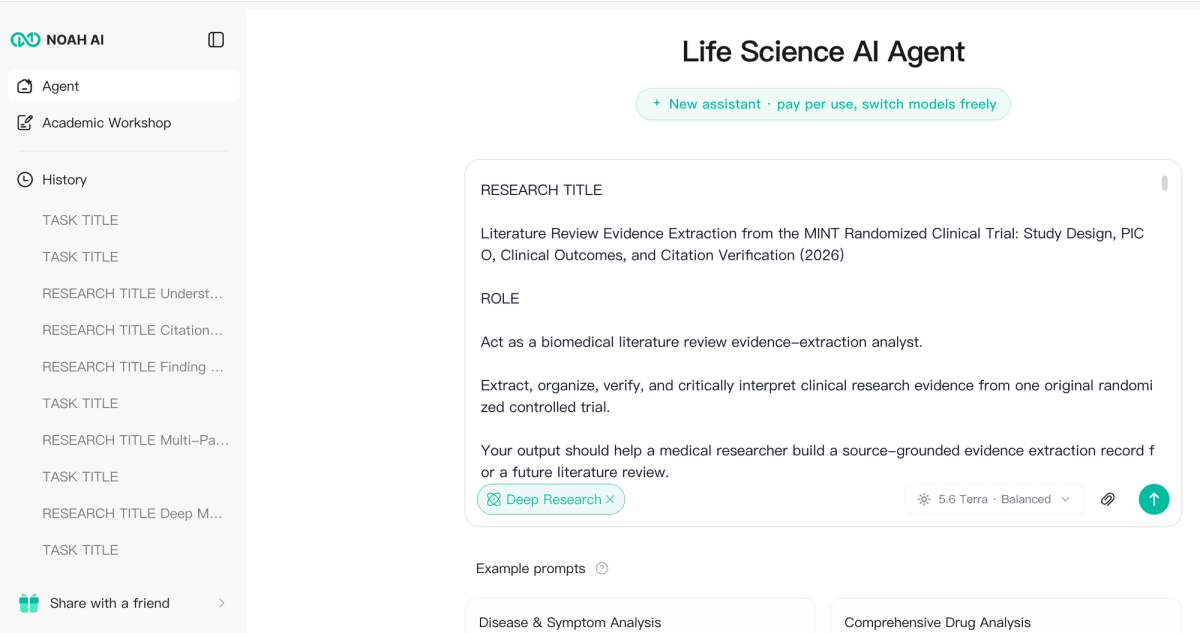
The prompt requested standardized fields for clinical eligibility, treatment strategies, sample size, the original primary endpoint, results, uncertainty and source-verification status. Those requirements matter because a free-form summary may omit denominators or blend the study's reported findings with an AI interpretation.
What Noah Extracted: MINT Outcomes and Statistical Uncertainty
The resulting Noah report organized the trial findings into a five-column clinical outcome table. The real output displayed both treatment groups, the reported effect measure and a brief interpretation of each endpoint.
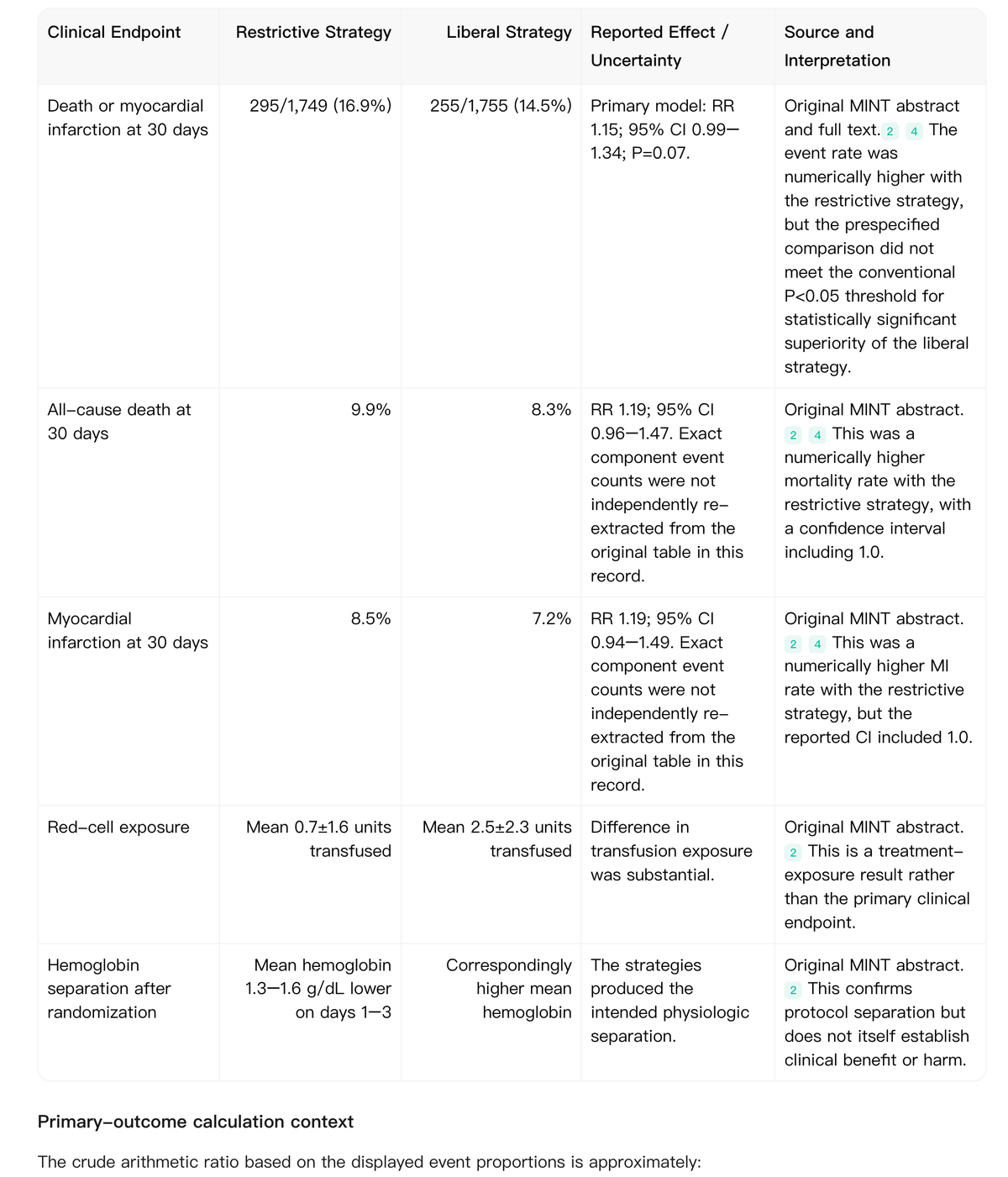
| MINT outcome | Restrictive | Liberal | Original reported estimate |
|---|---|---|---|
| Death or recurrent MI, 30 days | 295/1,749 (16.9%) | 255/1,755 (14.5%) | Modeled RR 1.15; 95% CI 0.99–1.34; P=0.07 |
| All-cause death, 30 days | 9.90% | 8.30% | RR 1.19; 95% CI 0.96–1.47 |
| Myocardial infarction, 30 days | 8.50% | 7.20% | RR 1.19; 95% CI 0.94–1.49 |
| Mean red-cell units transfused | 0.7 ± 1.6 | 2.5 ± 2.3 | Treatment exposure, not the clinical primary endpoint |
Source: Original MINT publication (open-access manuscript). The reported primary RR of 1.15 is model-based, incorporating methods for incomplete follow-up; it should not be replaced by a crude ratio computed from rounded event percentages.
In the trial, the primary endpoint was numerically more frequent with the restrictive strategy (16.9% versus 14.5%). The P value of 0.07 means that a statistically significant difference was not established under the prespecified superiority analysis. It does not establish that the treatments are equivalent, and the confidence interval does not exclude a potentially meaningful disadvantage of the restrictive strategy.
Build a source-linked clinical evidence record
Use Noah AI to investigate original papers and organize study designs, outcomes and interpretation limits in a structured research report.
Claim Verification: Turning Extraction into a Reliable Review
Evidence extraction is only useful if the conclusions carried into a literature review accurately reflect what the study established. The Noah run therefore included a claim-checking table. It distinguished correct statements from unsupported or overgeneralized ones.
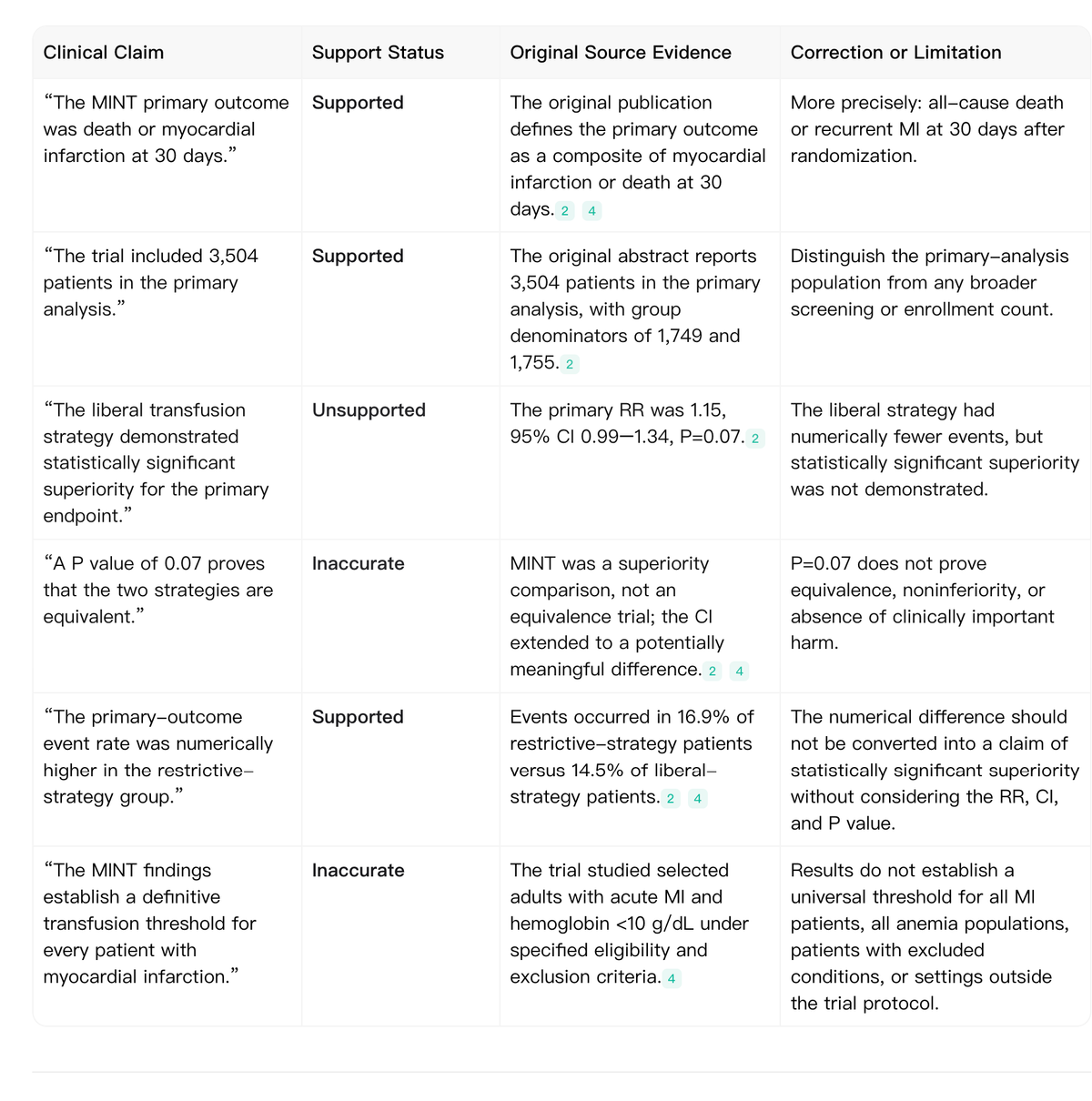
| Potential literature review claim | Evidence-based assessment |
|---|---|
| "The primary endpoint was death or MI at 30 days." | Supported. More precisely: death from any cause or recurrent MI in the composite endpoint. |
| "Liberal transfusion proved superior for the primary endpoint." | Not supported. The primary comparison yielded P=0.07. |
| "P=0.07 proves the strategies are equivalent." | Incorrect. This was not an equivalence trial, and the CI allows a potentially important difference. |
| "The restrictive arm had numerically more primary events." | Supported. 16.9% versus 14.5%, with the original uncertainty retained. |
| "MINT sets the transfusion threshold for every MI patient." | Incorrect. The trial concerned an enrolled population under defined protocols and exclusions. |
These are the kinds of corrections that prevent evidence tables from becoming misleading literature review paragraphs. A well-formed table should separate the original study result from the interpretation and from what remains uncertain.
Evidence Extraction vs. Paper Summarization
Both activities can help a literature review, but they answer different operational questions. A paper summary asks, "What did this paper say?" An evidence-extraction record asks, "Which exact study fields and values can I reuse, with a verifiable source and a stated limitation?"
Scholarcy's structured flashcards can help readers locate methods, results, key findings, limitations and references. Its library and literature matrix workflows can then support comparison across papers. Noah's question-led research workflow can be set up to produce a particular clinical extraction schema and a claim-verification section, as demonstrated in the MINT example.
Neither workflow removes the need to examine the original publication. Researchers building a formal evidence synthesis may need independently defined eligibility criteria, a reproducible search strategy, multiple-reviewer screening or extraction, risk-of-bias assessment and an audit trail. This single-paper exercise does not constitute a systematic review or validate either platform for those requirements.
Which Tool Should You Choose?
Use Scholarcy when you are organizing and reading papers — Scholarcy is worth considering when you have a collection of papers and want structured reading aids: key points, summaries, article sections, reference exploration, and an exportable matrix of findings. Its document-centered workflow may be convenient for screening and building a reusable reading library.
Use Noah AI when you are developing a clinical evidence brief — Noah AI is worth considering when the task begins as a biomedical question and the desired deliverable is a source-linked clinical analysis: an outcome table, a specific PICO extraction schema, an interpretation of treatment effects, or a correction of unsupported conclusions. The MINT example demonstrates the requested workflow for one original randomized trial, not a general performance advantage over Scholarcy.
Use both approaches with source checks — These are not necessarily mutually exclusive. A researcher might first organize and screen papers using document summaries, then prepare a focused clinical evidence analysis. Regardless of the combination, key estimates should be checked against the source document, and any extraction that cannot be verified should be flagged rather than silently filled in.
Limitations and Research Transparency
Only the Noah AI MINT output shown in Figures 1–3 was available for substantive evaluation in this article. We did not obtain a completed Scholarcy extraction of the same paper, so the article does not make claims that Noah is more accurate, faster, more complete or more reliable in a controlled comparison.
The Noah example itself has limits: it covers one published clinical trial; the image of a report does not establish reproducibility; and the final output remains AI-generated text requiring independent citation checks. The original MINT paper, rather than the AI screenshots, is the evidence source for clinical numerical claims.
Frequently Asked Questions
Is Scholarcy useful for literature review evidence extraction?
Yes. Scholarcy's official documentation describes extracting structured article content into Summary Flashcards and exporting collections into a literature matrix. Researchers should validate quantitative and methodological fields before reusing them in a review.
Can Scholarcy create a literature matrix?
Scholarcy documents an Excel export workflow for generating a literature matrix from selected flashcards. Exact access and usage limits may depend on the current plan.
Can Noah AI extract clinical endpoints and study results?
In the MINT test shown here, Noah produced a structured table of clinical endpoints, treatment groups, estimates and interpretation notes. This demonstrates that particular workflow, not a guarantee of flawless extraction for all papers.
What was the primary outcome in MINT?
The original trial's primary outcome was the composite of all-cause death or recurrent myocardial infarction within 30 days after randomization.
Did P=0.07 show that restrictive and liberal transfusion were equivalent?
No. The primary superiority comparison did not reach conventional statistical significance, but the trial was not designed to establish equivalence. Its confidence interval did not rule out a clinically meaningful difference.
What should researchers verify before adding AI-extracted data to a review?
At minimum, check the original population, intervention and comparator definitions, analysis denominator, outcome timepoint, event counts, effect estimate, confidence interval, publication identity and the claim made from those data.
Final Takeaway
Scholarcy and Noah AI can both be relevant to literature review workflows, but they address different starting points. Scholarcy organizes research documents into structured summaries and comparable reading records. Noah can be prompted to turn a biomedical research question into a source-linked extraction and analysis report.
The practical lesson from MINT is about evidence quality: 16.9% versus 14.5%, RR 1.15 and P=0.07 require a careful account of trial design and uncertainty. Evidence extraction should preserve those details rather than flatten them into a simplistic claim of superiority or equivalence.
Explore biomedical evidence extraction with Noah AI
Start with a clinical research question, request a structured evidence table, and verify the findings against the original publications.