
Noah AI vs SciSpace for Medical Literature Reviews (2026)
Linda
Compare two AI research tools using a real medical literature review on intravenous iron therapy in heart failure. See how Noah AI organizes clinical trials, synthesizes evidence, and preserves important scientific uncertainties.
Compare two AI research tools using a real medical literature review on intravenous iron therapy in heart failure. See how Noah AI organizes clinical trials, synthesizes evidence, and preserves important scientific uncertainties.
Try Noah AI for free · Free credits available · No credit card required
AI literature review tools can help researchers find papers, read publications, and organize scientific information. But medical literature reviews require more than collecting articles or generating summaries.
Researchers often need to compare clinical trials with different patient populations, interventions, primary endpoints, statistical analyses, and follow-up periods.
A useful medical evidence review should distinguish a statistically significant primary result from a secondary finding, recognize when trials use different endpoint definitions, and avoid turning uncertain evidence into an overly confident conclusion.
Noah AI and SciSpace both support literature-related research workflows, but they approach the work from different starting points.
SciSpace offers an academic literature workspace with paper search, AI-generated insights, PDF analysis, and customizable research columns.
Noah AI provides a life-science-oriented research Agent that can be prompted to build structured clinical evidence tables, compare randomized trials, and synthesize biomedical findings with explicit limitations.
To make the comparison concrete, we used the same clinical research topic:
Our Medical Literature Review Question: In adults with heart failure and iron deficiency, how does intravenous iron therapy affect heart failure hospitalizations, cardiovascular mortality, functional outcomes, and safety?
This topic provides a useful comparison because multiple randomized clinical trials have investigated intravenous iron, yet their results cannot be reduced to one simple claim.
Comparison disclosure: We ran Noah AI directly and captured its clinical evidence table and final evidence synthesis. We also accessed SciSpace Literature Review using the same topic and captured its paper-and-insights interface. This is a practical workflow demonstration, not a standardized accuracy, speed, or completeness benchmark.
Evidence cutoff for the demonstrated Noah AI review: October 13, 2026.
Quick Takeaway: Noah AI vs SciSpace
NOAH AI — For Structured Biomedical Evidence
Consider Noah AI when your research question requires detailed comparison of clinical trials, interpretation of outcomes, synthesis of medical evidence, and clear evidence boundaries.
Free credits available · No credit card required
SCISPACE — For Academic Paper Exploration
Consider SciSpace when you want a literature search workspace with paper listings, AI-generated paper insights, customizable columns, and PDF-centered investigation.
Neither tool should be treated as a substitute for verifying primary publications. The more important question is which workflow helps researchers inspect and interpret the evidence needed for a particular medical task.
Noah AI vs SciSpace: Side-by-Side Comparison
The table below compares the workflows and features relevant to medical literature reviews. These are capability distinctions, not performance scores.
| Comparison Area | Noah AI | SciSpace |
|---|---|---|
| Primary orientation | Biomedical, medical, and life-science research workflows. | Academic literature research across disciplines. |
| Research entry point | Describe a biomedical task to Noah Agent and specify the required evidence output. | Start from Literature Review search, paper results, or PDF investigation. |
| Clinical evidence extraction | In our test, generated a trial-level table with population, iron regimen, endpoint, result, and limitation. | Supports paper insights and customizable extraction columns. |
| Cross-paper comparison | In our test, compared pivotal randomized trials and preserved differences between primary endpoints. | Allows papers to be examined using common table fields and review workflows. |
| Evidence synthesis | Generated an outcome-based synthesis separating supported findings from uncertainty. | Offers literature-review and deeper review workflows for research synthesis. |
| Full-paper investigation | Supports document-informed research tasks within its Agent workflow. | Provides a dedicated Chat with PDF tool. |
| Evidence limitations | Our example explicitly distinguished hospitalization evidence from unresolved mortality benefit. | Paper insights and synthesized claims require primary-source checking. |
| Best-fitting task | Medical trial comparison and evidence interpretation. | Academic literature discovery, paper reading, and research organization. |
| Getting started | Free credits available; no credit card required. | Feature access and limits depend on the current SciSpace plan. |
SciSpace has meaningful literature review and PDF-analysis capabilities. Noah AI is particularly relevant when the desired deliverable is a structured biomedical evidence review rather than simply a collection of paper summaries.
What Makes a Medical Literature Review Useful?
Medical literature review involves several distinct tasks: identifying studies, extracting comparable information, assessing methodological differences, interpreting results, and synthesizing the evidence.
These steps matter because two clinical trials may evaluate similar treatments but answer different questions.
A review should preserve at least the following information:
| Evidence Element | Why It Matters |
|---|---|
| Population | Patients with different disease stages or baseline risks may not be directly comparable. |
| Intervention and comparator | Different formulations and dosing regimens should not be treated as identical. |
| Primary endpoint | A first-event outcome and a recurrent-event outcome estimate different quantities. |
| Effect estimate and precision | Confidence intervals and statistical criteria shape how a result can be interpreted. |
| Limitations | Design, missing data, and follow-up differences affect confidence and applicability. |
| Source traceability | Researchers must be able to verify major claims in the original publications. |
A well-organized table is useful only when it preserves these distinctions accurately.
Noah AI: From Medical Research Question to Structured Evidence Review
For this comparison, we tested Noah AI on intravenous iron therapy in heart failure with iron deficiency.
We asked the Agent to identify pivotal randomized trials, compare primary endpoints and clinical outcomes, interpret differences across studies, and produce a source-grounded evidence synthesis.
The test used Noah AI Agent with Deep Research. Its task instructions emphasized randomized trial evidence, correct endpoint interpretation, citation traceability, and identification of uncertainty.
The output included a detailed clinical evidence table and an outcome-level evidence summary.
1. Noah AI Organized Four Major Clinical Trials into an Evidence Table
The first useful output was a structured comparison of pivotal randomized studies.
Instead of listing trial conclusions in separate paragraphs, Noah placed study populations, intravenous iron regimens, primary endpoints, numerical results, and key limitations into a common evidence table.
The output included AFFIRM-AHF, IRONMAN, HEART-FID, and FAIR-HF2.
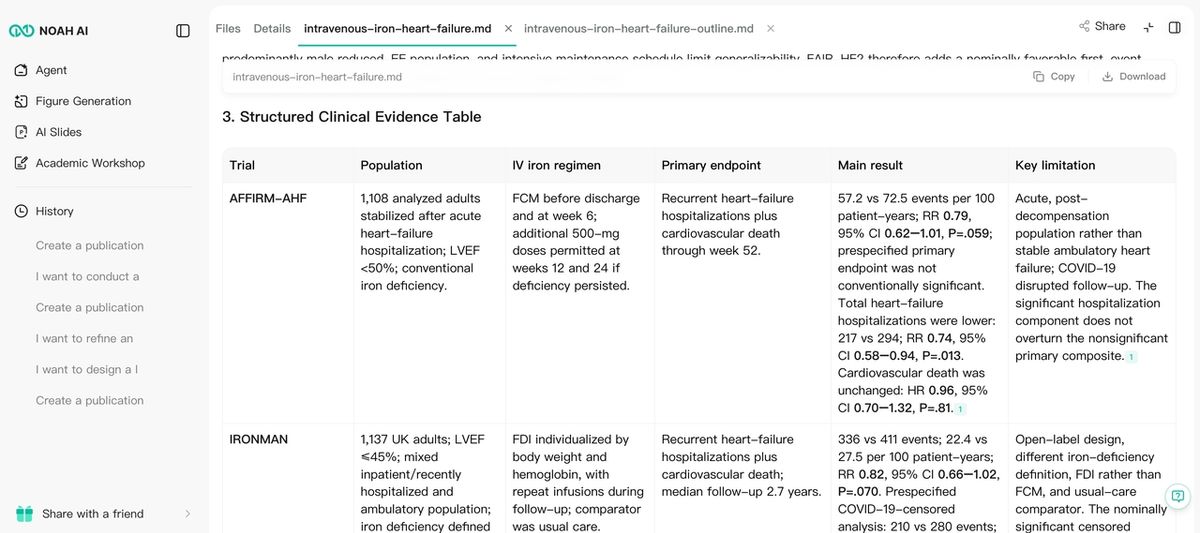
Several details make this table useful for medical researchers.
In AFFIRM-AHF, the prespecified recurrent heart failure hospitalization and cardiovascular death composite had a rate ratio of 0.79, with a 95% confidence interval of 0.62–1.01 and P=.059.
That primary comparison did not meet conventional statistical significance, even though total heart failure hospitalizations were lower with ferric carboxymaltose.
In IRONMAN, the overall primary recurrent-event comparison also did not meet conventional significance. A prespecified analysis censoring follow-up at the COVID-19 disruption produced a more favorable result, but that sensitivity analysis should not replace the overall primary finding.
In HEART-FID, the hierarchical primary endpoint had P=.02, but the prespecified significance criterion was .01.
Therefore, describing HEART-FID as having achieved its primary endpoint simply because P was below .05 would be incorrect.
FAIR-HF2 introduced a further distinction: one first-event comparison was nominally favorable, but the trial did not satisfy its prespecified overall co-primary endpoint success criterion.
Why This Noah Output Matters
A medical evidence table should not simply display the most favorable result from each study. It should preserve whether the prespecified primary analysis succeeded, which endpoints were measured, and why the findings cannot be compared without qualification.
This is the kind of structured output that makes a biomedical literature review more useful than a list of disconnected article summaries.
2. Noah AI Summarized the Evidence Without Hiding Uncertainty
The second output organized the evidence by clinical outcome.
Noah separated heart failure hospitalization, cardiovascular mortality, functional outcomes, and safety, with a dedicated column for the main uncertainty associated with each conclusion.
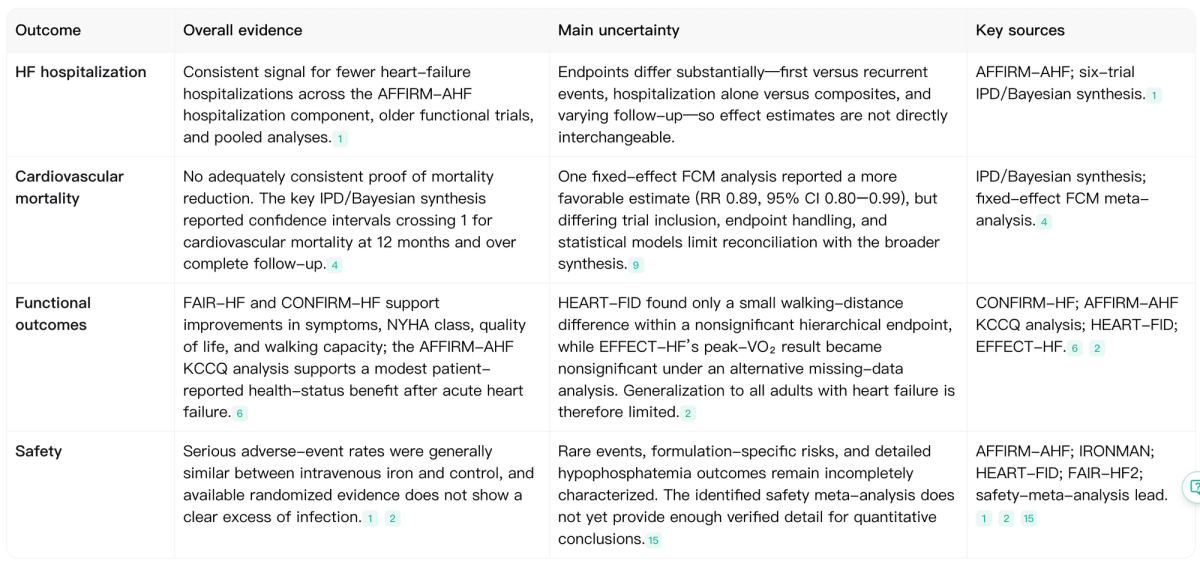
The key distinction was between evidence supporting fewer heart failure hospitalizations and evidence concerning cardiovascular mortality.
In the 2025 six-trial systematic review and meta-analysis involving 7,175 participants, the composite of recurrent heart failure hospitalizations and cardiovascular death favored intravenous iron.
The cardiovascular mortality component alone remained uncertain. The pooled hazard ratio was 0.80 (95% CI 0.61–1.03) at 12 months and 0.87 (95% CI 0.73–1.04) across complete follow-up.
These confidence intervals include no difference, so the pooled results did not clearly establish a cardiovascular mortality reduction.
In addition, the trials used different iron formulations, iron deficiency definitions, treatment schedules, and outcome measures. Their results should not be treated as though they came from identical study designs.
| Outcome | Evidence Interpretation | Important Qualification |
|---|---|---|
| HF hospitalization | Randomized and pooled evidence supports fewer hospitalizations. | Endpoints, clinical settings, and follow-up vary. |
| CV mortality | Benefit has not been clearly established in the main six-trial synthesis. | Pooled confidence intervals include no effect. |
| Functional outcomes | Earlier trials support symptom and exercise-capacity improvements. | Magnitude and consistency differ between studies. |
| Safety | Overall serious adverse-event rates were generally similar. | Rare and formulation-specific harms need further verification. |
The practical advantage demonstrated here is not merely the ability to generate a table.
Noah AI produced a review structure in which each outcome was connected to its evidence, uncertainty, and relevant studies.
Researchers can use that structure as a working basis for source verification, further appraisal, and literature synthesis.
START WITH NOAH AI — Turn Medical Papers into a Structured Evidence Review
Use Noah AI to compare biomedical studies, organize clinical endpoints, identify evidence limitations, and develop a source-grounded literature review.
Try Noah AI for free. Free credits are included, and no credit card is required to get started.
SciSpace: A Paper-Centered Literature Review Workspace
SciSpace provides a different interface for exploring academic literature.
Its Literature Review workspace allows users to search for studies, browse retrieved papers, inspect AI-generated insights, and create or add columns for additional information.
SciSpace also offers PDF-focused analysis, which can be useful when researchers need to examine individual papers in more detail.
We entered the same heart failure and intravenous iron research topic into SciSpace Literature Review.
The captured screen showed paper results on the left, an Insights column in the center, and an Add a Column interface on the right.
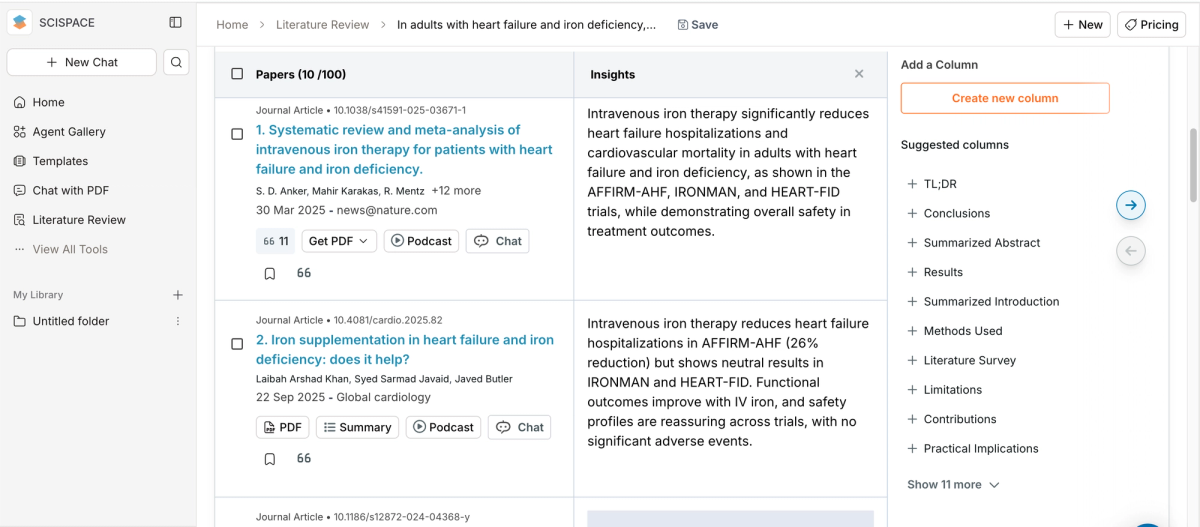
The interface is useful for discovering relevant publications and navigating paper-level information.
For example, researchers can identify relevant review articles, examine the retrieved studies, and use additional columns to compare methods, results, or limitations.
These capabilities make SciSpace a practical environment for literature exploration and PDF-centered research.
However, the initial AI-generated insights should be treated as leads for verification rather than final clinical conclusions.
What Our Example Shows About Evidence Verification
The two captured outputs illustrate why clinical evidence interpretation matters.
In the visible SciSpace Insights column, one statement described intravenous iron as significantly reducing both heart failure hospitalizations and cardiovascular mortality.
That statement is too broad when compared with the major randomized trial results and the principal six-trial synthesis used in this review.
The 2025 pooled analysis reported a favorable composite outcome, driven substantially by fewer heart failure hospitalizations. But the cardiovascular mortality estimate alone did not establish a clear benefit.
| Evidence Check | What the Source Supports |
|---|---|
| AFFIRM-AHF | Cardiovascular mortality was approximately 14% in both groups; a reduction was not established. |
| HEART-FID | The hierarchical primary endpoint did not meet its prespecified significance threshold. |
| Six-trial meta-analysis | The pooled cardiovascular mortality confidence interval included no effect. |
| Appropriate overall conclusion | Hospitalization benefit is supported; a clear cardiovascular mortality benefit remains uncertain. |
In the captured Noah AI output, the final evidence summary preserved this distinction.
These screenshots illustrate different stages of the literature review process. Noah AI's captured output provides a structured synthesis of clinical evidence, while SciSpace's captured interface presents initial paper-level insights. This example does not establish that either tool is more accurate overall. Both outputs require verification against primary clinical sources.
It demonstrates why researchers should inspect the relationship between AI-generated wording, primary study endpoints, and pooled statistical estimates.
The Medical Evidence Standard
A statistically significant composite endpoint does not automatically prove that every individual component, including cardiovascular mortality, was significantly reduced.
Researchers can inspect the published pooled evidence directly in the 2025 systematic review and meta-analysis.
Key Differences Between Noah AI and SciSpace
- Biomedical Question-to-Evidence Workflow — Noah AI can be prompted to begin with a medical research question and produce a structured, source-grounded evidence review. In this example, the output moved from pivotal trial identification to a consistent clinical comparison table and an outcome-based synthesis. SciSpace offers a research workspace for finding, reading, and organizing papers. It can also support deeper review activities through its available review modes and configurable information columns. The distinction is therefore one of workflow emphasis, not an absolute capability boundary.
- Clinical Trial-Level Comparison — Noah's tested output made the relationship between populations, interventions, primary endpoints, effects, and limitations explicit. This matters when comparing trials such as AFFIRM-AHF, IRONMAN, HEART-FID, and FAIR-HF2, whose designs and success criteria are not identical. SciSpace's customizable columns can also help organize paper-level comparisons. Researchers should verify that extracted fields represent the original trial results rather than only conclusions from secondary summaries.
- Cross-Study Interpretation — A medical literature review needs to explain not only what each study reported, but also why related studies may appear to disagree. In our Noah test, the synthesis preserved differences involving the patient setting, iron formulation, endpoint hierarchy, follow-up, and statistical uncertainty. These qualifications are important because a favorable secondary outcome should not automatically overturn a trial's primary analysis.
- PDF Reading and Paper Investigation — SciSpace provides a dedicated Chat with PDF experience, making it a practical option when a researcher wants to investigate the details of individual academic papers. Noah's advantage in this demonstration was the structured biomedical synthesis produced from the specified research task. Both types of workflow can be useful: document-level inspection supports accurate extraction, while cross-paper synthesis helps answer the broader research question.
- Cost of Trying the Workflow — Researchers evaluating new AI tools may not want to commit to a subscription before understanding how the product handles their scientific questions. Noah AI offers free credits and does not require a credit card to get started. That makes it possible to explore the Agent workflow before deciding whether additional paid usage is appropriate. Free credits are usage-limited, and the available balance or cost of a particular task may vary. They should not be confused with unlimited free Deep Research usage.
When Should You Choose Noah AI?
Noah AI is worth considering when the main deliverable is a medical or life-science evidence review that needs to preserve clinical distinctions.
Examples include comparing pivotal randomized trials, building a clinical evidence table, examining potentially conflicting biomedical findings, and preparing a cited research synthesis.
Its tested output is particularly relevant to researchers who need to separate:
- Primary endpoints from secondary or sensitivity analyses.
- Individual trials from overlapping meta-analyses.
- Heart failure hospitalization effects from mortality effects.
- Study-level findings from pooled interpretation.
- Supported conclusions from unresolved uncertainty.
The tested workflow generated these distinctions without requiring the researcher to manually format every comparison table from scratch.
It is still a research-assistance workflow. All important values, source statements, and interpretations require verification before academic, regulatory, or clinical use.
When Does SciSpace Make More Sense?
SciSpace may be a convenient option when the primary task involves discovering academic papers, reading individual PDFs, browsing research findings, or organizing a collection of articles using customizable fields.
Its paper-centered interface can be useful across many academic disciplines, not just clinical and biomedical research.
Researchers who already have a well-established SciSpace literature review workflow may prefer to continue using it for those activities.
But a concise AI insight should not replace verification of exact clinical study results, particularly when the conclusion concerns mortality, a prespecified primary endpoint, or treatment safety.
Can You Use Noah AI and SciSpace Together?
Yes. The tools can be used for complementary parts of a literature-review process.
| Research Stage | Possible Workflow |
|---|---|
| Find relevant publications | Use SciSpace and authoritative databases such as PubMed. |
| Read important papers | Inspect full articles, supplements, and methodological details. |
| Build a biomedical evidence table | Use Noah AI to structure comparable fields across trials. |
| Synthesize clinical findings | Use Noah AI to organize evidence by outcome and uncertainty. |
| Verify final conclusions | Check major claims against original publications and statistical reports. |
The purpose is not to maximize the number of AI platforms used.
It is to preserve a review process in which the final conclusions can be traced back to evidence.
What Researchers Should Verify Before Using Either Output
Regardless of which AI tool generates the literature review, researchers should check the underlying sources before relying on its conclusions.
- Original trial title, DOI, PMID, and publication year.
- Exact randomized and analyzed populations.
- Intervention, comparator, and dosing strategy.
- Prespecified primary endpoint and significance threshold.
- Event counts, denominators, effect estimates, and confidence intervals.
- Whether a favorable result came from a primary, secondary, or sensitivity analysis.
- Differences in first-event, recurrent-event, and hierarchical outcomes.
- Overlap between original trials and published meta-analyses.
- Safety data and adverse-event definitions.
- Whether the final wording is stronger than the source evidence allows.
A narrative AI-assisted literature review is not automatically a systematic review. Formal systematic review work additionally requires an explicit protocol, reproducible searches, screening decisions, appropriate risk-of-bias assessment, and auditable synthesis methods.
The principal objective is a reliable scientific interpretation, not merely a polished report.
Frequently Asked Questions
Is Noah AI Better Than SciSpace for Medical Literature Reviews?
It depends on the task. In our demonstrated example, Noah AI produced a structured clinical evidence table and outcome-level synthesis with explicit uncertainties. SciSpace provided a paper-centered literature review workspace with AI insights and configurable columns. This single case does not establish an overall performance ranking.
Can Noah AI Compare Multiple Clinical Trials?
Yes. In the tested workflow, Noah AI generated a comparison of AFFIRM-AHF, IRONMAN, HEART-FID, and FAIR-HF2, including populations, treatment regimens, primary endpoints, reported results, and limitations.
Can SciSpace Conduct Literature Reviews?
Yes. SciSpace provides literature search and review workflows, paper insights, customizable extraction columns, and PDF analysis. Its AI-generated conclusions should be verified against original sources.
Does Noah AI Automatically Produce a Systematic Review?
The demonstrated task produced an AI-assisted narrative medical evidence review. A formal systematic review requires protocol-driven searching, screening, verification, risk-of-bias assessment, and appropriate synthesis beyond a generated report.
What Is the Difference Between a Paper Summary and Evidence Synthesis?
A paper summary explains the contents of an individual publication. Evidence synthesis compares findings across studies, evaluates differences in methods and populations, and develops a qualified conclusion about the broader evidence.
Why Is Clinical Endpoint Interpretation Important?
Similar clinical trials may use different primary endpoints and statistical procedures. A significant secondary result does not necessarily mean the primary endpoint succeeded, and a favorable composite outcome does not prove that each component improved significantly.
Can I Use Noah AI for Free?
Yes. Noah AI offers free credits and does not require a credit card to get started. Free usage is subject to the available credit balance and applicable task costs.
Should I Verify AI-Generated Medical Literature Review Results?
Yes. Researchers should verify important clinical claims, numerical estimates, citations, study populations, endpoint definitions, and conclusions against the original literature before using the review in academic or clinical work.
Related Reading
Explore additional Noah AI guides for medical literature reviews and biomedical evidence synthesis.
- How to Conduct a Medical Literature Review with AI: Step-by-Step Guide
- Best SciSpace Alternatives for Medical Research (2026)
- How to Create an Evidence Table for a Literature Review with AI
- Best AI Tools for Medical Literature Review and Evidence Synthesis (2026)
Final Takeaway: Which Tool Fits Your Medical Research Workflow?
Noah AI and SciSpace both offer useful ways to work with academic literature, but the best choice depends on the desired research output.
SciSpace is a capable workspace for discovering papers, investigating PDFs, organizing publications, and exploring academic evidence.
Noah AI is especially relevant when the objective is to turn a biomedical research question into a structured comparison of clinical evidence.
In our heart failure example, Noah organized major randomized trials into an evidence table and developed an outcome-based synthesis that preserved the distinction between hospitalization benefit and uncertain cardiovascular mortality benefit.
That distinction is central to medical evidence review: a useful scientific conclusion must explain not just what appears promising, but also what remains unproven.
Both products still require source verification, and the screenshots shown here represent specific workflows rather than a comprehensive head-to-head benchmark.
For researchers who want to explore a biomedical question, inspect trial-level differences, and develop a reviewable medical evidence summary, Noah AI offers a practical starting point.
With free credits available and no credit card required, researchers can try the Noah AI workflow before making a paid commitment.
A Good Medical Literature Review Does More Than Find Papers. It Shows What the Evidence Supports, Where Studies Differ, and What Remains Uncertain.
NOAH AI · FREE CREDITS AVAILABLE — Start Your Medical Literature Review with Noah AI
Compare clinical trials, organize biomedical evidence, identify conflicting findings, and create structured literature review drafts with Noah AI.
Try Noah AI for Free — Get started with free credits. No credit card required.