
Noah AI vs Undermind for Deep Literature Research (2026)
Linda
Compare Noah AI vs Undermind for deep literature research in 2026. Explore biomedical evidence synthesis, paper discovery, source citations, and research gaps.
Compare Noah AI and Undermind for deep scientific literature research, biomedical evidence synthesis, paper discovery, source verification, and research-gap analysis.
Evidence cutoff for the Noah research case: October 15, 2026
Introduction
Deep literature research is not simply about finding more papers. Researchers also need to understand how studies relate to one another, which conclusions are supported by primary evidence, and where important uncertainties remain.
This is especially challenging in biomedical research, where the evidence surrounding one therapeutic target may span human genetics, molecular biology, animal experiments, biomarker studies, and clinical trials.
Noah AI and Undermind both help researchers investigate scientific literature, but they emphasize different parts of the research workflow.
Undermind offers an AI research workspace focused on deep literature discovery, paper relevance, full-text investigation, and citation-grounded research.
Noah AI provides a medical and life-science research Agent that can organize evidence, compare findings, and generate structured biomedical syntheses.
To make this comparison practical, we used both products in a research context involving TREM2 and Alzheimer's disease.
This article examines the outputs we could actually observe, rather than relying only on general product descriptions.
Quick Takeaway
Use Noah AI when your research begins with a biomedical question and you want a structured synthesis connecting genetic, mechanistic, biomarker, and clinical evidence.
Use Undermind when you want a research workspace for discovering, collecting, reading, and investigating scientific papers, with the option to run deeper literature searches.
In our TREM2 example, Noah produced an evidence landscape and a translational research-gap table.
The Undermind workspace displayed a literature-grounded discussion supported by its paper library and explicitly identified a missing full-text clinical trial publication that needed to be uploaded for further verification.
Both observations are useful, but they demonstrate different parts of the workflow.
The central distinction: Noah's observed output emphasized structured biomedical evidence synthesis. Undermind's observed Chat Knowledge output emphasized working with a research library and identifying source-access limitations.
This is not a controlled accuracy or search-recall benchmark. In particular, the Undermind screenshot shows zero Deep Searches at the time of capture.
Is Undermind Free in 2026?
Yes. Undermind offers a free plan for exploratory scientific research.
Its official pricing information describes access to AI research chat, deep searches, reports, and collaborative workspaces, subject to standard usage limits.
Paid plans increase usage capacity and provide access to more advanced research options.
The Undermind screenshot used in this article was taken from an account visibly marked as being on the free tier.
However, being on the free tier does not mean every research task can be completed without limits.
Researchers should consider how often they need to search, how many papers they need to inspect, and whether their workflow requires access to full-text PDFs.
Noah AI also offers free signup credits. Researchers can explore its Agent workflow without providing a credit card at registration, subject to available credits and the cost of the selected task.
See Undermind's official website for current plan information.
Side-by-Side Comparison
| Comparison Area | Noah AI | Undermind |
|---|---|---|
| Primary focus | Medical and life-science research | Scientific literature discovery and research |
| Starting point | Biomedical research question or task | Research question, paper library, or deep search |
| Literature exploration | Biomedical literature research through Agent | Iterative searches, paper relevance, and citation exploration |
| Evidence analysis | Structured biomedical evidence synthesis | Literature-grounded chat, reports, and evidence tables |
| Source handling | Cited findings and original publication identifiers | PDF library, abstracts, citations, and source inspection |
| Observed output | Evidence landscape and translational-gap table | Chat Knowledge response identifying a missing trial PDF |
| Observed limitation | Some primary trial details were checked at abstract level | Central trial PDF absent from the workspace; zero Deep Searches shown |
Product capabilities are based on official information. The observed-output rows refer only to the research material and screenshots discussed below.
Why Deep Literature Research Needs More Than Paper Search
Literature discovery and evidence synthesis are related but different research tasks.
A literature search helps researchers identify publications relevant to a scientific question.
An evidence synthesis then asks what those publications establish, how their findings connect, and whether their methods support the proposed conclusions.
Consider a therapeutic target associated with Alzheimer's disease.
One study might identify a gene variant associated with disease risk. Another might investigate the target in mouse microglia. A third might examine biomarkers in human cerebrospinal fluid. A clinical trial might then test whether an intervention improves patient outcomes.
These studies are connected, but they measure different things.
An effective research workflow needs both relevant source discovery and careful interpretation across those different types of evidence.
Noah AI Output: From Biomedical Research Question to Evidence Synthesis
We tested Noah AI using a research question about TREM2 in Alzheimer's disease.
The investigation focused on four domains:
- Human genetic evidence linking TREM2 to Alzheimer's disease risk.
- Microglial mechanisms and experimental disease models.
- Human cerebrospinal fluid soluble TREM2 biomarkers.
- Clinical translation, including the AL002 INVOKE-2 trial.
The goal was not simply to retrieve papers about TREM2.
It was to understand how evidence from these different domains supported or challenged the rationale for targeting TREM2 therapeutically.
1. Starting the Research in Noah AI
We entered a detailed prompt into Noah AI Agent using Deep Research.
The central question was:
What does the scientific literature reveal about the role of TREM2 in Alzheimer's disease, and how do findings from human genetics, microglial biology, biomarker research, and therapeutic studies support or challenge the clinical translation of TREM2-targeted treatments?
We instructed Noah to prioritize original scientific research, distinguish evidence types, identify limitations, and use an evidence cutoff of October 22, 2026.
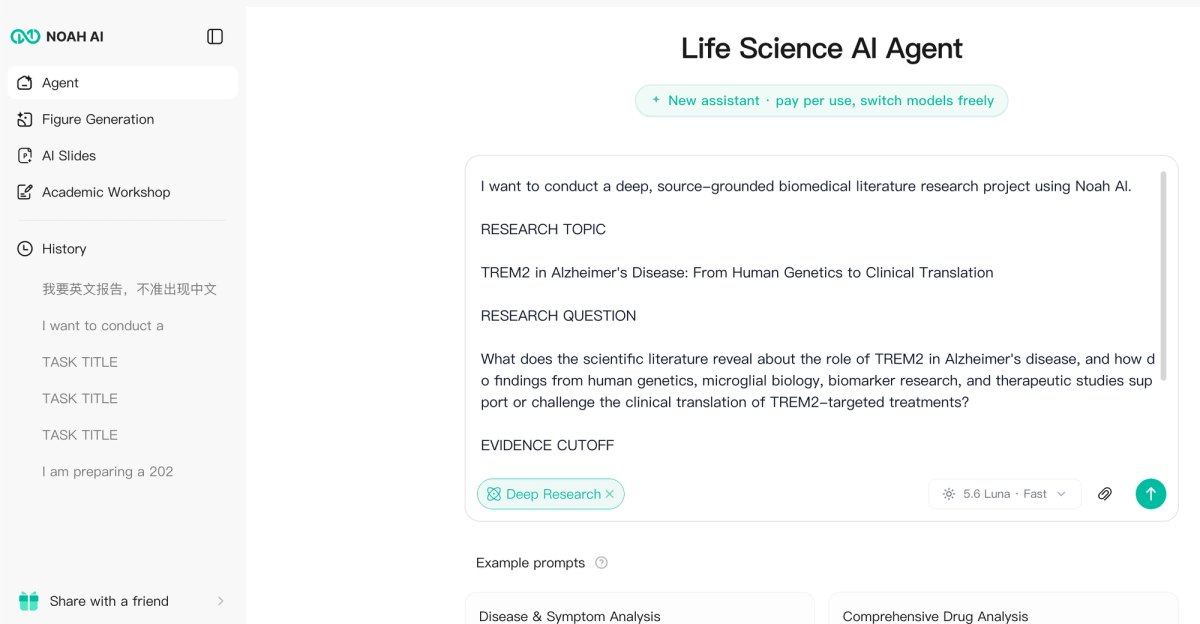
A focused prompt is important because evidence from genetic association studies, mechanistic experiments, and randomized clinical trials cannot be interpreted using identical standards.
2. Noah AI Evidence Landscape
Noah generated a table titled TREM2 Deep Literature Evidence Landscape.
The table arranged representative original studies according to their scientific role.
Instead of mixing all the publications into one narrative, the output separated genetic evidence, experimental microglial biology, human biomarkers, and clinical intervention results.
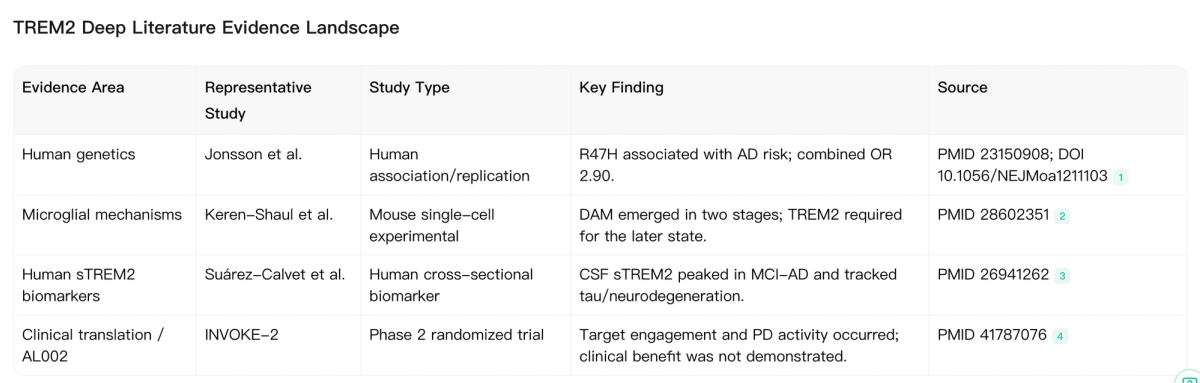
The first category concerned human genetics.
The original study by Jonsson and colleagues found that the rare TREM2 R47H variant was associated with Alzheimer's disease risk, with a combined odds ratio of approximately 2.90.
This finding supports the biological relevance of TREM2 to disease susceptibility.
However, it does not automatically demonstrate that activating TREM2 with a drug will improve the course of established Alzheimer's disease.
Read the original TREM2 genetic study.
The second category examined microglial mechanisms.
Keren-Shaul and colleagues investigated disease-associated microglia in experimental models and described a TREM2-dependent component of the response.
This provided mechanistic evidence, but findings from animal models do not establish clinical treatment efficacy in humans.
Read the original disease-associated microglia study.
The third category examined human biomarker evidence.
Suárez-Calvet and colleagues investigated soluble TREM2 in cerebrospinal fluid and reported associations with early symptomatic Alzheimer's disease and neuronal injury markers.
These observations support the relevance of sTREM2 to disease-related biological processes, but they do not establish it as a validated surrogate for clinical benefit.
Read the human sTREM2 biomarker study.
The fourth category concerned clinical translation.
The phase 2 INVOKE-2 trial tested AL002, an investigational TREM2 agonistic antibody, in 381 participants with early Alzheimer's disease.
The published trial reported sustained target engagement and pharmacodynamic changes, including reduced cerebrospinal fluid sTREM2 and increased osteopontin.
However, AL002 did not meet its primary clinical endpoint of change in Clinical Dementia Rating–Sum of Boxes (CDR-SB).
Read the published INVOKE-2 randomized trial.
This distinction is essential: evidence of biological target engagement does not establish clinical efficacy.
3. Noah AI Research Gaps and Contradictions
Noah's next major output was titled Translational Evidence Gaps and Contradictions.
This table focused on what researchers still cannot conclude from the available literature.
Its four main questions concerned genetic validation, translation from animal models to humans, the clinical meaning of sTREM2 biomarkers, and the gap between target engagement and clinical improvement.
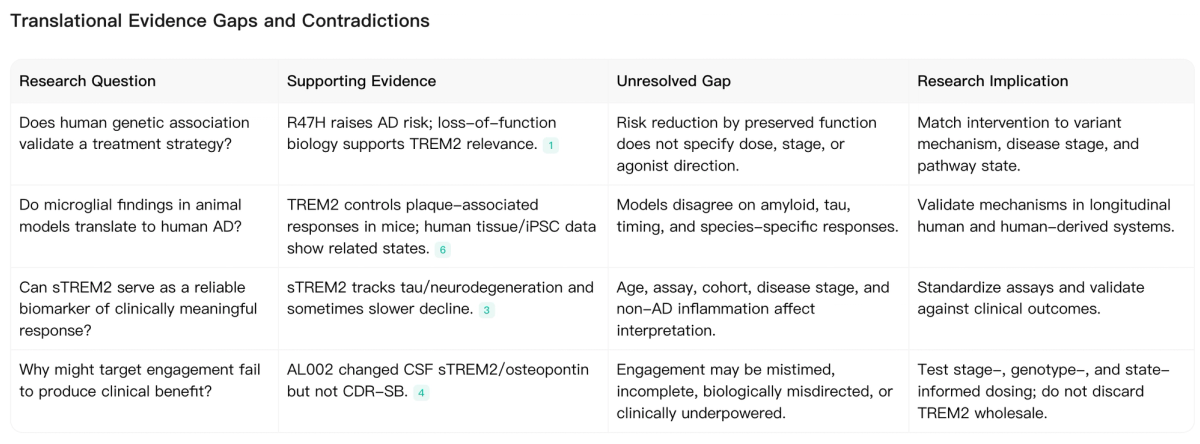
One important question was why a treatment could engage its intended biological target without demonstrating clinical benefit.
The available trial findings show that AL002 produced measurable pharmacodynamic changes but did not significantly improve the primary clinical endpoint.
Possible explanations could involve disease stage, target biology, dose, timing, or limitations of the intervention.
These explanations remain hypotheses; the negative trial alone does not establish which mechanism caused the lack of benefit.
It also does not prove that every possible TREM2-directed therapy would fail.
This is the kind of distinction a research synthesis should preserve: what the evidence demonstrates, what remains uncertain, and which questions require additional investigation.
What We Observed in Noah AI
The directly observed Noah workflow produced a structured evidence landscape and a separate translational-gap analysis.
It connected several research disciplines to one therapeutic question while retaining source information and important interpretation boundaries.
The output was useful for organizing the relationship between biological rationale and clinical evidence.
However, it was not an exhaustive systematic review. In particular, the Noah report indicated that some INVOKE-2 findings were verified from accessible publication records or abstract-level information rather than an independent review of every full-text supplementary table.
The source citations and extracted statements therefore remain subject to researcher verification.
Explore Deep Biomedical Research with Noah AI
Turn a medical research question into a structured evidence landscape, source-grounded synthesis, and research-gap analysis.
Free Credits Available · No Credit Card Required
Undermind Output: Literature Research in a Paper-Based Workspace
We also used Undermind to investigate the TREM2 and Alzheimer's disease literature.
Unlike the screenshots from Noah AI, the Undermind screenshot shows a response inside its Chat Knowledge workspace.
At the time the screenshot was captured, the workspace displayed:
- 36 PDFs in the paper library.
- 38 abstracts available in the workspace.
- 0 Deep Searches recorded in that workspace view.
- A literature-grounded chat response discussing TREM2-related evidence.
- A recommendation to upload the full-text INVOKE-2 publication for closer verification.
The PDF and abstract counts describe the visible workspace contents. They should not be interpreted as the number of unique studies retrieved by a comprehensive search.
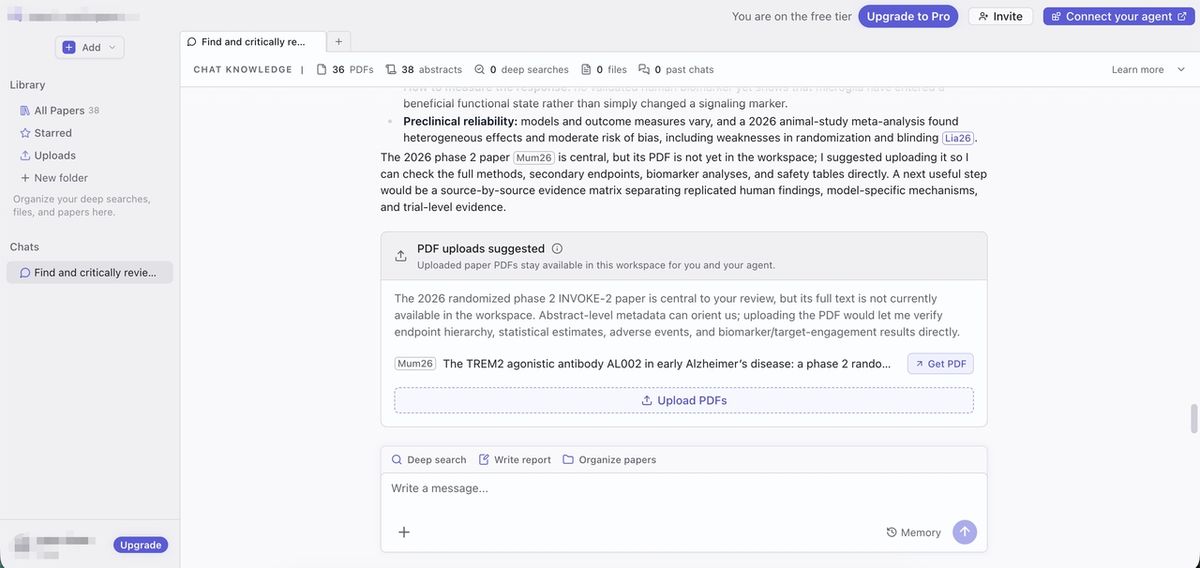
1. Working With a Scientific Paper Library
The Undermind interface presents research chat alongside a collection of scientific publications.
This makes it possible to discuss a question in the context of research materials available in the workspace.
The visible output referred to findings from the literature and included source markers attached to specific papers.
That is relevant for researchers who are assembling, reviewing, and revisiting a body of scientific work over time.
However, the screenshot does not establish that Undermind independently retrieved all relevant TREM2 papers or completed a new Deep Search for this particular question.
2. Identifying Missing Full-Text Evidence
One of the most informative observations in the Undermind output was its treatment of the INVOKE-2 publication.
The response identified the 2026 phase 2 AL002 paper as central to the research question but stated that its PDF was not yet available in the workspace.
It recommended obtaining the full-text paper so the research could be checked more directly.
The suggested verification tasks included:
- Examining the trial's complete methods.
- Checking the primary and secondary endpoints.
- Reviewing statistical estimates.
- Inspecting reported adverse events.
- Verifying biomarker and target-engagement findings.
This is a useful research behavior because an abstract can summarize a trial's principal conclusions without containing all the information needed for detailed appraisal.
For example, the published INVOKE-2 abstract establishes that AL002 did not meet the primary CDR-SB endpoint, but a thorough appraisal of adverse events and exploratory analyses may require the full publication and supporting material.
The distinction between a known publication and an accessible full-text source is therefore important.
3. What This Undermind Screenshot Does and Does Not Demonstrate
The screenshot demonstrates that Undermind can provide a literature-grounded response in its Chat Knowledge environment while drawing attention to missing source material.
It also shows that the workspace can contain a substantial paper collection for further investigation.
However, it does not demonstrate the performance of Undermind's separate Deep Search engine in this research run.
The interface explicitly showed zero Deep Searches at the time of capture.
Undermind's official product documentation describes broader capabilities, including iterative literature discovery, citation exploration, full-text investigation, and research reporting.
Those capabilities are relevant to a deep literature research comparison, but they should be distinguished from the specific Chat Knowledge output shown here.
What Did We Learn From the Two Outputs?
The two products illustrated different research activities within the same biomedical topic.
Noah AI generated a structured synthesis connecting genetic association, experimental mechanisms, human biomarkers, and clinical results.
Undermind's visible Chat Knowledge response drew on its literature workspace and highlighted a source-access limitation affecting the depth of clinical-trial verification.
| Observed Dimension | Noah AI Output | Undermind Output |
|---|---|---|
| Research interaction | Agent with Deep Research | Chat Knowledge in a paper workspace |
| Visible research materials | Representative cited studies | 36 PDFs and 38 abstracts shown |
| Visible output | Evidence landscape and research-gap table | Cited research discussion and PDF-upload suggestion |
| Clinical-trial limitation | Not every supplementary trial detail independently checked | Primary INVOKE-2 PDF absent from workspace |
| What remains untested | Exhaustive literature coverage and comparative accuracy | Deep Search performance for the TREM2 query |
These observations should not be used to rank the products by speed, retrieval recall, factual accuracy, or overall research quality.
The workflows were not tested under identical conditions, and the screenshots document different modes of interaction.
The more practical conclusion is that both source organization and evidence interpretation matter for complex biomedical questions.
When Should You Use Noah AI?
- You are starting from a biomedical research question.
- You need to connect findings from several scientific disciplines.
- You want a structured medical evidence landscape.
- You need to distinguish experimental findings from human clinical evidence.
- You want to identify unresolved translational research questions.
- You need a source-grounded research output for further review.
Noah AI is particularly relevant when the main challenge is turning biomedical literature into an organized evidence synthesis.
When Should You Use Undermind?
- You are exploring a scientific topic and need to find relevant publications.
- You want to maintain and investigate a collection of research papers.
- You need to explore citation relationships and related studies.
- You want to ask questions about papers in a research workspace.
- You need to identify which important sources require full-text inspection.
- You want to generate literature-grounded reports and follow-up analyses.
Undermind is particularly relevant when a researcher wants to develop and investigate a body of scientific literature over time.
Its Deep Search capabilities are a separate part of the product and should be evaluated directly when comprehensive literature discovery is the primary requirement.
Can You Use Noah AI and Undermind Together?
Yes. The two tools can support complementary parts of a research workflow.
A researcher could use Undermind to discover relevant publications, assemble a paper collection, and identify original sources requiring closer reading.
The researcher could then use Noah AI to organize the selected biomedical evidence around a defined medical question and generate a structured synthesis.
For example, a TREM2 research project could follow these steps:
- Define the research question: Specify the biological and clinical aspects of TREM2.
- Discover relevant papers: Search for genetic, mechanistic, biomarker, and therapeutic studies.
- Inspect original sources: Obtain full texts for pivotal publications, including key clinical trials.
- Organize evidence: Separate genetic associations, experimental results, biomarkers, and trial outcomes.
- Synthesize findings: Identify supported conclusions and unresolved questions.
- Verify the report: Confirm numerical findings and important interpretations against the original publications.
This is a suggested combined workflow. We did not test an automated integration between Noah AI and Undermind.
Final Takeaway: Noah AI vs Undermind
Noah AI and Undermind both offer capabilities relevant to deep scientific literature research.
The central difference is not that one tool can search while the other can synthesize. Both support research activities across these areas.
In our actual TREM2 examples, Noah AI produced a structured biomedical evidence landscape and a translational-gap analysis.
Undermind's Chat Knowledge workspace supported literature-based investigation and identified a missing full-text clinical trial source that should be inspected before drawing stronger conclusions.
These findings reinforce two principles of reliable research.
First, identifying relevant evidence is not the same as establishing what that evidence proves.
Second, source-grounded answers remain limited by the underlying publications available for verification.
For researchers focused on biomedical evidence synthesis, Noah AI is a relevant option.
For researchers focused on building, exploring, and expanding a scientific literature collection, Undermind is also worth considering.
A comprehensive comparison of their search accuracy would require matched research questions, similar source access, direct use of both deep-search modes, and independent assessment of retrieved studies and generated claims.
Explore Deep Literature Research with Noah AI
Connect biomedical findings across studies, organize source-grounded evidence, and investigate important research questions.
Free Credits Available · No Credit Card Required
Start Researching with Noah AI →
Free credits and research usage are subject to current plan limits.
Frequently Asked Questions
Is Noah AI an Alternative to Undermind?
Yes. Both platforms support AI-assisted scientific literature research. Noah AI emphasizes medical and life-science research workflows, while Undermind provides deep literature discovery, paper libraries, and source-grounded research capabilities.
What Is the Main Difference Between Noah AI and Undermind?
The difference is primarily one of workflow emphasis. Noah AI can organize biomedical findings into structured evidence syntheses. Undermind offers a research workspace built around literature discovery, document analysis, and research exploration. Their capabilities overlap.
Can Undermind Perform Deep Literature Searches?
Yes. Undermind officially supports Deep Search for scientific literature exploration. However, the specific Undermind screenshot in this article shows a Chat Knowledge interaction with zero Deep Searches recorded at the time of capture.
Can Noah AI Identify Biomedical Research Gaps?
Noah AI can help organize literature and identify questions that remain unresolved. In our TREM2 example, it generated a table connecting genetic, experimental, biomarker, and clinical evidence to important translational research uncertainties.