
Oncology Clinical Trial Endpoints Beyond OS: PFS, EFS, pCR & PROs (2026)
Linda
Compare oncology clinical trial endpoints beyond OS, including PFS, EFS, pCR, ORR and PROs, with real KEYNOTE-522 evidence and FDA/HTA perspectives.
Evidence cutoff: October 22, 2026 · Scientific case study: KEYNOTE-522 (NCT03036488)
Overall survival (OS) is among the most meaningful outcomes in oncology: it answers whether people live longer. Yet waiting for enough deaths to occur can take years, especially in potentially curative cancer. During that time, progression, recurrence, pathological response, treatment toxicity, and changes in quality of life may already be affecting patients.
Do oncology trials always need to wait for overall survival? Not necessarily. Progression-free survival (PFS), event-free survival (EFS), pathological complete response (pCR), objective response rate (ORR), and patient-reported outcomes (PROs) can answer important, different questions. The key is to preserve each endpoint's meaning and the strength of evidence connecting it to clinical benefit.
To demonstrate an evidence-first approach, we tested Noah AI directly using a structured oncology endpoints research task. The generated report compared six endpoint categories and traced how evidence from the same randomized breast-cancer trial, KEYNOTE-522, developed across publications in 2020, 2022, and 2024. The screenshots below show authentic Noah AI outputs, not simulated interfaces.
Testing note: Only Noah AI was directly tested for this article. The screenshots show an actual oncology endpoint evidence matrix and a KEYNOTE-522 evidence timeline generated in the tested workflow. The outputs demonstrate research organization and evidence comparison, not independently verified scientific accuracy or a comprehensive review.
1. Why Overall Survival Remains Important
Overall survival measures time from a defined starting point, usually randomization, to death from any cause. Because the event is objective and important to patients, it is often considered the strongest direct measure of survival benefit. Unlike radiographic measurements, an OS event does not require interpretation of whether a lesion has progressed under RECIST or another imaging rule.
OS also integrates both treatment effects and possible fatal harms. A regimen may delay tumor progression yet cause toxicity or produce no gain in survival. That is a reason to collect OS information even when another outcome is the primary endpoint.
But OS is not always the only clinically appropriate trial endpoint. Longer survival, effective later-line treatments, treatment crossover, fewer observed deaths, and competing causes of mortality may delay or complicate an interpretable comparison. In early-stage disease, thousands of patients and extended follow-up may be required before an OS result is sufficiently mature.
The FDA's 2018 final guidance on cancer trial endpoints discusses endpoint selection in context. The FDA's August 2025 OS assessment guidance was still draft guidance at this report's evidence cutoff; it should not be described as a finalized regulatory requirement.
2. OS vs PFS vs EFS vs pCR vs ORR vs PROs
These endpoint names are often used together, but they measure different things. Treating them as interchangeable risks overstating what a clinical trial has established.
Overall survival (OS) is time to death from any cause. It directly measures survival, but it may require prolonged follow-up and can be influenced by subsequent therapies.
Progression-free survival (PFS) generally measures time from randomization to objective disease progression or death. PFS can provide earlier evidence of disease control, especially in metastatic settings. Its interpretation depends on imaging schedules, assessment rules, censoring, and whether delaying progression is clinically meaningful in that context.
Event-free survival (EFS) measures time to one of several prespecified events. In a neoadjuvant trial, events might include progression that prevents surgery, recurrence, another primary cancer, or death. The exact definition is protocol-specific; EFS in one disease is not automatically equivalent to EFS in another.
Pathological complete response (pCR) can measure the absence of residual invasive disease after neoadjuvant treatment at definitive surgery. In breast-cancer trials, the precise breast and lymph-node definition must be checked. A pCR rate may provide relatively early information, but a higher pCR rate does not by itself prove longer OS.
Objective response rate (ORR) is the proportion of patients with a complete or partial tumor response by defined criteria. It is helpful for measuring antitumor activity, particularly in early development, but it does not capture durability unless paired with duration of response or follow-up outcomes.
Patient-reported outcomes (PROs) describe symptoms, functioning, and quality of life directly reported by patients. They are not automatically substitutes for survival: when measured and analyzed appropriately, they are direct evidence about how patients feel and function. The FDA's October 2024 final guidance addresses the collection of core PRO measures in cancer trials.
Noah AI example: Oncology Clinical Endpoint Evidence Matrix
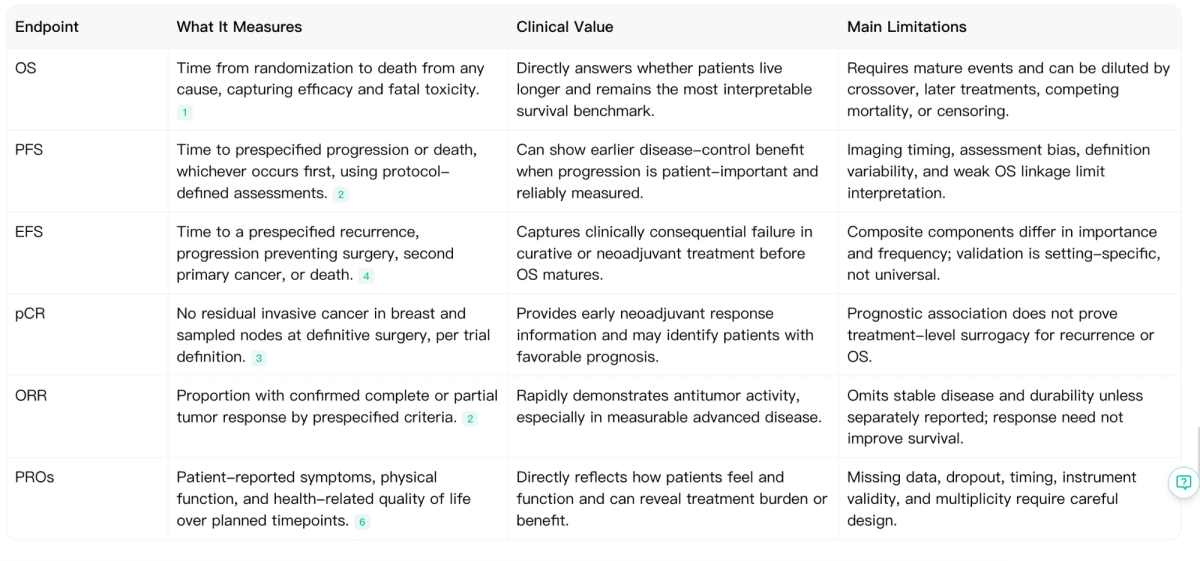
The matrix is useful because it does more than list acronyms. It pairs each measurement with a decision context and its limitations. Researchers should also examine the protocol-specific event definitions, because a seemingly familiar endpoint may be analyzed differently across trials.
3. KEYNOTE-522: How Clinical Evidence Matured from 2020 to 2024
KEYNOTE-522 (NCT03036488) is a randomized phase III trial in previously untreated stage II–III triple-negative breast cancer (TNBC). A total of 1,174 patients were assigned in a 2:1 ratio: 784 to a pembrolizumab-containing regimen and 390 to a placebo-containing regimen. The experimental strategy included neoadjuvant pembrolizumab with chemotherapy before surgery, followed by adjuvant pembrolizumab after surgery. The control included corresponding placebo and chemotherapy components.
The trial is a valuable teaching example because the same randomized program reported different outcomes as follow-up accumulated. Each published estimate has its own analysis population, cutoff and maturity. The 2020 pCR findings were based on an early subset, whereas the later EFS and OS analyses evaluated the randomized trial population.
2020: pCR Provided an Early Surgical-Response Signal
In the 2020 NEJM publication (PMID 32101663; DOI 10.1056/NEJMoa1910549), the first interim pCR analysis included the first 602 randomized patients. The reported pCR percentages were 64.8% for pembrolizumab plus chemotherapy and 51.2% for placebo plus chemotherapy. The estimated difference was 13.6 percentage points (95% CI 5.4–21.8; P<0.001).
This was evidence of more complete eradication of invasive disease at surgery in the studied setting. It was not yet a mature analysis demonstrating that patients lived longer.
2022: EFS Captured Recurrence-Related and Other Events
The 2022 NEJM EFS publication (PMID 35139274; DOI 10.1056/NEJMoa2112651) analyzed all 1,174 randomized patients at the fourth planned interim analysis, with a March 23, 2021 data cutoff and median follow-up of 39.1 months.
Estimated EFS at 36 months was 84.5% versus 76.8%, with a hazard ratio of 0.63 (95% CI 0.48–0.82; P<0.001). The trial's EFS definition included progression preventing definitive surgery, local or distant recurrence, second primary cancer, or death. This offered stronger longitudinal evidence about clinically consequential events than pCR alone.
2024: OS Provided Later, Direct Survival Evidence
The 2024 NEJM OS publication (PMID 39282906; DOI 10.1056/NEJMoa2409932) reported OS as a secondary endpoint for all 1,174 randomized patients. At the March 22, 2024 cutoff, median follow-up was 75.1 months.
Estimated OS at 60 months was 86.6% versus 81.7%—an absolute difference of 4.9 percentage points—with P=0.002. These mature data demonstrated a significant OS benefit of the complete neoadjuvant/adjuvant regimen over its comparator in the enrolled population. The study did not isolate the survival contribution of adjuvant pembrolizumab from the earlier components of the regimen.
Noah AI example: KEYNOTE-522 Evidence Timeline
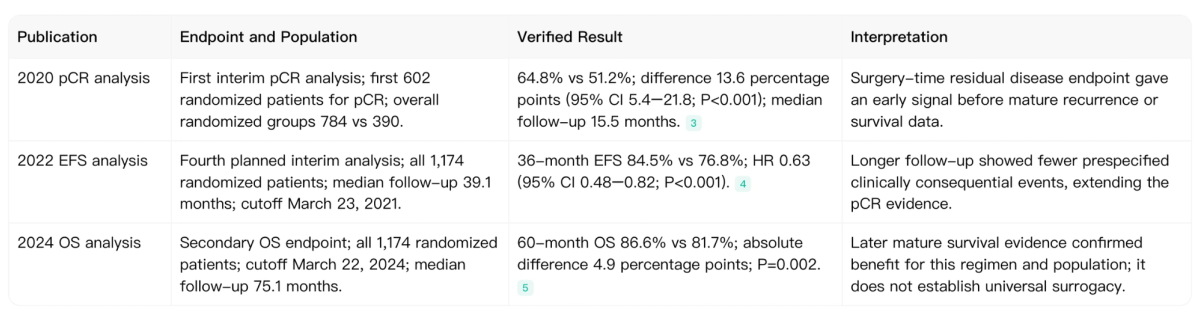
The progression from pCR to EFS to OS is useful precisely because it shows evidence maturation, not a universal mathematical conversion from one endpoint to another. A single trial with improvements in all three endpoints cannot establish that every therapy raising pCR will also improve OS across different cancer types or treatment classes.
4. Does an Earlier Endpoint Predict Overall Survival?
An endpoint may be prognostic without being a well-validated surrogate for treatment effect. For example, patients achieving pCR often have better outcomes. But this patient-level relationship does not establish that a new drug increasing pCR will necessarily extend OS when evaluated in a randomized trial.
Three questions help separate the evidence:
- Biological plausibility: Is there a credible mechanism linking the earlier measurement to a later clinically meaningful outcome?
- Patient-level association: Do people with better earlier outcomes also tend to have better later outcomes after accounting for confounding and follow-up?
- Trial-level treatment-effect association: Across comparable randomized trials, do treatment-induced improvements in the candidate surrogate reliably predict treatment-induced improvements in survival or another relevant endpoint?
Trial-level evidence is particularly important when a surrogate is intended to stand in for the effect of a new treatment on a target clinical outcome. The 2026 ISPOR Good Practices Report (PMID 41679646) recommends rigorous evaluation of surrogate relationships, including multivariate meta-analytic approaches and explicit treatment of uncertainty when surrogate information is used in health technology assessment (HTA).
Surrogacy can be context-dependent. Even a well-supported relationship for one cancer stage, drug class, patient population, or endpoint definition should not be transferred without justification to another. KEYNOTE-522 is therefore best described as a real case of evidence progressing from an early pathological endpoint to later survival confirmation—not as proof that pCR universally predicts OS.
5. FDA, NICE, and ISPOR: Different Evidence Questions
Different decision-makers can use the same trial data while asking different questions.
FDA regulatory evaluation. U.S. oncology drug assessment considers whether trial results support the claimed benefit-risk profile for a defined population. Overall survival is highly interpretable, but other endpoints can be appropriate in particular diseases and designs. FDA's 2018 endpoint document is final guidance. Its August 2025 OS assessment document remained draft guidance as of the evidence cutoff.
NICE and health technology assessment. HTA decisions examine comparative clinical effectiveness, costs, quality-adjusted life-years where relevant, and uncertainty in the evidence base. A treatment's PFS advantage may be meaningful, but reimbursement modeling could still depend strongly on how that advantage translates into longer-term survival, treatment costs, symptoms, or quality of life. The NICE PMG36 manual was last updated March 31, 2026.
ISPOR methodological perspective. The 2026 surrogate endpoints report emphasizes transparent statistical validation and appropriate handling of uncertainty. It does not create a universal formula for translating a tumor-response rate into survival gain.
The point is not that any one organization is for or against alternative endpoints. Instead, regulatory approval, clinical practice, and health-economic evaluation may require different combinations of direct patient outcomes, surrogate validation, safety, and follow-up.
6. Patient-Reported Outcomes Are Not Just Another Surrogate
Patients may value avoiding symptoms, maintaining everyday function, and reducing treatment burden alongside living longer. PRO instruments can capture these experiences directly, while tumor imaging and survival statistics may not.
A usable PRO analysis requires prespecified measures, appropriate timing, a strategy for missing data, and explicit interpretation of what size of change matters to patients. Treatment withdrawal, disease progression, and death can create informative dropout; simply analyzing complete questionnaires may bias results.
The FDA's 2024 final PRO guidance provides a framework for collecting core patient-reported information. The KEYNOTE-522 papers reviewed here establish pCR, EFS and OS findings; they do not establish a specific PRO benefit in this case study. An evidence-led article should not invent that result.
7. How We Used Noah AI to Compare Oncology Endpoints
For the Noah AI case study, the research task was constrained to official oncology endpoint guidance, the three named KEYNOTE-522 publications, and relevant ISPOR and NICE methods sources. We then required structured output that separated endpoint definitions, clinical value, interpretation limits, analysis populations, and publication dates.
The resulting report generated two complementary research outputs: a six-row endpoint matrix, and a three-row KEYNOTE-522 evidence timeline. Both are shown above using actual Noah output screenshots. This demonstration establishes the existence of those outputs in the tested workflow; it is not a claim that Noah independently validates clinical trial data without human review.
A useful research workflow is to define the clinical decision, assemble primary evidence, extract endpoint-specific details, compare them in a structured table, and return to the underlying sources whenever an estimate or interpretation matters. Researchers should verify the PMID, DOI, trial registration, denominator, cutoff date, estimand, and applicable endpoint definition before reusing the summary in formal research or development decisions.
Try an Evidence-Grounded Oncology Research Task
Organize oncology trial publications and compare what their endpoints actually establish. New users receive 300 free credits on signup — no credit card required.
Get 300 Free Credits with Noah AI →
8. Practical Checklist: Selecting an Oncology Trial Endpoint
Before choosing or interpreting an endpoint, work through these questions:
- Treatment setting: Is the study neoadjuvant, adjuvant, curative-intent, or metastatic?
- Patient-important outcome: Is the intended benefit longer life, delayed progression or recurrence, improved function, or fewer symptoms?
- Endpoint definition: Does the protocol specify the event, time origin, population, assessment frequency, censoring, and handling of intercurrent events?
- Comparator and subsequent treatment: Could treatment switching or unequal follow-up therapy influence OS?
- Evidence maturity: Are the number of observed events, follow-up duration, and interim testing rules adequate?
- Surrogacy: Is there appropriate treatment-level validation in a comparable disease and therapeutic setting?
- Patient experience: Are toxicity, PROs, and quality-of-life outcomes collected and interpreted?
- Decision requirements: Would the same evidence support the intended regulatory question, clinical use, and HTA assessment?
A single endpoint rarely captures everything important about a therapy. A well-designed program often combines an interpretable primary endpoint with prespecified safety, survival, and patient-centered secondary outcomes.
9. Frequently Asked Questions
What is the difference between OS and PFS?
OS measures time to death from any cause. PFS usually measures time to progression or death, whichever occurs first. PFS can mature earlier, but a PFS advantage does not necessarily mean that patients live longer.
Is EFS the same as PFS?
No. EFS uses a protocol-specific composite of events and is common in settings where surgery, recurrence, or other treatment failure matters. Its precise event definition can differ from PFS and between trials.
Does a higher pCR rate guarantee an OS benefit?
No. pCR can be a useful early measurement and may be prognostic, but treatment-level surrogacy for OS must be validated in the relevant setting. KEYNOTE-522 showed positive findings at both early and later endpoints in one trial; that does not establish a universal rule.
What did KEYNOTE-522 show over time?
Its publications reported pCR of 64.8% versus 51.2% in the 2020 early subset, 36-month EFS of 84.5% versus 76.8% in 2022, and 60-month OS of 86.6% versus 81.7% in 2024. These were different analysis timepoints and not interchangeable denominators.
Are patient-reported outcomes surrogate endpoints?
Not automatically. Measures of symptoms, function, and quality of life can be direct patient-relevant outcomes. Their reliability still depends on instrument validity, trial design, missing-data handling, and meaningful interpretation.
Can AI determine the best oncology endpoint for a trial?
AI can assist with finding publications, organizing definitions, and comparing evidence. Endpoint selection still requires disease-specific methodological, clinical, statistical, patient, and regulatory judgment. Any AI-generated references or numerical claims should be checked against the primary sources.
10. References and Evidence Limitations
- FDA. Clinical Trial Endpoints for the Approval of Cancer Drugs and Biologics. Final guidance (2018).
- FDA. Approaches to Assessment of Overall Survival in Oncology Clinical Trials. Draft guidance (August 2025).
- Schmid P, et al. Pembrolizumab for Early Triple-Negative Breast Cancer. NEJM (2020). PMID 32101663.
- Schmid P, et al. Event-free Survival with Pembrolizumab in Early Triple-Negative Breast Cancer. NEJM (2022). PMID 35139274.
- Schmid P, et al. Overall Survival with Pembrolizumab in Early-Stage Triple-Negative Breast Cancer. NEJM (2024). PMID 39282906.
- KEYNOTE-522 Trial Registration — NCT03036488.
- FDA. Core Patient-Reported Outcomes in Cancer Clinical Trials. Final guidance (October 2024).
- Bujkiewicz S, et al. Methods for Evaluation of Surrogate Endpoints for HTA Decision Making: ISPOR Task Force. Value in Health (2026). PMID 41679646.
- NICE. Technology Appraisal and Highly Specialised Technologies: The Manual, PMG36 (updated March 2026).
Evidence limitations. This article uses the Noah report prepared with evidence available through October 22, 2026. It is a focused methodological case study, not a systematic review of all oncology endpoints or a quantitative surrogate-validation meta-analysis. Trial-specific published estimates may change with subsequent analyses. PRO benefits are not inferred from the three KEYNOTE-522 publications. FDA draft documents are identified as drafts, and primary sources should be checked before regulatory or clinical decisions.
Final Takeaway: Look Beyond a Single Oncology Endpoint
OS remains indispensable when the question is whether a therapy helps patients live longer. But earlier endpoints may provide legitimate, timely evidence about tumor response, recurrence, disease control, and patients' experience. The correct interpretation depends on the cancer setting, trial design, exact endpoint definition, and whether the evidence supports the intended clinical or regulatory decision.
KEYNOTE-522 shows how one trial's evidence evolved from pCR to EFS and, eventually, mature OS. The scientific lesson is not that earlier outcomes always predict survival; it is that researchers can make better decisions by keeping which endpoint, which population, which analysis, and which date visible together.
Explore Clinical Trial Evidence with Noah AI
Bring together primary oncology publications, organize endpoint comparisons, and build source-linked research summaries. Get 200 free credits when you sign up — no credit card required.
For research and educational use only. Not medical, regulatory, or investment advice.