
OS vs PFS in Oncology Trials: How to Compare Clinical Evidence with AI (2026)
Linda
Compare OS, PFS and iDFS in oncology trials with AI. Explore real HER2-positive breast cancer evidence from CLEOPATRA, DESTINY-Breast03 and KATHERINE.
A source-grounded comparison of overall survival, progression-free survival, and invasive disease-free survival using CLEOPATRA, DESTINY-Breast03, and KATHERINE.Noah AI research case study · Evidence cutoff: October 29, 2026 · HER2-positive breast cancerOverall survival (OS) is among the clearest outcomes in cancer research: did patients live longer? Yet it is not always the earliest or most practical way to assess a therapy. Progression-free survival (PFS) can reveal disease-control effects before survival data mature, while disease-free survival (DFS) and invasive disease-free survival (iDFS) reflect recurrence-related outcomes in potentially curative treatment settings.These endpoints are not interchangeable. They count different events, are often measured at different times, and can be affected by very different clinical and statistical factors. That creates a challenge for researchers reviewing oncology trials: an impressive PFS result cannot be read as a guaranteed OS result, and a seven-year iDFS rate cannot be directly compared with a median metastatic PFS.This article follows three randomized HER2-positive breast cancer trials and demonstrates how a source-linked AI literature workflow can organize the evidence without replacing critical appraisal, statistical analysis, or regulatory judgment. Each numerical comparison below is within its own randomized trial, not a head-to-head comparison between the three regimens.
Overall Survival: A Trusted Benchmark, but Not Always Best
Overall survival is typically defined as time from randomization to death from any cause. It is directly relevant to patients and relatively objective: a death event is generally less dependent on investigator interpretation than an imaging-based declaration of disease progression. It also incorporates both beneficial and harmful consequences of therapy, including fatal toxicity.OS has limitations. Some trials need years to accumulate enough deaths for a precise estimate. Patients may switch treatments after progression, cross over to an active regimen, or receive effective subsequent therapies. Those events can complicate attribution of the eventual survival difference to the initially randomized treatment. OS also does not, on its own, capture symptom relief, time spent free of progression, functional outcomes, or treatment burden.
CLEOPATRA: earlier PFS evidence and mature OS follow-up
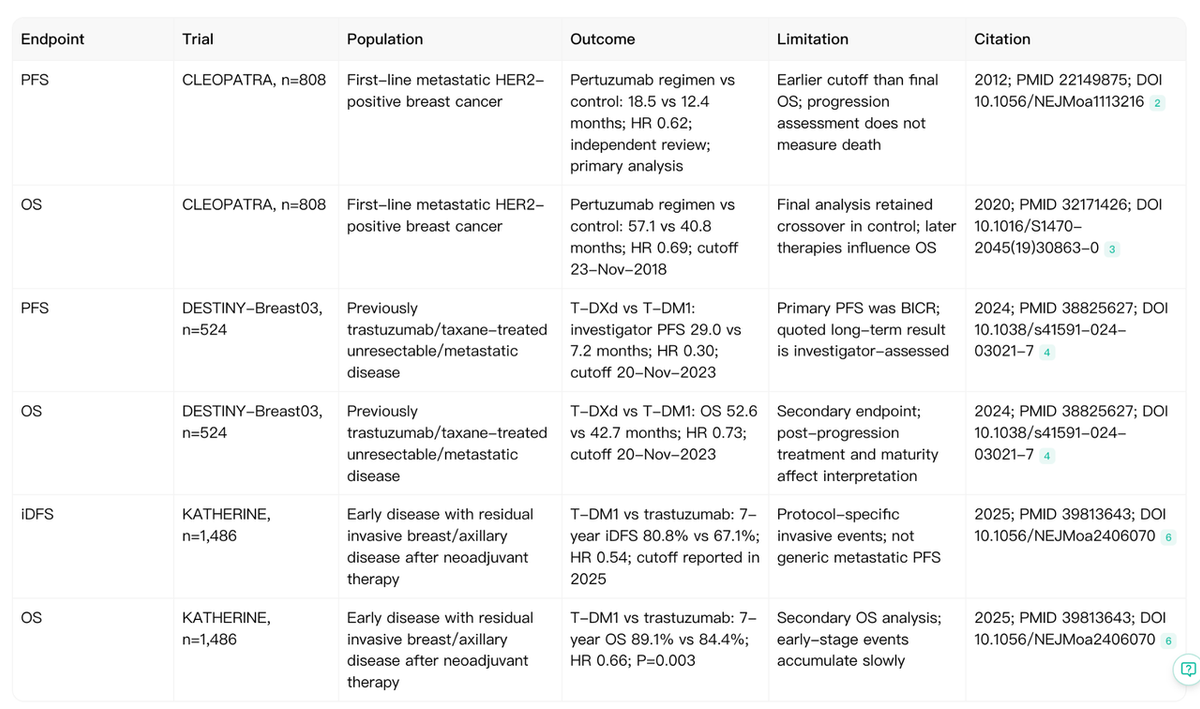
CLEOPATRA (NCT00567190) randomized 808 patients with previously untreated HER2-positive metastatic breast cancer to pertuzumab, trastuzumab, and docetaxel or placebo, trastuzumab, and docetaxel. Its primary endpoint was independently reviewed PFS. The original analysis reported median PFS of 18.5 versus 12.4 months (HR 0.62; 95% CI 0.51–0.75). Original randomized report.Survival evidence matured later. At the final end-of-study analysis with a November 23, 2018 data cutoff and approximately 100 months of median follow-up, median OS was 57.1 versus 40.8 months (HR 0.69; 95% CI 0.58–0.82). The report also documented that 50 patients crossed from the control arm to pertuzumab. Those crossover patients remained in their originally randomized group for the intent-to-treat efficacy analysis. Final OS publication.The lesson is not that every PFS advantage will later produce an OS advantage. Rather, CLEOPATRA is a concrete case where an earlier progression endpoint was supported by mature randomized survival evidence in the same population, with important context about crossover and later treatment.
Why Aren’t Alternative Oncology Endpoints Used More Widely?
Alternative endpoints can provide useful evidence sooner, but their interpretation is often less straightforward than the endpoint acronym suggests. Progression can depend on scan schedules and response criteria; recurrence endpoints depend on which local, regional, contralateral, distant, or death events the protocol counts. A statistically favorable result is not necessarily proof of a patient-important improvement of the same magnitude.
| Endpoint | What it measures | Typical context | Key interpretation issue |
|---|---|---|---|
| OS | Time until death from any cause | Advanced or early cancer | Slow to mature; influenced by later treatment and crossover |
| PFS | Time until defined progression or death | Advanced/metastatic cancer | Imaging frequency, assessment method and censoring can affect results |
| DFS | Time until specified recurrence or death | Curative/adjuvant cancer care | Event definitions vary between protocols |
| iDFS | Time until specified invasive recurrence or death | Early breast cancer | Not equivalent to metastatic PFS or an automatic OS surrogate |
The trade-off differs by disease stage. For metastatic disease, controlling progression can matter even before longer-term survival is known. After surgery for early disease, recurrence and invasive events may be more meaningful short- and medium-term signals than radiographic progression of measurable disease.
DESTINY-Breast03: name the PFS assessment method
DESTINY-Breast03 (NCT03529110) randomized 524 patients with previously treated, unresectable or metastatic HER2-positive breast cancer to trastuzumab deruxtecan (T-DXd) or trastuzumab emtansine (T-DM1). The primary endpoint was PFS assessed by blinded independent central review (BICR), while OS was a key secondary endpoint.In the peer-reviewed 2024 long-term analysis, with a November 20, 2023 cutoff, investigator-assessed median PFS was 29.0 versus 7.2 months (HR 0.30; 95% CI 0.24–0.38). Median OS was 52.6 versus 42.7 months (HR 0.73; 95% CI 0.56–0.94). Nature Medicine long-term analysis.This distinction matters: the widely quoted 29.0-versus-7.2-month estimate is investigator-assessed PFS, not the original centrally reviewed primary PFS estimate. An AI-generated evidence table should preserve that label, the analysis cutoff, and the trial’s original endpoint hierarchy rather than silently merge them.The 2026 five-year update separately reported investigator-assessed PFS of 29.0 versus 7.8 months and median OS of 56.4 versus 42.7 months. That later evidence was reported as a conference abstract; it should not be presented as the same analysis as the 2024 peer-reviewed paper or given an equivalent source label.
KATHERINE: invasive disease-free survival in early cancer
KATHERINE (NCT01772472) randomized 1,486 patients with HER2-positive early breast cancer and residual invasive disease after neoadjuvant therapy and surgery to adjuvant T-DM1 or trastuzumab. Its primary endpoint was invasive disease-free survival (iDFS), which counted prespecified invasive local, regional, contralateral or distant events, or death—not radiographic progression in a metastatic setting.The original report found three-year iDFS of 88.3% versus 77.0% (HR 0.50). In the 2025 updated report, with median follow-up of 8.4 years, seven-year iDFS was 80.8% versus 67.1% (HR 0.54; 95% CI 0.44–0.66), and seven-year OS was 89.1% versus 84.4% (HR 0.66; 95% CI 0.51–0.87).That later OS benefit is important evidence for the randomized treatment comparison. It does not mean iDFS is universally validated as a substitute for OS in every breast cancer regimen or adjuvant trial. The exact event definition, population, duration of observation and statistical analysis still determine what can be concluded.
Comparing Clinical Evidence with Noah AI
One way to make endpoint reviews more auditable is to begin with a question that identifies the disease, the trial set and the specific evidence fields. For this case, the question was:
How do OS, PFS and iDFS differ in clinical meaning, study design and interpretation across CLEOPATRA, DESTINY-Breast03 and KATHERINE? Compare the enrolled populations, randomized sample sizes, numerical outcomes, assessment methods, data cutoffs, limitations and original citations.
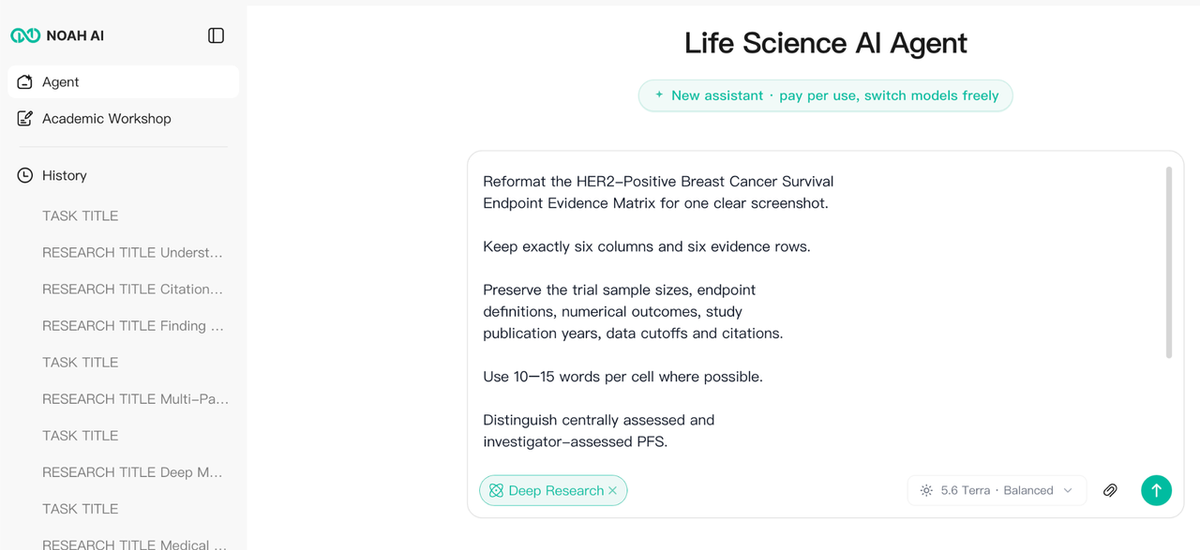
The study-level information can then be organized into an evidence matrix. Each outcome needs to stay attached to its trial, treatment comparison, population, endpoint definition, publication and analysis date. This is the work of evidence organization—not a replacement for checking the papers.Figure 1 shows a follow-up formatting instruction prepared in the Noah interface to make an evidence matrix more readable. The text is visible in the input field; the image does not establish that this instruction was submitted, and it is not the original research question.
The resulting table below preserves six endpoint rows covering the three trials. The numbers should be read within each trial. The table is not a network meta-analysis, a comparative effectiveness ranking or independent verification of every statistical assumption.
A simple verification checklist for every row
- Confirm the trial: NCT identifier, eligibility, disease stage, treatment line and actual randomized comparison.
- Confirm the endpoint: whether PFS was centrally or investigator assessed, whether iDFS included specific invasive events, and which endpoints were primary or secondary.
- Confirm the numbers: group sizes, outcome measures, hazard ratios and confidence intervals against the cited primary paper.
- Confirm maturity: source publication, data cutoff, median follow-up and whether the analysis was peer reviewed or conference-only.
- Explain limitations: subsequent therapy, crossover, scan schedules, population differences, informative censoring, safety and missing data.
The most consequential error in this case would be treating the investigator-assessed PFS result from DESTINY-Breast03 as its centrally reviewed primary endpoint. A second would be treating KATHERINE’s postoperative iDFS results as if they measured the same clinical state as metastatic PFS. Both mistakes are avoided when source definitions are preserved in the table.
Build a source-linked clinical evidence review
Use Noah AI to organize oncology trial endpoints, report numerical findings with citations, and identify evidence gaps for human verification.Get 300 Free CreditsNo credit card required · Explore Noah AI with free credits
Why a PFS Benefit Does Not Automatically Establish an OS Benefit
The most important methodological distinction is between a beneficial treatment effect on PFS and evidence that PFS validly predicts the effect on OS. A patient whose cancer progresses earlier may have a worse prognosis. But a patient-level association between progression and mortality is not the same as a validated surrogate relationship between treatment effects across randomized trials.Several circumstances can separate PFS from OS. Effective drugs given after progression may extend life even when the randomized treatment produces little change in PFS. Conversely, a treatment can delay radiographic progression while creating toxicity that offsets benefit. In open-label trials, progression judgments and scan intervals can affect measured PFS. Crossovers can also reduce the observed separation in OS. All these factors change the meaning of a hazard ratio.CLEOPATRA, DESTINY-Breast03 and KATHERINE each offer within-trial evidence of the endpoints they reported. They do not collectively validate PFS or iDFS as an OS surrogate across treatment classes or disease settings. A surrogacy claim would need a larger and methodologically appropriate evidence base, typically across multiple randomized trials, assessing the relationship between treatment effects with proper statistical handling of uncertainty.It is equally important to recognize that PFS and iDFS can have value beyond the role of a hypothetical surrogate. Avoiding progression, treatment escalation, symptomatic recurrence or invasive relapse may be meaningful to patients in its own right. Whether an improvement is large, reliably measured and clinically important depends on the specific cancer setting and outcome definition.
Towards Stakeholder Alignment on Alternative Oncology Endpoints
Different stakeholders ask different questions of the same endpoint result. Patients and clinicians may consider progression, symptoms, treatment burden, survival and quality of life together. Researchers must make protocol definitions and statistical methods credible. Regulators consider whether an endpoint can support an effectiveness claim in the relevant setting. Health technology assessment (HTA) bodies and payers also need to understand whether short-term gains credibly inform longer-term benefits and economic value.The FDA’s 2018 final guidance on oncology endpoints addresses endpoint selection in cancer trials. Its August 2025 OS assessment document remains draft guidance, and focuses on prespecified OS assessment in randomized trials, including cases where OS is not the primary endpoint. Neither document can be reduced to a rule that any positive PFS result automatically merits approval.From an HTA perspective, the concern is partly one of extrapolation: a treatment might demonstrate a PFS difference within two years while a cost-effectiveness model projects survival over a much longer period. A model that implicitly assumes every PFS gain produces a proportional OS gain can overstate certainty. The 2026 ISPOR Task Force good-practices report describes biological plausibility, individual-level association and trial-level surrogacy as distinct dimensions of evidence. Transparent uncertainty and suitable statistical validation remain necessary.That is where a cited evidence matrix adds practical value. It cannot determine whether an endpoint is acceptable to the FDA or an HTA agency; it can, however, preserve the data and caveats those decisions require: exactly which endpoint, trial, population, source, date and degree of uncertainty underlie a claim.
Looking Beyond Overall Survival
OS remains an exceptionally important oncology outcome, but it does not answer every question patients and researchers care about. PFS can provide an earlier, treatment-relevant disease-control signal in metastatic cancer. DFS and iDFS can capture important recurrence-related events after potentially curative treatment. The exact protocol definition determines what the endpoint measures.The three HER2-positive breast cancer trials illustrate this in different ways: CLEOPATRA links early independent-review PFS to mature survival follow-up; DESTINY-Breast03 shows why reviewer type and data cutoff must accompany PFS estimates; and KATHERINE demonstrates how an early invasive-recurrence endpoint can be followed by later OS data in a postoperative population. None supplies a universal shortcut from one endpoint to another.For an AI-assisted clinical evidence review, the standard should therefore be straightforward: retain the randomized comparison, preserve endpoint definitions, cite the primary source, label the analysis date, and disclose what the findings cannot prove.
Review oncology evidence with Noah AI
Compare published trials, check endpoint definitions and turn source-grounded findings into a traceable research brief.Get 300 Free CreditsNo credit card required · Start with free credits
Frequently Asked Questions
What is the main difference between OS and PFS?
OS measures time until death from any cause. PFS measures time until protocol-defined progression or death, whichever occurs first. PFS may mature earlier but is more sensitive to how disease progression is assessed.
Does improved PFS mean patients live longer?
Not necessarily. A PFS benefit is evidence about progression or death under the trial’s definition, but an OS effect requires its own outcome data or appropriate validation. Subsequent therapies, crossover, disease biology and toxicity may change the relationship.
Is iDFS the same as DFS or PFS?
No. iDFS counts prespecified invasive recurrence and death events in an early-stage setting. General DFS definitions vary by protocol, and metastatic PFS measures progression in an active-disease setting. These outcomes should not be merged without reviewing the protocol.
Can AI determine whether PFS is a valid surrogate for OS?
AI can organize and summarize relevant research, but formal surrogate validation needs appropriate trial-level evidence and statistical methods. Acceptance of endpoints for approval or reimbursement is determined by the relevant regulatory and HTA decision-makers.