
PRMT5 Target Evaluation: MTAP Deletion and MTA-Cooperative Inhibition (2026)
Linda
This PRMT5 target evaluation report uses Noah AI-assisted biomedical research to organize public evidence on target biology, MTAP deletion, clinical validation, competitive programs, IP considerations, and R&D strategy.
Evidence cutoff: October 13, 2026 · Oncology target evaluation · Noah AI-assisted research
This PRMT5 target evaluation report uses Noah AI-assisted biomedical research to organize public evidence on target biology, MTAP deletion, clinical validation, competitive programs, IP considerations, and R&D strategy. The research is intended to support expert assessment rather than replace scientific, regulatory, legal, or investment judgment.
The central question is whether MTAP deletion can support a clinically differentiated, MTA-cooperative PRMT5 inhibition strategy, and what a new R&D program would need to demonstrate to compete.
Executive Summary
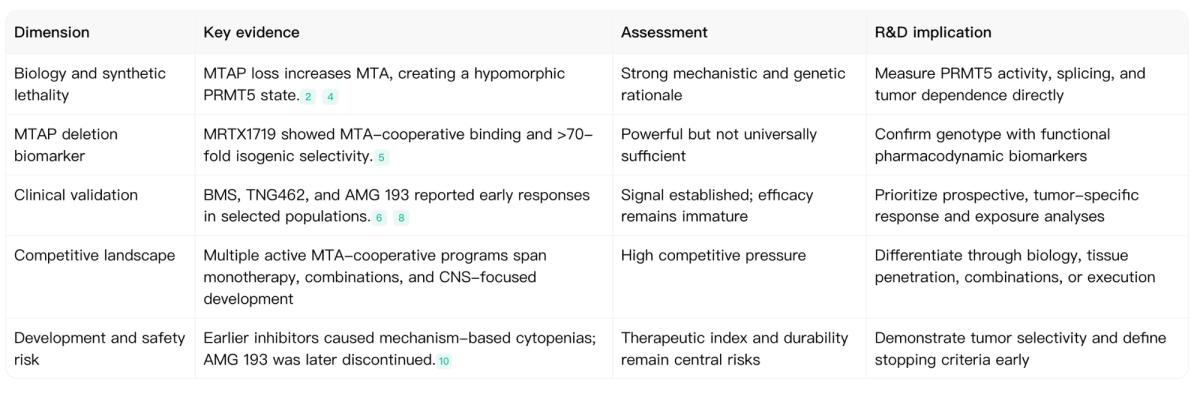
PRMT5 is a type II protein arginine methyltransferase with essential roles in spliceosomal snRNP assembly, RNA processing, and methylation biology. Homozygous MTAP deletion can cause methylthioadenosine (MTA) accumulation, leaving tumor cells in a partially inhibited PRMT5 state. MTA-cooperative inhibitors aim to exploit this selective vulnerability by preferentially engaging the PRMT5–MTA complex instead of broadly suppressing PRMT5 across healthy tissues.
Human data support early proof of concept, but clinical validation remains incomplete. The BMS-986504/navlimetostat program has reported early antitumor activity; TNG462/vopimetostat reported a 27% ORR among 94 evaluable patients in a sponsor update. AMG 193/anvumetostat reported a 21.4% ORR among 42 efficacy-assessable patients in an early Phase I dataset and Amgen announced in April 2026 that it would discontinue further development following a comprehensive review of its oncology portfolio and emerging AMG 193 clinical data. These datasets are not head-to-head comparisons.
For a new program, target attractiveness depends on functional biomarker selection, durable tumor exposure, therapeutic index, relevant tumor types, and defensible combination or CNS strategies—not MTAP deletion alone.
Key Target Metrics
| Metric | PRMT5 evaluation |
|---|---|
| Target | PRMT5 (protein arginine methyltransferase 5) |
| UniProt | O14744 |
| Development landscape | Multiple MTA-cooperative programs, including active and discontinued clinical assets |
| Clinical trials | Early-phase and randomized-development studies across selected MTAP-deleted tumors; no verified exhaustive count |
| Published results | Early peer-reviewed, conference, and sponsor-reported evidence; mature randomized efficacy not established at the evidence cutoff |
Target Attractiveness Snapshot
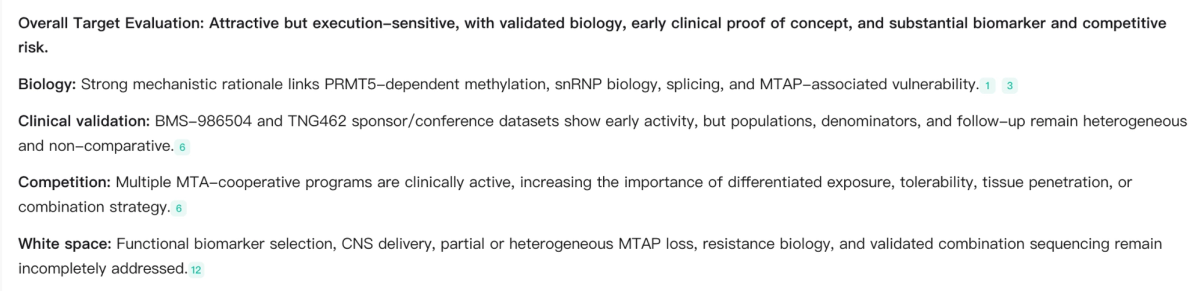
Biology. PRMT5 catalyzes symmetric dimethylarginine (sDMA) marks on spliceosomal proteins and supports snRNP biogenesis and RNA splicing. MTAP loss can increase MTA and partially constrain residual PRMT5 activity, creating a mechanistic dependency that MTA-cooperative inhibitors seek to exploit.
Disease context. The leading clinical focus is homozygously MTAP-deleted non-small cell lung cancer (NSCLC), pancreatic cancer, mesothelioma, and selected other solid tumors. However, MTAP deletion is not a universal clinical response predictor: tumor composition, stromal metabolism, functional MTA accumulation, and drug exposure can vary.
Strategy. Prioritize source-verified MTAP-loss selection, evidence of intratumoral target inhibition, tolerable schedules, and combinations grounded in tumor biology. Avoid extrapolating activity across tumor types from pooled single-arm datasets.
Biology and Disease Rationale
PRMT5 works with its partner MEP50/WDR77 to methylate protein substrates, including Sm proteins required to assemble spliceosomal small nuclear ribonucleoproteins. Perturbing this pathway can disrupt pre-mRNA splicing and downstream tumor-maintenance functions. This is mechanistically attractive but also creates a potential normal-tissue liability: PRMT5 is necessary in nonmalignant cells.
The MTAP–MTA–PRMT5 synthetic-lethality hypothesis can be described in a sequence: MTAP homozygous deletion → MTA accumulation → partial PRMT5 inhibition → increased dependence on residual PRMT5 → selective vulnerability to additional PRMT5-pathway inhibition. MTAP normally participates in MTA metabolism. When MTAP is lost, MTA may accumulate and reduce PRMT5 activity. Early functional-genomic work linked MTAP loss to greater dependence on PRMT5 and WDR77.
An MTA-cooperative compound is not interchangeable with an earlier nonselective PRMT5 inhibitor. MRTX1719, the predecessor name for BMS-986504, showed preferential PRMT5–MTA complex binding and more than 70-fold selectivity for MTAP-deleted versus wild-type cells in an isogenic experimental model. That supports the selectivity concept, but model-based selectivity alone does not prove superior safety or efficacy in patients. MAT2A inhibition is another related metabolic strategy; it reduces SAM availability upstream and is not itself direct PRMT5 inhibition.
The biomarker is more than a binary MTAP label
MTAP homozygous deletion, absence of MTAP protein by immunohistochemistry (IHC), and actual intratumoral MTA elevation are related but distinct measurements. Studies of primary MTAP-deleted glioblastoma samples have shown that MTA accumulation detected in cell culture may not translate straightforwardly to the in-vivo tumor environment, potentially because surrounding MTAP-expressing stromal cells metabolize MTA. MTAP IHC can be informative but requires assay controls, careful interpretation of heterogeneity, and appropriate genomic confirmation.
For translational development, a stronger evidence package would combine genomic MTAP status, MTAP protein assessment, and functional pharmacodynamic markers—such as sDMA suppression, PRMT5-dependent splicing changes, or MTA measurement where feasible. A response hypothesis must still be tested in defined tumor populations; not all MTAP-deleted cancers can be assumed to respond.
Validation and Clinical Competition
Clinical programs support further evaluation of the mechanism, but the evidence is heterogeneous. Peer-reviewed research supports the molecular rationale and some Phase I findings; important updates for BMS-986504 and TNG462 were reported at conferences or by their sponsors. Trial registration and recruiting status demonstrate development activity, not treatment efficacy. The programs below differ in dose, histology, line of therapy, data cutoff, response evaluability, and follow-up, so their percentages should not be ranked as direct comparisons.
| Clinical strategy | Program and public evidence | R&D implication |
|---|---|---|
| MTA-cooperative monotherapy | BMS-986504 / navlimetostat (MRTX1719): 23% sponsor/conference-reported ORR in a study enrolling 152 patients across tumor types; median duration of response 10.5 months, with the precise ORR denominator requiring verification. TNG462 / vopimetostat: sponsor-reported 27% ORR in 94 tumor-evaluable patients in an interim analysis. | Strong early signal, but comparative efficacy and durability are not established. Track denominators, exposure, follow-up, cytopenias, and prospective target inhibition. |
| MTAP-deleted NSCLC | A separate BMS-986504 report described 29% ORR among 35 clinically evaluable MTAP-deleted NSCLC patients. BMS is pursuing further randomized and combination development. AZD3470 is also being evaluated in MTAP-deficient advanced solid tumors, without a sufficiently established public human response dataset at the cutoff. | Define line of therapy, oncogenic drivers, assay criteria, and comparator. Randomized results are needed before selecting a clinical winner. |
| Pancreatic cancer | TNG462 sponsor data described 25% ORR in 39 active-dose second-line pancreatic patients with sufficient follow-up, while ORR across its broader pancreatic population was 15%. BMS-986504 has additional randomized-development activity in pancreatic cancer, but no outcome is inferred from registration. | Preserve cohort definitions and combination backbones; do not generalize pooled tumor responses to pancreatic disease. |
| Combination and CNS strategies | Programs explore chemotherapy, PD-1 blockade, and RAS-pathway partners. TNG456 is a brain-penetrant PRMT5 program with early clinical study entry, but no verified human ORR dataset was identified in the supplied report. Preclinical combination effects remain hypotheses, not clinical benefit. | Test added activity without losing the therapeutic window. CNS programs need documented intracranial exposure and target engagement, not just nominal brain penetration. |
| Discontinued and high-risk development | AMG 193 / anvumetostat: peer-reviewed Phase I data reported 21.4% ORR in 42 efficacy-assessable patients, with nausea, fatigue, vomiting, and dose-limiting toxicities. Amgen discontinued the program in April 2026, stating overall efficacy did not meet its investment threshold. TNG908 was also stopped after inadequate exposure for its glioblastoma goal. | Require explicit efficacy, exposure, safety, and go/no-go gates. An early response signal does not establish a viable registrational program. |
Navlimetostat remains a significant competitive reference, with ongoing MTAP-selected monotherapy and combination research. Early NSCLC activity is especially relevant for positioning, but the broad and NSCLC-specific analyses use different populations and denominators. The report identifies randomized NSCLC and pancreatic development as important future readouts, not as completed positive trials.
TNG462 has reported activity across multiple histologies, including pancreatic cancer, but its subgroup estimates come from selected sponsor-defined, interim cohorts. The program's differentiation must ultimately be evaluated using durability, clinically relevant exposure, patient selection, and tolerability alongside efficacy. TNG456 adds a CNS-focused development hypothesis; its clinical effectiveness was not established by the evidence reviewed.
AMG 193 is a critical cautionary case. Its published early activity remains valid historical evidence, yet Amgen's April 2026 decision means it must not be listed as an active advancing competitor. The disclosed reason was inadequate overall efficacy for further internal investment; attributing discontinuation to a specific toxicity or biomarker failure without evidence would be incorrect.
IP and Competitive Strategy
IP diligence should distinguish MTA-cooperative compound chemistry, PRMT5–MTA binding selectivity, composition-of-matter claims, MTAP-based patient-selection methods, assay technologies, dosing and scheduling, and combination-treatment claims. Public patent leads identified in the research report include WO2022192745A1, WO2025076500A1, and WO2025217297A1. Their publication alone does not establish surviving enforceable claims, patent expiry, freedom to operate, exclusivity, or non-infringement; those require dedicated legal review.
Clinically credible differentiation will also depend on tissue exposure, patient selection, response durability, and hematologic or splicing-related adverse effects. Potential combination strategies include MTAP-loss tumors with KRAS or broader RAS-pathway alterations, chemotherapy partners, or immune checkpoint blockade. The report contains preclinical support for selected combinations but does not establish their comparative clinical efficacy. Each proposed combination requires a clear mechanistic rationale, dose/safety assessment, and a prospective development plan.
Recommendation
Enter. Consider a differentiated MTA-cooperative PRMT5 program only with demonstrated MTAP-null versus MTAP-wild-type selectivity, clinically plausible tumor exposure, and evidence of sustained pharmacodynamic effect. Start with a defined disease and treatment setting—rather than broad unselected solid tumors—and use genomic, protein, and functional biomarker measurements to test the selection strategy.
Partner. Evaluate assets or enabling capabilities that supply a specific advantage: CNS delivery, RAS-combination expertise, companion-diagnostic methods, or regional development rights. Diligence should address human exposure, tumor pharmacodynamics, safety, trial conduct, IP position, and any licensing constraints.
Monitor. Follow BMS randomized NSCLC and pancreatic studies, TNG462 progression toward confirmatory evidence, TNG456 CNS exposure and efficacy, AZD3470 readouts, and prospective validation of MTAP functional biomarkers. Also monitor hematologic toxicity, dose interruptions, and overlap with combination partners.
Avoid. Avoid non-differentiated broad PRMT5 inhibition, assuming MTAP deletion always creates adequate intratumoral MTA, or treating preliminary non-comparative response rates as definitive proof of superiority. Do not classify AMG 193 as an active program after its announced discontinuation.
Bottom Line
PRMT5 is an attractive but execution-sensitive oncology target. MTAP deletion creates a biologically credible synthetic-lethal vulnerability, and MTA-cooperative inhibitors have produced early human response signals. Yet therapeutic index, functional biomarker validity, drug exposure, durability, and rapidly developing competition remain substantial uncertainties. The strongest opportunity is a differentiated, biomarker-defined PRMT5–MTA strategy in a focused clinical setting, supported by prospective evidence rather than the genotype alone.
Evidence note: This article summarizes research with an October 13, 2026 cutoff. Program status and efficacy reports derive from different evidence classes, including peer-reviewed publications, trial registries, conferences, and sponsor disclosures. Reported outcomes are not directly comparable across programs. IP discussion is not legal advice. Clinical decisions require independent review of the original sources.
Try Noah AI for Free
Use Noah AI to research target biology, evaluate clinical evidence, compare development programs, and build source-linked target evaluation reports.
Free credits are available, and no credit card is required to get started.