
Retatrutide vs Orforglipron 2026: Weight Loss & GLP-1 Q&A
Linda
Compare retatrutide and orforglipron in 2026. Explore weight loss, lean mass, muscle preservation, ACHIEVE-3, oral GLP-1 therapies, and market competition.
Evidence cutoff: October 15, 2026 · Clinical evidence Q&A
2026 has brought important developments in next-generation incretin therapy. Retatrutide is an investigational GIP/GLP-1/glucagon triple receptor agonist, while orforglipron (Foundayo) is a once-daily oral small-molecule GLP-1 receptor agonist. This Q&A examines efficacy, lean mass, oral delivery, competition, and future market scenarios using public clinical and regulatory evidence. Retatrutide remains investigational, while orforglipron (Foundayo) received FDA approval for weight management in April 2026. No head-to-head clinical trial directly comparing these two drugs is presented here; their efficacy findings come from separate studies and should not be interpreted as direct comparative evidence.
Retatrutide
How does retatrutide compare with existing obesity medications in weight loss efficacy and lean mass preservation?
The available clinical evidence separates total weight reduction from changes in body composition. A phase 2 DXA substudy directly assessed body composition with retatrutide, but it did not compare retatrutide with orforglipron. The proportion of lean-mass loss was similar to that reported with other obesity treatments, but this does not establish superior skeletal muscle preservation or functional outcomes.
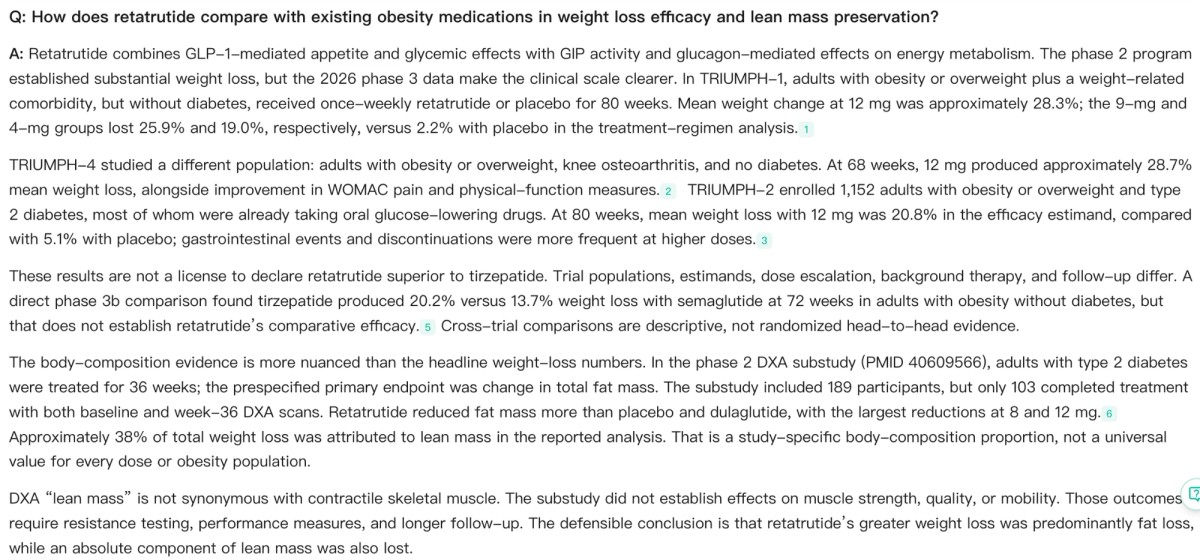
Body-composition study; TRIUMPH-1 results.
Will muscle preservation become an independent drug-development priority in the GLP-1 era?
Probably—but as a quality-of-weight-loss objective rather than a replacement for weight or cardiometabolic endpoints. Rapid energy restriction and appetite suppression can reduce fat-free mass. A review of incretin pharmacotherapy estimates roughly 10% or about 6 kg of lean-mass loss in some treatment settings, while emphasizing that supervised resistance exercise can improve lean mass and strength.((7)) The clinical concern is greatest in older adults, people with frailty or sarcopenic obesity, those with type 2 diabetes, and patients beginning treatment with low muscle reserve.
The percentage of weight loss classified as lean tissue does not independently prove clinically meaningful muscle damage. Lean mass includes water, organs, connective tissue, and other non-fat compartments. Drug-development programs should therefore measure appendicular skeletal muscle, strength, gait speed, sit-to-stand performance, falls, and patient-reported function—not only DXA percentages.
Established practice is multimodal: individualized resistance training, adequate dietary protein, sufficient micronutrient intake, and monitoring of nutrition, function, and tolerability. The precise protein target should be individualized, particularly in kidney disease or other conditions affecting nutrition. In older adults with sarcopenic obesity, current evidence supports caution and active monitoring because this population remains underrepresented in pivotal incretin trials.((8))
Muscle-preserving drugs—such as activin type II receptor antibodies or selective androgen-receptor agonists—remain investigational, not established add-ons with proven long-term benefit.((8)) They could be standalone therapies, add-ons for high-risk patients, or targeted treatments for frail patients. That positioning will require durable improvements in strength, mobility, falls, or independence, rather than only a favorable composition ratio.
Which patients could benefit most from triple agonists such as retatrutide, and how large might this treatment opportunity become?
The clearest potential niche is patients needing large absolute weight reduction: class II or III obesity, obesity with type 2 diabetes, high cardiometabolic risk, or inadequate response to current pharmacotherapy. TRIUMPH-1 produced nearly 30% weight loss at 12 mg, including in participants with severe obesity.((1)) TRIUMPH-2 adds evidence in people receiving background glucose-lowering treatment.((3))
Positioning will depend on tolerability, maintenance after dose escalation, access, reimbursement, cost, and evidence for cardiovascular, renal, sleep-apnea, and functional outcomes. Greater weight loss does not automatically guarantee better adherence, durable maintenance, or superior long-term outcomes.
As of October 15, 2026, retatrutide remains investigational; it has no FDA-approved indication. TRIUMPH-3 and related phase 3 studies broaden the evidence base across complications and risk groups, but regulatory status must not be inferred from positive trial results or sponsor announcements.((9)) Commercially, retatrutide could become an escalation option for high-need patients, while semaglutide, tirzepatide, and oral products serve different combinations of efficacy, tolerability, convenience, and price. No exact market share follows from the available evidence without a sourced forecasting model.
Orforglipron
Will oral orforglipron expand obesity treatment among people who prefer not to use injections?
It can expand the addressable pool, but "oral" does not mean universally better adherence. FDA approved Foundayo (orforglipron) on April 1, 2026, with reduced-calorie diet and increased physical activity for long-term weight reduction in adults with obesity, or adults with overweight and at least one weight-related comorbidity.((10))((11)) This obesity indication should be kept separate from the product's type 2 diabetes development program.
Foundayo is taken once daily without the empty-stomach and water-timing restrictions associated with oral semaglutide. That may help patients with injection aversion, travel constraints, or a preference for tablets. In ATTAIN-1, 3,127 adults with obesity without diabetes received orforglipron or placebo for 72 weeks; weight loss at 36 mg was 11.2% versus 2.1% with placebo, while gastrointestinal adverse events remained common.((12))
Patient-preference surveys do not establish observed switching, persistence, or routine-care outcomes. Daily dosing may be easier for some patients and more burdensome for others than a weekly injection. Uptake will depend on price, coverage, availability, side effects, and consistency.
How could orforglipron affect competition among first- and second-generation GLP-1 treatments?
ACHIEVE-3 provides a direct randomized comparison of orforglipron and oral semaglutide in type 2 diabetes. Its findings should not be generalized to all obesity populations.
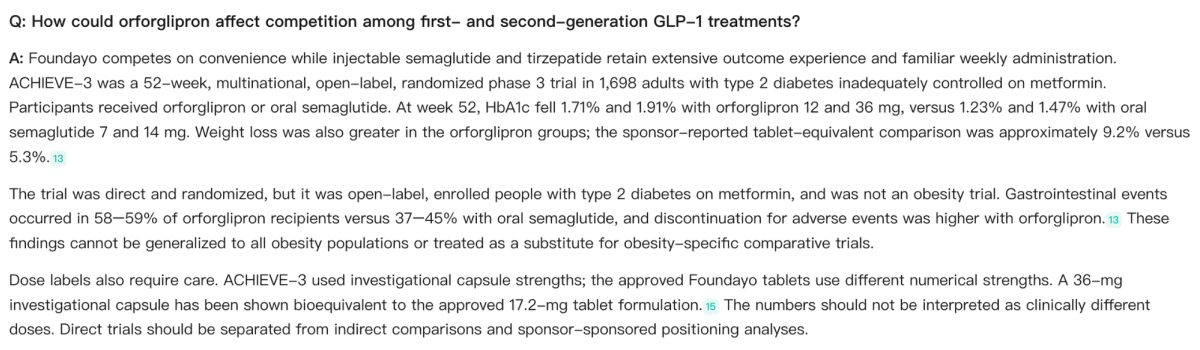
Clinical trial publication; Formulation bioequivalence.
How could oral GLP-1 therapies compete with generic semaglutide and future triple agonists through 2031–2032?
The outcome will likely be segmented rather than decided by a single "best" drug. Semaglutide patent and exclusivity expiry will differ by country and formulation; there is no universal global generic-launch date. Manufacturing, reimbursement, price, supply, safety, and persistence may matter as much as efficacy.
Three evidence-based scenarios are plausible:
- Scenario A—efficacy-led care: higher-efficacy injectables remain important for people requiring substantial weight loss, diabetes control, or complication reduction. Triple agonists could compete primarily in escalation and severe-obesity segments.
- Scenario B—convenience-led adoption: oral GLP-1 products gain share among injection-averse patients and in health systems where daily tablets are easier to prescribe, dispense, or reimburse. This depends on real-world persistence, not preference surveys alone.
- Scenario C—price-led initiation: lower-cost generic semaglutide, where legally and commercially available, expands first-line pharmacotherapy and pressures branded products in price-sensitive segments. Branded oral products may respond through access programs, differentiated convenience, or stronger efficacy.
These are scenarios, not sales forecasts. The competitive map will depend on comparative outcomes, access, manufacturing, and whether long-term data validate convenience.
Conclusion
Retatrutide represents a potentially high-efficacy, still-investigational escalation strategy, whereas Foundayo is an approved oral option whose differentiator is administration convenience. Their roles should not be conflated: clinical efficacy, lean-mass quality, regulatory status, delivery preference, and commercial adoption are separate questions. The market outcome remains uncertain until comparative and real-world evidence mature.
Compare GLP-1 Clinical Evidence with Noah AI
Use Noah AI to investigate clinical trials, compare drug efficacy and safety, and organize evidence on emerging obesity treatments.
Free credits are available, and no credit card is required to get started.
This article distinguishes findings from clinical trials, investigational therapies, approved products and forward-looking market scenarios. Study citations link to the research sources used in the supplied report.