
TOP2A Target Evaluation Report 2026: Biology & R&D Strategy
Linda
Explore TOP2A biology, clinical validation, TOP2A vs TOP2B selectivity, cardiotoxicity, drug competition, IP considerations, and R&D strategy in 2026.
A source-aware assessment of TOP2A target biology, topoisomerase II clinical evidence, competitive benchmarks, safety constraints, and differentiated R&D opportunities.
Evidence cutoff: October 14, 2026 · Noah AI-assisted biomedical research
This TOP2A target evaluation report uses Noah AI-assisted research to organize evidence on biology, clinical validation, competing therapies, intellectual property considerations, and R&D strategy. Its central question is not whether TOP2A is biologically essential: it is whether the clinical and competitive evidence leaves room for a genuinely differentiated therapeutic program.
Established topoisomerase II drugs provide a substantial historical benchmark. But broader TOP2 drug-class activity should not be mistaken for proof that a selective TOP2A agent—or a TOP2A-linked biomarker strategy—will improve patient outcomes. The analysis therefore separates target-specific results, class-level drug evidence, TOP2B-associated toxicity, and hypotheses still requiring clinical validation.
Executive Readout
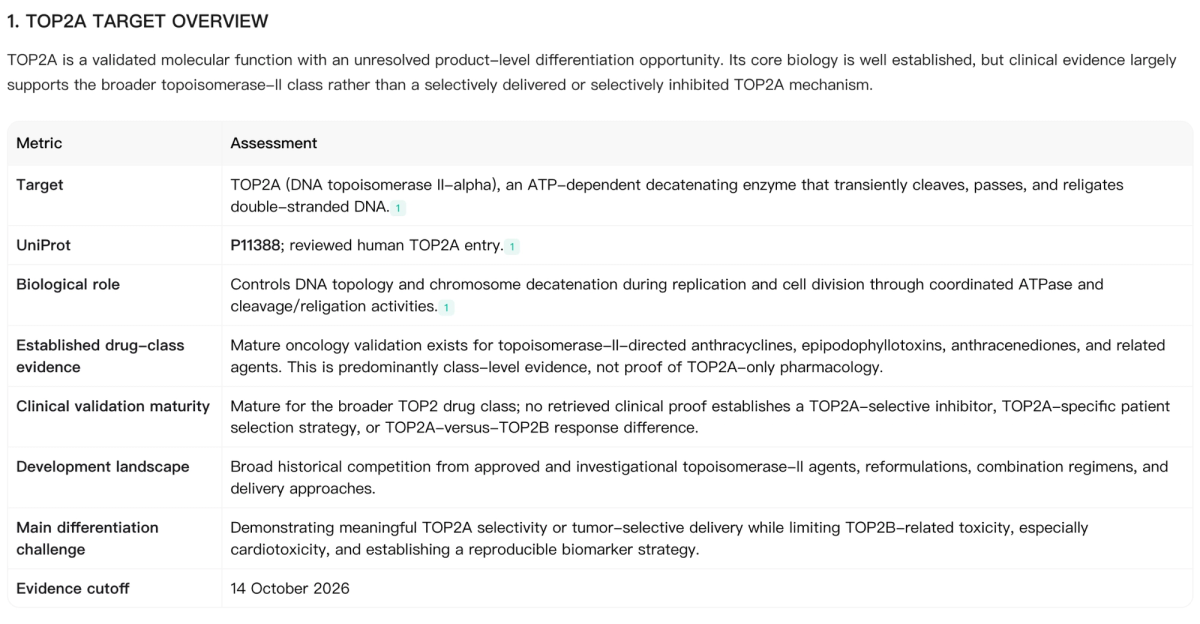
TOP2A is biologically well validated but commercially challenging to differentiate. ATP-dependent DNA decatenation and chromosome segregation provide a strong mechanistic foundation. Anthracyclines, epipodophyllotoxins, and related drugs demonstrate that interference with TOP2-associated DNA processing has clinical antitumor activity, but they are not clinical proof of superior TOP2A-only pharmacology. Marrow suppression, cumulative cardiac risk, DNA damage, and genotoxicity make the therapeutic window central to any new development proposal.
| Evaluation dimension | Evidence-based assessment |
|---|---|
| Biology confidence | High. TOP2A has established roles in strand passage, decatenation, replication, and chromosome maintenance. |
| Validation maturity | High for the TOP2 class; limited for TOP2A-specific selectivity. Existing approved drugs do not establish a TOP2A-selective therapeutic advantage. |
| Competition pressure | High. Historical cytotoxic agents, formulations, combinations, and delivery platforms all create relevant benchmarks. |
| Room for differentiation | Selective and evidence-dependent. TOP2B-sparing chemistry, tumor-directed delivery, and validated biomarkers remain opportunities, not established clinical successes. |
Why Source-Linked Evidence Matters
A useful target report must distinguish biological mechanism, target annotation, drug-class clinical validation, isoform-selective pharmacology, and clinical biomarker evidence. A trial mentioning doxorubicin or etoposide does not, by itself, demonstrate selective engagement of TOP2A. Likewise, a target annotation in a database is not equivalent to a prospective study showing that patients with high TOP2A expression benefit more from treatment.
The difference matters because TOP2A is associated with proliferating-cell biology, whereas TOP2B has functions in postmitotic tissues and is implicated in some treatment-associated toxicity mechanisms. TOP2A amplification, RNA expression, and protein abundance can also diverge. Research teams should therefore preserve the assay type, tumor context, comparator, evidence maturity, and unresolved alternative explanations when evaluating candidate biomarkers or new assets.
Noah AI can help assemble these layers into a reviewable record; original publications, trial entries, drug labels, and patent documents still require direct examination before clinical, BD, or investment decisions.
Biology: What the Target Controls
Mechanistic anchor. TOP2A is an ATP-dependent DNA topoisomerase that transiently cuts one DNA duplex, passes another through the break, and religates the cut DNA. This coordinated reaction regulates topology and chromosome decatenation. The mechanism provides a strong rationale for drugs that interfere with DNA processing in rapidly dividing cells.
Disease logic. TOP2A supports DNA replication, chromosome condensation, and segregation. Experimental degradation studies in human cells connect TOP2A directly to the maintenance of mitotic chromosome structure. Increased proliferation and replication stress in tumors can create a therapeutic rationale, but expression alone does not establish drug sensitivity or an actionable selection threshold.
Translational caveat. TOP2A and TOP2B are related but non-identical enzymes. Their different cellular contexts make isoform-selective chemistry scientifically interesting, yet conventional TOP2-targeting drugs do not provide a clinically validated TOP2A-over-TOP2B selectivity advantage. A differentiated program must demonstrate its mechanism and therapeutic index rather than rely on TOP2A essentiality.
Validation Evidence
Clinical evidence is mature for several topoisomerase II-directed drug classes, but limited for therapies designed to act only through TOP2A. The comparison below summarizes major established agents without treating their historical use as proof of isoform-selective benefit.
| Agent | Validation context | Principal limitation for TOP2A evaluation |
|---|---|---|
| Doxorubicin | Established anthracycline use across several solid and hematologic malignancies; causes broad DNA-associated cytotoxicity. | Cumulative cardiotoxicity, marrow suppression, and no demonstrated clinical TOP2A-only selectivity. |
| Epirubicin | Anthracycline clinical precedent, including breast cancer and other settings. | Cardiac and hematologic toxicity; target annotation does not establish TOP2A-specific response. |
| Etoposide | Established epipodophyllotoxin use in lung, germ-cell, and hematologic cancers; stabilizes TOP2–DNA cleavage complexes. | Broad TOP2-associated mechanism, DNA damage, and marrow suppression. |
| Mitoxantrone | Established anthracenedione use in selected cancers. | Cumulative cardiac and hematologic risks; no verified selective TOP2A clinical advantage. |
| Teniposide | Additional epipodophyllotoxin precedent in selected hematologic indications. | Class-level TOP2 pharmacology rather than prospective TOP2A-guided patient selection. |
The key commercial and scientific lesson is that existing drugs demonstrate the value—and the liabilities—of this pharmacological class. Any new program needs direct isoform-resolved activity data, a reproducible biomarker hypothesis, and evidence that the proposed delivery or chemistry actually changes the balance of antitumor exposure and normal-tissue damage.
Clinical and Competitive Landscape
Competition extends beyond assets tagged directly to TOP2A in a target database. Anthracyclines, etoposide-like agents, reformulations, multidrug regimens, and experimental selective compounds all shape the benchmark. The most plausible differentiation approaches involve a wider therapeutic window, delivery restricted to tumor tissue, or a carefully validated molecular context.
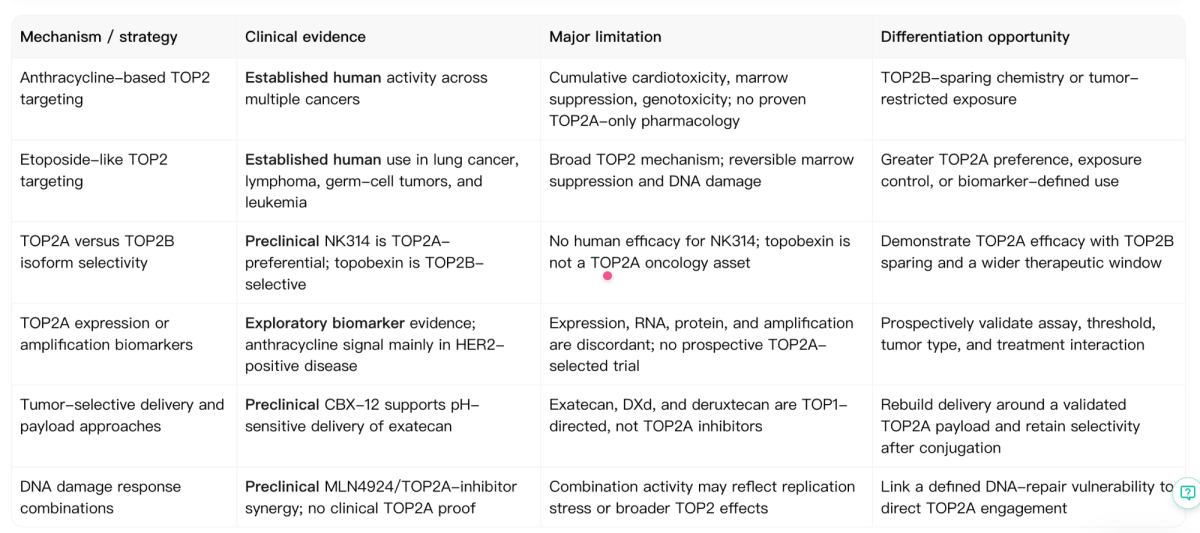
Isoform-selective research. NK314 has been described in preclinical research as TOP2A-preferential; it offers a chemical precedent, not established patient benefit. Topobexin is an experimental TOP2B-selective compound investigated in relation to anthracycline cardioprotection, not a clinical TOP2A oncology treatment. These examples show why direct paralog-resolved testing matters for any differentiation claim.
Biomarker limitations. Some retrospective breast cancer analyses have investigated TOP2A status in relation to anthracycline outcomes, including HER2-associated settings, but gene amplification, RNA expression, and protein abundance are not interchangeable. Other tumor contexts, such as aggressive prostate cancer, remain exploratory rather than supported by prospective TOP2A-selected treatment trials.
Delivery and payload accuracy. Tumor-selective delivery is strategically attractive, but a TOP1-directed payload must never be labeled a TOP2A inhibitor. Exatecan, DXd, and deruxtecan belong to the TOP1-directed payload category. A proposed TOP2A delivery program would need separate evidence for payload mechanism, released active drug, TOP2A/TOP2B activity, intratumoral exposure, and safety.
Combination opportunities. DNA damage response combinations have mechanistic appeal, including preclinical research linking TOP2 inhibition to replication stress or PTEN-related vulnerability. However, synergy in a cell or animal model is not proof of clinical efficacy or TOP2A-selective causation. These strategies need robust translational markers and prospective testing.
IP and Freedom-to-Operate Lens
Patent and partnering diligence should examine compound chemistry, TOP2A versus TOP2B selectivity, catalytic versus cleavage-complex mechanisms, linker and delivery technology, formulation, dosing, biomarkers, combination methods, and indication-specific uses. A new payload or conjugate should be assessed as a complete product architecture rather than only by the annotated target.
Public disclosures related to TOP2A nuclear-export biology illustrate possible technical claim directions. A publication or patent application alone, however, does not prove enforceable claim scope, expiry, exclusivity, ownership across jurisdictions, or freedom to operate. Formal diligence requires claim-by-claim and jurisdiction-specific examination before investment or licensing decisions.
R&D Recommendation
Enter selectively. Advance TOP2A-focused programs only where they can test a measurable advantage over established TOP2 drugs: improved tumor-to-normal exposure, TOP2A-preferential chemistry with TOP2B sparing, or a prospective biomarker-defined indication. Define the comparator and safety benchmark before using TOP2A expression or target essentiality as a commercial rationale.
Monitor. Track isoform-selectivity data, tumor exposure, cardiotoxicity and marrow toxicity, assay concordance, and whether biomarker- or DDR-combination signals progress beyond preclinical or retrospective evidence. Where formulations or conjugates are involved, confirm the actual released payload and mechanism of action.
Avoid. Avoid undifferentiated conventional cytotoxic development, treating TOP2 drug-class activity as proof of TOP2A selectivity, or categorizing exatecan/DXd payloads as TOP2A agents. Do not equate technical patent disclosures with freedom-to-operate clearance.
Bottom line: TOP2A remains biologically important and clinically relevant through established drug-class activity, but the opportunity for a new program is narrower than that broad validation suggests. Selective chemistry, tumor-directed delivery, and rigorously validated patient selection are the defensible research avenues.
Try Noah AI for Free
Use Noah AI to investigate target biology, compare clinical evidence, evaluate competitive programs, and prepare reviewable target evaluation reports.
Free credits are available, and no credit card is required to get started.
Data note: Evidence cutoff October 14, 2026. This article summarizes Noah-assisted public-evidence research; confirm primary studies, current clinical status, drug labeling, and patent records before making clinical, legal, or investment decisions.